
Jerusalem / Tel Aviv — October 28, 2026
Israeli voters delivered a sharp, inconclusive verdict on Tuesday in the country’s first national election since the October 7, 2023 Hamas attacks, denying Prime Minister Benjamin Netanyahu’s right-wing and religious coalition a majority while stopping short of handing a clear mandate to the opposition bloc led by former IDF chief of staff Gadi Eisenkot. Exit polls released by major television networks shortly after voting ended at 10 p.m. showed neither camp reaching the 61 seats required for a majority in the 120-member Knesset, setting the stage for potentially prolonged coalition negotiations and political uncertainty.
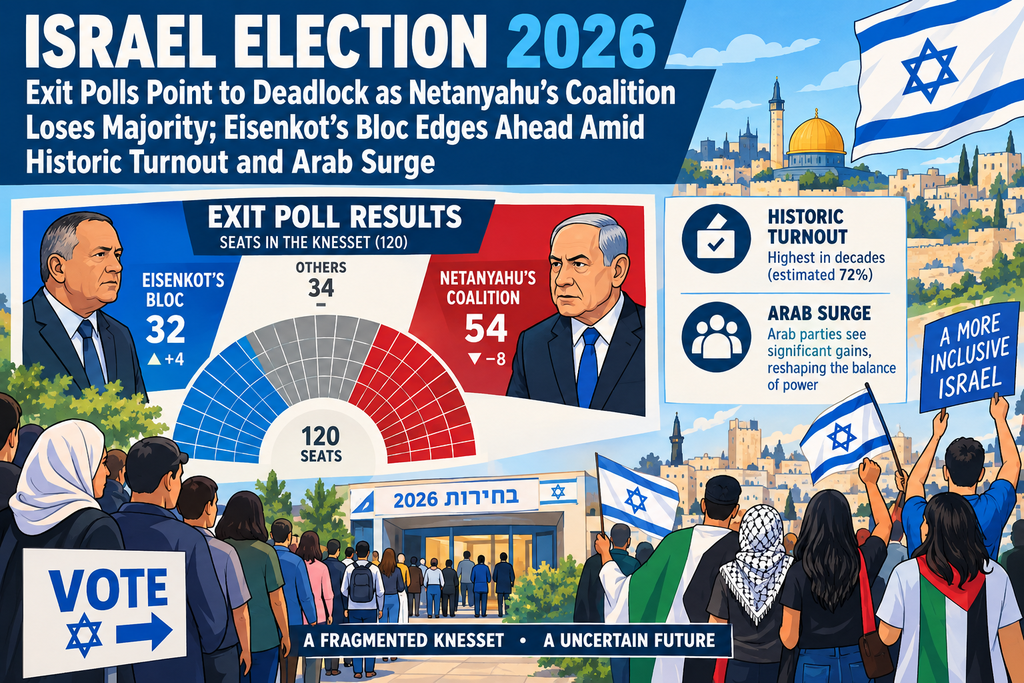
Most mainstream exit polls projected Eisenkot’s anti-Netanyahu or “change” bloc at 52–53 seats, Netanyahu’s pro-government coalition at around 50, and Arab parties at a striking 16–18 seats — a significant jump from the roughly 10 they held in the outgoing Knesset. Likud remained the single largest party in most surveys with 24–27 seats, followed closely by Eisenkot’s newly formed Yashar party at 20–23. Turnout reached approximately 77.7 per cent, the highest in a Knesset election since 1999 and well above the 70.6 per cent recorded in 2022.
The results represent a clear erosion of support for Netanyahu’s coalition, which entered the election holding 64 seats (or higher in some counts of the outgoing parliament). They also reflect the deep divisions that have defined Israeli politics since the Hamas-led massacre of October 7, 2023, the subsequent multi-front wars in Gaza, Lebanon, and against Iranian proxies, and the intense domestic debates over accountability, military service, judicial reform, and the future of the ultra-Orthodox draft exemption.
The Exit Poll Picture
Israeli television networks released slightly varying projections, a common feature of election night in Israel’s complex proportional representation system. Channel 12, one of the most closely watched, showed Likud with 24 seats, Yashar with 22, B’Yachad (led by Naftali Bennett and Yair Lapid) with 12, the Joint List with 11, the Democrats with 10 or 9, Yisrael Beiteinu with 8–9, Ra’am with 7, Shas with 8, and the far-right and ultra-Orthodox parties (Otzma Yehudit, Religious Zionism, United Torah Judaism) in the 6-seat range. The opposition bloc was projected at 52, the coalition at 50, and Arab parties at 18.
Kan 11 (public broadcaster) gave Likud 25, Yashar 21, B’Yachad 13–14, Democrats 10, Joint List 10–11, Yisrael Beiteinu 8, Ra’am 7, and the religious and far-right parties between 6 and 7 each, yielding a 53–50 split in favour of the opposition with Arab parties at 17. Channel 13 produced similar numbers: Likud 25, Yashar 23, B’Yachad 14, and an opposition edge of 53–50. i24NEWS was somewhat more favourable to the right, projecting Likud at 27, Yashar at 20, a coalition bloc of 55, opposition at 49, and Arab parties at 16. Channel 14, often seen as more right-leaning, stood out with Likud at 30 and the right-wing bloc at 60 — just short of a majority.
These are exit polls, not final results. Official counting by the Central Elections Committee is underway, with more precise figures expected in the coming days and formal certification around November 4. Early counting samples can shift projections, particularly for parties near the 3.25 per cent electoral threshold. Still, the consistency across most networks on the central storyline — no clear majority for either major bloc and a surge for Arab parties — has been widely accepted as the working baseline.
Background: A Full-Term Election After Trauma
The 2026 election marked a rare full four-year term for a Knesset. The previous elections in November 2022 returned Netanyahu to power at the head of a hard-right coalition that included Likud, Shas, United Torah Judaism, Otzma Yehudit, and the Religious Zionist Party. That government survived the immediate aftermath of October 7 and the long wars that followed, becoming the first in decades to complete its statutory term.
The October 7 attacks, in which Hamas and other militants killed approximately 1,200 people and took more than 250 hostages, fundamentally reshaped Israeli politics. The subsequent military campaigns in Gaza, the fighting against Hezbollah in Lebanon, strikes related to Iran, and the prolonged hostage crisis dominated public discourse. Questions of intelligence and military failures on October 7, the conduct and duration of the wars, the fate of remaining hostages, the economic and social costs, and the government’s handling of the ultra-Orthodox draft exemption became central campaign issues.
Eisenkot, who served as IDF chief of staff from 2015 to 2019 and later entered politics with Benny Gantz’s National Unity party, emerged as the leading alternative. He founded Yashar (meaning “straight,” “honest,” or “truthful”) in September 2025 after leaving National Unity. The party positioned itself as a centrist, security-focused vehicle emphasising professional governance, accountability for October 7, universal national service, and a Jewish and democratic Israel committed to the values of the Declaration of Independence. Eisenkot repeatedly stated he would not serve under Netanyahu.
Yashar’s list featured a mix of security veterans (including former Shin Bet chief Yoram Cohen in the number-two slot), former ministers, social entrepreneurs, and other professionals. It quickly rose in the polls to become the largest opposition party. The broader anti-Netanyahu camp also included B’Yachad (a partnership involving Bennett and Lapid), Yair Golan’s Democrats (a left-leaning list), and Avigdor Lieberman’s Yisrael Beiteinu, which has long emphasised security and secular issues, particularly the draft.
Netanyahu’s campaign focused on security achievements, warnings about the opposition’s ability to form a stable government, and appeals to his traditional base. The right-wing and religious parties campaigned on continued hard-line policies toward the Palestinians, support for settlements, and protection of the ultra-Orthodox status quo on military service and religious matters. Arab parties, long marginalised in coalition arithmetic because most Jewish parties have ruled out formal partnerships with them, saw an opportunity in high turnout among Israel’s roughly 21–22 per cent Arab population.
High Turnout and the Arab Factor
Voter participation was exceptionally high. By 8 p.m., turnout already stood at 74.3 per cent — the highest at that hour in decades — and closed at about 77.7 per cent. Arab communities recorded particularly strong participation, driven by a combination of frustration with government policies, the impact of the wars, and effective mobilisation. The Joint List (Hadash-Balad-Ta’al) and Ra’am (United Arab List, led by Mansour Abbas) together appeared headed for 16–18 seats, their strongest showing in years.
This surge complicates government formation. Both major Jewish blocs have historically been reluctant to rely on Arab parties for a governing majority. Eisenkot’s camp has signalled openness to some form of arrangement or minority government supported from outside by Arab parties under strict conditions, but partners such as Lieberman have been more sceptical. Netanyahu’s side has shown even less inclination to partner with Arab lists. The result is that the Arab parties may hold the balance of power without being invited into government, potentially forcing creative parliamentary arrangements, minority governments, or further elections.
Reactions and the Path Ahead
Eisenkot’s camp greeted the exit polls with cautious celebration. He issued a statement framing the results as evidence of a lack of confidence in Netanyahu and the government responsible for the failures surrounding October 7, and indicated his bloc should receive the first opportunity to form a government. Headquarters erupted when the bloc numbers appeared favourable even though Likud remained the largest single party.
Netanyahu’s side emphasised that Likud had outperformed many pre-election surveys and remained the largest party. Some right-wing commentators highlighted Channel 14’s more optimistic projection. During the day, Netanyahu had accused elements of the left and Arab sectors of trying to “steal the election,” language that drew sharp criticism and accusations that he was laying the groundwork to contest unfavourable results.
President Isaac Herzog will play a key formal role. After official results are certified, he will consult with party leaders and task a candidate — usually, but not always, the leader of the largest party or the largest bloc — with forming a government. That candidate will have a limited period (typically 28 days, with a possible extension) to assemble a coalition commanding at least 61 seats or sufficient support to govern as a minority. Failure can lead to another candidate being tasked or to new elections.
Israeli politics has a long history of protracted negotiations, last-minute deals, and unexpected coalitions. Possible scenarios include an Eisenkot-led government relying on outside support from Arab parties; a narrower right-wing government if some opposition parties can be peeled away or if final numbers improve for the coalition; a broader national-unity arrangement; or prolonged stalemate leading to another election. Control of the Knesset itself in the interim period will also matter for procedural power.
Broader Implications
The election was widely viewed as a referendum on Netanyahu’s long dominance of Israeli politics and his handling of the post-October 7 era. Netanyahu, Israel’s longest-serving prime minister, has survived multiple corruption trials, previous election cycles, and intense public protests. A loss of majority, even without a clear opposition victory, marks a significant political setback.
For ordinary Israelis, the results prolong uncertainty at a time when many seek stability, reconstruction of communities devastated on October 7, resolution of the remaining hostage cases, economic recovery, and a coherent long-term security strategy regarding Iran, Hezbollah, and Gaza. Debates over the ultra-Orthodox draft, religion-state relations, and the judiciary remain unresolved and will feature heavily in any coalition talks.
Internationally, the outcome will be scrutinised for its implications for the Israeli-Palestinian conflict, relations with the United States and European partners, normalisation efforts with Arab states, and regional deterrence. A prolonged political vacuum or a weak government could complicate decision-making on sensitive security and diplomatic files.
As counting continues and party leaders begin private consultations, Israel faces familiar but high-stakes territory: a fragmented Knesset, deep societal divides, and the difficult work of translating election results into a functioning government. The exit polls have clarified the arithmetic but not the solution. The coming weeks of negotiation will determine whether the country can move past the political deadlock that has defined much of the past decade or whether another election cycle becomes necessary. Official results and the first formal steps toward coalition formation are expected in the days ahead.