

Singapore / New York / Tokyo — November 4, 2026
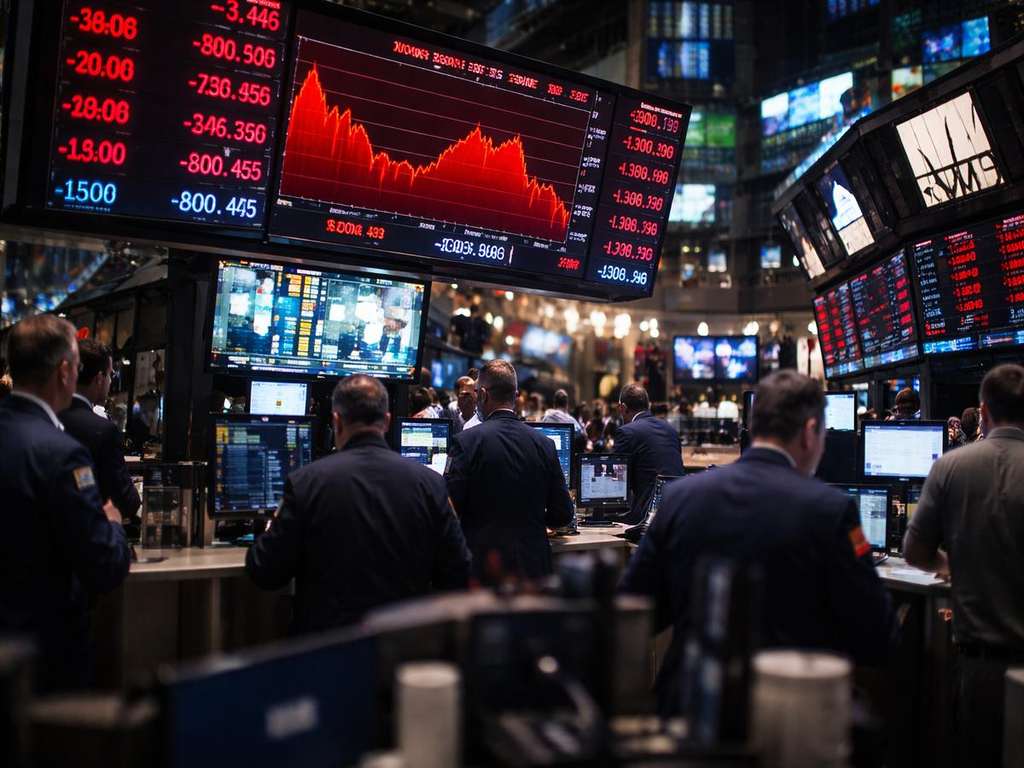
Global financial markets plunged into a sharp sell-off on Wednesday as results from the U.S. midterm elections confirmed a decisive Democratic “blue sweep,” with the party capturing majorities in both the Senate and the House of Representatives. The outcome delivered a major setback to President Donald Trump and the Republican Party, triggering immediate fears among investors that a Democratic-controlled Congress would impose tougher regulations on artificial intelligence, slow the massive data-centre buildout that has powered the AI-driven market rally, and introduce greater corporate oversight.
Asian markets bore the brunt of the early reaction. Japan’s Nikkei 225 tumbled as much as 3–4.5 per cent to multi-month lows, South Korea’s Kospi swung wildly after opening higher and later posting significant intraday declines before partial recovery, and chipmakers across the region—including Samsung Electronics, SK Hynix, and Taiwan Semiconductor Manufacturing Company (TSMC)—saw sharp losses. SoftBank Group, a major AI investor, led declines in Tokyo. European futures pointed lower, while U.S. equity futures for the S&P 500 and Nasdaq dropped, with Nasdaq contracts initially falling more than 2 per cent before paring some losses. The U.S. dollar weakened, and Treasury yields fell as investors sought safety.
The sell-off reflected a rapid reassessment of the policy landscape. For nearly two years under unified Republican control, markets had benefited from a relatively light-touch regulatory environment that facilitated enormous capital expenditure on AI infrastructure. A Democratic Congress raises the prospect of hearings, potential legislation on data centres, energy use, antitrust scrutiny of Big Tech, and other constraints that could slow the AI investment boom.
The Political Earthquake
Voters delivered a striking rebuke to the Trump administration and Republicans. Democrats flipped key Senate seats in states including Texas, South Carolina, Ohio, North Carolina, Kansas, and Iowa, while holding or expanding their position in other competitive races. They also secured control of the House. The Associated Press and major networks projected Democratic majorities in both chambers, marking one of the more decisive midterm shifts in recent decades and reaching deep into traditional Republican territory.
President Trump, who was not on the ballot, faced the classic midterm penalty amplified by voter concerns over affordability, energy prices, foreign policy developments including the situation with Iran, and perceptions of governance. Democratic victories in governorships in places such as Texas further underscored the breadth of the shift. The new Congress will take office in January 2027, leaving Trump with divided government for the final two years of his term.
Markets had partially priced in a possible Democratic House majority in the weeks leading up to the election, but the scale of the Senate gains and the overall sweep exceeded many expectations. Prediction markets had shown rising odds of a blue wave in the final stretch, and the confirmation accelerated positioning.
Asia’s AI-Sensitive Markets Hit Hardest
The most dramatic price action unfolded in Asia, where equity markets are heavily exposed to the global semiconductor and technology supply chain that feeds U.S. AI demand. Japan’s Nikkei 225 dropped sharply, with reports of declines around 3–4.5 per cent at points during the session, hitting levels last seen in May. SoftBank shares slumped heavily. Memory and chip-related names faced intense pressure.
South Korea’s Kospi experienced high volatility. The index opened strongly higher, buoyed by overnight U.S. tech rebounds in some sessions, but then reversed as election results solidified, with reports of intraday drops of 3 per cent or more before later recovery that left it mixed or modestly higher by some closes. Samsung and SK Hynix, central to the global memory and chip ecosystem, saw significant swings and net pressure at various points. Taiwan’s market and Hong Kong’s Hang Seng also weakened, though less dramatically than Tokyo. Australia’s market declined amid its own domestic factors, including a recent rate decision.
The common thread was concern over the sustainability of the data-centre boom. AI training and inference require enormous computing power, driving demand for advanced chips, servers, power infrastructure, and cooling. Investors worried that Democratic majorities could lead to environmental reviews, local moratoriums (already discussed in some U.S. states and cities), federal scrutiny of energy consumption, or broader AI safety and competition rules that might delay or scale back projects. Texas, a major data-centre hub, saw a Democratic gubernatorial win that added to the unease given prior comments on the sector.
U.S. Futures, Dollar, and Bonds React
In after-hours and futures trading, U.S. equity contracts reflected the same anxiety. S&P 500 futures declined roughly 0.6–1.2 per cent at points, while Nasdaq futures fell more sharply before recovering some ground. The technology-heavy composition of the Nasdaq made it particularly sensitive. Treasury yields dropped, with the 10-year yield falling several basis points toward the 4.90 per cent area, as investors rotated into safer assets. The dollar index weakened to multi-week or one-month lows against major currencies.
This combination—equities down, yields down, dollar softer—pointed to a risk-off move driven by policy uncertainty rather than an immediate growth scare. Lower yields can eventually support equities by reducing discount rates on future cash flows, but the near-term focus remained on regulatory risk for the highest-valuation parts of the market.
European markets were expected to open lower, tracking the Asian declines and U.S. futures. Broader global indices reflected the same caution.
Why AI Became the Focal Point
The AI trade has been the dominant driver of equity market performance since the generative AI breakthrough. Massive capital spending by hyperscalers and related companies fueled earnings growth expectations and propelled valuations. Chipmakers, equipment suppliers, power and infrastructure names, and software firms benefited. At the same time, questions had already begun to surface about the pace of spending versus near-term returns, contributing to volatility in late October and early November.
A Democratic Congress is widely expected to take a more assertive approach to technology policy. Potential areas of focus include:
- Scrutiny of data-centre energy and water use, and possible incentives or restrictions tied to environmental goals.
- Antitrust and competition policy affecting dominant platforms.
- AI safety, transparency, and liability rules.
- Broader corporate regulation and tax enforcement.
Even without immediate legislation, the threat of investigations, hearings, and a less permissive regulatory environment can alter investment plans and investor risk appetite. Some state-level developments, including potential data-centre moratoriums or tighter permitting in key locations, amplified the concern.
Analysts noted that the magnitude of the Democratic gains mattered. A narrow majority might produce gridlock that markets often tolerate or even prefer, as it limits large-scale policy shifts. A more decisive sweep raises the odds of meaningful action or at least heightened uncertainty.
Historical Context and Market Psychology
Midterm elections have historically been followed by positive equity returns on average. Data stretching back decades show the S&P 500 often advances in the six-to-twelve months after midterms as political uncertainty clears and attention returns to fundamentals. Divided government has frequently been associated with strong market performance because it constrains ambitious fiscal or regulatory agendas.
This cycle is different in important ways. The market has been unusually concentrated in AI-related names, and those valuations embed optimistic assumptions about continued rapid infrastructure buildout. Any credible threat to that narrative produces outsized reactions. Additionally, fiscal concerns—already elevated with U.S. debt levels high—mean that reduced expectations for further stimulus or tax changes can support bonds while pressuring growth-sensitive equities.
The initial sell-off also reflected classic positioning dynamics. Investors who had been long the AI trade reduced exposure quickly once the political outcome became clearer. Safe-haven flows into Treasuries and away from the dollar followed.
Analyst Perspectives
Market strategists described the reaction as a logical pricing of higher regulatory risk for the AI complex. Some viewed the early declines as potentially overdone if the new Congress proves less aggressive than feared or if economic fundamentals remain solid. Others cautioned that the combination of elevated valuations, recent AI spending scepticism, and a more hostile political environment could keep volatility elevated.
Comments highlighted the dual nature of the outcome: reduced prospects for additional fiscal stimulus (supportive for bonds and the currency in a certain way) alongside greater oversight risk for technology (negative for equities, especially growth stocks). Lower yields were seen as a potential eventual cushion for the broader market once the initial shock fades.
Broader Implications and Outlook
Beyond the immediate price action, the Democratic majorities will shape the policy environment for the remainder of Trump’s term. Areas likely to see friction include appropriations, the debt ceiling, nominations, investigations, and any residual agenda items from the administration. Gridlock on major legislation is probable, but oversight and procedural tools remain powerful.
For markets, the key questions in coming sessions will be the depth and duration of the sell-off, the performance of AI-related names relative to the broader market, and whether bond yields continue to ease. Corporate earnings, economic data, and Federal Reserve policy will eventually reassert themselves as primary drivers, consistent with historical patterns after midterms.
In Asia, attention will remain on semiconductor demand signals and any comments from companies about customer spending plans. In the United States, the focus will shift to the incoming Congress’s early priorities once the new members are seated.
The events of November 4 underscored how tightly financial markets have become linked to political outcomes in an era of concentrated technology leadership and large-scale capital projects. A Democratic sweep has forced a rapid recalibration of expectations around the AI investment cycle that has defined the market for the past several years. Whether the sell-off marks a temporary adjustment or the start of a more sustained period of caution will depend on the concrete policy signals that emerge in the weeks and months ahead, alongside the underlying strength of corporate earnings and the global economy.
As trading continued across time zones, the message from markets was clear: the political landscape has changed, and investors are adjusting positions accordingly. The blue wave has arrived, and the global stock market is reacting in real time.