
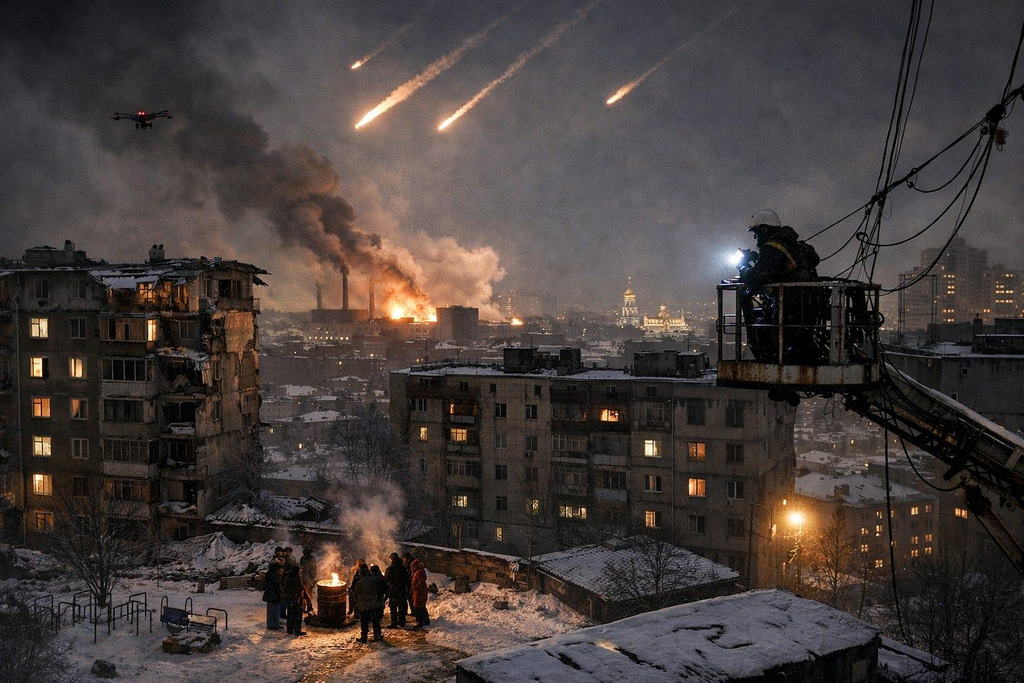
Kyiv, November 5, 2026 — Russian forces launched one of the largest assaults of the year on Ukraine’s energy infrastructure on the night of November 2–3, triggering widespread power outages and the most severe water disruption Kyiv has experienced since the full-scale invasion began in February 2022. Residents across much of the capital went without running water for more than 24 hours as electricity cuts disabled pumping stations, while emergency blackouts hit the city and surrounding regions. The attacks came as the death toll from a separate Russian strike on a humanitarian aid site in southern Ukraine climbed to 40, underscoring the intensifying pressure on Ukrainian civilians ahead of winter and planned diplomatic talks.
Ukraine’s air force reported that Russia launched hundreds of drones and dozens of missiles in the barrage. President Volodymyr Zelenskyy stated that the assault involved 289 drones, 17 ballistic missiles, and 59 cruise missiles, striking power plants, substations, and transmission systems from Odesa in the south to Rivne in the west. Later reports indicated further drone activity, with Ukrainian forces claiming to have downed or suppressed the majority of the aerial targets. Energy company DTEK, Ukraine’s largest private generator, said three of its five thermal power plants were knocked offline. The national grid operator Ukrenergo described the strikes as among the heaviest on the energy system in months, forcing emergency power cuts in Kyiv, Kyiv Oblast, and several other regions including Poltava, Sumy, Chernihiv, Cherkasy, and Kharkiv.
Kyiv Mayor Vitali Klitschko described the electricity situation in the capital as “very difficult” or “extremely difficult.” Damage to facilities in the Kyiv regional energy hub forced emergency outages that disrupted not only household power but also critical services. Electric public transport—trams and trolleybuses—was suspended in parts of the city, prompting authorities to add bus routes. Warming and charging points were hastily established in the worst-hit districts so residents could warm themselves and power devices.
The cascading effects on water supply proved particularly severe. Kyivvodokanal, the city’s water utility, reported that key water-supply facilities lost power after the strikes, effectively cutting running water across much of the capital. Outages were reported in central districts and elsewhere; some restaurants closed bathrooms to customers. Experts and officials familiar with the system characterised it as Kyiv’s most serious water outage of the full-scale war. Residents were directed to public drinking fountains and pump rooms. Water pressure and supply were restored gradually on November 4 after power returned to pumping stations, though full normalisation took time as pipes refilled and systems restarted. By late November 4, authorities reported that all water and sewage pumping stations were operating normally and pressure had stabilised, while emergency electricity cuts were lifted in most areas in favour of scheduled outages. The grid, however, remained under significant strain.
Mykhailo Yatsuk, director of the Institute of Water Problems and Land Reclamation, warned that the situation could worsen in winter. The attack highlighted the vulnerability of interconnected systems: without electricity, water infrastructure cannot function even if the physical plants remain intact. Officials noted that previous backup options, such as powering water supply from certain combined heat and power plants, had been lost due to cumulative damage.
Simultaneously, attention focused on the Zaporizhzhia region village of Komyshuvakha, near the front line. On November 2 (Monday), multiple Russian guided bombs struck a former school building and nearby shelter being used as a humanitarian aid distribution point. Residents had gathered to collect aid. Zelenskyy reported the death toll rising to 40, with dozens more possibly still buried under rubble as search-and-rescue operations continued into subsequent days. Local officials and Ukrainian sources described the strike as one of the deadliest single attacks on civilians in recent years of the war. Russia claimed it targeted military units in the area; Ukrainian authorities and aid organisations rejected that characterisation, emphasising the civilian and humanitarian nature of the site. World Central Kitchen and other groups noted the facility served as a community hub for distributing food and water.
The dual crises—infrastructure collapse in the capital and mass civilian casualties in the south—occur against the backdrop of Russia’s established winter strategy of targeting energy systems to impose hardship. Ukrainian officials and analysts have long warned that Moscow aims to degrade living conditions in major cities, forcing blackouts, cold apartments, and disrupted services as temperatures drop. Earlier strikes in October had already damaged power plants and substations around Kyiv and other cities, leaving the system more fragile. Nuclear plants have been forced to reduce output at times because transmission infrastructure was hit. Repairs are repeatedly delayed by successive attacks.
Ukrainian air defences continue to intercept large numbers of drones, but ballistic and certain cruise missiles remain harder to stop, especially amid shortages of advanced interceptors. Zelenskyy and other officials have repeatedly called for additional air-defence systems and ammunition from Western partners. The latest barrage occurred roughly a week before U.S.-brokered talks involving Ukrainian and Russian representatives were expected to resume in Abu Dhabi around November 10–11. Discussions were anticipated to touch on security guarantees, possible energy-related de-escalation, and Black Sea arrangements. The timing of the strikes raised questions about the atmosphere for negotiations, though both sides have continued military operations regardless of diplomatic calendars.
In Brussels, officials from the United States, Germany, France, Britain, NATO, the World Bank, and the European Union met to discuss long-term reconstruction needs once the war eventually ends—an acknowledgement of the enormous scale of damage already inflicted on Ukraine’s energy, housing, and industrial base. Domestically, Ukrainian authorities emphasised resilience: emergency services, rapid restoration efforts, and public adaptation through generators, shared charging points, and community support. Yet the repeated nature of the attacks has worn down both physical infrastructure and public patience. Experts project that without sustained protection of the grid and accelerated repairs, winter blackouts could last many hours daily in a worst-case scenario of further strikes and cold weather.
On the battlefield, the broader war of attrition continues with grinding advances and counterattacks, particularly in the east and northeast. Russian forces maintain pressure along multiple axes while Ukraine conducts its own long-range strikes on Russian energy and logistics targets, including oil refineries. The human cost remains high on both sides, with daily casualty reports and the constant threat of aerial bombardment for civilians far from the front lines.
For Kyiv residents, the immediate ordeal of darkened streets, silent elevators, empty taps, and disrupted transport has eased somewhat with restorations. Yet the underlying vulnerability persists. Power and water systems that once seemed robust now depend on a fragile web of substations, transmission lines, and generating capacity under relentless attack. As temperatures fall and diplomatic efforts proceed in parallel with military operations, the latest strikes serve as a stark reminder that the war’s impact extends far beyond the trenches—into the daily lives of millions trying to keep their homes lit, warm, and supplied with the most basic necessities.
The coming weeks will test Ukraine’s ability to repair and protect critical infrastructure, the West’s willingness to supply additional defensive weapons, and whether any diplomatic progress can reduce the intensity of attacks on civilian systems. For now, Kyiv and other cities remain on alert, generators humming where available, and public fountains standing ready should the lights—and the water—go out again.