

In early November 2026, NASA astronauts completed a critical spacewalk to install the final roll-out solar array on the International Space Station, marking the culmination of a multi-year power system upgrade. At the same time, the agency continues to advance its Artemis program after the successful crewed lunar flyby of Artemis II earlier this year, with hardware stacking underway for Artemis III and firm plans targeting a human landing on the Moon in 2028. These developments underscore NASA’s dual focus on sustaining low-Earth orbit operations while preparing for a long-term presence on the lunar surface and eventual human missions to Mars.
On November 5, NASA astronaut Anil Menon and Canadian Space Agency astronaut Joshua Kutryk exited the International Space Station airlock for a spacewalk lasting roughly six and a half to seven hours. Their primary task was to install and deploy the eighth and final International Space Station Roll-Out Solar Array (IROSA) on the station’s 3B power channel. This completed a years-long effort that began with earlier installations. The new arrays mount over the original solar wings, some of which have operated since the early 2000s. Together, the eight IROSAs are designed to boost the station’s available electrical power by up to 30 per cent, raising generation capacity from approximately 160 kilowatts toward 215 kilowatts.
Mission managers gave the go-ahead the previous day after the Expedition 75 crew completed final preparations. Live coverage from NASA tracked the astronauts as they removed the array from its carrier, manoeuvred it into position, and unfurled the flexible solar panels. The upgrade supports ongoing research, operations, and the station’s planned controlled deorbit around 2030. It was the 286th spacewalk supporting ISS assembly and maintenance, and the ninth of 2026. A prior spacewalk on October 29 by the same pair had installed the seventh array. These power enhancements ensure the orbiting laboratory remains productive for scientific work in biotechnology, materials science, Earth observation, and human physiology studies that inform deeper space exploration.
The ISS continues to serve as a critical proving ground. Crew rotations, such as the recent arrival of Crew-13, including NASA astronauts Jessica Watkins and Luke Delaney alongside international partners, maintain continuous human presence. Cargo and science deliveries via commercial partners, including SpaceX under the Commercial Resupply Services contract, keep the station supplied. Research conducted aboard the station directly feeds into Artemis planning and Mars analogue studies.
Earlier in 2026, NASA achieved a major milestone with Artemis II. In April, the mission launched four astronauts—NASA’s Reid Wiseman (commander), Victor Glover, Christina Koch, and Canadian Space Agency astronaut Jeremy Hansen—on a roughly 10-day flight that took them around the Moon and safely back to Earth with a splashdown in the Pacific. The crew tested the Orion spacecraft’s systems, life support, and communications in deep space, marking the first crewed lunar flyby in more than five decades. Images of Earthset over the lunar limb captured during the mission highlighted the achievement. Post-flight analysis confirmed the performance of Orion’s heat shield and other critical components.
Building on that success, NASA under Administrator Jared Isaacman has accelerated and refined the Artemis architecture. In updates provided in October 2026 at Kennedy Space Centre, agency leaders outlined a streamlined path: Artemis III is targeted for mid-2027 as an Earth-orbit demonstration mission, followed by Artemis IV in 2028 as the first crewed lunar landing since Apollo 17 in 1972. The changes emphasise reducing complexity, increasing flight cadence of the Space Launch System (SLS), and focusing resources on surface infrastructure rather than the previously planned Gateway lunar orbit station, which has been paused.
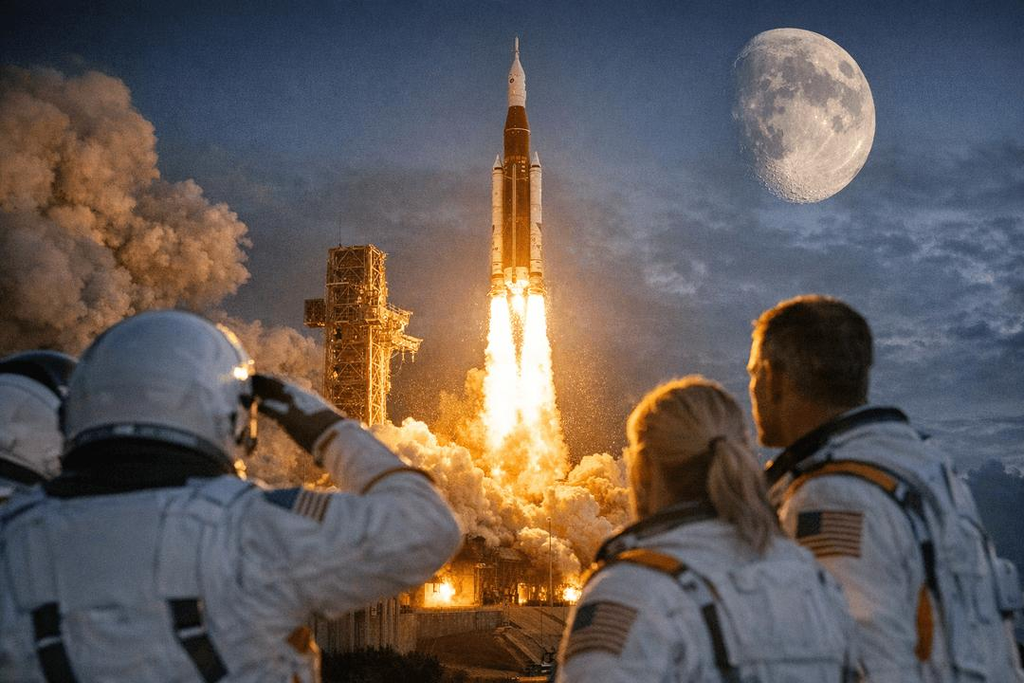
For Artemis III, four astronauts will launch aboard Orion on an SLS rocket for a planned 14-day (extendable to about 17 days) mission in low Earth orbit. The sequence involves Blue Origin launching a Blue Moon lander test article first, followed by the SLS/Orion crew docking with it for systems checks and crew transfer practice. Orion will then undock and rendezvous with a SpaceX Starship Human Landing System test article launched from Kennedy Space Centre’s Launch Complex 39A. These dual docking demonstrations aim to reduce risk for the subsequent landing mission by validating critical interfaces, procedures, and operations with the commercial landers. Hardware progress includes stacking of the Artemis III solid rocket boosters on the mobile launcher, integration of the core stage with its four RS-25 engines, and use of structural test articles and a spacer in place of the Interim Cryogenic Propulsion Stage since the mission remains in Earth orbit. Processing timelines have been significantly reduced.
Artemis IV, targeted for 2028, will send astronauts to the lunar surface near the South Pole using one of the commercial landers—either SpaceX’s Starship or Blue Origin’s Blue Moon Mark 2—depending on readiness. NASA is pursuing parallel development paths with both providers to maximise the chance of a successful landing within the desired timeframe. The South Pole region is of high scientific interest due to potential water ice deposits in permanently shadowed craters, which could support future propellant production, life support, and sustained operations. Subsequent missions will expand exploration and begin establishing elements of a Moon Base.
NASA’s broader lunar strategy, outlined in phases, moves from robotic precursor missions and initial crewed landings toward semi-permanent infrastructure for early habitation and logistics in the late 2020s and early 2030s, progressing to continuous human presence thereafter. Contracts and partnerships support surface elements, communications, mobility systems such as rovers, and habitats. Commercial Lunar Payload Services (CLPS) continues delivering science instruments and technology demonstrations to the surface, providing data on landing sites, resources, and environmental conditions.
Beyond the Moon, NASA is advancing Mars-related preparations. The CHAPEA (Crew Health and Performance Exploration Analogue) mission concluded in late October 2026 when four volunteer crew members—commander Ross Elder, medical officer Ellen Ellis, science officer Matthew Montgomery, and flight engineer James Spicer—emerged after 378 days inside a 1,700-square-foot, 3D-printed habitat at Johnson Space Centre simulating Mars conditions. The crew lived and worked under resource constraints, isolation, and communication delays typical of a Mars mission. Post-mission evaluations will inform future analogue studies and actual exploration architecture. NASA plans to evolve the program into broader Moon and Mars Exploration Analogues focused on surface operations.
Robotic missions complement human efforts. The ESCAPADE (Escape and Plasma Acceleration and Dynamics Explorers) twin spacecraft, launched previously, are scheduled for powered Earth flybys in early November 2026 to adjust trajectories toward Mars. They will study how the solar wind interacts with the Martian atmosphere and drives atmospheric escape, providing insights relevant to planetary evolution and future human missions. Other ongoing assets include the Perseverance rover continuing sample collection and exploration on the Martian surface, orbiters relaying data, and preparatory work for future sample return and eventual human landings. JPL-led concepts such as SkyFall (Mars helicopters for ice and weather mapping) and MoonFall (propulsive drones for lunar South Pole survey) illustrate the agency’s investment in advanced mobility and reconnaissance.
Science and technology development remain central. NASA’s heliophysics missions study solar activity and space weather, which pose risks to astronauts and spacecraft. Earth science satellites monitor climate, oceans, and atmospheric processes. Astrophysics assets, including Hubble and preparations for future observatories, continue delivering discoveries about the universe. Voyager 1, still operating at interstellar distances, recently underwent power conservation measures and recovered from a brief communications pause, demonstrating the longevity of NASA’s deep-space engineering. Sounding rocket campaigns and experimental aircraft, such as the newly announced X-70 Fractal, support aeronautics and rapid-response science.
International collaboration underpins much of this work. The ISS partnership with Russia, Europe, Japan, and Canada continues, as seen in the joint spacewalks and mixed crews. Artemis involves the Canadian Space Agency, European Space Agency, Japan Aerospace Exploration Agency, and others through contributions to Orion, science instruments, and surface systems. Commercial partners—SpaceX for crew and cargo transportation as well as Starship, Blue Origin for New Glenn and Blue Moon, and numerous CLPS providers—have transformed access to space by lowering costs and increasing launch cadence.
Challenges persist. Schedule pressures on complex systems, supply-chain issues for avionics and specialised components, and the inherent risks of human spaceflight require constant management. Cost control and technical maturation of landers, spacesuits (including lighter “sortie” designs optimised for surface operations), and surface systems remain priorities. NASA has emphasised internal rapid prototyping and streamlined processes to address bottlenecks, including redesigning critical components at lower cost and faster timelines than external estimates.
Looking ahead, the combination of ISS operations, Artemis acceleration, robotic pathfinding, and analogue testing positions NASA to achieve a sustained lunar presence this decade and to build the foundations for Mars. The November 2026 solar array completion ensures the ISS can support research through the remainder of its operational life while the agency shifts emphasis outward. Artemis III’s planned 2027 docking demonstrations will validate the commercial human landing systems in flight, clearing the way for the historic 2028 return of astronauts to the lunar surface. Success there will open a new era of exploration focused not only on flags and footprints but on science, resource utilisation, economic opportunity, and preparation for the next giant leap to Mars.
These efforts collectively represent one of the most ambitious periods in NASA’s history since the Apollo era. By integrating government leadership with commercial innovation and international partnership, the agency is working to make the Moon a stepping stone and Mars a reachable destination within the coming decades. Continued progress on hardware, testing, and operations in the months and years ahead will determine how swiftly these goals are realised. The recent spacewalk and ongoing Artemis stacking activities provide tangible evidence that the work is advancing steadily on multiple fronts.