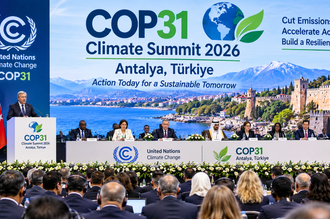


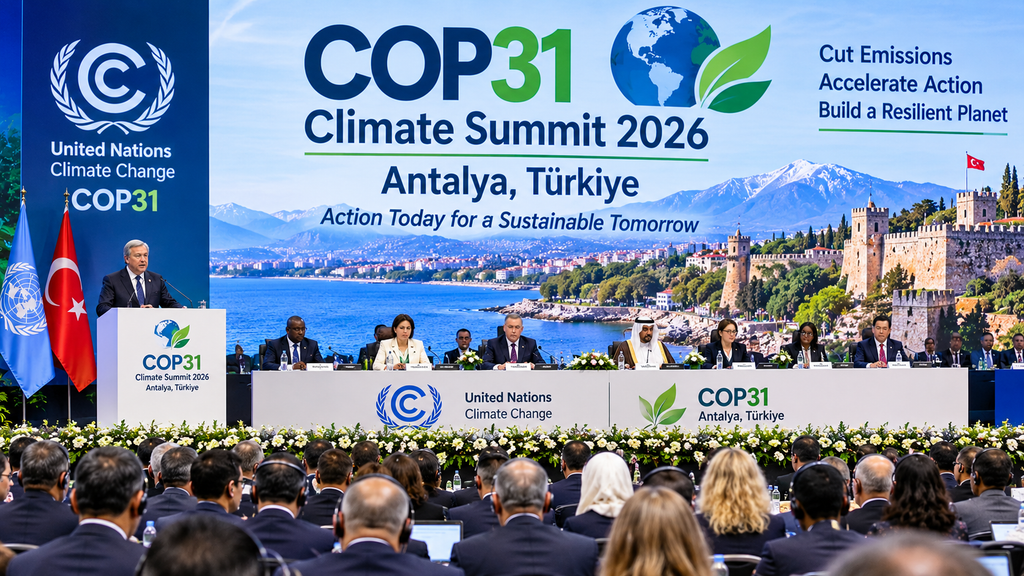
Antalya, Türkiye — World leaders, negotiators, scientists, activists and business representatives gather in the Mediterranean city of Antalya this week for the 31st United Nations Climate Change Conference, known as COP31, with the explicit aim of shifting the global climate regime from repeated pledges toward concrete implementation of existing commitments on emissions reductions, finance, adaptation and a just transition.
The conference runs from 9 to 20 November 2026 at the Antalya Expo Centre. A World Leaders’ Summit is scheduled for 11–12 November. Türkiye hosts the event and holds the formal presidency under Environment, Urbanisation and Climate Change Minister Murat Kurum. In an unusual power-sharing arrangement agreed at COP30 in Belém, Australia’s Climate Change and Energy Minister Chris Bowen serves as President of Negotiations, managing the formal negotiating process, draft texts and the overarching cover decision.
Expectations remain tempered by geopolitical tensions, constrained public budgets in developed countries, and scientific assessments showing that current national climate plans remain far short of what is required to limit warming. Yet the presidency has framed COP31 as an “Implementation COP” and “Future COP,” focused on turning dialogue into action.
The Dual Presidency and Unusual Hosting Arrangement
The decision to stage COP31 in Antalya resulted from a compromise after both Türkiye and Australia bid to host the 2026 conference. Under UN rules, host selection requires consensus; without agreement, the meeting would have defaulted to Bonn. After negotiations during COP30, the two countries settled on Türkiye as host and former president, while Australia leads the negotiations. Pacific island states, which had supported Australia’s bid, hosted preparatory meetings in Fiji and Tuvalu.
Kurum has emphasised that Türkiye holds the presidency and final decision-making authority, while Bowen manages the negotiating track. Both have stated they will work in close consultation. The arrangement is being closely watched as a test of whether shared leadership can deliver results on contentious files.
Türkiye has also shaped a parallel Action Agenda organised around ten priority themes, including clean energy transition and electrification, zero waste and methane reduction, oceans and seas, food security, climate-resilient cities, and a Climate Implementation Bridge. A centrepiece voluntary pledge seeks to raise electricity’s share of global final energy demand from roughly 23 per cent today to 35 per cent by 2035.
The Scientific Backdrop: Emissions Gap and Inadequate Ambition
COP31 opens against a stark scientific assessment. The UNFCCC’s 2026 Nationally Determined Contributions (NDC) Synthesis Report, covering new or updated NDCs from 154 Parties representing about 71 per cent of 2019 global emissions, projects that full implementation of current plans would reduce global greenhouse gas emissions by only around 6 per cent by 2035 relative to 2019 levels on average. Even including conditional elements dependent on international support, the reduction reaches only about 9 per cent.
The UNEP Emissions Gap Report 2026 paints a similar picture. Full delivery of unconditional and conditional NDCs would leave a gap of approximately 16 billion tonnes of CO₂ equivalent in 2035 relative to pathways that limit peak warming to around 1.7–1.8°C and return temperature rise to 1.5°C or below by 2100. Current policies put the world on track for roughly 2.6°C of warming this century. To stay on the lowest-overshoot 1.5°C pathway, global emissions would need to fall by roughly 18 per cent by 2030, 45 per cent by 2035 and 69 per cent by 2040 relative to 2025 levels.
These figures underscore the central challenge for negotiators: the first Global Stocktake under the Paris Agreement, concluded at COP28, called for transitioning away from fossil fuels, tripling renewable energy capacity and halting and reversing deforestation by 2030. National plans submitted since then have not closed the gap at the required scale or speed. COP31 marks the formal start of the second Global Stocktake process, which will conclude in 2028 and is expected to inform the next round of NDCs.
Core Negotiating Tracks: Emissions, Fossil Fuels and Mitigation
Formal negotiations will address whether and how to strengthen the Mitigation Work Programme (MWP), the principal formal agenda item focused on accelerating emissions reductions this decade. Parties remain divided on the programme’s future scope, duration and level of detail. Some groups, including small island states, least developed countries and the European Union, favour a more substantive, delivery-oriented approach with sectoral focus. Others resist anything that could be interpreted as new top-down targets.
Language on fossil fuels remains highly sensitive. COP28 produced the landmark call to “transition away from fossil fuels in energy systems.” Subsequent conferences have struggled to operationalise that language. At COP31, attention centres on whether the cover decision will reaffirm, strengthen or dilute previous wording, and whether voluntary roadmaps on fossil-fuel transition and deforestation published by previous presidencies gain broader political endorsement.
Türkiye’s Action Agenda emphasises electrification as a practical pathway. Raising electricity’s share of final energy to 35 per cent by 2035 would require massive expansion of renewable generation, grid infrastructure and end-use electrification in transport, buildings and industry. Proponents argue this offers a technology-neutral, investment-oriented framing that can attract broader support than explicit fossil-fuel phase-out language. Critics note that without complementary measures to constrain coal, oil and gas production and consumption, electrification alone will not deliver the necessary emissions trajectory.
Methane reduction features prominently in the Action Agenda and in satellite monitoring reports highlighting leaks from landfills and other sources. Short-lived climate pollutants offer relatively rapid near-term cooling potential if addressed aggressively.
Climate Finance: The Persistent Fault Line
Finance remains the most politically charged issue. At COP29 in Baku, parties agreed the New Collective Quantified Goal (NCQG) of at least $300 billion per year by 2035 from a wide variety of sources, with developed countries taking the lead, alongside a broader call to enable scaled-up finance of at least $1.3 trillion per year. Developing countries have consistently described the $300 billion figure as inadequate relative to estimated needs running into the trillions.
At COP30, parties committed to triple adaptation finance by 2035. The precise baseline remains contested; many developing-country groups interpret the goal as reaching at least $120 billion annually. Delivery has lagged. The 2026 Adaptation Gap Report showed public adaptation finance from developed countries at only $28.2 billion in 2024, far below estimated needs of hundreds of billions.
At COP31, developing countries are pushing for a dedicated Climate Finance Work Programme focused on the provision of public, grant-based and concessional finance under Article 9.1 of the Paris Agreement, greater predictability, improved access, and clearer accountability. Developed countries emphasise mobilisation of private finance, the role of multilateral development banks, and the broader $1.3 trillion enabling goal. Questions around the quality of finance, debt burdens, and the balance between mitigation and adaptation remain unresolved.
The Fund for Responding to Loss and Damage continues to face a significant gap between submitted proposals and available resources. Calls for a standing agenda item on loss and damage and stronger replenishment processes are expected.
Adaptation and the Global Goal on Adaptation
Progress on the Global Goal on Adaptation (GGA) will be measured against the 59 indicators agreed at COP30 under the UAE–Belém Framework. Negotiators must refine methodologies and data systems so that progress can be tracked consistently. Without robust metrics, it remains difficult for the financial sector and governments to reward resilience investments or for vulnerable countries to demonstrate results.
National Adaptation Plans are shifting from formulation toward implementation. The presidency and many parties stress the need to make adaptation finance more accessible and to integrate climate resilience into national development planning, cities, food systems and oceans.
Just Transition
A major expected outcome is operationalisation of the Belém–Antalya Mechanism for global just transitions (sometimes referred to as the Belém Just Transition Mechanism). Established conceptually at COP30, the mechanism is intended to coordinate international cooperation supporting workers, communities and countries through the shift away from fossil-fuel-dependent economies. Key open questions include its institutional form, funding, governance, links to finance and mitigation work programmes, and the role of labour, Indigenous Peoples and affected communities. Civil society groups insist that human-rights language and safeguards agreed in earlier text must be retained.
India and other developing countries have signalled they will seek continuation of just-transition work while resisting any new top-down mitigation targets that do not respect national circumstances and the principle of common but differentiated responsibilities.
Broader Context and Participation
The United States, having withdrawn from the Paris Agreement, is not expected to send an official government delegation, though members of Congress, subnational governments, businesses and civil society will attend. The absence of the world’s second-largest emitter adds complexity to negotiations on collective ambition and finance.
Türkiye itself faces scrutiny over domestic emissions, including satellite-detected methane plumes from major landfills, even as it promotes a Zero Waste Initiative and plans to present an industrial decarbonisation platform aimed at attracting more than $6 billion for steel, aluminium, cement and fertiliser sectors.
Approximately 91 heads of state and government and nearly 300 ministers are expected. The Blue Zone will host official negotiations; the Green Zone will be open to the public for exhibitions, panels and side events.
What Would Constitute Success?
Success at COP31 is unlikely to take the form of a single landmark treaty text. More realistic markers include:
- A cover decision that reaffirms the transition away from fossil fuels, endorses accelerated electrification, and provides political direction for the second Global Stocktake.
- Concrete steps to operationalise the just-transition mechanism with clear terms of reference and funding pathways.
- Clarification of the adaptation-finance baseline and progress toward predictable delivery of the tripling commitment.
- Launch or strengthening of a Climate Finance Work Programme focused on public provision under Article 9.1.
- Refinement of Global Goal on Adaptation indicators and stronger links between national plans and international support.
- Voluntary but high-ambition Action Agenda pledges on electrification, methane, zero waste and resilient cities that attract significant participation from governments, cities, businesses and investors.
Failure would be measured by continued deadlock on finance quality and quantity, dilution of fossil-fuel language, and an inability to move the Mitigation Work Programme beyond dialogue.
Looking Ahead
COP31 occurs at a moment when climate impacts are intensifying, clean-technology costs continue to fall, and political space for ambitious multilateralism remains constrained. The dual presidency experiment, the emphasis on implementation, and the scientific clarity provided by the latest NDC and Emissions Gap reports create both opportunity and pressure.
Whether Antalya produces measurable acceleration in emissions trajectories, finance flows, and resilience will depend less on the final communiqué than on the decisions governments, investors, and institutions take in the months and years that follow. The Paris Agreement’s temperature goals remain within technical reach only if the current decade delivers far deeper cuts than existing national plans currently project. COP31 is the latest, and far from the last, test of whether the international community can close that gap.