

In a development that has sent shockwaves through Silicon Valley and the global technology sector, Jensen Huang, the co-founder and longtime chief executive of Nvidia Corp., resigned effective immediately on November 12, 2026. The board of the world’s most valuable semiconductor company accepted his resignation as president, CEO, and director after a rapid cascade of revelations involving extramarital affairs, one of which raised national security concerns. Chief Financial Officer Colette Kress, who has held the finance role since 2013, was named interim CEO, while director Harvey C. Jones was appointed the company’s first-ever board chair.
Huang, 63, had led Nvidia for its entire 33-year history, transforming a graphics-chip maker founded in 1993 into the indispensable supplier of accelerators powering the artificial-intelligence boom. Under his leadership, the company reached a market capitalisation near $4 trillion and captured the overwhelming majority of the data-centre AI accelerator market. His abrupt exit, following reports of relationships with a businesswoman suspected by U.S. intelligence of acting for Chinese authorities and with Nvidia employees who reported to him, has erased hundreds of billions of dollars in market value and forced the industry to confront questions about succession, governance, and over-reliance on a single charismatic founder.
The crisis unfolded with unusual speed. In late October 2026, The New York Times reported that U.S. intelligence agencies believed Alice Huang, a Chinese businesswoman and former executive at Singapore-based AI infrastructure firm Megaspeed International, had been recruited by China’s Ministry of State Security to gather information from Jensen Huang. The two are not related. Megaspeed had purchased billions of dollars of Nvidia chips, and separate reporting raised questions about whether some shipments may have reached Chinese entities in ways that tested U.S. export controls. Beijing has denied that Alice Huang is a spy.
On November 8, Huang issued an internal memo admitting he had been unfaithful to his wife and apologising to his family and colleagues. Nvidia’s board responded by launching an independent investigation led by the law firm Wachtell, Lipton, Rosen & Katz and initially expressed confidence in Huang’s leadership, stating it had no reason to believe national security or company secrets had been compromised. That stance shifted dramatically after further reporting. On November 11, The New York Times detailed an alleged affair with Kimberly Powell, Nvidia’s vice president of healthcare, who reported directly to Huang. Video and witness accounts from a company conference in March were cited. Reuters subsequently reported a third intimate relationship with another Nvidia employee, who has not been named.
The board met late on November 11 and accepted Huang’s resignation the following morning. He will have no ongoing role at the company. Shares fell as much as 14 per cent in early trading before partially recovering to close down about 4.3 per cent on the day of the announcement, wiping more than $180 billion from the company’s valuation that session and roughly $490 billion over the week. The broader market felt the impact as well, with technology indices under pressure given Nvidia’s outsized weighting.
Reactions across the technology community mixed shock with concern. Venture capitalists described the day as “dark” for the United States and the Western technology ecosystem, arguing that Huang’s vision and deal-making capacity had been central to the AI infrastructure build-out. President Donald Trump praised Huang’s record while publicly suggesting Apple CEO Tim Cook as a possible successor, an idea that generated immediate discussion though it remains outside the formal search process. Congressional scrutiny intensified, with lawmakers examining both the personal relationships and Nvidia’s past advocacy for continued sales of advanced chips to China. Huang was reported to have agreed to testify before Congress.
Colette Kress brings deep institutional knowledge. As CFO, she has managed the financial side of Nvidia’s explosive growth and has been a regular presence with investors. In an internal note, she acknowledged the difficulty of the period while emphasising continuity of operations, customer commitments, and the product roadmap. Harvey Jones, a longtime director and former CEO of Synopsys, assumes the newly created chair role, a structural change intended to strengthen board oversight after years in which Huang exercised unusually concentrated authority.
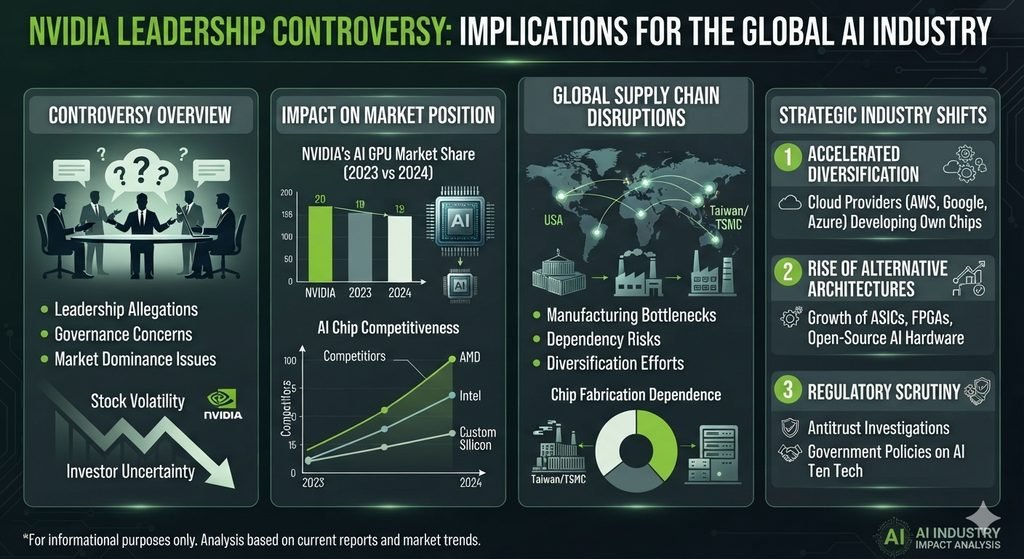
For the global AI industry, the implications are both immediate and structural. Nvidia supplies the majority of the high-end GPUs used to train and run large language models and other advanced systems. Near-term demand and existing supply agreements appear largely locked in; customers and cloud providers have multi-year capacity plans already under way. Analysts note that Nvidia remains technologically two to three years ahead of the nearest competitors in key GPU architectures, and the fundamental demand trajectory for AI compute is not expected to reverse simply because of a leadership change.
Medium-term risks are more pronounced. Huang functioned not only as chief technologist and public face but as a central capital allocator and relationship manager. Nvidia under his direction invested billions in startups, provided lease guarantees and capacity backstops, and acted as a de facto financier of the broader AI ecosystem. Large commitments, including substantial support for OpenAI data-centre projects and efforts to treat AI infrastructure as a distinct asset class for institutional capital, relied heavily on his personal credibility and networks. A prolonged period of uncertainty around permanent leadership could slow some of that ecosystem financing and raise the cost of capital for AI infrastructure projects.
Competitors stand to benefit from any distraction or perceived vulnerability. AMD and Broadcom, already advancing their own accelerated computing platforms, saw share-price gains in the immediate aftermath. Custom silicon efforts by major cloud providers and the gradual rise of alternative architectures could gain incremental momentum if customers decide to diversify suppliers more aggressively. Yet Nvidia’s software stack, networking solutions, and installed base create high switching costs that will limit rapid market-share shifts. Industry observers expect any erosion to be gradual rather than abrupt.
Governance questions have come into sharper focus. Nvidia operated for decades without a board chair and with Huang exercising broad personal control over dozens of direct reports. The absence of a publicly groomed successor left the company exposed when personal controversy escalated. The decision to appoint an interim CEO from the finance ranks and to create a formal chair role signals an effort to institutionalise decision-making. The board has said it is considering both internal and external candidates for the permanent CEO position. Names floated in market commentary have included technical leaders such as Ian Buck, who oversees hyperscale and high-performance computing, as well as external figures, though no formal shortlist has been disclosed.
National security dimensions add another layer of complexity. The investigation into whether Huang was targeted by a foreign intelligence operation continues. Separately, the scandal has strengthened political momentum in Washington for tighter restrictions on advanced chip exports to China. U.S. House leadership has pointed to a growing consensus for additional limits. Any tightening of export rules would affect Nvidia’s addressable market and could accelerate Chinese efforts to develop domestic alternatives, with second-order effects on global supply chains and pricing.
Investor and customer confidence will be tested in the coming quarters. Nvidia is scheduled to report results shortly after the leadership change, providing an early opportunity for Kress and the board to reaffirm guidance and product timelines. Enterprise buyers and hyperscalers are watching closely for any signs of roadmap slippage or disruption in customer support. Most analysts expect operational continuity in the near term precisely because the company’s engineering depth and order backlog are substantial. The larger question is whether the organisation can sustain the same pace of strategic risk-taking and ecosystem orchestration without the founder who personified those qualities.
The episode also serves as a reminder of concentration risk in the AI supply chain. For several years, the industry has operated with an extraordinary dependence on one company’s hardware, software, and capital. That dependence delivered rapid progress; it also created a single point of vulnerability. Huang’s departure does not eliminate Nvidia’s technological lead, but it forces customers, investors, and policymakers to confront the fragility of a system built so heavily around one individual.
In the weeks ahead, the focus will shift to the search for a permanent chief executive, the findings of the independent investigation, and any legislative or regulatory responses in Washington. For an industry that has ridden Nvidia’s success to record valuations and unprecedented infrastructure spending, the leadership transition marks the end of an era defined by a single, highly visible founder and the beginning of a more institutional, and potentially more contested, phase. The global AI economy remains dependent on the continued execution of the company Huang built. Whether that execution continues at the same intensity under new leadership will shape the competitive landscape for years to come.