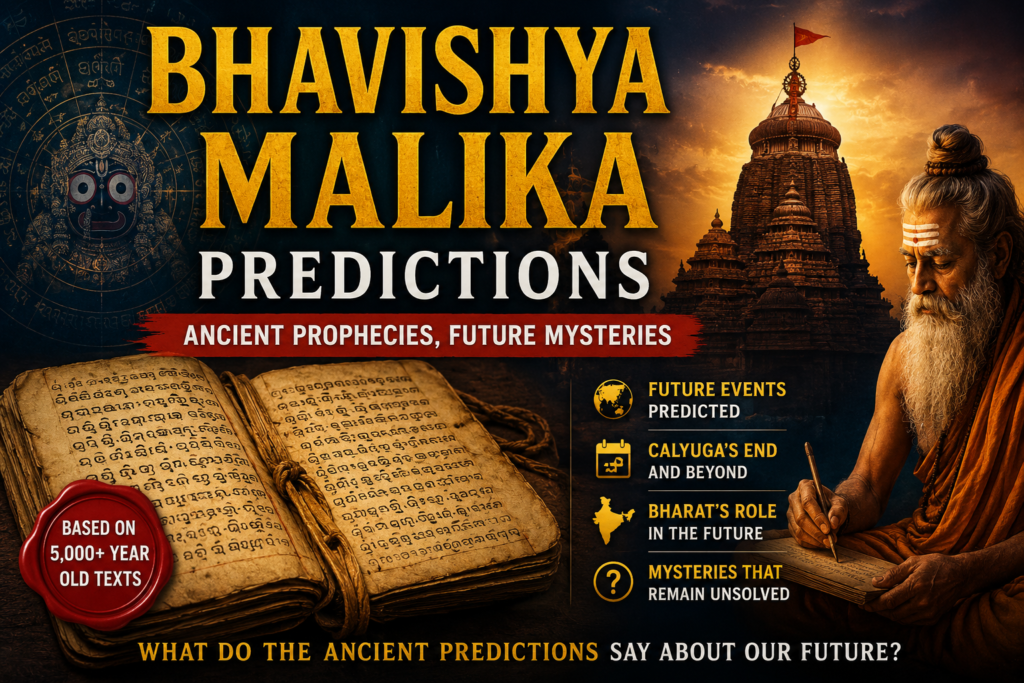
Predictions of the Bhavishya Malika: A Detailed Exploration of Prophetic Visions for the End of Kali Yuga and the Dawn of Satya Yuga
The Bhavishya Malika, often translated as the “Garland of the Future” or “Book of Prophecies,” stands as one of the most intriguing and discussed prophetic texts in the Odia devotional tradition of India. Attributed primarily to the 16th-century saint Achyutananda Das and his companions, known collectively as the Panchasakha (five friends), this collection of writings on palm leaves offers a vivid roadmap of humanity’s future. Composed around 600 years ago in the sacred land of Odisha, associated with Lord Jagannath, these texts blend spirituality, morality, eschatology, and detailed forecasts of cataclysmic events leading to the transition from Kali Yuga (the current age of strife) to Satya Yuga (the Golden Age).
Unlike broader Puranic literature, the Bhavishya Malika is uniquely focused on the final phases of Kali Yuga, providing what believers describe as precise timelines, signs, and sequences of events. Modern compilations, such as the Bhavishya Malika Puran by Pandit Kashinath Mishra, have decoded and translated these verses, making them accessible globally. According to these interpretations, Kali Yuga’s effective duration has been shortened due to accumulated human sins—from the traditional 432,000 years to approximately 5,000 years—with the transition to Satya Yuga slated around 2032.
This article delves deeply into the origins, core prophecies, specific timelines, spiritual implications, and debates surrounding the text, aiming to provide a balanced, comprehensive overview exceeding 2000 words for those seeking thorough insight.
Origins and Authorship: The Panchasakha Tradition
The Panchasakha—Achutananda Das, Jagannath Das, Balaram Das, Jasobanta Das, and Ananta Das—were close devotees of Lord Jagannath and contemporaries in the 15th-16th century Odisha under the Gajapati rulers. Deeply rooted in Bhakti (devotion) and Vaishnavism, they composed numerous works, including Malikas (prophetic garlands), inspired by divine vision. Achyutananda Das is particularly credited with the most detailed future-oriented prophecies in the Bhavishya Malika.
These texts were inscribed on palm leaves and copper plates and were preserved in secret until the prophesied end times. The name “Malika” refers to a garland-like structure of verses, each linking events in a chain of predictions. The Panchasakha emphasised that these revelations were meant for true devotees, guiding them through chaos toward spiritual awakening. Lord Jagannath himself is central, with prophecies stating that the deity’s abode in Puri will be a key site for divine signs and the eventual incarnation of Kalki Avatar.
Pandit Kashinath Mishra, after decades of research, compiled and decoded these manuscripts. His works, including English translations published around 2023-2025, present the prophecies systematically. The texts draw from Jagannath culture, integrating local traditions with pan-Hindu cosmology, and were kept confidential to prevent misuse.
Scholars note the linguistic style: archaic Odia poetry rich in symbolism, metaphors, and astronomical references, requiring interpretive expertise. Proponents argue that this esoteric nature protects the knowledge for the right audience at the appointed time.
Understanding the Yugas and the Shortening of Kali Yuga
Hindu cosmology divides time into four Yugas: Satya (truth), Treta, Dvapara, and Kali (darkness/strife). Traditional durations are vast—Kali Yuga spanning 432,000 years—but the Bhavishya Malika asserts a contraction. Achyutananda Das, citing divine instruction, modified references from texts like the Manusmriti, stating that due to rampant sins, the Kali Yuga would last only about 5,000 years. By this reckoning, the age nears its conclusion.
Sins accelerating the end include moral decay, environmental exploitation, corruption, loss of dharma (righteousness), and disregard for the five elements (Pancha Bhoota: earth, water, fire, air, ether). The text warns of farmers abandoning agriculture, wild animals invading human settlements, unnatural weather, and societal collapse. These are not mere metaphors but observable signs of imbalance.
The transition involves “Khanda Pralaya” (partial dissolution), not total annihilation, paving the way for renewal. This cyclical view aligns with broader Hindu philosophy but adds urgency with specific dates tied to Jagannath Temple events and planetary positions.
Key Signs of Kali Yuga’s End
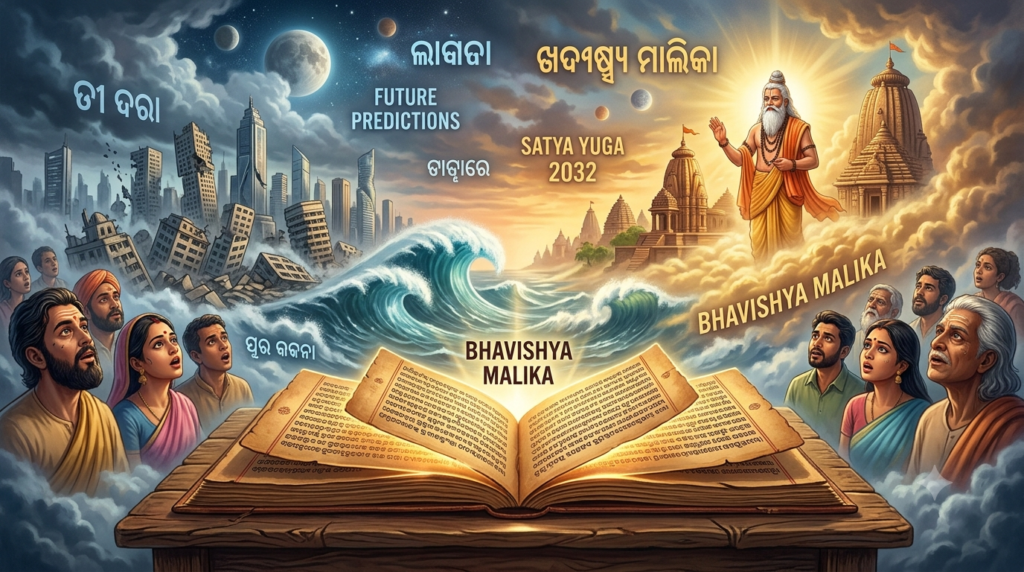
The Bhavishya Malika enumerates numerous omens:
Temple and Divine Signs: Unusual behaviour of flags at Jagannath Temple in Puri—flying erratically, tearing, or changing directions. The deity’s chariot or idols show anomalies. A major cyclone struck the temple area.
Environmental and Natural Phenomena: Intensified solar heat, two suns visible, continuous heavy rains leading to floods, record-breaking earthquakes, tsunamis, droughts, and cyclones. Wild animals are entering villages and cities. Pollution and human misconduct provoke the elements’ wrath.
Social and Moral Decay: Widespread corruption, breakdown of family values, religious hypocrisy, economic disparity, and loss of interest in farming and traditional dharma. Pandemics of unknown origin (64 types predicted).
Astronomical Indicators: Specific planetary conjunctions, such as Saturn in Pisces (around 2025-2028), triggering major conflicts.
These signs serve as warnings, urging devotees to practice Trisandhya (thrice-daily prayer) and ethical living for protection.
Major Catastrophes and World War 3
The prophecies detail escalating turmoil from the mid-2020s:
Natural Disasters (2022-2027 and beyond): Devastating floods, earthquakes (including three massive ones), fires, storms, and rising sea levels submerging coastal areas and parts of continents. Mumbai and other cities are at risk; significant portions of America, Europe, and Canada are potentially affected.
Pandemics: 64 varieties of unknown viruses and diseases peaking around 2025-2027, causing widespread panic and mortality.
Economic and Societal Collapse: Inflation, food shortages, machinery age ending, global crises leading to hardship.
World War 3: A pivotal prophecy involves a major global conflict, often interpreted as starting around 2025 with shadow wars (e.g., India-Pakistan), escalating into involvement of China, Islamic coalitions (up to 13 countries), and others against India and allies. Duration estimates vary (some say 6 years, 6 months, or about 13 months of intense phase). Nuclear elements are possible. India ultimately prevails with divine aid.
The war is framed as the final battle of Kali Yuga, a “Dharma Yuddha” between righteousness and adharma.
The Seven Days of Darkness
One of the most dramatic predictions is seven days and nights of total darkness, where the sun and moon “hide.” During this period, ghostly or demonic forces may manifest, testing humanity. This event, expected between 2028-2031 in some readings, precedes the Kalki intervention and Satya Yuga dawn. It symbolises a cosmic reset.
Kalki Avatar: Descent, Role, and the New Era
Central to the text is Lord Vishnu’s tenth avatar, Kalki, who incarnates to restore dharma. Born in Odisha (possibly Sambalpur or related areas, in secrecy), Kalki grows amid turmoil, unites devotees, and leads the final victory. Details include childhood leelas, social life in Bhubaneswar, in some interpretations, and the establishment of Sudharma Maha-Maha Sangh (a grand organisation of devotees) with 16 Mandals.
Kalki reforms all religions, unifying humanity under Sanatan Dharma. The Golden Age begins around 2032, lasting perhaps 1009 years or more in variants, marked by peace, righteousness, and spiritual prosperity. All scriptures converge on this renewal.
Specific verses describe Kalki’s parents (e.g., Vishnu Sharma and Yashovati in some readings) and the divine secrecy surrounding the birth.
Timeline Summary (Interpretive)
Up to 2025: Rising tensions, initial conflicts, disasters, pandemics.
2026: Major shifts (“Shunya” or zero-like disruptions), floods, geopolitical changes, intensified crises.
2025-2028: Peak of World War 3, Saturn in Pisces influence, destruction by elements.
2028-2031: Darkness, final cataclysms.
2032 Onward: Kalki’s full manifestation, Satya Yuga commencement, global reformation.
Note: Exact dates are interpretive and may vary across commentators.
Authenticity, Controversies, and Scepticism
Supporters highlight “chilling accuracies” matching current events: pandemics, wars, climate crises, and geopolitical tensions. The text’s specificity—names, sequences, locations—sets it apart.
Critics question modern compilations’ fidelity to originals, noting potential post-hoc interpretations or additions. Some label certain editions “fake” or commercially driven. As with Nostradamus or other prophecies, vagueness allows flexible fitting. Historical authenticity debates persist, though the Panchasakha’s legacy is well-established in Odia literature.
Reddit and online forums reflect divided opinions: faith for some, scepticism for others. The text itself cautions that it is for devotees, not intellectual debate.
Spiritual Message and Relevance Today
Beyond doomsday fears, the Bhavishya Malika is a call to dharma, devotion, and harmony with nature. It encourages preparation through righteous living, not panic. In an era of global uncertainty—climate change, conflicts, technological disruption—the prophecies resonate as moral allegories and hopeful visions of renewal.
Believers form communities, promote Trisandhya, and await unification. Critics see value in its ethical teachings regardless of literal fulfilment.
Conclusion: Hope Amid Tribulation
The Bhavishya Malika paints a dramatic arc: from profound darkness and destruction to luminous renewal under Kalki. Whether viewed as literal scripture, symbolic guidance, or cultural heritage, it underscores humanity’s capacity for both fall and redemption. As Pandit Mishra’s works emphasise, the focus should be on spiritual evolution.
For deeper engagement, consult original translations, visit Odisha’s sacred sites, or study with qualified scholars. In uncertain times, such texts remind us that cycles end, and light follows darkness. The ultimate prophecy may be humanity’s choice: cling to adharma or embrace dharma for a brighter future.
(interpretations; prophecies are subject to faith and scholarly variance. Approach with open-minded discernment.)
Predictions of the Bhavishya Malika: A Detailed Exploration of Prophetic Visions for the End of Kali Yuga and the Dawn of Satya Yuga
The Bhavishya Malika, often translated as the “Garland of the Future” or “Book of Prophecies,” stands as one of the most intriguing and discussed prophetic texts in the Odia devotional tradition of India. Attributed primarily to the 16th-century saint Achyutananda Das and his companions, known collectively as the Panchasakha (five friends), this collection of writings on palm leaves offers a vivid roadmap of humanity’s future. Composed around 600 years ago in the sacred land of Odisha, associated with Lord Jagannath, these texts blend spirituality, morality, eschatology, and detailed forecasts of cataclysmic events leading to the transition from Kali Yuga (the current age of strife) to Satya Yuga (the Golden Age).
Unlike broader Puranic literature, the Bhavishya Malika is uniquely focused on the final phases of Kali Yuga, providing what believers describe as precise timelines, signs, and sequences of events. Modern compilations, such as the Bhavishya Malika Puran by Pandit Kashinath Mishra, have decoded and translated these verses, making them accessible globally. According to these interpretations, Kali Yuga’s effective duration has been shortened due to accumulated human sins—from the traditional 432,000 years to approximately 5,000 years—with the transition to Satya Yuga slated around 2032.
This article delves deeply into the origins, core prophecies, specific timelines, spiritual implications, and debates surrounding the text, aiming to provide a balanced, comprehensive overview exceeding 2000 words for those seeking thorough insight.
Origins and Authorship: The Panchasakha Tradition
The Panchasakha—Achutananda Das, Jagannath Das, Balaram Das, Jasobanta Das, and Ananta Das—were close devotees of Lord Jagannath and contemporaries in the 15th-16th century Odisha under the Gajapati rulers. Deeply rooted in Bhakti (devotion) and Vaishnavism, they composed numerous works, including Malikas (prophetic garlands), inspired by divine vision. Achyutananda Das is particularly credited with the most detailed future-oriented prophecies in the Bhavishya Malika.
These texts were inscribed on palm leaves and copper plates and were preserved in secret until the prophesied end times. The name “Malika” refers to a garland-like structure of verses, each linking events in a chain of predictions. The Panchasakha emphasised that these revelations were meant for true devotees, guiding them through chaos toward spiritual awakening. Lord Jagannath himself is central, with prophecies stating that the deity’s abode in Puri will be a key site for divine signs and the eventual incarnation of Kalki Avatar.
Pandit Kashinath Mishra, after decades of research, compiled and decoded these manuscripts. His works, including English translations published around 2023-2025, present the prophecies systematically. The texts draw from Jagannath culture, integrating local traditions with pan-Hindu cosmology, and were kept confidential to prevent misuse.
Scholars note the linguistic style: archaic Odia poetry rich in symbolism, metaphors, and astronomical references, requiring interpretive expertise. Proponents argue that this esoteric nature protects the knowledge for the right audience at the appointed time.
Understanding the Yugas and the Shortening of Kali Yuga
Hindu cosmology divides time into four Yugas: Satya (truth), Treta, Dvapara, and Kali (darkness/strife). Traditional durations are vast—Kali Yuga spanning 432,000 years—but the Bhavishya Malika asserts a contraction. Achyutananda Das, citing divine instruction, modified references from texts like the Manusmriti, stating that due to rampant sins, the Kali Yuga would last only about 5,000 years. By this reckoning, the age nears its conclusion.
Sins accelerating the end include moral decay, environmental exploitation, corruption, loss of dharma (righteousness), and disregard for the five elements (Pancha Bhoota: earth, water, fire, air, ether). The text warns of farmers abandoning agriculture, wild animals invading human settlements, unnatural weather, and societal collapse. These are not mere metaphors but observable signs of imbalance.
The transition involves “Khanda Pralaya” (partial dissolution), not total annihilation, paving the way for renewal. This cyclical view aligns with broader Hindu philosophy but adds urgency with specific dates tied to Jagannath Temple events and planetary positions.
Key Signs of Kali Yuga’s End
The Bhavishya Malika enumerates numerous omens:
Temple and Divine Signs: Unusual behaviour of flags at Jagannath Temple in Puri—flying erratically, tearing, or changing directions. The deity’s chariot or idols show anomalies. A major cyclone struck the temple area.
Environmental and Natural Phenomena: Intensified solar heat, two suns visible, continuous heavy rains leading to floods, record-breaking earthquakes, tsunamis, droughts, and cyclones. Wild animals are entering villages and cities. Pollution and human misconduct provoke the elements’ wrath.
Social and Moral Decay: Widespread corruption, breakdown of family values, religious hypocrisy, economic disparity, and loss of interest in farming and traditional dharma. Pandemics of unknown origin (64 types predicted).
Astronomical Indicators: Specific planetary conjunctions, such as Saturn in Pisces (around 2025-2028), triggering major conflicts.
These signs serve as warnings, urging devotees to practice Trisandhya (thrice-daily prayer) and ethical living for protection.
Major Catastrophes and World War 3
The prophecies detail escalating turmoil from the mid-2020s:
Natural Disasters (2022-2027 and beyond): Devastating floods, earthquakes (including three massive ones), fires, storms, and rising sea levels submerging coastal areas and parts of continents. Mumbai and other cities are at risk; significant portions of America, Europe, and Canada are potentially affected.
Pandemics: 64 varieties of unknown viruses and diseases peaking around 2025-2027, causing widespread panic and mortality.
Economic and Societal Collapse: Inflation, food shortages, machinery age ending, global crises leading to hardship.
World War 3: A pivotal prophecy involves a major global conflict, often interpreted as starting around 2025 with shadow wars (e.g., India-Pakistan), escalating into involvement of China, Islamic coalitions (up to 13 countries), and others against India and allies. Duration estimates vary (some say 6 years, 6 months, or about 13 months of intense phase). Nuclear elements are possible. India ultimately prevails with divine aid.
The war is framed as the final battle of Kali Yuga, a “Dharma Yuddha” between righteousness and adharma.
The Seven Days of Darkness
One of the most dramatic predictions is seven days and nights of total darkness, where the sun and moon “hide.” During this period, ghostly or demonic forces may manifest, testing humanity. This event, expected between 2028-2031 in some readings, precedes the Kalki intervention and Satya Yuga dawn. It symbolises a cosmic reset.
Kalki Avatar: Descent, Role, and the New Era
Central to the text is Lord Vishnu’s tenth avatar, Kalki, who incarnates to restore dharma. Born in Odisha (possibly Sambalpur or related areas, in secrecy), Kalki grows amid turmoil, unites devotees, and leads the final victory. Details include childhood leelas, social life in Bhubaneswar, in some interpretations, and the establishment of Sudharma Maha-Maha Sangh (a grand organisation of devotees) with 16 Mandals.
Kalki reforms all religions, unifying humanity under Sanatan Dharma. The Golden Age begins around 2032, lasting perhaps 1009 years or more in variants, marked by peace, righteousness, and spiritual prosperity. All scriptures converge on this renewal.
Specific verses describe Kalki’s parents (e.g., Vishnu Sharma and Yashovati in some readings) and the divine secrecy surrounding the birth.
Timeline Summary (Interpretive)
Up to 2025: Rising tensions, initial conflicts, disasters, pandemics.
2026: Major shifts (“Shunya” or zero-like disruptions), floods, geopolitical changes, intensified crises.
2025-2028: Peak of World War 3, Saturn in Pisces influence, destruction by elements.
2028-2031: Darkness, final cataclysms.
2032 Onward: Kalki’s full manifestation, Satya Yuga commencement, global reformation.
Note: Exact dates are interpretive and may vary across commentators.
Authenticity, Controversies, and Scepticism
Supporters highlight “chilling accuracies” matching current events: pandemics, wars, climate crises, and geopolitical tensions. The text’s specificity—names, sequences, locations—sets it apart.
Critics question modern compilations’ fidelity to originals, noting potential post-hoc interpretations or additions. Some label certain editions “fake” or commercially driven. As with Nostradamus or other prophecies, vagueness allows flexible fitting. Historical authenticity debates persist, though the Panchasakha’s legacy is well-established in Odia literature.
Reddit and online forums reflect divided opinions: faith for some, scepticism for others. The text itself cautions that it is for devotees, not intellectual debate.
Spiritual Message and Relevance Today
Beyond doomsday fears, the Bhavishya Malika is a call to dharma, devotion, and harmony with nature. It encourages preparation through righteous living, not panic. In an era of global uncertainty—climate change, conflicts, technological disruption—the prophecies resonate as moral allegories and hopeful visions of renewal.
Believers form communities, promote Trisandhya, and await unification. Critics see value in its ethical teachings regardless of literal fulfilment.
Conclusion: Hope Amid Tribulation
The Bhavishya Malika paints a dramatic arc: from profound darkness and destruction to luminous renewal under Kalki. Whether viewed as literal scripture, symbolic guidance, or cultural heritage, it underscores humanity’s capacity for both fall and redemption. As Pandit Mishra’s works emphasise, the focus should be on spiritual evolution.
For deeper engagement, consult original translations, visit Odisha’s sacred sites, or study with qualified scholars. In uncertain times, such texts remind us that cycles end, and light follows darkness. The ultimate prophecy may be humanity’s choice: cling to adharma or embrace dharma for a brighter future.
(interpretations; prophecies are subject to faith and scholarly variance. Approach with open-minded discernment.)
Predictions of the Bhavishya Malika: A Detailed Exploration of Prophetic Visions for the End of Kali Yuga and the Dawn of Satya Yuga
The Bhavishya Malika, often translated as the “Garland of the Future” or “Book of Prophecies,” stands as one of the most intriguing and discussed prophetic texts in the Odia devotional tradition of India. Attributed primarily to the 16th-century saint Achyutananda Das and his companions, known collectively as the Panchasakha (five friends), this collection of writings on palm leaves offers a vivid roadmap of humanity’s future. Composed around 600 years ago in the sacred land of Odisha, associated with Lord Jagannath, these texts blend spirituality, morality, eschatology, and detailed forecasts of cataclysmic events leading to the transition from Kali Yuga (the current age of strife) to Satya Yuga (the Golden Age).
Unlike broader Puranic literature, the Bhavishya Malika is uniquely focused on the final phases of Kali Yuga, providing what believers describe as precise timelines, signs, and sequences of events. Modern compilations, such as the Bhavishya Malika Puran by Pandit Kashinath Mishra, have decoded and translated these verses, making them accessible globally. According to these interpretations, Kali Yuga’s effective duration has been shortened due to accumulated human sins—from the traditional 432,000 years to approximately 5,000 years—with the transition to Satya Yuga slated around 2032.
This article delves deeply into the origins, core prophecies, specific timelines, spiritual implications, and debates surrounding the text, aiming to provide a balanced, comprehensive overview exceeding 2000 words for those seeking thorough insight.
Origins and Authorship: The Panchasakha Tradition
The Panchasakha—Achutananda Das, Jagannath Das, Balaram Das, Jasobanta Das, and Ananta Das—were close devotees of Lord Jagannath and contemporaries in the 15th-16th century Odisha under the Gajapati rulers. Deeply rooted in Bhakti (devotion) and Vaishnavism, they composed numerous works, including Malikas (prophetic garlands), inspired by divine vision. Achyutananda Das is particularly credited with the most detailed future-oriented prophecies in the Bhavishya Malika.
These texts were inscribed on palm leaves and copper plates and were preserved in secret until the prophesied end times. The name “Malika” refers to a garland-like structure of verses, each linking events in a chain of predictions. The Panchasakha emphasised that these revelations were meant for true devotees, guiding them through chaos toward spiritual awakening. Lord Jagannath himself is central, with prophecies stating that the deity’s abode in Puri will be a key site for divine signs and the eventual incarnation of Kalki Avatar.
Pandit Kashinath Mishra, after decades of research, compiled and decoded these manuscripts. His works, including English translations published around 2023-2025, present the prophecies systematically. The texts draw from Jagannath culture, integrating local traditions with pan-Hindu cosmology, and were kept confidential to prevent misuse.
Scholars note the linguistic style: archaic Odia poetry rich in symbolism, metaphors, and astronomical references, requiring interpretive expertise. Proponents argue that this esoteric nature protects the knowledge for the right audience at the appointed time.
Understanding the Yugas and the Shortening of Kali Yuga
Hindu cosmology divides time into four Yugas: Satya (truth), Treta, Dvapara, and Kali (darkness/strife). Traditional durations are vast—Kali Yuga spanning 432,000 years—but the Bhavishya Malika asserts a contraction. Achyutananda Das, citing divine instruction, modified references from texts like the Manusmriti, stating that due to rampant sins, the Kali Yuga would last only about 5,000 years. By this reckoning, the age nears its conclusion.
Sins accelerating the end include moral decay, environmental exploitation, corruption, loss of dharma (righteousness), and disregard for the five elements (Pancha Bhoota: earth, water, fire, air, ether). The text warns of farmers abandoning agriculture, wild animals invading human settlements, unnatural weather, and societal collapse. These are not mere metaphors but observable signs of imbalance.
The transition involves “Khanda Pralaya” (partial dissolution), not total annihilation, paving the way for renewal. This cyclical view aligns with broader Hindu philosophy but adds urgency with specific dates tied to Jagannath Temple events and planetary positions.
Key Signs of Kali Yuga’s End
The Bhavishya Malika enumerates numerous omens:
Temple and Divine Signs: Unusual behaviour of flags at Jagannath Temple in Puri—flying erratically, tearing, or changing directions. The deity’s chariot or idols show anomalies. A major cyclone struck the temple area.
Environmental and Natural Phenomena: Intensified solar heat, two suns visible, continuous heavy rains leading to floods, record-breaking earthquakes, tsunamis, droughts, and cyclones. Wild animals are entering villages and cities. Pollution and human misconduct provoke the elements’ wrath.
Social and Moral Decay: Widespread corruption, breakdown of family values, religious hypocrisy, economic disparity, and loss of interest in farming and traditional dharma. Pandemics of unknown origin (64 types predicted).
Astronomical Indicators: Specific planetary conjunctions, such as Saturn in Pisces (around 2025-2028), triggering major conflicts.
These signs serve as warnings, urging devotees to practice Trisandhya (thrice-daily prayer) and ethical living for protection.
Major Catastrophes and World War 3
The prophecies detail escalating turmoil from the mid-2020s:
Natural Disasters (2022-2027 and beyond): Devastating floods, earthquakes (including three massive ones), fires, storms, and rising sea levels submerging coastal areas and parts of continents. Mumbai and other cities are at risk; significant portions of America, Europe, and Canada are potentially affected.
Pandemics: 64 varieties of unknown viruses and diseases peaking around 2025-2027, causing widespread panic and mortality.
Economic and Societal Collapse: Inflation, food shortages, machinery age ending, global crises leading to hardship.
World War 3: A pivotal prophecy involves a major global conflict, often interpreted as starting around 2025 with shadow wars (e.g., India-Pakistan), escalating into involvement of China, Islamic coalitions (up to 13 countries), and others against India and allies. Duration estimates vary (some say 6 years, 6 months, or about 13 months of intense phase). Nuclear elements are possible. India ultimately prevails with divine aid.
The war is framed as the final battle of Kali Yuga, a “Dharma Yuddha” between righteousness and adharma.
The Seven Days of Darkness
One of the most dramatic predictions is seven days and nights of total darkness, where the sun and moon “hide.” During this period, ghostly or demonic forces may manifest, testing humanity. This event, expected between 2028-2031 in some readings, precedes the Kalki intervention and Satya Yuga dawn. It symbolises a cosmic reset.
Kalki Avatar: Descent, Role, and the New Era
Central to the text is Lord Vishnu’s tenth avatar, Kalki, who incarnates to restore dharma. Born in Odisha (possibly Sambalpur or related areas, in secrecy), Kalki grows amid turmoil, unites devotees, and leads the final victory. Details include childhood leelas, social life in Bhubaneswar, in some interpretations, and the establishment of Sudharma Maha-Maha Sangh (a grand organisation of devotees) with 16 Mandals.
Kalki reforms all religions, unifying humanity under Sanatan Dharma. The Golden Age begins around 2032, lasting perhaps 1009 years or more in variants, marked by peace, righteousness, and spiritual prosperity. All scriptures converge on this renewal.
Specific verses describe Kalki’s parents (e.g., Vishnu Sharma and Yashovati in some readings) and the divine secrecy surrounding the birth.
Timeline Summary (Interpretive)
Up to 2025: Rising tensions, initial conflicts, disasters, pandemics.
2026: Major shifts (“Shunya” or zero-like disruptions), floods, geopolitical changes, intensified crises.
2025-2028: Peak of World War 3, Saturn in Pisces influence, destruction by elements.
2028-2031: Darkness, final cataclysms.
2032 Onward: Kalki’s full manifestation, Satya Yuga commencement, global reformation.
Note: Exact dates are interpretive and may vary across commentators.
Authenticity, Controversies, and Scepticism
Supporters highlight “chilling accuracies” matching current events: pandemics, wars, climate crises, and geopolitical tensions. The text’s specificity—names, sequences, locations—sets it apart.
Critics question modern compilations’ fidelity to originals, noting potential post-hoc interpretations or additions. Some label certain editions “fake” or commercially driven. As with Nostradamus or other prophecies, vagueness allows flexible fitting. Historical authenticity debates persist, though the Panchasakha’s legacy is well-established in Odia literature.
Reddit and online forums reflect divided opinions: faith for some, scepticism for others. The text itself cautions that it is for devotees, not intellectual debate.
Spiritual Message and Relevance Today
Beyond doomsday fears, the Bhavishya Malika is a call to dharma, devotion, and harmony with nature. It encourages preparation through righteous living, not panic. In an era of global uncertainty—climate change, conflicts, technological disruption—the prophecies resonate as moral allegories and hopeful visions of renewal.
Believers form communities, promote Trisandhya, and await unification. Critics see value in its ethical teachings regardless of literal fulfilment.
Conclusion: Hope Amid Tribulation
The Bhavishya Malika paints a dramatic arc: from profound darkness and destruction to luminous renewal under Kalki. Whether viewed as literal scripture, symbolic guidance, or cultural heritage, it underscores humanity’s capacity for both fall and redemption. As Pandit Mishra’s works emphasise, the focus should be on spiritual evolution.
For deeper engagement, consult original translations, visit Odisha’s sacred sites, or study with qualified scholars. In uncertain times, such texts remind us that cycles end, and light follows darkness. The ultimate prophecy may be humanity’s choice: cling to adharma or embrace dharma for a brighter future.
(interpretations; prophecies are subject to faith and scholarly variance. Approach with open-minded discernment.)
Predictions of the Bhavishya Malika: A Detailed Exploration of Prophetic Visions for the End of Kali Yuga and the Dawn of Satya Yuga
The Bhavishya Malika, often translated as the “Garland of the Future” or “Book of Prophecies,” stands as one of the most intriguing and discussed prophetic texts in the Odia devotional tradition of India. Attributed primarily to the 16th-century saint Achyutananda Das and his companions, known collectively as the Panchasakha (five friends), this collection of writings on palm leaves offers a vivid roadmap of humanity’s future. Composed around 600 years ago in the sacred land of Odisha, associated with Lord Jagannath, these texts blend spirituality, morality, eschatology, and detailed forecasts of cataclysmic events leading to the transition from Kali Yuga (the current age of strife) to Satya Yuga (the Golden Age).
Unlike broader Puranic literature, the Bhavishya Malika is uniquely focused on the final phases of Kali Yuga, providing what believers describe as precise timelines, signs, and sequences of events. Modern compilations, such as the Bhavishya Malika Puran by Pandit Kashinath Mishra, have decoded and translated these verses, making them accessible globally. According to these interpretations, Kali Yuga’s effective duration has been shortened due to accumulated human sins—from the traditional 432,000 years to approximately 5,000 years—with the transition to Satya Yuga slated around 2032.
This article delves deeply into the origins, core prophecies, specific timelines, spiritual implications, and debates surrounding the text, aiming to provide a balanced, comprehensive overview exceeding 2000 words for those seeking thorough insight.
Origins and Authorship: The Panchasakha Tradition
The Panchasakha—Achutananda Das, Jagannath Das, Balaram Das, Jasobanta Das, and Ananta Das—were close devotees of Lord Jagannath and contemporaries in the 15th-16th century Odisha under the Gajapati rulers. Deeply rooted in Bhakti (devotion) and Vaishnavism, they composed numerous works, including Malikas (prophetic garlands), inspired by divine vision. Achyutananda Das is particularly credited with the most detailed future-oriented prophecies in the Bhavishya Malika.
These texts were inscribed on palm leaves and copper plates and were preserved in secret until the prophesied end times. The name “Malika” refers to a garland-like structure of verses, each linking events in a chain of predictions. The Panchasakha emphasised that these revelations were meant for true devotees, guiding them through chaos toward spiritual awakening. Lord Jagannath himself is central, with prophecies stating that the deity’s abode in Puri will be a key site for divine signs and the eventual incarnation of Kalki Avatar.
Pandit Kashinath Mishra, after decades of research, compiled and decoded these manuscripts. His works, including English translations published around 2023-2025, present the prophecies systematically. The texts draw from Jagannath culture, integrating local traditions with pan-Hindu cosmology, and were kept confidential to prevent misuse.
Scholars note the linguistic style: archaic Odia poetry rich in symbolism, metaphors, and astronomical references, requiring interpretive expertise. Proponents argue that this esoteric nature protects the knowledge for the right audience at the appointed time.
Understanding the Yugas and the Shortening of Kali Yuga
Hindu cosmology divides time into four Yugas: Satya (truth), Treta, Dvapara, and Kali (darkness/strife). Traditional durations are vast—Kali Yuga spanning 432,000 years—but the Bhavishya Malika asserts a contraction. Achyutananda Das, citing divine instruction, modified references from texts like the Manusmriti, stating that due to rampant sins, the Kali Yuga would last only about 5,000 years. By this reckoning, the age nears its conclusion.
Sins accelerating the end include moral decay, environmental exploitation, corruption, loss of dharma (righteousness), and disregard for the five elements (Pancha Bhoota: earth, water, fire, air, ether). The text warns of farmers abandoning agriculture, wild animals invading human settlements, unnatural weather, and societal collapse. These are not mere metaphors but observable signs of imbalance.
The transition involves “Khanda Pralaya” (partial dissolution), not total annihilation, paving the way for renewal. This cyclical view aligns with broader Hindu philosophy but adds urgency with specific dates tied to Jagannath Temple events and planetary positions.
Key Signs of Kali Yuga’s End
The Bhavishya Malika enumerates numerous omens:
Temple and Divine Signs: Unusual behaviour of flags at Jagannath Temple in Puri—flying erratically, tearing, or changing directions. The deity’s chariot or idols show anomalies. A major cyclone struck the temple area.
Environmental and Natural Phenomena: Intensified solar heat, two suns visible, continuous heavy rains leading to floods, record-breaking earthquakes, tsunamis, droughts, and cyclones. Wild animals are entering villages and cities. Pollution and human misconduct provoke the elements’ wrath.
Social and Moral Decay: Widespread corruption, breakdown of family values, religious hypocrisy, economic disparity, and loss of interest in farming and traditional dharma. Pandemics of unknown origin (64 types predicted).
Astronomical Indicators: Specific planetary conjunctions, such as Saturn in Pisces (around 2025-2028), triggering major conflicts.
These signs serve as warnings, urging devotees to practice Trisandhya (thrice-daily prayer) and ethical living for protection.
Major Catastrophes and World War 3
The prophecies detail escalating turmoil from the mid-2020s:
Natural Disasters (2022-2027 and beyond): Devastating floods, earthquakes (including three massive ones), fires, storms, and rising sea levels submerging coastal areas and parts of continents. Mumbai and other cities are at risk; significant portions of America, Europe, and Canada are potentially affected.
Pandemics: 64 varieties of unknown viruses and diseases peaking around 2025-2027, causing widespread panic and mortality.
Economic and Societal Collapse: Inflation, food shortages, machinery age ending, global crises leading to hardship.
World War 3: A pivotal prophecy involves a major global conflict, often interpreted as starting around 2025 with shadow wars (e.g., India-Pakistan), escalating into involvement of China, Islamic coalitions (up to 13 countries), and others against India and allies. Duration estimates vary (some say 6 years, 6 months, or about 13 months of intense phase). Nuclear elements are possible. India ultimately prevails with divine aid.
The war is framed as the final battle of Kali Yuga, a “Dharma Yuddha” between righteousness and adharma.
The Seven Days of Darkness
One of the most dramatic predictions is seven days and nights of total darkness, where the sun and moon “hide.” During this period, ghostly or demonic forces may manifest, testing humanity. This event, expected between 2028-2031 in some readings, precedes the Kalki intervention and Satya Yuga dawn. It symbolises a cosmic reset.
Kalki Avatar: Descent, Role, and the New Era
Central to the text is Lord Vishnu’s tenth avatar, Kalki, who incarnates to restore dharma. Born in Odisha (possibly Sambalpur or related areas, in secrecy), Kalki grows amid turmoil, unites devotees, and leads the final victory. Details include childhood leelas, social life in Bhubaneswar, in some interpretations, and the establishment of Sudharma Maha-Maha Sangh (a grand organisation of devotees) with 16 Mandals.
Kalki reforms all religions, unifying humanity under Sanatan Dharma. The Golden Age begins around 2032, lasting perhaps 1009 years or more in variants, marked by peace, righteousness, and spiritual prosperity. All scriptures converge on this renewal.
Specific verses describe Kalki’s parents (e.g., Vishnu Sharma and Yashovati in some readings) and the divine secrecy surrounding the birth.
Timeline Summary (Interpretive)
Up to 2025: Rising tensions, initial conflicts, disasters, pandemics.
2026: Major shifts (“Shunya” or zero-like disruptions), floods, geopolitical changes, intensified crises.
2025-2028: Peak of World War 3, Saturn in Pisces influence, destruction by elements.
2028-2031: Darkness, final cataclysms.
2032 Onward: Kalki’s full manifestation, Satya Yuga commencement, global reformation.
Note: Exact dates are interpretive and may vary across commentators.
Authenticity, Controversies, and Scepticism
Supporters highlight “chilling accuracies” matching current events: pandemics, wars, climate crises, and geopolitical tensions. The text’s specificity—names, sequences, locations—sets it apart.
Critics question modern compilations’ fidelity to originals, noting potential post-hoc interpretations or additions. Some label certain editions “fake” or commercially driven. As with Nostradamus or other prophecies, vagueness allows flexible fitting. Historical authenticity debates persist, though the Panchasakha’s legacy is well-established in Odia literature.
Reddit and online forums reflect divided opinions: faith for some, scepticism for others. The text itself cautions that it is for devotees, not intellectual debate.
Spiritual Message and Relevance Today
Beyond doomsday fears, the Bhavishya Malika is a call to dharma, devotion, and harmony with nature. It encourages preparation through righteous living, not panic. In an era of global uncertainty—climate change, conflicts, technological disruption—the prophecies resonate as moral allegories and hopeful visions of renewal.
Believers form communities, promote Trisandhya, and await unification. Critics see value in its ethical teachings regardless of literal fulfilment.
Conclusion: Hope Amid Tribulation
The Bhavishya Malika paints a dramatic arc: from profound darkness and destruction to luminous renewal under Kalki. Whether viewed as literal scripture, symbolic guidance, or cultural heritage, it underscores humanity’s capacity for both fall and redemption. As Pandit Mishra’s works emphasise, the focus should be on spiritual evolution.
For deeper engagement, consult original translations, visit Odisha’s sacred sites, or study with qualified scholars. In uncertain times, such texts remind us that cycles end, and light follows darkness. The ultimate prophecy may be humanity’s choice: cling to adharma or embrace dharma for a brighter future.
(interpretations; prophecies are subject to faith and scholarly variance. Approach with open-minded discernment.)
Predictions of the Bhavishya Malika: A Detailed Exploration of Prophetic Visions for the End of Kali Yuga and the Dawn of Satya Yuga
The Bhavishya Malika, often translated as the “Garland of the Future” or “Book of Prophecies,” stands as one of the most intriguing and discussed prophetic texts in the Odia devotional tradition of India. Attributed primarily to the 16th-century saint Achyutananda Das and his companions, known collectively as the Panchasakha (five friends), this collection of writings on palm leaves offers a vivid roadmap of humanity’s future. Composed around 600 years ago in the sacred land of Odisha, associated with Lord Jagannath, these texts blend spirituality, morality, eschatology, and detailed forecasts of cataclysmic events leading to the transition from Kali Yuga (the current age of strife) to Satya Yuga (the Golden Age).
Unlike broader Puranic literature, the Bhavishya Malika is uniquely focused on the final phases of Kali Yuga, providing what believers describe as precise timelines, signs, and sequences of events. Modern compilations, such as the Bhavishya Malika Puran by Pandit Kashinath Mishra, have decoded and translated these verses, making them accessible globally. According to these interpretations, Kali Yuga’s effective duration has been shortened due to accumulated human sins—from the traditional 432,000 years to approximately 5,000 years—with the transition to Satya Yuga slated around 2032.
This article delves deeply into the origins, core prophecies, specific timelines, spiritual implications, and debates surrounding the text, aiming to provide a balanced, comprehensive overview exceeding 2000 words for those seeking thorough insight.
Origins and Authorship: The Panchasakha Tradition
The Panchasakha—Achutananda Das, Jagannath Das, Balaram Das, Jasobanta Das, and Ananta Das—were close devotees of Lord Jagannath and contemporaries in the 15th-16th century Odisha under the Gajapati rulers. Deeply rooted in Bhakti (devotion) and Vaishnavism, they composed numerous works, including Malikas (prophetic garlands), inspired by divine vision. Achyutananda Das is particularly credited with the most detailed future-oriented prophecies in the Bhavishya Malika.
These texts were inscribed on palm leaves and copper plates and were preserved in secret until the prophesied end times. The name “Malika” refers to a garland-like structure of verses, each linking events in a chain of predictions. The Panchasakha emphasised that these revelations were meant for true devotees, guiding them through chaos toward spiritual awakening. Lord Jagannath himself is central, with prophecies stating that the deity’s abode in Puri will be a key site for divine signs and the eventual incarnation of Kalki Avatar.
Pandit Kashinath Mishra, after decades of research, compiled and decoded these manuscripts. His works, including English translations published around 2023-2025, present the prophecies systematically. The texts draw from Jagannath culture, integrating local traditions with pan-Hindu cosmology, and were kept confidential to prevent misuse.
Scholars note the linguistic style: archaic Odia poetry rich in symbolism, metaphors, and astronomical references, requiring interpretive expertise. Proponents argue that this esoteric nature protects the knowledge for the right audience at the appointed time.
Understanding the Yugas and the Shortening of Kali Yuga
Hindu cosmology divides time into four Yugas: Satya (truth), Treta, Dvapara, and Kali (darkness/strife). Traditional durations are vast—Kali Yuga spanning 432,000 years—but the Bhavishya Malika asserts a contraction. Achyutananda Das, citing divine instruction, modified references from texts like the Manusmriti, stating that due to rampant sins, the Kali Yuga would last only about 5,000 years. By this reckoning, the age nears its conclusion.
Sins accelerating the end include moral decay, environmental exploitation, corruption, loss of dharma (righteousness), and disregard for the five elements (Pancha Bhoota: earth, water, fire, air, ether). The text warns of farmers abandoning agriculture, wild animals invading human settlements, unnatural weather, and societal collapse. These are not mere metaphors but observable signs of imbalance.
The transition involves “Khanda Pralaya” (partial dissolution), not total annihilation, paving the way for renewal. This cyclical view aligns with broader Hindu philosophy but adds urgency with specific dates tied to Jagannath Temple events and planetary positions.
Key Signs of Kali Yuga’s End
The Bhavishya Malika enumerates numerous omens:
Temple and Divine Signs: Unusual behaviour of flags at Jagannath Temple in Puri—flying erratically, tearing, or changing directions. The deity’s chariot or idols show anomalies. A major cyclone struck the temple area.
Environmental and Natural Phenomena: Intensified solar heat, two suns visible, continuous heavy rains leading to floods, record-breaking earthquakes, tsunamis, droughts, and cyclones. Wild animals are entering villages and cities. Pollution and human misconduct provoke the elements’ wrath.
Social and Moral Decay: Widespread corruption, breakdown of family values, religious hypocrisy, economic disparity, and loss of interest in farming and traditional dharma. Pandemics of unknown origin (64 types predicted).
Astronomical Indicators: Specific planetary conjunctions, such as Saturn in Pisces (around 2025-2028), triggering major conflicts.
These signs serve as warnings, urging devotees to practice Trisandhya (thrice-daily prayer) and ethical living for protection.
Major Catastrophes and World War 3
The prophecies detail escalating turmoil from the mid-2020s:
Natural Disasters (2022-2027 and beyond): Devastating floods, earthquakes (including three massive ones), fires, storms, and rising sea levels submerging coastal areas and parts of continents. Mumbai and other cities are at risk; significant portions of America, Europe, and Canada are potentially affected.
Pandemics: 64 varieties of unknown viruses and diseases peaking around 2025-2027, causing widespread panic and mortality.
Economic and Societal Collapse: Inflation, food shortages, machinery age ending, global crises leading to hardship.
World War 3: A pivotal prophecy involves a major global conflict, often interpreted as starting around 2025 with shadow wars (e.g., India-Pakistan), escalating into involvement of China, Islamic coalitions (up to 13 countries), and others against India and allies. Duration estimates vary (some say 6 years, 6 months, or about 13 months of intense phase). Nuclear elements are possible. India ultimately prevails with divine aid.
The war is framed as the final battle of Kali Yuga, a “Dharma Yuddha” between righteousness and adharma.
The Seven Days of Darkness
One of the most dramatic predictions is seven days and nights of total darkness, where the sun and moon “hide.” During this period, ghostly or demonic forces may manifest, testing humanity. This event, expected between 2028-2031 in some readings, precedes the Kalki intervention and Satya Yuga dawn. It symbolises a cosmic reset.
Kalki Avatar: Descent, Role, and the New Era
Central to the text is Lord Vishnu’s tenth avatar, Kalki, who incarnates to restore dharma. Born in Odisha (possibly Sambalpur or related areas, in secrecy), Kalki grows amid turmoil, unites devotees, and leads the final victory. Details include childhood leelas, social life in Bhubaneswar, in some interpretations, and the establishment of Sudharma Maha-Maha Sangh (a grand organisation of devotees) with 16 Mandals.
Kalki reforms all religions, unifying humanity under Sanatan Dharma. The Golden Age begins around 2032, lasting perhaps 1009 years or more in variants, marked by peace, righteousness, and spiritual prosperity. All scriptures converge on this renewal.
Specific verses describe Kalki’s parents (e.g., Vishnu Sharma and Yashovati in some readings) and the divine secrecy surrounding the birth.
Timeline Summary (Interpretive)
Up to 2025: Rising tensions, initial conflicts, disasters, pandemics.
2026: Major shifts (“Shunya” or zero-like disruptions), floods, geopolitical changes, intensified crises.
2025-2028: Peak of World War 3, Saturn in Pisces influence, destruction by elements.
2028-2031: Darkness, final cataclysms.
2032 Onward: Kalki’s full manifestation, Satya Yuga commencement, global reformation.
Note: Exact dates are interpretive and may vary across commentators.
Authenticity, Controversies, and Scepticism
Supporters highlight “chilling accuracies” matching current events: pandemics, wars, climate crises, and geopolitical tensions. The text’s specificity—names, sequences, locations—sets it apart.
Critics question modern compilations’ fidelity to originals, noting potential post-hoc interpretations or additions. Some label certain editions “fake” or commercially driven. As with Nostradamus or other prophecies, vagueness allows flexible fitting. Historical authenticity debates persist, though the Panchasakha’s legacy is well-established in Odia literature.
Reddit and online forums reflect divided opinions: faith for some, scepticism for others. The text itself cautions that it is for devotees, not intellectual debate.
Spiritual Message and Relevance Today
Beyond doomsday fears, the Bhavishya Malika is a call to dharma, devotion, and harmony with nature. It encourages preparation through righteous living, not panic. In an era of global uncertainty—climate change, conflicts, technological disruption—the prophecies resonate as moral allegories and hopeful visions of renewal.
Believers form communities, promote Trisandhya, and await unification. Critics see value in its ethical teachings regardless of literal fulfilment.
Conclusion: Hope Amid Tribulation
The Bhavishya Malika paints a dramatic arc: from profound darkness and destruction to luminous renewal under Kalki. Whether viewed as literal scripture, symbolic guidance, or cultural heritage, it underscores humanity’s capacity for both fall and redemption. As Pandit Mishra’s works emphasise, the focus should be on spiritual evolution.
For deeper engagement, consult original translations, visit Odisha’s sacred sites, or study with qualified scholars. In uncertain times, such texts remind us that cycles end, and light follows darkness. The ultimate prophecy may be humanity’s choice: cling to adharma or embrace dharma for a brighter future.
(interpretations; prophecies are subject to faith and scholarly variance. Approach with open-minded discernment.)
Predictions of the Bhavishya Malika: A Detailed Exploration of Prophetic Visions for the End of Kali Yuga and the Dawn of Satya Yuga
The Bhavishya Malika, often translated as the “Garland of the Future” or “Book of Prophecies,” stands as one of the most intriguing and discussed prophetic texts in the Odia devotional tradition of India. Attributed primarily to the 16th-century saint Achyutananda Das and his companions, known collectively as the Panchasakha (five friends), this collection of writings on palm leaves offers a vivid roadmap of humanity’s future. Composed around 600 years ago in the sacred land of Odisha, associated with Lord Jagannath, these texts blend spirituality, morality, eschatology, and detailed forecasts of cataclysmic events leading to the transition from Kali Yuga (the current age of strife) to Satya Yuga (the Golden Age).
Unlike broader Puranic literature, the Bhavishya Malika is uniquely focused on the final phases of Kali Yuga, providing what believers describe as precise timelines, signs, and sequences of events. Modern compilations, such as the Bhavishya Malika Puran by Pandit Kashinath Mishra, have decoded and translated these verses, making them accessible globally. According to these interpretations, Kali Yuga’s effective duration has been shortened due to accumulated human sins—from the traditional 432,000 years to approximately 5,000 years—with the transition to Satya Yuga slated around 2032.
This article delves deeply into the origins, core prophecies, specific timelines, spiritual implications, and debates surrounding the text, aiming to provide a balanced, comprehensive overview exceeding 2000 words for those seeking thorough insight.
Origins and Authorship: The Panchasakha Tradition
The Panchasakha—Achutananda Das, Jagannath Das, Balaram Das, Jasobanta Das, and Ananta Das—were close devotees of Lord Jagannath and contemporaries in the 15th-16th century Odisha under the Gajapati rulers. Deeply rooted in Bhakti (devotion) and Vaishnavism, they composed numerous works, including Malikas (prophetic garlands), inspired by divine vision. Achyutananda Das is particularly credited with the most detailed future-oriented prophecies in the Bhavishya Malika.
These texts were inscribed on palm leaves and copper plates and were preserved in secret until the prophesied end times. The name “Malika” refers to a garland-like structure of verses, each linking events in a chain of predictions. The Panchasakha emphasised that these revelations were meant for true devotees, guiding them through chaos toward spiritual awakening. Lord Jagannath himself is central, with prophecies stating that the deity’s abode in Puri will be a key site for divine signs and the eventual incarnation of Kalki Avatar.
Pandit Kashinath Mishra, after decades of research, compiled and decoded these manuscripts. His works, including English translations published around 2023-2025, present the prophecies systematically. The texts draw from Jagannath culture, integrating local traditions with pan-Hindu cosmology, and were kept confidential to prevent misuse.
Scholars note the linguistic style: archaic Odia poetry rich in symbolism, metaphors, and astronomical references, requiring interpretive expertise. Proponents argue that this esoteric nature protects the knowledge for the right audience at the appointed time.
Understanding the Yugas and the Shortening of Kali Yuga
Hindu cosmology divides time into four Yugas: Satya (truth), Treta, Dvapara, and Kali (darkness/strife). Traditional durations are vast—Kali Yuga spanning 432,000 years—but the Bhavishya Malika asserts a contraction. Achyutananda Das, citing divine instruction, modified references from texts like the Manusmriti, stating that due to rampant sins, the Kali Yuga would last only about 5,000 years. By this reckoning, the age nears its conclusion.
Sins accelerating the end include moral decay, environmental exploitation, corruption, loss of dharma (righteousness), and disregard for the five elements (Pancha Bhoota: earth, water, fire, air, ether). The text warns of farmers abandoning agriculture, wild animals invading human settlements, unnatural weather, and societal collapse. These are not mere metaphors but observable signs of imbalance.
The transition involves “Khanda Pralaya” (partial dissolution), not total annihilation, paving the way for renewal. This cyclical view aligns with broader Hindu philosophy but adds urgency with specific dates tied to Jagannath Temple events and planetary positions.
Key Signs of Kali Yuga’s End
The Bhavishya Malika enumerates numerous omens:
Temple and Divine Signs: Unusual behaviour of flags at Jagannath Temple in Puri—flying erratically, tearing, or changing directions. The deity’s chariot or idols show anomalies. A major cyclone struck the temple area.
Environmental and Natural Phenomena: Intensified solar heat, two suns visible, continuous heavy rains leading to floods, record-breaking earthquakes, tsunamis, droughts, and cyclones. Wild animals are entering villages and cities. Pollution and human misconduct provoke the elements’ wrath.
Social and Moral Decay: Widespread corruption, breakdown of family values, religious hypocrisy, economic disparity, and loss of interest in farming and traditional dharma. Pandemics of unknown origin (64 types predicted).
Astronomical Indicators: Specific planetary conjunctions, such as Saturn in Pisces (around 2025-2028), triggering major conflicts.
These signs serve as warnings, urging devotees to practice Trisandhya (thrice-daily prayer) and ethical living for protection.
Major Catastrophes and World War 3
The prophecies detail escalating turmoil from the mid-2020s:
Natural Disasters (2022-2027 and beyond): Devastating floods, earthquakes (including three massive ones), fires, storms, and rising sea levels submerging coastal areas and parts of continents. Mumbai and other cities are at risk; significant portions of America, Europe, and Canada are potentially affected.
Pandemics: 64 varieties of unknown viruses and diseases peaking around 2025-2027, causing widespread panic and mortality.
Economic and Societal Collapse: Inflation, food shortages, machinery age ending, global crises leading to hardship.
World War 3: A pivotal prophecy involves a major global conflict, often interpreted as starting around 2025 with shadow wars (e.g., India-Pakistan), escalating into involvement of China, Islamic coalitions (up to 13 countries), and others against India and allies. Duration estimates vary (some say 6 years, 6 months, or about 13 months of intense phase). Nuclear elements are possible. India ultimately prevails with divine aid.
The war is framed as the final battle of Kali Yuga, a “Dharma Yuddha” between righteousness and adharma.
The Seven Days of Darkness
One of the most dramatic predictions is seven days and nights of total darkness, where the sun and moon “hide.” During this period, ghostly or demonic forces may manifest, testing humanity. This event, expected between 2028-2031 in some readings, precedes the Kalki intervention and Satya Yuga dawn. It symbolises a cosmic reset.
Kalki Avatar: Descent, Role, and the New Era
Central to the text is Lord Vishnu’s tenth avatar, Kalki, who incarnates to restore dharma. Born in Odisha (possibly Sambalpur or related areas, in secrecy), Kalki grows amid turmoil, unites devotees, and leads the final victory. Details include childhood leelas, social life in Bhubaneswar, in some interpretations, and the establishment of Sudharma Maha-Maha Sangh (a grand organisation of devotees) with 16 Mandals.
Kalki reforms all religions, unifying humanity under Sanatan Dharma. The Golden Age begins around 2032, lasting perhaps 1009 years or more in variants, marked by peace, righteousness, and spiritual prosperity. All scriptures converge on this renewal.
Specific verses describe Kalki’s parents (e.g., Vishnu Sharma and Yashovati in some readings) and the divine secrecy surrounding the birth.
Timeline Summary (Interpretive)
Up to 2025: Rising tensions, initial conflicts, disasters, pandemics.
2026: Major shifts (“Shunya” or zero-like disruptions), floods, geopolitical changes, intensified crises.
2025-2028: Peak of World War 3, Saturn in Pisces influence, destruction by elements.
2028-2031: Darkness, final cataclysms.
2032 Onward: Kalki’s full manifestation, Satya Yuga commencement, global reformation.
Note: Exact dates are interpretive and may vary across commentators.
Authenticity, Controversies, and Scepticism
Supporters highlight “chilling accuracies” matching current events: pandemics, wars, climate crises, and geopolitical tensions. The text’s specificity—names, sequences, locations—sets it apart.
Critics question modern compilations’ fidelity to originals, noting potential post-hoc interpretations or additions. Some label certain editions “fake” or commercially driven. As with Nostradamus or other prophecies, vagueness allows flexible fitting. Historical authenticity debates persist, though the Panchasakha’s legacy is well-established in Odia literature.
Reddit and online forums reflect divided opinions: faith for some, scepticism for others. The text itself cautions that it is for devotees, not intellectual debate.
Spiritual Message and Relevance Today
Beyond doomsday fears, the Bhavishya Malika is a call to dharma, devotion, and harmony with nature. It encourages preparation through righteous living, not panic. In an era of global uncertainty—climate change, conflicts, technological disruption—the prophecies resonate as moral allegories and hopeful visions of renewal.
Believers form communities, promote Trisandhya, and await unification. Critics see value in its ethical teachings regardless of literal fulfilment.
Conclusion: Hope Amid Tribulation
The Bhavishya Malika paints a dramatic arc: from profound darkness and destruction to luminous renewal under Kalki. Whether viewed as literal scripture, symbolic guidance, or cultural heritage, it underscores humanity’s capacity for both fall and redemption. As Pandit Mishra’s works emphasise, the focus should be on spiritual evolution.
For deeper engagement, consult original translations, visit Odisha’s sacred sites, or study with qualified scholars. In uncertain times, such texts remind us that cycles end, and light follows darkness. The ultimate prophecy may be humanity’s choice: cling to adharma or embrace dharma for a brighter future.
(interpretations; prophecies are subject to faith and scholarly variance. Approach with open-minded discernment.)