
Wall Street Hits Fresh Records as Soft Labour Data Eases Rate-Hike Fears; Tech Rebound and Strong Earnings Fuel Best Weekly Gains Since April
NEW YORK, August 8, 2026 — The U.S. stock market closed out a powerful week on Friday, August 7, with the S&P 500 reaching a new all-time closing high amid a sharp shift in interest-rate expectations triggered by unexpectedly weak July employment data. Major indexes posted their strongest weekly percentage gains since April, driven by a technology rebound, resilient corporate earnings, and growing optimism that the Federal Reserve under new Chair Kevin Warsh may delay any further tightening of monetary policy.
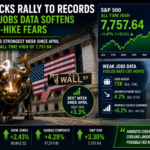
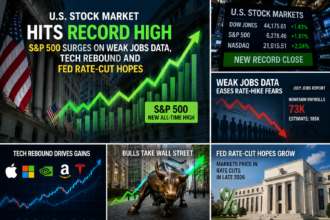
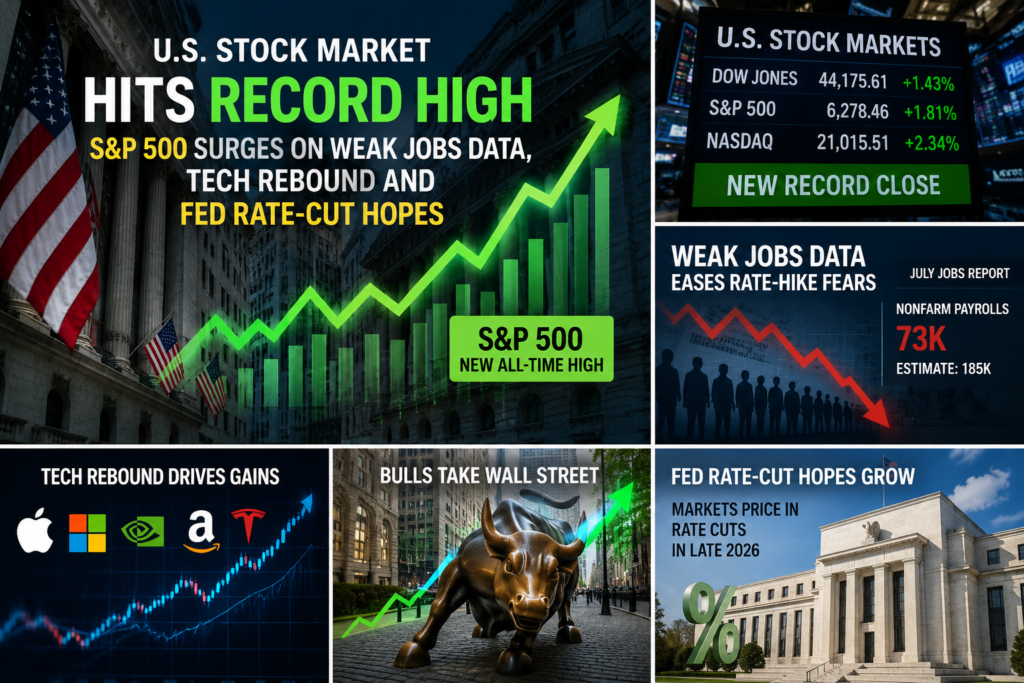
On Friday, the S&P 500 advanced 47.68 points, or 0.62%, to close at 7,757.64, surpassing its previous record set earlier in the week. The Dow Jones Industrial Average rose 151.83 points, or 0.28%, to 54,036.93. The tech-heavy Nasdaq Composite outperformed with a gain of 342.26 points, or 1.30%, finishing at 26,690.62. The Russell 2000 index of smaller companies climbed 1.1% to 3,034.49.
For the week, the S&P 500 gained approximately 3.58% to 3.6%, the Nasdaq surged about 5.19% to 5.2%, and the Dow advanced roughly 2.96% to 3%. These marked the strongest weekly performances for the three major indexes since mid-April. Year-to-date through Friday, the S&P 500 was up about 13.3%, the Dow approximately 12.4%, and the Nasdaq around 14.8%. The Russell 2000 showed even stronger gains in the mid-20% range in some measures earlier in the year, reflecting broader market participation beyond mega-cap names at various points in 2026.
The Catalyst: July Jobs Report Delivers a Surprise Contraction
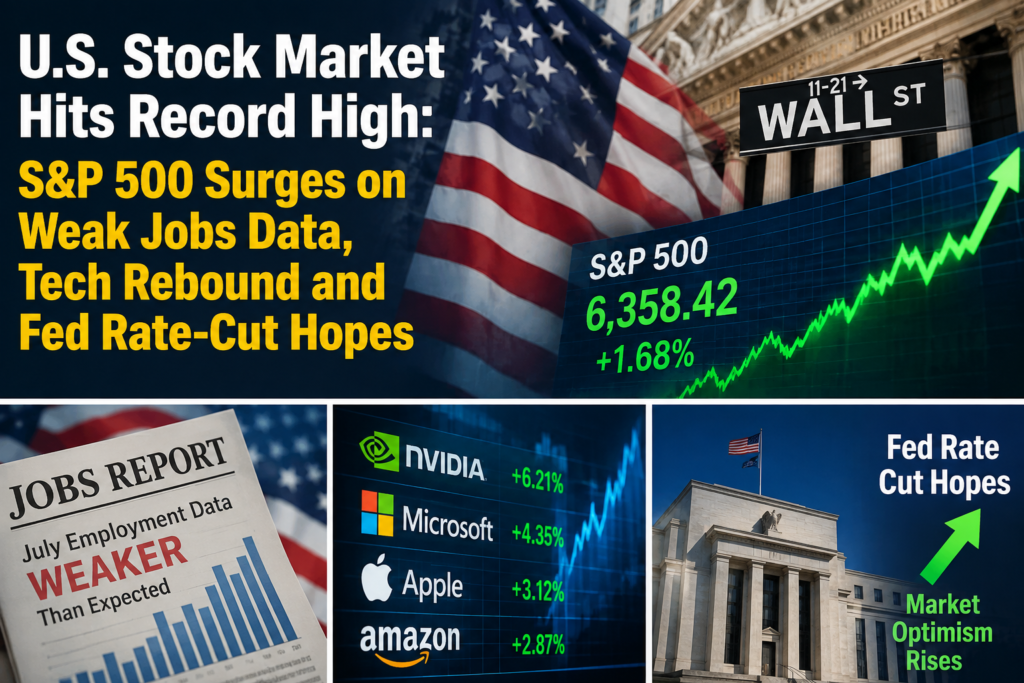
The primary driver of Friday’s advance and the week’s strong finish was the Bureau of Labour Statistics’ July employment report. Nonfarm payrolls unexpectedly declined by 23,000 jobs, far below economists’ consensus expectations of an increase of around 80,000 to 95,000. Prior months were revised lower by a combined 103,000 jobs, indicating the labour market had cooled more than previously understood.
The unemployment rate edged down to 4.1% from 4.2%, though this improvement stemmed largely from a drop in labour-force participation to 61.4%, its lowest level since early 2021, as workers left the workforce. Sectoral declines were notable in local government education, leisure and hospitality, and retail trade.
Market participants interpreted the soft payrolls data as reducing pressure on the Federal Reserve to raise interest rates at its September 16-17 meeting. According to the CME FedWatch tool, the probability of a 25-basis-point hike in September fell to approximately 44% from around 55% the previous day and as high as 67% a week earlier. Money markets continued to price in the possibility of tightening later in the year, but the near-term urgency diminished.
Treasury yields declined in response. The 10-year yield fell toward 4.64%, while shorter-dated yields also eased. Lower borrowing costs and higher present values of future corporate cash flows supported equities, particularly growth-oriented technology and software names.
Federal Reserve Under Kevin Warsh: A New Era of Limited Guidance
Kevin Warsh assumed the role of Federal Reserve Chair earlier in 2026, succeeding previous leadership. Under Warsh, the central bank has maintained the federal funds target range at 3.50% to 3.75% following a series of holds. The July FOMC meeting produced a notable 9-3 vote, with three regional presidents dissenting in favour of a rate increase—the most unified directional dissent in years. Warsh has emphasised a data-dependent approach, reduced forward guidance, and a focus on delivering price stability, while avoiding the detailed projections and communication styles of prior chairs.
Inflation remains a central concern, with oil price volatility linked to Middle East tensions contributing to upside risks. However, the soft labour data provided the Fed with more flexibility. Analysts noted that while a September hike remains possible depending on upcoming inflation readings (including July CPI due the following week), the urgency has lessened. Warsh’s tenure has been characterised by “watchful thinking” and a preference for letting markets respond more to economic data than to central bank signalling.
Corporate Earnings Provide Fundamental Support
The second-quarter earnings season has been robust and is nearing completion, with roughly 88% of S&P 500 companies having reported. Results have substantially exceeded expectations: approximately 86% of companies beat analyst estimates, with an average upside surprise near 29% in some tallies. Aggregate second-quarter earnings growth forecasts have been revised sharply higher, in some cases approaching or exceeding 40-48% year-over-year in certain analyses—more than double earlier estimates.
Energy companies posted strong growth supported by higher oil prices earlier in the period. Communications and consumer discretionary sectors also contributed positively. Technology and semiconductor names, after periods of volatility and concerns about an “AI bubble” or elevated capital expenditures, showed resilience. Software companies in particular delivered upbeat results and guidance that helped dispel fears of disruption from artificial intelligence spending patterns.
Notable individual movers on Friday and during the week included Atlassian, which surged more than 30-35% after strong quarterly results and robust growth projections. Airbnb rose sharply on a blowout quarter and raised revenue outlook. SpaceX (SPCX), which completed a record initial public offering in June 2026 at $135 per share (raising tens of billions and achieving a valuation in the trillions at peak), experienced significant volatility. After its first post-IPO earnings and the expiration of a major lockup tranche that more than doubled the tradable float (unlocking hundreds of millions of shares potentially worth around $100 billion), the stock initially sold off on concerns about heavy AI-related capital spending and supply overhang. However, it rebounded strongly later in the week, gaining over 15% on Friday in some reports as lockup fears proved less damaging than anticipated. Further unlocks are scheduled through December 2026, with Elon Musk’s significant holdings locked longer.
Chip stocks and related names recovered, with the semiconductor space contributing to the Nasdaq’s outperformance. Other software and cloud names also advanced on solid reports.
Sector Performance and Market Breadth
Technology led the weekly gains in many measures, with some reports showing the sector up more than 7% for the week. Materials and industrials also performed well on Friday and over the period. Energy faced pressure in some sessions amid fluctuating oil prices and mixed individual results. Communication services and certain defensive areas lagged at times.
Market breadth improved during the strong week, with small- and mid-cap indexes participating. Earlier in 2026, there had been notable rotations: small caps and value had periods of leadership, while the so-called Magnificent Seven mega-caps experienced relative underperformance at points even as broader technology advanced. Energy had strong year-to-date showings earlier, supported by geopolitical oil spikes. By early August, the narrative had shifted back toward growth and tech resilience alongside solid fundamentals.
Geopolitical and Macro Backdrop
Middle East developments, including tensions involving Iran and the Strait of Hormuz, have been a recurring source of volatility. Oil prices spiked earlier on escalations and ceasefire uncertainties under the Trump administration, contributing to inflation concerns and Treasury yield moves. By early August, signs of potential de-escalation or deal progress helped moderate some energy price pressure, supporting risk assets. However, oil remained sensitive, with Brent crude rising on some days.
The broader U.S. economy has shown resilience in consumption and business investment, particularly in technology and AI-related capex, even as the labour market cools and housing remains soft. Inflation has been sticky in some measures, keeping the Fed vigilant.
Historical Context and 2026 Trajectory
The U.S. equity market entered 2026 coming off strong prior years driven by AI enthusiasm, corporate profitability, and earlier monetary easing. The S&P 500 and Nasdaq achieved multiple records through the first half, with technology and semiconductors powering gains at various stages. Volatility increased mid-year amid Fed transition uncertainty, oil shocks, and rotation away from pure mega-cap growth at times. July saw mixed performance before the early August rebound.
By early August, the market had recovered to new highs on the S&P 500, supported by earnings and the dovish interpretation of labour data. Volatility indexes remained relatively contained compared to stress periods.
Investor Sentiment, Risks, and Outlook
Sentiment improved markedly into the weekend, with risk appetite returning to growth and cyclical areas. Bond market reactions reinforced the equity bid. Looking ahead, the focus shifts to July inflation data (CPI and PPI), retail sales, and remaining earnings reports, including from major technology and industrial names. The September FOMC meeting will be pivotal.
Key risks include a reacceleration in inflation (particularly if energy prices rise again), further labour market deterioration that signals broader economic weakness rather than a soft landing, geopolitical flare-ups, and ongoing supply dynamics in newly public high-profile names like SpaceX. Elevated valuations in parts of the technology sector, high capital spending on AI infrastructure, and potential policy shifts remain watch points. On the positive side, strong corporate balance sheets, ongoing productivity gains from technology, and the possibility of a prolonged Fed pause could support further equity advances.
Analysts have described the current environment as one where markets are climbing a “wall of worry,” with data dependency under the Warsh Fed creating both opportunities and uncertainty. Diversification across market caps, styles (growth and value), and sectors continues to be emphasised by many strategists.
Broader Implications for Investors and the Economy
The week’s developments underscore the sensitivity of U.S. equities to monetary policy expectations. A weaker labour market that does not trigger recession fears can be interpreted as “Goldilocks” for stocks—cooling enough to restrain rate hikes without collapsing demand. Corporate America’s ability to deliver robust earnings growth even amid higher-for-longer rate regimes earlier in the cycle has provided a fundamental floor.
For retail and institutional investors, the combination of record index levels, mixed sector leadership, and geopolitical noise highlights the importance of disciplined allocation rather than chasing short-term momentum. Fixed-income markets have also reacted, with yields providing some relief to rate-sensitive sectors such as real estate and utilities at times, though performance has varied.
Internationally, U.S. market strength influences global capital flows, currency markets (the dollar eased with lower rate-hike odds), and emerging-market assets. Commodity markets remain intertwined with equity performance via energy and materials.
Conclusion
As of the close on August 7, 2026, the U.S. stock market stands at elevated levels, with the S&P 500 at a record high and major indexes posting impressive weekly gains. The unexpected soft jobs report shifted the near-term rate outlook more favourably for equities, while strong earnings provided confirmation of underlying corporate health. Technology and growth names led the charge, supported by specific corporate catalysts including software beats and a resilient response from SpaceX shares post-lockup.
The path forward remains data-dependent. Upcoming inflation readings and Fed communications under Chair Warsh will be critical in determining whether the current momentum can be sustained or whether renewed tightening fears reemerge. For now, Wall Street has responded positively to signs of labour market cooling that ease the immediate threat of higher rates, capping a week that reminded investors of the market’s capacity for rapid recovery when policy headwinds recede.
[ This report reflects market conditions and available data as of the close of trading on Friday, August 7, 2026, and the subsequent weekend analysis. Markets remain subject to rapid change based on new economic releases, corporate announcements, and geopolitical developments. Investors should consult professional advisors and consider their individual circumstances when making decisions.]
=