

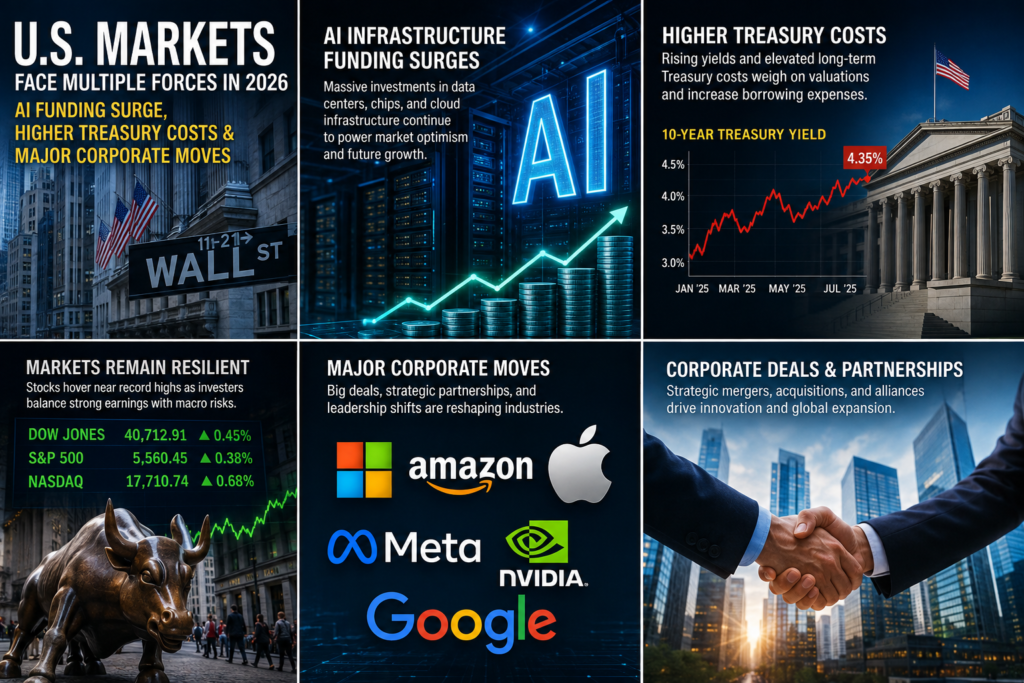
U.S. financial markets are operating at the intersection of transformative technological investment, persistent fiscal pressures, and shifting regulatory landscapes. In mid-August 2026, three interconnected developments have drawn particular attention: the scale of capital flowing into artificial intelligence infrastructure, the elevated cost of long-term U.S. government borrowing, and a pair of high-profile corporate and regulatory actions involving Nvidia’s equity positions and a conditional banking charter for a Trump family-linked crypto venture.
These elements are not isolated. The enormous capital requirements of AI data centres and related hardware are reshaping corporate balance sheets and investment strategies. At the same time, the U.S. Treasury’s need to finance large deficits at higher yields is influencing broader risk appetite and the cost of capital across the economy. Corporate disclosures and regulatory decisions are adding further layers of complexity and opportunity for investors.
Nvidia’s Expanding Equity Footprint: SpaceX and Intel Stakes
On August 14, 2026, Nvidia Corp. disclosed in a regulatory filing that it held approximately 122.8 million Class A shares of SpaceX as of June 30, valued at nearly $21 billion at the then-prevailing price. The same filing showed a stake of about 214.8 million shares in Intel Corp., valued at roughly $30 billion at quarter-end. These positions ranked as Nvidia’s two largest disclosed equity holdings.
The SpaceX stake originated from Nvidia’s participation in a large funding round for Elon Musk’s xAI. Reports indicate Nvidia invested as much as $10 billion in xAI as part of a $20 billion Series E completed in January 2026. Shortly afterwards, SpaceX acquired xAI in an all-stock transaction. Nvidia’s xAI shares converted into SpaceX Class A shares. SpaceX completed its initial public offering in June 2026, one of the largest on record, providing a public market valuation that allowed the position to be quantified in Nvidia’s 13F-style disclosures.
By mid-August, SpaceX shares had declined from their end-of-June levels near $171 to around $140, reducing the mark-to-market value of Nvidia’s holding to approximately $17 billion. Even after the decline, the position remained substantial and strategically significant. SpaceX has publicly committed to using Nvidia hardware exclusively for its AI data centres, citing the forthcoming Vera Rubin architecture as preferred. This creates a circular relationship in which Nvidia both supplies critical chips and holds a large equity interest in one of its major customers.
The Intel position tells a different story of rapid appreciation. Nvidia’s $5 billion investment, made in connection with a September 2025 strategic partnership to co-develop chips for PCs and data centres, had grown to roughly $30 billion by the end of June 2026. Subsequent market movements trimmed that value, but the gain still represented a multi-bagger return in under a year, reflecting Intel’s recovery in foundry and AI-related capabilities.
Taken together, the two stakes illustrate how Nvidia has moved beyond pure semiconductor sales into active strategic investing across the AI supply chain. The company has also participated in or facilitated larger financing structures. Reports in August 2026 indicated Nvidia was assembling a consortium of major asset managers—including Apollo, Blackstone, BlackRock, Brookfield, Goldman Sachs, and KKR—aimed at mobilising more than $500 billion to help finance customers’ AI infrastructure needs. This follows earlier discussions of potential large backstops, including talks related to OpenAI data-centre projects.
Market participants view these moves as both defensive and offensive. By taking equity stakes and helping arrange financing, Nvidia helps ensure demand for its GPUs while capturing upside in the broader ecosystem it enables. Critics note the potential for conflicts or concentrated risk if AI infrastructure spending slows or if key customers face financing difficulties. Supporters argue the approach is a rational response to the capital intensity of the current AI build-out.
Conditional Bank Charter for World Liberty Financial
On the same day as Nvidia’s disclosure, the Office of the Comptroller of the Currency (OCC) granted conditional preliminary approval for a national trust bank charter to World Liberty Trust Company, an entity linked to World Liberty Financial. World Liberty Financial is a cryptocurrency venture in which an entity affiliated with President Donald Trump and certain family members holds a substantial ownership stake, reported at around 38 per cent.
The charter, if finalised after the company meets additional pre-opening requirements, would allow World Liberty Trust to issue, redeem, and custody its USD1 stablecoin directly, as well as provide related digital-asset custody services. Currently, those functions are handled by a partner, BitGo. The stablecoin has grown to a market value in the range of $3–4 billion.
The application was filed in January 2026. The review process drew public comment, including concerns from Democratic lawmakers and others about potential conflicts of interest given the Trump family’s economic interest and the fact that the OCC is led by a Trump appointee. The OCC letter addressed these objections, along with issues related to foreign investment, stablecoin regulation, and other matters. World Liberty representatives have stated that the structure is designed to comply with applicable law, including the Genius Act governing stablecoins, and to avoid conflicts.
This approval fits a broader pattern under the current OCC of granting trust bank charters to crypto and digital-asset firms, including entities associated with Circle, Ripple, and others. Proponents argue that federal chartering brings greater oversight, transparency, and integration of stablecoins into the regulated banking system. Critics continue to highlight the appearance of preferential treatment and the risks of mixing presidential family business interests with federal regulatory decisions.
The decision has implications for the stablecoin market and for the broader intersection of crypto and traditional finance. A federally chartered trust bank focused on USD1 could expand institutional adoption while subjecting the issuer to ongoing OCC supervision. Market reaction has been measured, reflecting both the conditional nature of the approval and the already substantial size of the USD1 token.
The Scale of AI Infrastructure Capital Formation
Underlying both the Nvidia disclosures and broader market dynamics is an unprecedented wave of capital directed at AI infrastructure. Bank of America data cited in early August 2026 indicated that AI-related funding had already reached $344 billion year-to-date, surpassing the full-year 2025 total of $136 billion. U.S. hyperscale cloud providers accounted for a large share, followed by non-U.S. providers, data-centre projects, and financing tied to companies such as Nvidia and SpaceX.
Corporate capital expenditures tell a similar story. Consensus forecasts for hyperscaler spending in 2026 have been revised sharply higher, with estimates around $720 billion in some analyses. Major technology firms have tapped both equity and debt markets aggressively. Alphabet, Amazon, Meta, Microsoft, and Oracle have collectively raised hundreds of billions since early 2025 through bond offerings and equity transactions. Individual deals have included multi-tens-of-billions bond sales and large equity raises.
Private capital is also mobilising at scale. Nvidia’s reported $500 billion consortium effort is one example of asset managers treating AI infrastructure as a new asset class comparable to traditional infrastructure such as toll roads or renewable energy projects—assets expected to generate long-term contracted cash flows. Data-centre developers, power providers, and chipmakers are securing debt and equity packages measured in the tens of billions for individual campuses. Projects involving tens or even hundreds of gigawatts of eventual capacity are under discussion, though execution timelines stretch years into the future and depend on power availability, permitting, and supply-chain constraints.
Federal policy is reinforcing the private-sector push. The CHIPS and Science Act continues to channel incentives into semiconductor research and manufacturing. Recent letters of intent totalling hundreds of millions of dollars have targeted AI-related chip technologies, advanced packaging, and materials. The National Science Foundation and other agencies have announced programs to expand AI research infrastructure, data systems, and regional hubs, with private-sector partners including major chip companies signalling support. Broader initiatives under the Trump administration’s AI-related executive actions and action plans emphasise domestic capability, energy for compute, and exportable technology stacks.
The capital intensity creates both opportunity and risk. Successful deployment of large clusters can generate substantial returns for chip suppliers, cloud providers, and power developers. Overbuilding, delays in power infrastructure, or a slowdown in AI model demand could strand capital and pressure valuations. Financing structures that rely on long-term leases or offtake agreements transfer some risk to customers, but concentration among a handful of hyperscalers and model developers remains a concern for lenders and equity investors.
Elevated Long-Term Treasury Borrowing Costs
While private capital floods into AI, the U.S. government faces a markedly more expensive borrowing environment for long-duration debt. In mid-August 2026, the Treasury sold $25 billion of 30-year bonds at a yield of 5.216 per cent—the highest rate at auction for that maturity since 2001. The preceding day’s 10-year auction also cleared at the highest yield for that tenor since 2007.
These results reflect a broader rise in long-term yields. The 30-year yield has traded above 5 per cent for extended periods in 2026, driven by a combination of factors: large projected deficits, concerns about inflation persistence (including energy-price risks), expectations that the Federal Reserve will keep policy rates higher for longer, and heavy Treasury supply. Interest expense on the public debt has risen sharply; fiscal-year-to-date figures have shown double-digit percentage increases, and debt service now exceeds defence spending in some comparisons. The national debt has approached or exceeded $40 trillion, with the debt-to-GDP ratio above 121 per cent.
Primary dealers and the Treasury Borrowing Advisory Committee have noted that current coupon auction sizes appear adequate for the near term, but projections for later fiscal years imply the need for adjustments—either larger issuance or greater reliance on shorter-maturity bills. Market participants have speculated about a possible tilt toward shorter-duration issuance to reduce the average cost of new debt, though such a shift carries its own risks for rollover and liquidity management.
Higher long-term yields have tangible effects across the economy. Mortgage rates have climbed, with 30-year fixed averages rising toward multi-year highs. Corporate bond spreads and borrowing costs for capital-intensive projects, including data centres and energy infrastructure, face upward pressure even as equity markets remain focused on AI growth narratives. Equity valuations of growth companies can be sensitive to the discount rates implied by higher Treasury yields.
Investors have absorbed recent auctions with “decent” demand, according to market reports, yet the clearing yields send a clear signal: financing large fiscal deficits requires higher compensation. Analysts have described the results as a warning to policymakers that fiscal sustainability and term-premium risks are receiving greater attention from bond buyers.
Interconnections and Market Implications
The three themes—AI infrastructure capital, Treasury costs, and specific corporate/regulatory developments—interact in several ways. The same large asset managers participating in Nvidia’s financing consortium are also major holders of Treasuries and corporate credit. Higher government borrowing costs can raise the hurdle rate for private infrastructure projects. Conversely, successful AI-driven productivity gains could eventually support stronger growth and tax revenues, easing fiscal pressures over the longer term—though that outcome remains speculative and distant.
Nvidia’s dual role as chip supplier and strategic investor amplifies its systemic importance. A slowdown in AI spending would affect not only its semiconductor revenues but also the value of its large equity stakes and the success of customer financing vehicles it helps organise. SpaceX’s exclusive reliance on Nvidia hardware ties the rocket and satellite company’s AI ambitions tightly to the chipmaker’s technology roadmap and supply capacity.
On the regulatory side, the World Liberty charter decision occurs against a backdrop of broader crypto-friendly policy shifts. Expanded stablecoin activity under federal oversight could increase demand for short-term Treasuries or other high-quality liquid assets used as reserves, creating a modest incremental bid for government securities. At the same time, political controversy surrounding the approval may keep the issue in the public eye and subject future related actions to heightened scrutiny.
Equity markets have generally remained resilient, supported by continued earnings strength in technology and AI-related sectors. Fixed-income markets show greater caution at the long end. Volatility in both equities and rates has been elevated around key data releases, Fed communications, and major corporate announcements.
Risks and Forward-Looking Considerations
Several risks warrant monitoring. First, execution risk in AI infrastructure is high. Power availability, grid connections, skilled labour, and advanced packaging capacity all constrain the speed of deployment. Delays or cost overruns could impair project returns and financing structures.
Second, fiscal and monetary policy interactions remain uncertain. If inflation proves stickier than expected, or if energy prices spike again, the Federal Reserve may need to maintain restrictive policy longer, reinforcing high long-term yields. Persistent large deficits increase the stock of debt that must be rolled and serviced at whatever rates the market demands.
Third, concentration risk is elevated. A small number of companies dominate AI chip supply, cloud capacity, and frontier model development. Cross-ownership and financing interdependencies, as illustrated by Nvidia’s stakes and customer support, can amplify both upside and downside outcomes.
Fourth, regulatory and political risk surrounds both the crypto banking charter process and the broader industrial-policy approach to AI and semiconductors. Changes in administration priorities, congressional oversight, or international trade conditions could alter the trajectory of capital flows and competitive dynamics.
Looking ahead, market participants will watch several indicators: subsequent Treasury auction results and any adjustments to issuance strategy; further details on Nvidia’s financing consortium and customer offtake agreements; progress toward finalisation of the World Liberty trust charter; quarterly capital-expenditure guidance from hyperscalers; and macroeconomic data on inflation, growth, and labour markets that influence the Fed’s path.
The current environment is defined by an abundance of private capital for AI infrastructure alongside scarcity of cheap long-term government funding. Corporate strategies that combine operational leadership with balance-sheet creativity—exemplified by Nvidia’s equity and financing activities—are one response. Regulatory decisions that expand the perimeter of federally supervised digital-asset activity represent another. Whether these developments ultimately support durable growth or contribute to imbalances will depend on execution, macroeconomic outcomes, and the evolution of fiscal policy over the coming years.
In summary, U.S. financial markets in August 2026 are absorbing a historic surge in AI-related investment while contending with the highest long-term Treasury financing costs in a generation and navigating high-visibility corporate and regulatory events. The Nvidia, SpaceX and Intel disclosures highlight the deepening financial interconnections within the AI ecosystem. The conditional charter for World Liberty Trust marks a further step in the integration of stablecoins into the regulated banking system under the current administration. Together with the elevated cost of government borrowing, these developments underscore both the opportunities and the tensions present in today’s capital markets. Investors, policymakers, and corporate leaders will continue to calibrate strategies against this complex backdrop in the months ahead.