
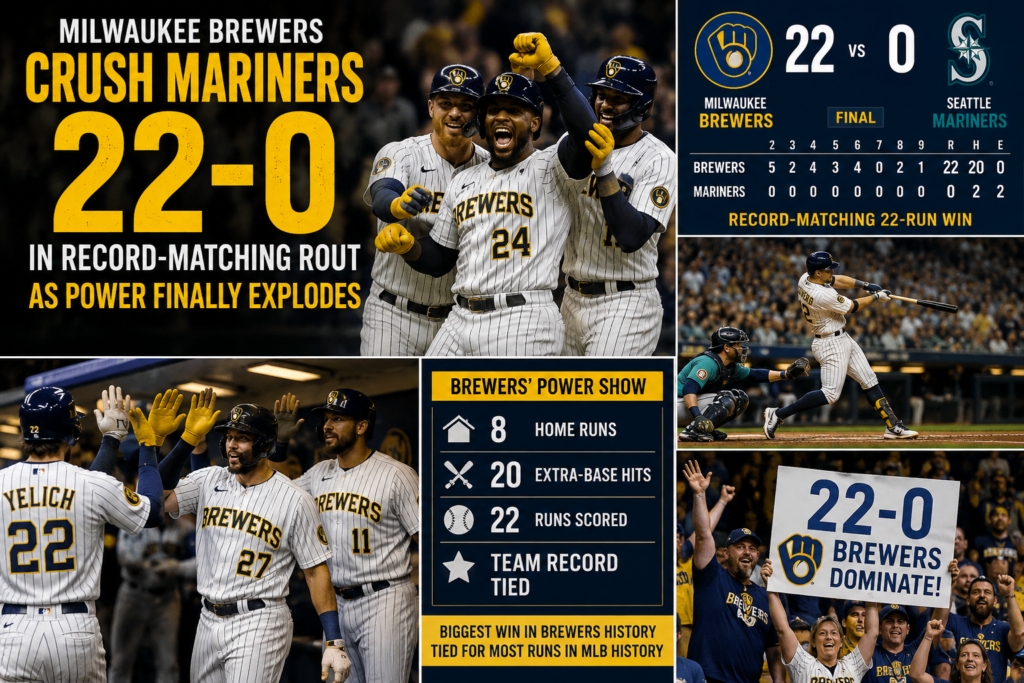
What began as a tense, weather-interrupted evening at American Family Field transformed into one of the most lopsided and historically significant games of the 2026 Major League Baseball season. The Brewers (78-48), owners of the best record in baseball and a commanding lead in the National League Central, exploded for 21 runs over their final four innings at the plate. They matched the modern-era (since 1901) record for the largest shutout margin, equaling the feats of the 1975 Pittsburgh Pirates and the 2004 Cleveland Indians. The victory also tied the franchise record for runs scored in a single game, a mark first set on Aug. 28, 1992, when the Brewers pounded the Toronto Blue Jays 22-2.
Four home runs powered the offensive onslaught. Christian Yelich, David Hamilton and Luis Lara each delivered three-run blasts, while Jake Bauers added a two-run shot. Lara’s homer was the first of his big-league career. The Brewers finished with a season-high 22 hits. Every player who stepped to the plate reached base at least once, and eight different Brewers scored multiple runs—a new franchise record. Only Brice Turang failed to record a hit among the 12 players who batted.
On the mound, Kyle Harrison delivered five sharp innings, allowing just two hits and two walks while striking out eight. He improved to 10-3. Shane Drohan followed with two scoreless frames, Grant Anderson worked the eighth, and catcher Gary Sánchez closed it out in the ninth, throwing a series of soft tosses under 40 mph while navigating two hits to complete the five-hitter.
For the Mariners (59-67), the night was an unmitigated disaster. The 22 runs allowed tied a franchise record for most runs surrendered in a game. Four pitchers, including position player Leo Rivas, were charged with the damage. Seattle’s run differential plunged from minus-23 entering the contest to minus-45, a figure that somehow still ranked among the better marks in a struggling American League West. The loss dropped the Mariners further in the AL West and wild-card races.
A Slow Start and a Bizarre First Run
The game opened under unusual circumstances. A tornado warning for Milwaukee County put everyone on edge during the early innings. The Brewers managed only four hits and a single run through the first four frames against Mariners starter Bryce Miller. That lone run, however, set an early tone of hustle and chaos that would later give way to pure power.
With two outs in the first, Bauers doubled to right field when Victor Robles slipped slightly while fielding the ball. William Contreras followed with a single to left. Randy Arozarena’s throw home appeared to have Bauers dead to rights. Bauers, sliding headfirst, slapped at Cal Raleigh’s mitt and dislodged the ball. His momentum carried him past the plate. After a moment of confusion—and a pointed gesture from Yelich—Bauers dove back and touched home just before Raleigh could apply the tag. The umpires confirmed the score, and Milwaukee led 1-0.
Miller settled in thereafter, keeping the Brewers in check until the fifth. Harrison, meanwhile, was dealing. The left-hander mixed fastballs and off-speed pitches effectively, recording eight strikeouts and allowing only a pair of hits. His efficiency stood in stark contrast to the offensive fireworks that followed.
The Fifth-Inning Explosion
The dam broke in the bottom of the fifth. Milwaukee strung together singles and walks to load the bases and put runners in scoring position. Jackson Chourio delivered an RBI single. Contreras added a sacrifice fly. With two outs, Yelich stepped in and crushed a three-run home run to right-center field—his ninth of the season—off Miller. The blast made the score 6-0 and ended Miller’s night. He departed after 4⅔ innings, charged with seven hits and five earned runs.
It was the Brewers’ biggest inning in weeks, matching a five-run fifth they had produced in a July win over the Angels. More importantly, it signaled that the power the club had largely lacked all season—Milwaukee entered the night with the fewest home runs in baseball at 117—was suddenly on display. Seattle manager Dan Wilson later noted that the Brewers possess multiple players capable of going deep, even if the team as a whole has not ranked among the league leaders in long balls.
Homers in the Sixth and More Runs in the Seventh
Any hope of a Mariners comeback evaporated in the sixth. Garrett Mitchell opened the frame with a single. Joey Ortiz walked. Hamilton then launched a three-run homer to right-center, his first since early June and his fourth of the season. The blast snapped a 42-game home-run drought and gave him a career-high four RBIs by night’s end. After Turang walked, Bauers followed with a two-run shot to right—his 22nd of the year—pushing the lead to 11-0 and chasing reliever Josh Simpson.
The seventh brought more of the same. Three singles among the first four batters plated another run, with Hamilton’s RBI single extending his productive night. Consecutive errors by the Mariners defense, including a dropped relay throw by Josh Naylor that spoiled a potential double play, allowed still more runs to score. The lead ballooned to 13-0 or higher depending on the exact accounting of the inning’s chaos.
The Eighth-Inning Meltdown
By the time the eighth arrived, the outcome was long decided. Seattle turned to Rivas, an infielder, in a classic mop-up appearance. What followed was pure baseball absurdity. Rivas was greeted by a parade of hits. Five consecutive singles set the table. Lara then crushed a three-run home run—the first of his Major League career—as part of a 3-for-6 evening that also included four RBIs. The onslaught continued. Nine runs scored in total on nine hits against Rivas, eight of them earned.
The low point for Seattle came on a Yelich sacrifice fly with the bases loaded. Center fielder Julio Rodríguez caught the ball for what he believed was the third out and casually tossed it into the stands as a souvenir. Trouble was, it was only the second out. The remaining runners were awarded home on the error, turning the sacrifice fly into a three-run play and pushing the Brewers past the 20-run mark. The final score reached 22-0 after the inning concluded.
Eight different Brewers scored multiple runs. Mitchell finished 4-for-6. Hamilton and Lara each collected three hits. Yelich and Lara drove in four runs apiece. The 22 hits matched the run total in perfect symmetry.
Closing It Out
Anderson handled the eighth without incident. In the ninth, Sánchez took the mound for the Brewers—a position-player pitching appearance that has become more common in blowouts. He worked around two hits, mixing in several pitches that barely reached 40 mph, and secured the final outs to complete the five-hit shutout. The Mariners managed only five hits and four walks all night while striking out 10 times.
Historical Context and Franchise Records
The 22-0 final score tied the modern-era record for largest shutout margin. Only the 1975 Pirates (against the Chicago Cubs) and the 2004 Indians (against the New York Yankees) had previously achieved the feat since 1901. Looking further back, the largest home shutout remains the 1885 New York Giants’ 24-0 victory over the Buffalo Bisons. The Philadelphia Quakers (now Phillies) also posted a 24-0 win in 1887.
For the Brewers, the 22 runs matched their single-game franchise record from 1992. The margin of victory—22 runs—set a new club mark, surpassing a previous 20-0 shutout of the Pirates in 2010. The night also featured the rare achievement of every batter reaching base and the franchise record for players scoring multiple runs in one contest.
For the Mariners, the 22 runs allowed tied their franchise high for runs surrendered. It marked the fourth time this month they had allowed 10 or more runs. The loss was their worst by margin in team history, eclipsing a previous 21-1 defeat.
Managerial and Player Perspectives
Brewers manager Pat Murphy kept the celebration measured. “It’s one game but a pretty darn good performance,” he said. “I’d like to order that every night.” The comments reflected both satisfaction with the offensive outburst and an understanding that such nights are rare, particularly for a club that has thrived more on contact, defense and pitching than pure power.
Hamilton’s breakout performance provided a personal highlight. After a lengthy drought, the multi-hit, multi-RBI night and the long ball offered a reminder of the depth available on the roster. Lara’s first career homer in a nine-run inning against a position player will likely remain a career footnote, but it still counted toward the historic total.
On the Seattle side, the evening compounded recent struggles. The Mariners entered the series after a weekend series win against Houston that had generated some positive momentum. That feeling evaporated quickly. Wilson’s bullpen management and Miller’s early struggles drew scrutiny, as did the defensive miscues and the mental lapse by Rodríguez. The club now sits four games behind the Astros in the AL West and three games out of the final wild-card spot, with a difficult remaining schedule that includes more games against Milwaukee, the Chicago Cubs and the Philadelphia Phillies before a road trip against the Boston Red Sox and Toronto Blue Jays.
Broader Implications for Both Clubs
The Brewers continue to look like the team to beat in the National League. At 30 games over .500 and 20 games over .500 at home, they have maintained consistency through a long season. Their pitching staff has been a strength all year, and nights like this demonstrate that the offense can overwhelm opponents when the bats awaken. The lack of home-run power has been a talking point throughout the campaign, yet the ability of multiple players to deliver extra-base hits in bunches remains a quiet asset. With 36 games remaining at the time of the contest, Milwaukee sits in prime position for a deep postseason run.
Seattle faces a steeper climb. Last year’s AL West champions have struggled to generate consistent offense and have been plagued by pitching inconsistency. The run differential paints a clear picture of a club that has been outscored significantly over the course of the year. The division itself has been underwhelming, with no team separating itself dramatically, yet the Mariners’ recent form has not inspired confidence. Allowing a position player to absorb nine runs in an eighth inning is the kind of night that can linger in a clubhouse and test resolve.
The Atmosphere at American Family Field
Attendance was announced at 36,870. Early tension from the tornado warning gave way to growing excitement as the runs piled up. By the later innings, the crowd treated the proceedings with a mix of amusement and appreciation for the historic nature of the blowout. Fans who stayed until the end witnessed the rare sight of a catcher finishing a shutout with intentionally soft pitching and a center fielder handing out souvenirs at the wrong moment.
The game itself lasted long enough for the record books to be consulted in real time. Broadcasters and statisticians scrambled to confirm the modern-era shutout mark, the franchise records and the various individual achievements. What began as a relatively quiet contest ended as one of the most memorable nights of the 2026 season.
Looking Ahead
The two teams were scheduled to continue their series the following night, with Milwaukee’s Dustin May facing Seattle’s Logan Gilbert. For the Brewers, the focus remains on maintaining their pace and preparing for the stretch run. For the Mariners, the priority is damage control—finding ways to stabilize the pitching staff, tighten the defense and generate enough offense to stay relevant in a crowded wild-card picture.
Tuesday’s 22-0 final will stand as an outlier for both clubs. For Milwaukee, it was a night when everything clicked and the power that had been largely dormant all season suddenly erupted. For Seattle, it was a night to forget as quickly as possible. In the long arc of a baseball season, one game rarely defines a team. Yet some games, by sheer magnitude and historical weight, demand to be remembered. This was one of them.
The Brewers put the long ball on full display, matched a modern-era record, tied a franchise mark and sent a message that their best is still capable of arriving in overwhelming fashion. The Mariners absorbed the worst loss in franchise history and left American Family Field searching for answers. In the end, the scoreboard told the simplest and most accurate story: 22-0.