Japanese investment giant SoftBank emerged as the strongest performer among Asia’s leading tech stocks, climbing over 12%..The gains were driven by a risk-on mood in global markets amid expectations that the Middle East conflict may soon end following a peace agreement between the U.S. and Iran.

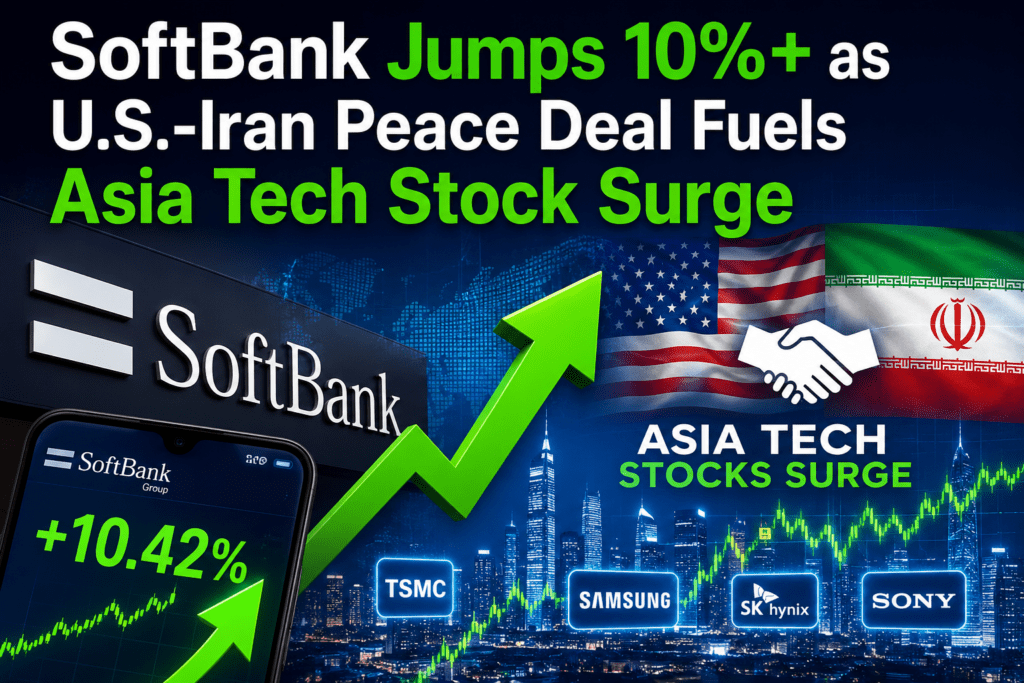
Asian Tech Stocks Surge as US-Iran Peace Deal Sparks Risk-On Rally Across Markets
Asian technology stocks surged on Monday, fueled by optimism over reports of a US-Iran agreement to end Middle East hostilities. The news sparked renewed investor confidence, especially in tech, as markets anticipated reduced geopolitical risk, steadier energy supplies, and a focus on long-term growth themes such as artificial intelligence (AI).
Leading the charge in Japan was SoftBank Group, which emerged as the top performer among major tech names in the region. The conglomerate, known for its aggressive investments in technology and visionary bets on the future of AI through its Vision Fund, closed the session up a robust 10%. This performance underscored SoftBank’s sensitivity to shifts in global risk appetite, given its broad exposure to international tech ecosystems. Close behind were semiconductor equipment giants Tokyo Electron and Advantest, which rose 7% and 7.67% respectively. These companies, critical players in the chip manufacturing supply chain, benefited from expectations of smoother global trade flows and sustained demand for advanced electronics.
In South Korea, memory chip powerhouses Samsung Electronics and SK Hynix also delivered solid gains on the Kospi Index. Samsung climbed 4.5%, while SK Hynix advanced 6.42%. Both firms have been standout performers in recent weeks. Last month, each company achieved a significant milestone by crossing the $1 trillion market capitalisation threshold, reflecting their dominant positions in the global semiconductor industry, particularly in DRAM and NAND flash memory technologies essential for AI servers, smartphones, and data centres. Their recent momentum highlights the market’s continued faith in the AI megatrend even amid periodic geopolitical turbulence.
Taiwan’s tech heavyweights followed suit. Taiwan Semiconductor Manufacturing Company (TSMC), the world’s largest contract chipmaker and a foundational pillar of the global semiconductor supply chain, rose 2.81%. Hon Hai Precision Industry, better known as Foxconn, the primary assembler for many of the world’s leading consumer electronics brands, including Apple, gained 2.69%. These more moderate increases still contributed to a broader sense of relief across Asian bourses, as Taiwan’s tech sector is deeply intertwined with global demand for high-performance computing.
The surge in these stocks did not occur in isolation. SoftBank, Samsung Electronics, and SK Hynix have all recorded substantial cumulative gains over recent weeks. SoftBank’s ascent has been particularly noteworthy, as it recently reclaimed its position as Japan’s most valuable company. This reflects renewed investor enthusiasm for its diversified portfolio, which spans everything from Arm Holdings to numerous AI and robotics startups. The semiconductor names, meanwhile, continue to ride the wave of explosive demand for AI infrastructure, with data centre expansions by major cloud providers driving orders for advanced chips.
Analysts attribute much of Monday’s positive momentum to a classic “risk-on” sentiment. Geopolitical uncertainties in the Middle East have long weighed on investor psychology, contributing to volatility in energy prices and supply chains. The prospect of a lasting resolution has alleviated those concerns, allowing capital to flow back into growth-oriented sectors. Lower potential disruptions to oil shipments and shipping routes translate into more predictable costs for manufacturers and consumers alike, indirectly supporting corporate earnings forecasts across the tech industry.
The breakthrough was publicly confirmed by Pakistan’s Prime Minister Shehbaz Sharif on Sunday. According to Sharif, both Iran and the United States have agreed to an accord that includes the immediate and permanent termination of all military operations across multiple fronts. Pakistan played a constructive mediating role in facilitating dialogue between the parties. The official signing ceremony is scheduled for Friday, June 19, in Switzerland, adding a formal diplomatic seal to the agreement.
President Donald Trump reinforced the news with a characteristically direct statement on his Truth Social platform. “The Deal with the Islamic Republic of Iran is now complete,” he wrote. The agreement includes reopening the Strait of Hormuz without a toll system and the lifting of the U.S. naval blockade of Iran. In a memorable flourish, Trump added, “Ships of the World, start your engines. Let the oil flow!” The Strait of Hormuz, a narrow chokepoint through which roughly one-fifth of global oil consumption passes daily, has been a perennial flashpoint. Free and unimpeded access is expected to ease pressure on global energy markets, potentially stabilising or even lowering oil prices in the coming weeks. This development is particularly significant for energy-intensive industries, including semiconductor fabrication, which requires substantial power and rare materials often transported via maritime routes.
The broader Asian markets mirrored the optimism in the tech sector. Major indices across the region posted gains as traders priced in reduced tail risks and the possibility of improved economic stability. This shift comes at a time when many investors have been carefully navigating a complex global landscape marked by trade tensions, inflationary pressures in certain economies, and the relentless pace of technological change.Ecaterina Bigos, Chief Investment Officer for Core Investments Asia ex-Japan at BNP Paribas Asset Management, offered insightful commentary on the dynamics at play. Speaking to CNBC’s “Squawk Box Asia” on Monday, she noted that while investors are actively rebalancing portfolios in response to the new geopolitical reality, they remain firmly committed to the AI opportunity. “Because again, not to forget that investors are trying to rebalance some parts of the portfolios, but they still want to stay in that race of AI,” Bigos explained. Her remarks capture the prevailing mood: the peace deal removes a major headwind, but it does not fundamentally alter the structural drivers propelling tech valuations higher. AI-related capital expenditure continues to accelerate, with hyperscale’s and enterprises alike racing to build out next-generation infrastructure. The implications of the US-Iran deal extend well beyond immediate stock price movements. For the technology sector, stable energy prices could help moderate production costs for chips and electronic components. Many fabrication plants (fabs) are highly energy-dependent, and any sustained reduction in oil and gas volatility would improve margin visibility. Moreover, smoother operations in international waters would reduce insurance and logistics costs for companies reliant on global supply chains spanning Asia, Europe, and the Middle East.From a macroeconomic perspective, the agreement could bolster global growth forecasts. Reduced uncertainty often encourages business investment and consumer spending. Emerging markets in Asia, many of which export heavily to the West, stand to benefit from a more predictable trade environment. South Korea and Taiwan, in particular, with their outsized roles in semiconductors, are poised to capitalise on any rebound in global electronics demand.
It is worth noting the broader context of recent market behaviour. Tech stocks have shown remarkable resilience throughout periods of geopolitical strain, largely because of the secular tailwinds provided by digital transformation, cloud computing, and generative AI. Companies like TSMC and Samsung are not merely participants in these trends—they are enablers. Their ability to produce cutting-edge nodes (such as 3nm and 2nm processes) underpins everything from autonomous vehicles to advanced data analytics. The peace deal effectively removes one layer of distraction, allowing investors to refocus on earnings potential and innovation pipelines.
SoftBank’s outsized performance also highlights the unique positioning of Japanese conglomerates in the global tech narrative. Under the leadership of Masayoshi Son, SoftBank has consistently positioned itself at the forefront of disruptive technologies. Its stakes in Arm, which designs the architecture powering the majority of smartphones and an increasing share of AI accelerators, give it leveraged exposure to industry growth. Monday’s 10% jump reflects the market’s appreciation for this strategic alignment.
Looking ahead, market participants will closely monitor developments following the June 19 signing ceremony. Diplomatic follow-through, compliance mechanisms, and regional reactions will determine whether the optimism proves durable. In the meantime, the initial market response suggests that investors are willing to embrace a more constructive outlook.The AI race remains the dominant theme. Despite periodic volatility, capital continues to pour into data centres, specialised chips, and software platforms capable of harnessing ever-larger models. South Korean memory makers SK Hynix and Samsung are critical to this buildout, supplying high-bandwidth memory (HBM) solutions that have become bottlenecks in training advanced AI systems. Their recent valuation milestones underscore the market’s willingness to assign premium multiples to companies at the heart of this transformation.
Taiwan’s TSMC and Foxconn similarly occupy indispensable roles. TSMC’s technological leadership ensures that cutting-edge designs from companies like NVIDIA, AMD, and Apple can be realised at scale. Foxconn’s manufacturing prowess supports the assembly of consumer devices that bring these technologies into everyday use. Monday’s gains, while more measured than those in Japan and South Korea, still reflect broad-based relief.
In summary, the surge in Asian tech stocks on Monday represents more than just a short-term reaction to positive headlines. It signals a market eager to move past geopolitical distractions and refocus on the transformative potential of technology. With the US-Iran deal paving the way for greater stability in energy markets and global trade routes, investors appear poised to reward companies best positioned to thrive in an environment of reduced uncertainty and accelerating innovation. As the week progresses and more details emerge from the Swiss signing ceremony, the coming sessions will test whether this initial enthusiasm can translate into sustained momentum. For now, the mood across Asian trading floors is decidedly upbeat, with technology once again at the forefront of the rally.
====
—