AI Ethics: Navigating the Moral Landscape of Artificial Intelligence in the 21st Century
Introduction
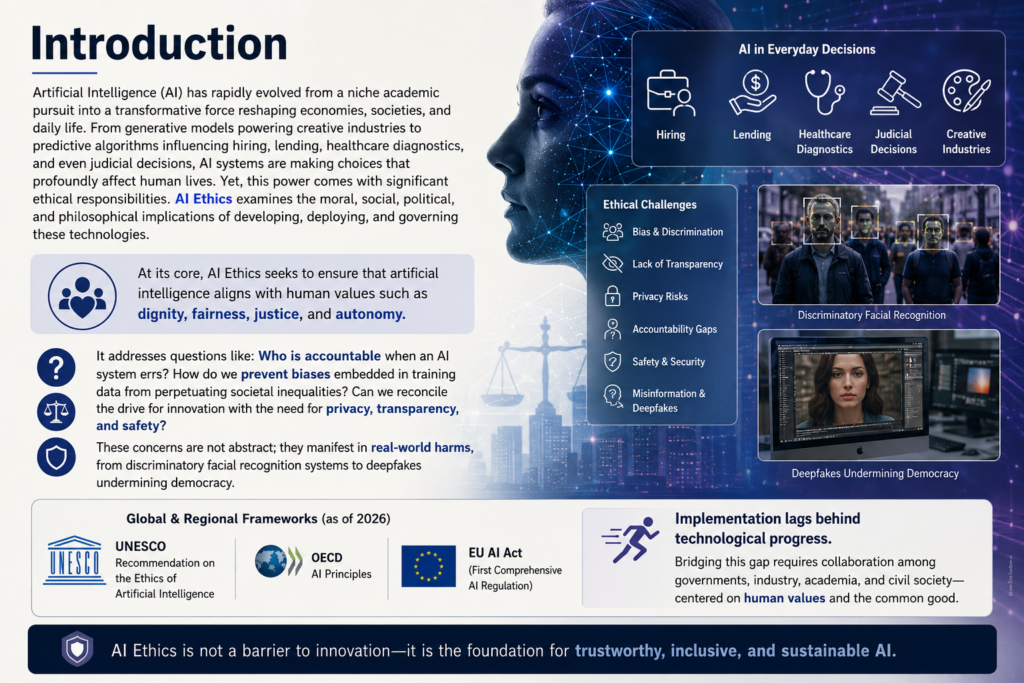
Artificial Intelligence (AI) has rapidly evolved from a niche academic pursuit into a transformative force reshaping economies, societies, and daily life. From generative models powering creative industries to predictive algorithms influencing hiring, lending, healthcare diagnostics, and even judicial decisions, AI systems are making choices that profoundly affect human lives. Yet, this power comes with significant ethical responsibilities. AI Ethics examines the moral, social, political, and philosophical implications of developing, deploying, and governing these technologies.
At its core, AI Ethics seeks to ensure that artificial intelligence aligns with human values such as dignity, fairness, justice, and autonomy. It addresses questions like: Who is accountable when an AI system errs? How do we prevent biases embedded in training data from perpetuating societal inequalities? Can we reconcile the drive for innovation with the need for privacy, transparency, and safety? These concerns are not abstract; they manifest in real-world harms, from discriminatory facial recognition systems to deepfakes undermining democracy.
The urgency of AI Ethics has intensified with the rise of large language models (LLMs), multimodal AI, and autonomous agents. As of 2026, frameworks like UNESCO’s Recommendation on the Ethics of Artificial Intelligence, the OECD AI Principles, and the EU AI Act provide global and regional guardrails, but implementation lags behind technological progress.
This article explores the foundations, key challenges, case studies, regulatory responses, and future directions of AI Ethics in approximately 2500 words. It draws on established principles and recent developments to argue that ethical AI is not a constraint on progress but a prerequisite for sustainable, trustworthy innovation.
Historical Context and Evolution of AI Ethics
The ethical discourse around intelligent machines predates modern computing. In the 1940s, Isaac Asimov introduced the “Three Laws of Robotics” in his science fiction, highlighting concerns about control and harm. Alan Turing’s work in the 1950s raised questions about machine intelligence and its societal role. However, systematic academic and policy attention emerged in the late 20th and early 21st centuries.
Early AI ethics focused on philosophical issues, such as whether machines could possess moral agency or consciousness. The 2010s marked a turning point with the proliferation of machine learning, big data, and deep learning. High-profile incidents, including biased recidivism prediction tools like COMPAS (which disproportionately flagged Black defendants as higher risk) and privacy scandals involving data-hungry AI systems, propelled the field forward.
By the mid-2010s, tech companies, governments, and academics began issuing principles. Google’s 2018 AI Principles, for instance, emphasised avoiding harmful applications. International bodies followed: the OECD adopted its AI Principles in 2019 (updated in 2024), promoting trustworthy AI that respects human rights. UNESCO’s 2021 Recommendation became the first global standard, grounded in human rights, proportionality, and sustainability.
The 2020s brought generative AI, amplifying concerns. Models like the GPT series demonstrated unprecedented capabilities but also risks of hallucination, bias amplification, and intellectual property theft. The EU AI Act, entering full force around 2026, classifies systems by risk levels—banning unacceptable ones like social scoring and imposing strict obligations on high-risk applications.
Today, AI Ethics has matured into a multidisciplinary field intersecting computer science, philosophy, law, sociology, and economics. It shifts from reactive harm mitigation to proactive design of ethical systems throughout the AI lifecycle: data collection, model training, deployment, and monitoring.
Core Principles of AI Ethics
Several overlapping frameworks define ethical AI. Common principles include:
Fairness and Non-Discrimination: AI should not perpetuate or exacerbate biases based on race, gender, age, or other protected characteristics. Fairness can be assessed at different stages—pre-processing (data), in-processing (model), or post-processing (outputs). Challenges arise because statistical parity (equal outcomes across groups) may conflict with individual fairness or predictive accuracy.
Transparency and Explainability: Users and affected parties should understand how AI decisions are made. “Black box” models like deep neural networks obscure reasoning, eroding trust. Techniques such as SHAP (Shapley Additive exPlanations) and LIME help, but trade-offs exist with performance. The EU AI Act mandates transparency for high-risk systems.
Privacy and Data Protection: AI thrives on data, raising surveillance and consent issues. Principles from GDPR influence global standards, emphasising data minimisation, purpose limitation, and user rights (e.g., right to be forgotten). Privacy-enhancing technologies (PETs) like federated learning and differential privacy offer solutions.
Accountability and Responsibility: Clear lines of responsibility are essential. This includes auditability, redress mechanisms, and human oversight. Who is liable—a developer, deployer, or user—when AI causes harm? Frameworks stress “human-in-the-loop” for critical decisions.
Safety, Security, and Robustness: AI must be reliable under adversarial conditions (e.g., resisting poisoning attacks) and safe (avoiding unintended harm). This extends to alignment—ensuring advanced AI pursues intended goals without side effects.
Beneficence and Sustainability: AI should promote human well-being, social good, and environmental sustainability. Training large models consumes enormous energy, contributing to climate change.
Proportionality and Do No Harm: Interventions should be necessary, effective, and minimal. UNESCO emphasises this human-rights-centred approach.
These principles are not exhaustive but form a foundation. Implementation requires technical tools, organisational governance, and cultural shifts.
Major Ethical Challenges
Bias and Fairness
Bias is one of the most documented issues. Training data often reflects historical prejudices. Facial recognition systems have shown higher error rates for darker-skinned individuals and women. Autonomous vehicles reportedly detect children and darker-skinned pedestrians less accurately. In hiring, LLMs can reproduce gender stereotypes from resumes.
Mitigation involves diverse datasets, bias audits, and fairness metrics. However, defining “fair” is context-dependent and value-laden—different cultures or stakeholders may disagree.
Privacy and Surveillance
AI-powered surveillance, from predictive policing to workplace monitoring, risks eroding civil liberties. The Cambridge Analytica scandal highlighted data misuse for manipulation. Generative AI exacerbates this through synthetic media. Privacy by design and robust regulations are critical, yet global enforcement varies.
Transparency and the Black Box Problem
Complex models defy easy explanation, complicating accountability in healthcare (e.g., diagnostic AI) or finance (credit scoring). Over-reliance on opaque systems can deskill professionals and reduce public trust. Explainable AI (XAI) research is advancing, but perfect transparency may be impossible for frontier models.
Accountability and Liability
When an autonomous vehicle crashes or a medical AI misdiagnoses, responsibility is diffuse. Developers may claim “it’s just a tool,” while users defer to the system. Legal frameworks are evolving, but gaps remain, especially for general-purpose AI.
Misinformation, Deepfakes, and Societal Harm
Generative AI enables convincing falsehoods, threatening elections and trust. Deepfakes of public figures or non-consensual intimate imagery raise consent and harm issues. Content moderation AI struggles with context and cultural nuance.
Economic and Labor Impacts
AI automation displaces jobs, particularly in routine cognitive and manual work, widening inequality. While it creates new roles, transitions demand reskilling. Ethical questions include the just distribution of gains and preventing exploitative “AI sweatshops.”
Autonomous Weapons and Existential Risks
Lethal Autonomous Weapons Systems (LAWS) raise “meaningful human control” concerns. Long-term, superintelligent AI poses alignment and control risks, though debates rage on immediacy.
Environmental and Global Equity
Training models emit carbon equivalent to multiple flights. Benefits often accrue to wealthy nations and corporations, exacerbating the Global South’s digital divide. Ethical AI demands inclusive development and green computing.
These challenges interconnect; addressing one often impacts others, requiring holistic approaches.
Case Studies
COMPAS Recidivism Algorithm: Used in U.S. courts, this tool was criticised for racial bias, falsely labelling Black defendants as higher risk. ProPublica’s investigation revealed disparities not fully explained by crime rates. It underscored the need for auditing and transparency in justice systems.
IBM Watson Health in Oncology: Early deployments faced criticism for opaque recommendations and potential biases in training data from U.S. populations, limiting generalizability. It highlighted challenges in high-stakes healthcare AI and the importance of diverse, high-quality data.
Facial Recognition in Policing: UK and U.S. cases showed disproportionate misidentification of minorities, leading to bans or moratoriums in some cities. These illustrate surveillance ethics and calls for regulation.
Generative AI and Deepfakes: Investigations into tools generating non-consensual content on platforms highlight platform responsibility and the limits of technical fixes without policy intervention.
Positive examples include companies implementing ethical frameworks for fraud detection or accessible services, balancing innovation with safeguards.
Regulatory Frameworks and Governance
Regulation has accelerated. The EU AI Act adopts a risk-based approach: unacceptable risks banned, high-risk systems heavily regulated (transparency, conformity assessments), limited and minimal risk with lighter rules. Full applicability nears in 2026.
The U.S. favors sector-specific and voluntary guidelines, with states leading (e.g., bias audits). China emphasizes state control and security. International efforts like UNESCO and G7 initiatives seek harmonization.
Corporate governance involves AI ethics boards, impact assessments, and red-teaming. Co-governance models propose stakeholder inclusion beyond governments and firms.
Challenges include regulatory fragmentation, enforcement capacity, and balancing innovation with safety.
Future Outlook
By 2026 and beyond, expect focus on agentic AI, multimodal systems, and sovereignty. Sustainability, autonomy, and operationalizing ethics will dominate. Advances in XAI, synthetic data, and decentralized governance could help. Global cooperation via WHO or expanded treaties is vital for healthcare and beyond.
The next five years offer a window to embed safeguards before risks solidify.
Conclusion
AI Ethics is not optional; it is foundational to harnessing AI for humanity’s benefit. By prioritizing principles like fairness, transparency, and accountability, fostering multidisciplinary collaboration, and implementing robust governance, we can steer toward equitable, safe, and beneficial outcomes. The responsibility lies with developers, policymakers, organizations, and citizens alike. As AI capabilities grow, so must our ethical maturity. The choices we make today will define whether AI becomes a tool for liberation or division.AI Ethics: Navigating the Moral Landscape of Artificial Intelligence in the 21st Century
Introduction
Artificial Intelligence (AI) has rapidly evolved from a niche academic pursuit into a transformative force reshaping economies, societies, and daily life. From generative models powering creative industries to predictive algorithms influencing hiring, lending, healthcare diagnostics, and even judicial decisions, AI systems are making choices that profoundly affect human lives. Yet, this power comes with significant ethical responsibilities. AI Ethics examines the moral, social, political, and philosophical implications of developing, deploying, and governing these technologies.
At its core, AI Ethics seeks to ensure that artificial intelligence aligns with human values such as dignity, fairness, justice, and autonomy. It addresses questions like: Who is accountable when an AI system errs? How do we prevent biases embedded in training data from perpetuating societal inequalities? Can we reconcile the drive for innovation with the need for privacy, transparency, and safety? These concerns are not abstract; they manifest in real-world harms, from discriminatory facial recognition systems to deepfakes undermining democracy.
The urgency of AI Ethics has intensified with the rise of large language models (LLMs), multimodal AI, and autonomous agents. As of 2026, frameworks like UNESCO’s Recommendation on the Ethics of Artificial Intelligence, the OECD AI Principles, and the EU AI Act provide global and regional guardrails, but implementation lags behind technological progress.
This article explores the foundations, key challenges, case studies, regulatory responses, and future directions of AI Ethics in approximately 2500 words. It draws on established principles and recent developments to argue that ethical AI is not a constraint on progress but a prerequisite for sustainable, trustworthy innovation.
Historical Context and Evolution of AI Ethics
The ethical discourse around intelligent machines predates modern computing. In the 1940s, Isaac Asimov introduced the “Three Laws of Robotics” in his science fiction, highlighting concerns about control and harm. Alan Turing’s work in the 1950s raised questions about machine intelligence and its societal role. However, systematic academic and policy attention emerged in the late 20th and early 21st centuries.
Early AI ethics focused on philosophical issues, such as whether machines could possess moral agency or consciousness. The 2010s marked a turning point with the proliferation of machine learning, big data, and deep learning. High-profile incidents, including biased recidivism prediction tools like COMPAS (which disproportionately flagged Black defendants as higher risk) and privacy scandals involving data-hungry AI systems, propelled the field forward.
By the mid-2010s, tech companies, governments, and academics began issuing principles. Google’s 2018 AI Principles, for instance, emphasised avoiding harmful applications. International bodies followed: the OECD adopted its AI Principles in 2019 (updated in 2024), promoting trustworthy AI that respects human rights. UNESCO’s 2021 Recommendation became the first global standard, grounded in human rights, proportionality, and sustainability.
The 2020s brought generative AI, amplifying concerns. Models like the GPT series demonstrated unprecedented capabilities but also risks of hallucination, bias amplification, and intellectual property theft. The EU AI Act, entering full force around 2026, classifies systems by risk levels—banning unacceptable ones like social scoring and imposing strict obligations on high-risk applications.
Today, AI Ethics has matured into a multidisciplinary field intersecting computer science, philosophy, law, sociology, and economics. It shifts from reactive harm mitigation to proactive design of ethical systems throughout the AI lifecycle: data collection, model training, deployment, and monitoring.
Core Principles of AI Ethics
Several overlapping frameworks define ethical AI. Common principles include:
Fairness and Non-Discrimination: AI should not perpetuate or exacerbate biases based on race, gender, age, or other protected characteristics. Fairness can be assessed at different stages—pre-processing (data), in-processing (model), or post-processing (outputs). Challenges arise because statistical parity (equal outcomes across groups) may conflict with individual fairness or predictive accuracy.
Transparency and Explainability: Users and affected parties should understand how AI decisions are made. “Black box” models like deep neural networks obscure reasoning, eroding trust. Techniques such as SHAP (Shapley Additive exPlanations) and LIME help, but trade-offs exist with performance. The EU AI Act mandates transparency for high-risk systems.
Privacy and Data Protection: AI thrives on data, raising surveillance and consent issues. Principles from GDPR influence global standards, emphasising data minimisation, purpose limitation, and user rights (e.g., right to be forgotten). Privacy-enhancing technologies (PETs) like federated learning and differential privacy offer solutions.
Accountability and Responsibility: Clear lines of responsibility are essential. This includes auditability, redress mechanisms, and human oversight. Who is liable—a developer, deployer, or user—when AI causes harm? Frameworks stress “human-in-the-loop” for critical decisions.
Safety, Security, and Robustness: AI must be reliable under adversarial conditions (e.g., resisting poisoning attacks) and safe (avoiding unintended harm). This extends to alignment—ensuring advanced AI pursues intended goals without side effects.
Beneficence and Sustainability: AI should promote human well-being, social good, and environmental sustainability. Training large models consumes enormous energy, contributing to climate change.
Proportionality and Do No Harm: Interventions should be necessary, effective, and minimal. UNESCO emphasises this human-rights-centred approach.
These principles are not exhaustive but form a foundation. Implementation requires technical tools, organisational governance, and cultural shifts.
Major Ethical Challenges
Bias and Fairness
Bias is one of the most documented issues. Training data often reflects historical prejudices. Facial recognition systems have shown higher error rates for darker-skinned individuals and women. Autonomous vehicles reportedly detect children and darker-skinned pedestrians less accurately. In hiring, LLMs can reproduce gender stereotypes from resumes.
Mitigation involves diverse datasets, bias audits, and fairness metrics. However, defining “fair” is context-dependent and value-laden—different cultures or stakeholders may disagree.
Privacy and Surveillance
AI-powered surveillance, from predictive policing to workplace monitoring, risks eroding civil liberties. The Cambridge Analytica scandal highlighted data misuse for manipulation. Generative AI exacerbates this through synthetic media. Privacy by design and robust regulations are critical, yet global enforcement varies.
Transparency and the Black Box Problem
Complex models defy easy explanation, complicating accountability in healthcare (e.g., diagnostic AI) or finance (credit scoring). Over-reliance on opaque systems can deskill professionals and reduce public trust. Explainable AI (XAI) research is advancing, but perfect transparency may be impossible for frontier models.
Accountability and Liability
When an autonomous vehicle crashes or a medical AI misdiagnoses, responsibility is diffuse. Developers may claim “it’s just a tool,” while users defer to the system. Legal frameworks are evolving, but gaps remain, especially for general-purpose AI.
Misinformation, Deepfakes, and Societal Harm
Generative AI enables convincing falsehoods, threatening elections and trust. Deepfakes of public figures or non-consensual intimate imagery raise consent and harm issues. Content moderation AI struggles with context and cultural nuance.
Economic and Labor Impacts
AI automation displaces jobs, particularly in routine cognitive and manual work, widening inequality. While it creates new roles, transitions demand reskilling. Ethical questions include the just distribution of gains and preventing exploitative “AI sweatshops.”
Autonomous Weapons and Existential Risks
Lethal Autonomous Weapons Systems (LAWS) raise “meaningful human control” concerns. Long-term, superintelligent AI poses alignment and control risks, though debates rage on immediacy.
Environmental and Global Equity
Training models emit carbon equivalent to multiple flights. Benefits often accrue to wealthy nations and corporations, exacerbating the Global South’s digital divide. Ethical AI demands inclusive development and green computing.
These challenges interconnect; addressing one often impacts others, requiring holistic approaches.
Case Studies
COMPAS Recidivism Algorithm: Used in U.S. courts, this tool was criticised for racial bias, falsely labelling Black defendants as higher risk. ProPublica’s investigation revealed disparities not fully explained by crime rates. It underscored the need for auditing and transparency in justice systems.
IBM Watson Health in Oncology: Early deployments faced criticism for opaque recommendations and potential biases in training data from U.S. populations, limiting generalizability. It highlighted challenges in high-stakes healthcare AI and the importance of diverse, high-quality data.
Facial Recognition in Policing: UK and U.S. cases showed disproportionate misidentification of minorities, leading to bans or moratoriums in some cities. These illustrate surveillance ethics and calls for regulation.
Generative AI and Deepfakes: Investigations into tools generating non-consensual content on platforms highlight platform responsibility and the limits of technical fixes without policy intervention.
Positive examples include companies implementing ethical frameworks for fraud detection or accessible services, balancing innovation with safeguards.
Regulatory Frameworks and Governance
Regulation has accelerated. The EU AI Act adopts a risk-based approach: unacceptable risks banned, high-risk systems heavily regulated (transparency, conformity assessments), limited and minimal risk with lighter rules. Full applicability nears in 2026.
The U.S. favors sector-specific and voluntary guidelines, with states leading (e.g., bias audits). China emphasizes state control and security. International efforts like UNESCO and G7 initiatives seek harmonization.
Corporate governance involves AI ethics boards, impact assessments, and red-teaming. Co-governance models propose stakeholder inclusion beyond governments and firms.
Challenges include regulatory fragmentation, enforcement capacity, and balancing innovation with safety.
Future Outlook
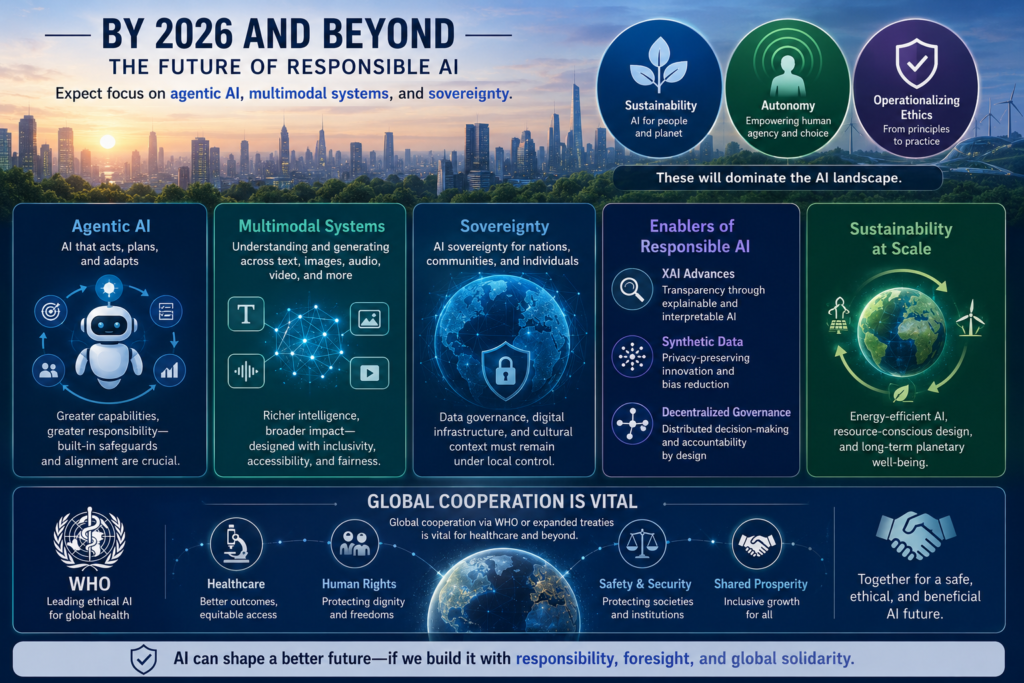
By 2026 and beyond, expect focus on agentic AI, multimodal systems, and sovereignty. Sustainability, autonomy, and operationalizing ethics will dominate. Advances in XAI, synthetic data, and decentralized governance could help. Global cooperation via WHO or expanded treaties is vital for healthcare and beyond.
The next five years offer a window to embed safeguards before risks solidify.
Conclusion
AI Ethics is not optional; it is foundational to harnessing AI for humanity’s benefit. By prioritizing principles like fairness, transparency, and accountability, fostering multidisciplinary collaboration, and implementing robust governance, we can steer toward equitable, safe, and beneficial outcomes. The responsibility lies with developers, policymakers, organizations, and citizens alike. As AI capabilities grow, so must our ethical maturity. The choices we make today will define whether AI becomes a tool for liberation or division.
===