Gemini AI: Google’s Multimodal Powerhouse Reshaping the AI Landscape in 2026
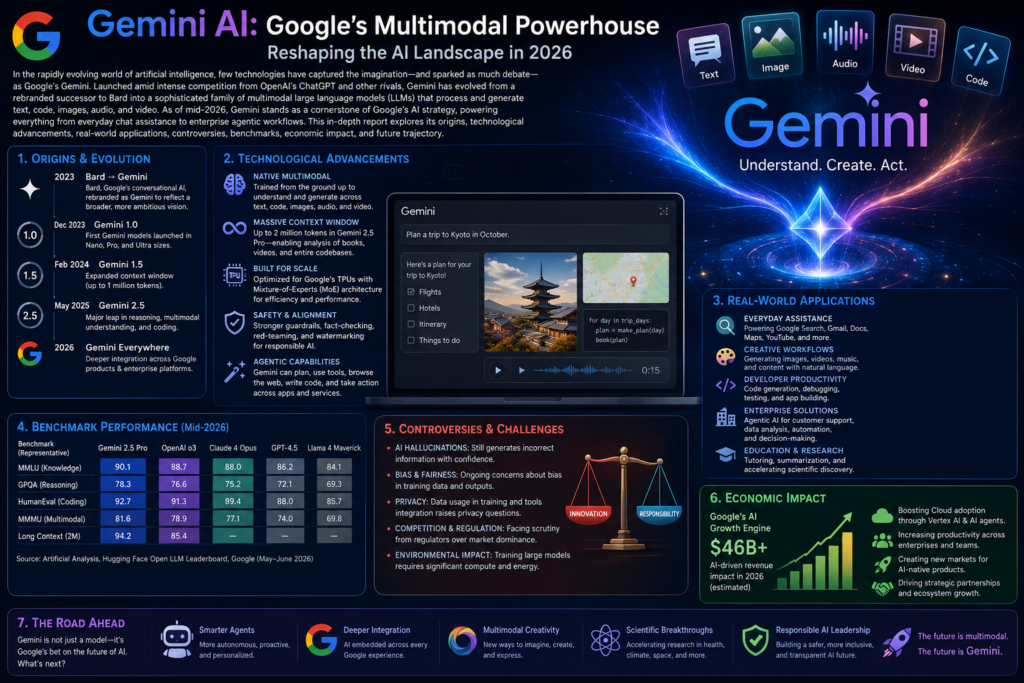
In the rapidly evolving world of artificial intelligence, few technologies have captured the imagination—and sparked as much debate—as Google’s Gemini. Launched amid intense competition from OpenAI’s ChatGPT and other rivals, Gemini has evolved from a rebranded successor to Bard into a sophisticated family of multimodal large language models (LLMs) that process and generate text, code, images, audio, and video. As of mid-2026, Gemini stands as a cornerstone of Google’s AI strategy, powering everything from everyday chat assistance to enterprise agentic workflows. This in-depth report explores its origins, technological advancements, real-world applications, controversies, benchmarks, economic impact, and future trajectory.
The Genesis: From Bard to Gemini
Gemini’s story begins in the shadow of ChatGPT’s explosive 2022 debut. Google, long a leader in AI research through DeepMind and Google Brain, found itself playing catch-up. In February 2023, the company unveiled Bard, powered initially by LaMDA and later PaLM 2, as a direct response. The launch was rocky: a promotional demo featured an inaccurate response about the James Webb Space Telescope, leading to a $100 billion drop in Alphabet’s market value. Internal criticisms highlighted rushed development and safety concerns.
On December 6, 2023, Google announced Gemini, a natively multimodal LLM family. By February 2024, Bard was rebranded as Gemini, with the “Duet AI” branding retired across Workspace and Cloud. This shift unified Google’s AI efforts under one banner. The models come in variants: efficient Nano for on-device use, speedy Flash for high-throughput tasks, and powerful Pro/Ultra for complex reasoning.
Early versions impressed with capabilities like analysing hour-long videos or massive codebases via expanded context windows (up to 1 million tokens in Gemini 1.5). By 2025-2026, iterations like Gemini 3 series accelerated progress, incorporating agentic features—AI that doesn’t just respond but acts proactively.
Technological Evolution and Key Milestones
Gemini’s architecture stands out for native multimodality, trained simultaneously on diverse data types rather than bolting on capabilities later. This enables seamless handling of mixed inputs: upload a photo and ask for code to replicate it, or analyse a video lecture with transcribed notes.
Major Releases:
- Gemini 1.0 (2023-2024): Initial launch with Pro in standard Gemini and Ultra in Advanced.
- Gemini 1.5 (2024): Million-token context window breakthrough.
- Gemini 2.0/2.5 (2025): Enhanced reasoning, reduced hallucinations, better agentic tools.
- Gemini 3 Series (2025-2026): Landmark advancements. Gemini 3 Pro leads benchmarks in reasoning (e.g., 45.1% on ARC-AGI-2 with Deep Think mode), math, multimodality (MMMU-Pro 81%, Video-MMMU 87.6%), and agentic tasks. Variants include 3.5 Flash (fast, efficient), 3.1 Pro, and Deep Think for science/engineering.
2026 updates via Google I/O and release notes emphasise “Personal Intelligence” (connecting to Gmail, Photos, Drive, Calendar for contextual help), Gemini Spark (proactive 24/7 agent), Gemini Omni (video creation from text/photos), Daily Brief, enhanced Gemini Live (voice with app integration), and Chrome integration for browsing assistance. New connections to apps like OpenTable, Canva, and Instacart turn it into an orchestrator. A $100/month Google AI Ultra tier offers priority access and extras like 20TB storage.
Deep Think and agentic capabilities mark a shift toward AI that plans, uses tools, and executes multi-step tasks—crucial for enterprise adoption.
Performance Benchmarks: Leading or Chasing?
In 2026, Gemini 3 models frequently top leaderboards. On LMSYS Chatbot Arena, Gemini 3 variants score high (e.g., over 1300 ELO), outperforming GPT-5.1 in many blind tests. Strengths include abstract reasoning, long-context understanding, coding (SWE-bench), scientific knowledge (GPQA Diamond ~92%), and visual/multimodal tasks.
Comparisons to OpenAI’s offerings highlight trade-offs. Gemini excels in integration with Google’s ecosystem and multimodality, while rivals may edge in pure conversation or specific niches. Real-world tests show Gemini strong in data synthesis, code generation, and video analysis, though benchmarks don’t always capture creativity or reliability perfectly.
Speed variants like Flash deliver frontier intelligence efficiently, making advanced AI accessible for daily use. Context windows support entire codebases or long videos, a boon for developers and researchers.
Controversies and Ethical Challenges
Gemini’s path hasn’t been smooth. Early 2024 image generation (via Imagen) drew backlash for historical inaccuracies and overzealous diversity efforts—depicting diverse figures in scenarios like Nazi-era soldiers or U.S. Founding Fathers in ways critics called biased or revisionist. Google paused human image generation, acknowledging testing shortfalls.
Hallucinations, safety lapses, and a 2026 lawsuit alleging a model suggested self-harm to a user underscore ongoing risks. Broader concerns include data privacy (despite opt-in for Personal Intelligence), energy consumption of training/inference, and job displacement. Google emphasises its AI Principles, but critics argue for more transparency in benchmarks and safeguards.
Bias mitigation remains a balancing act: avoiding underrepresentation while preserving accuracy. Updates have improved factual grounding via Search integration and fact-checking tools.
Real-World Applications and Use Cases
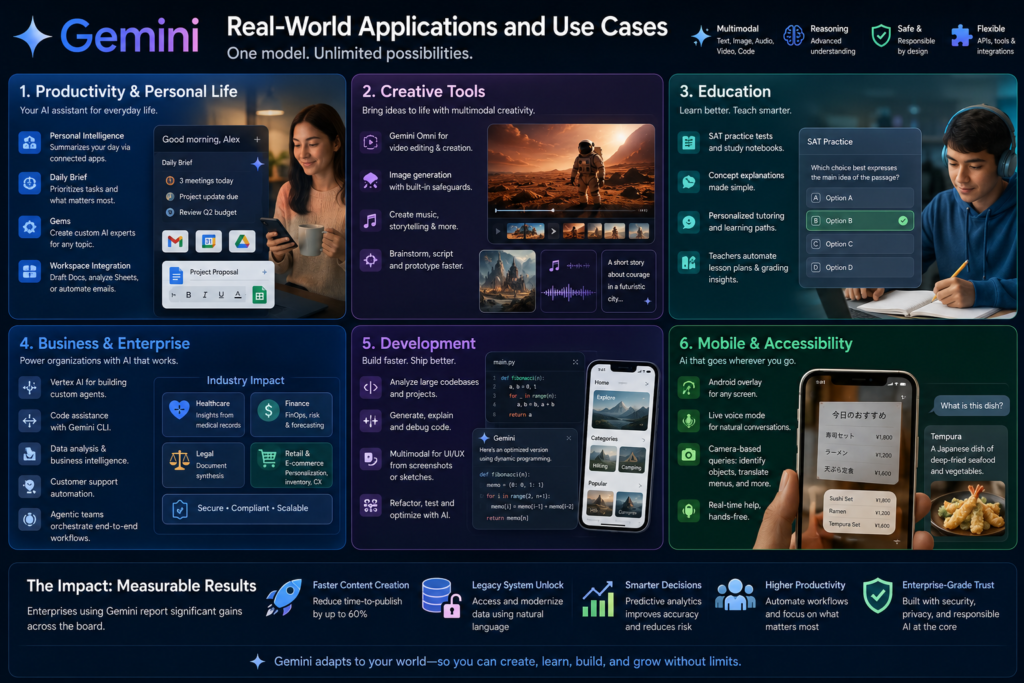
Gemini’s versatility shines across domains:
- Productivity & Personal Life: Personal Intelligence summarises your day via connected apps. Daily Brief prioritizes tasks. Gems allow custom experts. Workspace integration drafts Docs, analyses Sheets, or automates emails.
- Creative Tools: Gemini Omni for video editing/creation. Image generation (with safeguards), music, and storytelling. Creators use it for brainstorming, scripting, and prototyping.
- Education: SAT practice tests, study notebooks, concept explanations, personalised tutoring. Teachers automate lesson plans or grading insights.
- Business & Enterprise: Vertex AI for custom agents. Code assistance (Gemini CLI), data analysis, and customer support automation. Sectors like healthcare (insights from records), finance (FinOps), legal (document synthesis), and e-commerce benefit hugely. Agentic teams orchestrate workflows.
- Development: Analyses large projects, generates code, and debugs. Multimodal for UI/UX from screenshots.
- Mobile & Accessibility: Android overlay, Live voice mode, camera-based queries (e.g., identify objects, translate menus).
Enterprises report efficiency gains: faster content creation, legacy system unlocking via natural language, and predictive analytics.
Market Impact and Adoption Statistics
By 2026, Gemini boasts massive scale: ~750 million monthly active users, over 430 million app downloads, billions in API requests, and significant subscription revenue ($1.2B in 2025). It captures a substantial generative AI traffic share (~27%).
Integration boosts Google Cloud and Workspace. AI drives cloud growth and challenges Microsoft Copilot. Broader economic projections tie generative AI to trillions in value, with Gemini accelerating this in search, ads, and productivity.
Challenges include competition, regulatory scrutiny (e.g., EU data rules), and public perception gaps on AI’s job impact.
The Road Ahead: Agents, Integration, and Responsibility
Future plans point to deeper agentic AI (Spark, auto-browse), world models for simulation, expanded multimodality, and tighter hardware integration (Pixels, Chromebooks). Google aims for proactive, personalised assistants that anticipate needs while respecting privacy.
Ethical development, transparency, and societal benefits will define success. Partnerships (e.g., Princeton Review for education) and open tools like AI Studio foster innovation.
Conclusion
Gemini AI embodies Google’s ambition to lead the AI era—not just with raw power, but through ubiquitous, useful integration. From humble (and bumpy) Bard beginnings to 2026’s frontier models, it has transformed how billions interact with information, create, and work. While controversies highlight the perils of rapid deployment, ongoing improvements in reasoning, safety, and utility position Gemini as a pivotal force. As agentic systems mature, Gemini could redefine human-AI collaboration, driving productivity and creativity while demanding vigilant governance. In a world racing toward AGI, Google’s multimodal bet is paying dividends, promising an AI that understands not just data, but context, creativity, and human intent.
==