AI Robots: The Dawn of a New Mechanical Era – Revolutionising Humanity in 2026
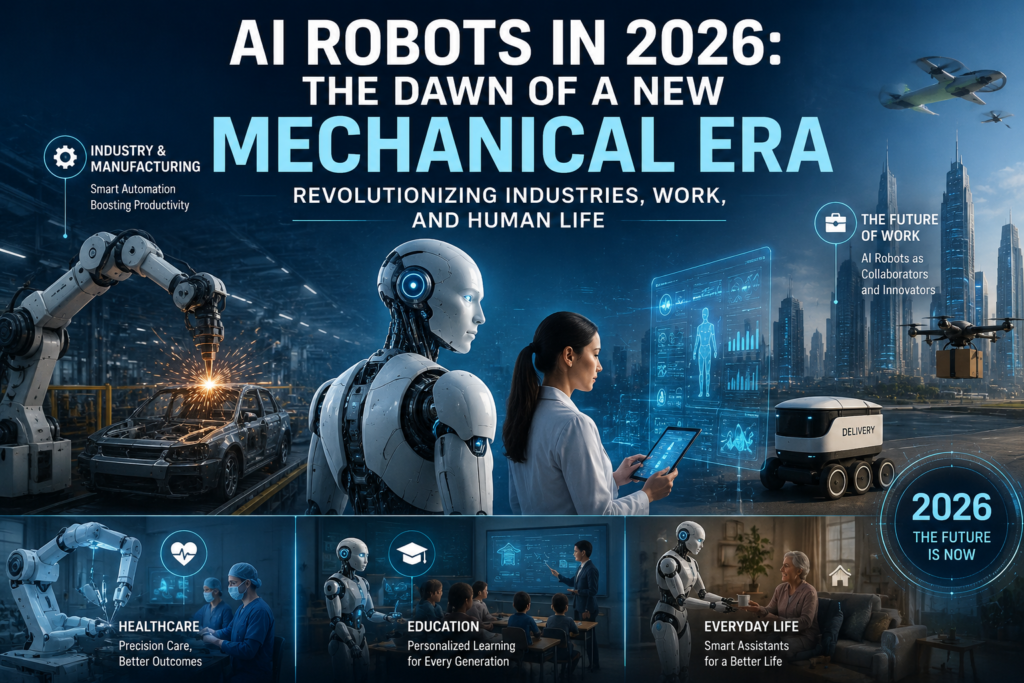
In the bustling factories of Shanghai and the research labs of Boston and Austin, a quiet revolution is unfolding. Humanoid robots, once the stuff of science fiction, are stepping into the real world with unprecedented dexterity, intelligence, and autonomy. As of mid-2026, AI-powered robots are no longer experimental curiosities but emerging workhorses poised to reshape industries, economies, and daily life. This detailed report examines the rapid evolution of AI robots, their groundbreaking capabilities, transformative applications, economic implications, ethical dilemmas, and the uncertain future they herald.
The Lead: Robots That Blur the Line Between Machine and Human
The year 2026 marks a pivotal inflexion point for robotics. China’s Moya humanoid, unveiled in late 2025, stunned observers with its soft, biomimetic design capable of shapeshifting, swimming, flying short distances, and even walking on water. Meanwhile, Boston Dynamics’ latest Atlas iteration demonstrated industrial feats like lifting heavy appliances with fluid grace, while Tesla’s Optimus Gen 3 promises mass deployment in factories. Companies like Figure AI, Unitree, Agility Robotics, and XPeng are flooding the market with prototypes that fold laundry, assemble products, and interact naturally with humans.
Global shipments of humanoid robots surged in 2025, with Chinese firms alone producing thousands of units compared to the hundreds from Western counterparts. Projections for 2026 indicate 10,000 to 20,000 units from leading players. The artificial intelligence in robotics market, valued at around $20-26 billion in 2025-2026, is forecasted to explode to $180 billion or more by 2033, growing at a CAGR exceeding 30% in many analyses.
This isn’t mere automation. Powered by advanced vision-language models, reinforcement learning, and edge AI, these robots perceive, reason, and adapt in ways that mimic human cognition. They represent the physical embodiment of generative AI, moving intelligence from screens into the tangible world. Yet, as excitement builds, so do profound questions about jobs, safety, ethics, and humanity’s role in an automated future.
A Brief History: From Industrial Arms to Sentient Companions
The journey of AI robots traces back to the mid-20th century. George Devol’s Unimate, the first industrial robot, joined General Motors’ assembly line in 1961, performing repetitive welding and handling tasks with precision but no intelligence. The 1970s and 1980s saw advancements in computer vision and early AI, but true integration lagged due to computational limits.
Boston Dynamics, founded in 1992 as a spin-off from MIT, pioneered dynamic locomotion with robots like BigDog and Atlas. Their hydraulic-powered machines amazed the world with parkour-like agility in videos, though they remained tethered to powerful computers and human operators for complex tasks.
The AI boom of the 2010s, fueled by deep learning breakthroughs from companies like DeepMind and OpenAI, provided the missing piece. By the early 2020s, Tesla’s announcement of Optimus in 2021—envisioned as a general-purpose humanoid for “unsafe, repetitive, or boring” tasks—galvanised the industry. Competitors like Figure AI, backed by OpenAI and others, entered the fray, focusing on AGI-level reasoning for physical tasks.
China’s aggressive push, supported by state initiatives, accelerated progress. By 2025, events like the Humanoid Robot Games and massive expos showcased thousands of bots. Soft robotics, inspired by biology, emerged as a key trend, allowing machines to interact safely with delicate objects and humans.
Today’s AI robots integrate multimodal AI—combining vision, language, touch, and proprioception. NVIDIA’s physical AI frameworks and similar technologies enable robots to learn from demonstration or simulation, transferring skills rapidly. What took years of programming now happens in hours through end-to-end neural networks.
Cutting-Edge Players and Breakthroughs in 2026
The competitive landscape is fierce, with a handful of leaders defining the field.
Tesla Optimus: Elon Musk’s vision for Optimus emphasises scalability and affordability. Gen 3 models reportedly use pure vision-based learning, reducing reliance on explicit programming. Demonstrations show bots performing household chores, factory assembly, and even basic social interactions. Tesla aims for high-volume production, with ambitious plans for millions eventually. Challenges persist, including delays in full autonomy and competition from more agile rivals.
Boston Dynamics Atlas: The new electric Atlas prioritises strength and versatility for industrial use. Recent videos depict it handling heavy loads, navigating complex environments, and collaborating with humans. Deployments at Hyundai facilities signal real-world integration, with plans for tens of thousands of units. Atlas excels in dynamic balance and power, setting a high bar for dexterity.
Figure AI and Others: Figure’s robots, leveraging advanced models like Helix, demonstrate impressive manipulation—folding clothes with human-like care. Agility Robotics focuses on logistics, while startups like Apptronik and 1X push boundaries in healthcare and companionship.
Chinese Innovation: Firms like Unitree, Agibot, and Gento produce affordable, capable humanoids at scale. Soft robots from Shanghai and all-terrain designs dominate expos. South Korea’s Tesollo and others add regional diversity. NVIDIA’s contributions in simulation and training accelerate global progress.
Key technological leaps include:
- Dexterity and Hands: Advanced grippers and tactile sensors enable fine motor skills, such as twisting balloon animals or handling fragile items.
- Learning and Adaptation: Robots now use foundation models for zero-shot learning, generalising from videos or minimal data.
- Embodied AI: Integration of large language models with physical control systems allows natural conversation and task planning.
- Energy and Durability: Improved batteries support longer shifts; soft materials enhance safety and versatility.
These advancements stem from massive compute investments, better sensors (LiDAR, cameras, haptics), and simulation-to-reality transfer.
Real-World Applications: From Factories to Frontlines
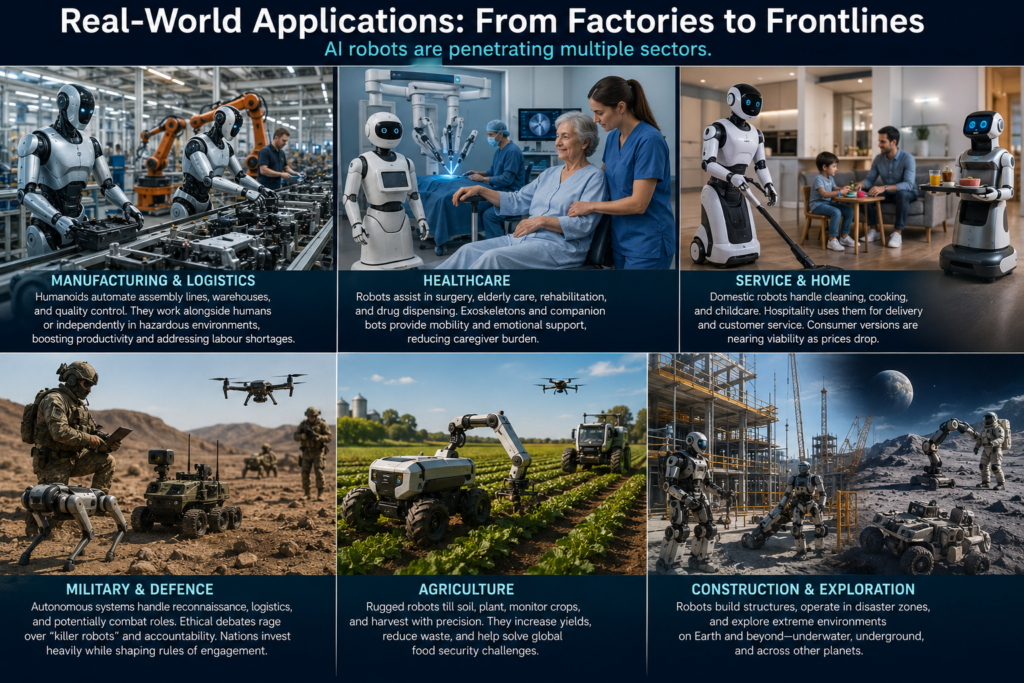
AI robots are penetrating multiple sectors.
Manufacturing and Logistics: Humanoids automate assembly lines, warehouses, and quality control. They work alongside humans (cobots) or independently in hazardous environments, boosting productivity and addressing labour shortages. Tesla and Hyundai deployments are early examples.
Healthcare: Robots assist in surgery, elderly care, rehabilitation, and drug dispensing. Exoskeletons and companion bots like Aletta provide mobility and emotional support. During pandemics or in ageing societies, they reduce caregiver burden.
Service and Home: Domestic robots handle cleaning, cooking, and childcare. Hospitality uses them for delivery and customer service. Consumer versions are nearing viability as prices drop.
Military and Defence: Autonomous systems handle reconnaissance, logistics, and potentially combat roles. Ethical debates rage over “killer robots” and accountability. The U.S. and others invest heavily while grappling with rules of engagement.
Agriculture, Construction, and Exploration: Rugged bots till fields, build structures, or explore disaster zones and other planets.
Economic Boom: Markets, Jobs, and Disruption
The AI robotics market is on a steep trajectory. Estimates vary, but consensus points to explosive growth: from roughly $20 billion in 2025-26 to over $100-180 billion by the early 2030s. Drivers include Industry 4.0, labour shortages, and falling costs (some units projected under $10,000-$30,000).
Economically, robots promise higher output, lower error rates, and 24/7 operation. However, job displacement looms large. Goldman Sachs and McKinsey projections from prior years suggested hundreds of millions of roles at risk globally, particularly in routine manual and administrative work. New jobs in robot maintenance, programming, and oversight will emerge, but transitions will be painful for many workers.
Small and medium businesses gain access as costs decline, democratizing automation. Supply chains become more resilient. Yet, inequality risks widen if benefits accrue mainly to tech giants and capital owners.
Ethical Quandaries and Societal Shifts
The rise of AI robots raises thorny issues. Job loss isn’t just economic—it erodes purpose, dignity, and community. Retraining programs, universal basic income pilots, and “robot taxes” are debated solutions.
Safety and liability: Who is responsible when a robot errs? Current frameworks struggle with autonomous decision-making. Bias in AI training data could perpetuate inequalities in hiring, policing, or care.
Military use amplifies concerns: Lethal autonomous weapons systems (LAWS) lower barriers to conflict, raise accountability questions (can a machine commit war crimes?), and spark arms races. International treaties lag behind technology.
Privacy, consent, and robot rights emerge as bots become more human-like. Emotional attachment to companions could blur boundaries. Existential risks—misaligned superintelligent systems in physical form—prompt calls for rigorous governance, though optimism about human-AI symbiosis prevails among developers.
Environmental impact is mixed: Robots optimise resource use but require rare materials and energy for production and operation.
Looking Ahead: Utopia, Dystopia, or Something In Between?
By 2030-2035, billions in economic value and millions of robots could populate factories, homes, and cities. Humanoids may achieve near-human versatility, accelerating scientific discovery, space exploration, and personalised medicine. Robotaxis and autonomous everything could redefine mobility.
Challenges remain: Technical hurdles in generalisation, energy efficiency, and cost; regulatory lags; public trust. Geopolitical competition, especially U.S.-China, will shape standards and access.
Optimists envision a world of abundance, where humans pursue creativity freed from drudgery. Pessimists warn of mass unemployment, surveillance states, or loss of agency. The truth likely lies in proactive policy, ethical design, and inclusive innovation.
Conclusion: Embracing the Future Responsibly
AI robots in 2026 are more than machines—they are mirrors reflecting our ingenuity, ambitions, and flaws. As they grow more capable, society must guide their integration thoughtfully. Investment in education, ethical frameworks, and equitable distribution will determine whether this technological wave lifts all boats or widens divides.
The robots are here. The question is not if they will transform our world, but how we choose to shape that transformation. Humanity’s next chapter will be written not just in code and circuits, but in the values we embed in our creations.
==