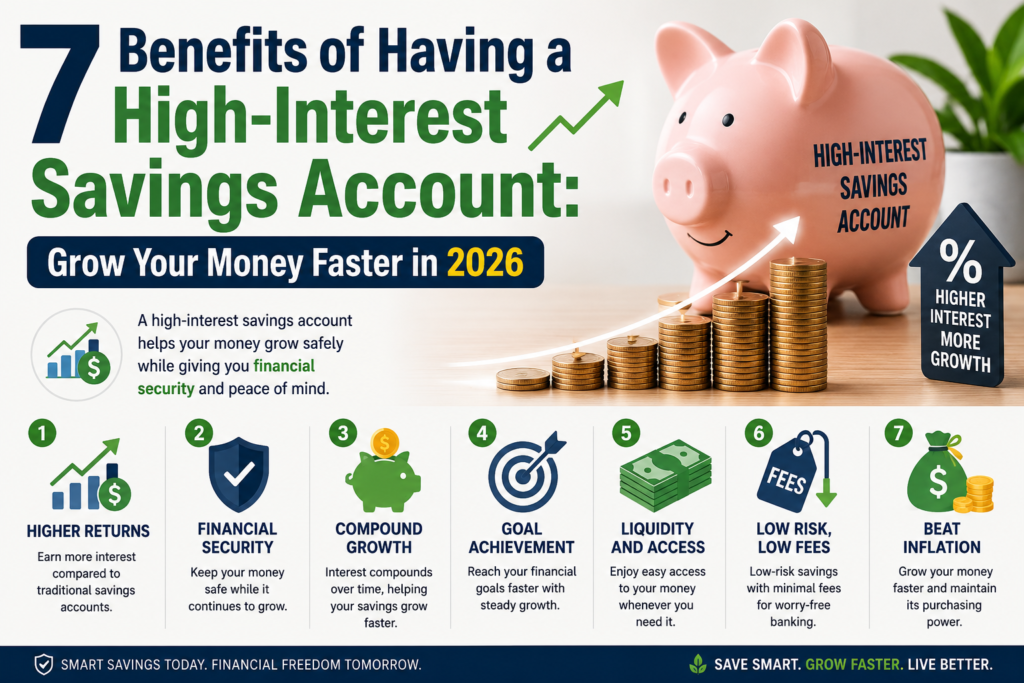
7 Benefits of Having a High-Interest Savings Account
A savings account is often the first step toward building financial discipline and managing everyday banking needs. Some traditional savings accounts focus on liquidity and secure fund storage, while others offer higher interest rates that can help account holders earn more on their deposits. As individuals seek efficient ways to grow their money while maintaining easy access to funds, a high-interest savings account has become an attractive option.
Understanding the benefits of a high-interest savings account can help individuals make informed decisions about their short-term and long-term financial goals.
What is a High-Interest Savings Account?
A high-interest savings account, also known as a high-yield savings account (HYSA), is a type of savings account that offers a comparatively higher interest rate on the account balance, subject to the bank’s terms and conditions.
In addition to earning interest, these accounts generally provide standard banking features such as:
- Fund transfers
- ATM access (often through networks)
- Online banking services
- Mobile banking facilities
- Bill payment capabilities
The combination of liquidity and interest earnings makes such accounts suitable for managing both daily transactions and emergency funds. Unlike certificates of deposit (CDs), which lock funds for a fixed term, or riskier investments like stocks, high-yield savings accounts strike a balance between growth and accessibility.
As of mid-2026, the national average savings account rate hovers around 0.38% to 0.61% APY, according to FDIC data. In contrast, top high-yield accounts offer rates between 3.5% and 5.00% APY, sometimes with tiered structures. For example, Varo Bank has advertised rates up to 5.00% on qualifying balances, while others like Pibank and Climate First Bank hover around 4.0-4.4%.
These accounts are typically offered by online banks, which have lower overhead costs than traditional brick-and-mortar institutions, allowing them to pass savings to customers through higher yields and fewer fees.
Now, let’s dive into the seven key benefits that make high-interest savings accounts a smart choice for many savers in today’s economic environment.
1. Significantly Higher Returns on Your Savings
The most obvious and compelling benefit is the potential for substantially higher interest earnings. Traditional savings accounts often yield pennies on the dollar, while high-yield accounts can multiply that return dramatically—often 10 to 15 times higher.
Consider a practical example: Suppose you have $10,000 saved. In a traditional account at 0.40% APY, you’d earn roughly $40 in interest over a year. Move that to a high-yield account at 4.5% APY, and your earnings jump to about $450—a difference of over $400 with no additional effort. Over five years, with compound interest, the gap widens even further.
This higher return is particularly valuable in an era of economic uncertainty. Online banks and fintechs compete aggressively, driving rates up. Many accounts compound interest daily or monthly, accelerating growth compared to quarterly compounding in older accounts.
For retirees or those nearing retirement, this can supplement income without touching principal. Young professionals building wealth can use it to bootstrap larger investments. The math is straightforward: even modest rate differences compound powerfully over time.
2. Liquidity and Easy Access to Funds
High-interest savings accounts excel in providing liquidity—your money remains readily available without the penalties associated with CDs or other locked products.
You can typically transfer funds to a linked checking account within one to two business days, often instantly via apps from providers like Ally or SoFi. Many offer ATM debit cards or reimbursement for out-of-network fees, and mobile apps allow seamless bill pay, transfers, and deposits.
This flexibility makes HYSAs ideal for emergency funds. Financial experts recommend keeping three to six months of living expenses accessible. With a high-yield account, that safety net not only sits idle but actively grows. Unlike stocks, which can plummet during market downturns, or bonds with interest rate risk, your principal is protected while earning competitive yields.
Real-life scenario: During unexpected events such as medical bills or job loss, quick access to funds prevents high-interest credit card debt. Users report peace of mind knowing funds are both safe and productive.
3. Safety and Security Through FDIC Insurance
Safety remains paramount. High-yield savings accounts from FDIC-insured institutions (or NCUA for credit unions) protect deposits up to $250,000 per depositor, per insured bank.
This government-backed insurance provides virtually risk-free storage, unlike volatile investments. Your money isn’t exposed to stock market swings or company bankruptcies (beyond the insured limit). Even during economic turbulence, such as inflation spikes or recessions, the principal remains intact.
Many high-yield providers are reputable online banks or arms of established institutions like Goldman Sachs (Marcus) or American Express. This security, paired with higher yields, makes them superior to keeping large sums in low-yield checking accounts or under the mattress.
4. The Power of Compound Interest
Compound interest is often called the “eighth wonder of the world,” and high-yield accounts supercharge it. Because rates are higher and many compound daily, earnings generate further earnings rapidly.
Let’s illustrate with numbers. At 4.5% APY compounded daily on $5,000:
- After 1 year: ~$5,229
- After 5 years: ~$6,250+
- After 10 years: ~$7,800+
Compare that to a 0.4% traditional account, which barely moves the needle. Automating transfers from paychecks turns this into a passive wealth-building machine. Tools in apps from Ally or Capital One allow goal-setting with visual trackers, reinforcing positive habits.
5. Protection Against Inflation
Inflation erodes purchasing power. When it runs at 2-3% or higher, low-yield accounts lose real value. High-yield savings accounts help counteract this by offering rates that often outpace inflation.
In 2026, with rates around 4%, savers preserve and grow real wealth better than in traditional accounts yielding under 1%. This is crucial for emergency funds or short-term goals like vacations, down payments, or weddings, where you can’t afford market risk.
By parking cash in a HYSA, you maintain liquidity while fighting the silent thief of inflation. Experts note this is especially beneficial during transitional economic periods when rates fluctuate but remain elevated compared to historical lows.
6. Low or No Fees and Minimal Requirements
Many high-yield accounts boast no monthly maintenance fees, no minimum balance requirements, and no minimum deposits to open.
Online institutions cut costs by skipping physical branches, passing savings along. This democratizes access: students, gig workers, and families can start small and watch balances grow. Some waive fees with direct deposit or simple activity, but many have none at all.
Fewer fees mean more of your money works for you. Contrast this with traditional banks charging $5-15 monthly if balances dip below thresholds. Over time, these savings add up significantly.
7. Building Financial Discipline and Achieving Goals
Beyond numbers, high-interest accounts foster better money habits. Seeing interest credits monthly motivates saving. Many platforms offer sub-accounts, goal buckets, or round-up features, turning saving into an engaging process.
They support diverse goals: emergency funds, home down payments, education, travel, or retirement supplements. The visibility of growth encourages budgeting and reduces impulse spending.
Parents teaching kids about money can open joint or custodial accounts. Couples managing joint finances benefit from shared high-yield pots. Overall, it promotes financial literacy and long-term stability.
How to Choose the Right High-Interest Savings Account
Not all HYSAs are equal. Consider:
- APY and Compounding: Shop current top rates, but read fine print on tiers.
- Fees and Accessibility: Check transfer limits (Regulation D may apply, though often relaxed), ATM access, and app quality.
- Insurance and Reputation: Verify FDIC/NCUA coverage.
- Integrations: Easy linking to checking, direct deposit bonuses.
- Customer Service: Read reviews on responsiveness.
Popular options in 2026 include Varo, Ally, SoFi, Marcus by Goldman Sachs, and Capital One, each with unique perks.
Potential Drawbacks to Consider
Rates are variable and can drop with Federal Reserve actions. Online-only banks lack branches (though many partner with ATMs). Transfer times might delay immediate needs. Some have balance caps for top rates. Always align with your overall financial plan—HYSAs complement, not replace, diversified investing.
Conclusion: A Smart Step in Personal Finance
High-interest savings accounts represent a low-risk, high-reward tool in an uncertain world. By offering superior returns, liquidity, safety, and convenience, they empower individuals to grow wealth passively while maintaining control. Whether you’re building an emergency fund, saving for a milestone, or simply optimising idle cash, the seven benefits outlined make a compelling case.
In an economy where every percentage point counts, shifting from a traditional savings account to a high-yield one is one of the simplest financial upgrades available. Start small, automate contributions, and watch your money work harder. Consult a financial advisor for personalised advice, and compare current offerings to find the best fit.
With rates remaining attractive in 2026, there’s never been a better time to make your savings account a true asset rather than a static holding.
==