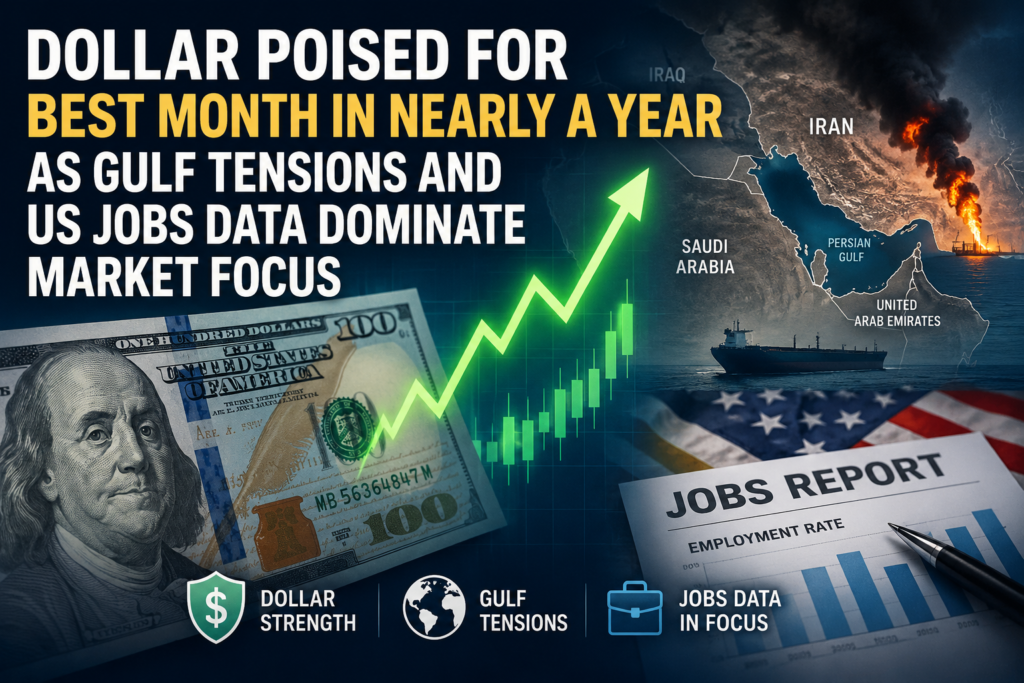
Dollar Poised for Best Month in Nearly a Year; Eyes on Gulf Tension, Jobs Data
The U.S. dollar is charging toward its strongest monthly performance in nearly a year, with the ICE U.S. Dollar Index (DXY) on track for a roughly 2.5% gain in June. This surge reflects a potent mix of resilient U.S. economic data, hawkish Federal Reserve signals, persistent geopolitical risks from the Middle East, and diverging monetary policy expectations across the Atlantic. As markets brace for key U.S. jobs data and the ECB Forum on Central Banking, the greenback’s momentum underscores its enduring status as the world’s preeminent safe-haven and reserve currency amid global uncertainty.
The Dollar’s June Rally: Numbers Tell the Story
As of late June 2026, the DXY has climbed from around 99 at the start of the month to hover near 101.3–101.5, marking a significant rebound. It hit a 13-month high of 101.80 on June 24, its strongest level since May 2025. This performance stands in stark contrast to the dollar’s softer footing earlier in the year and positions June as potentially its best month since the summer of 2025.
The rally has been broad-based. The euro has weakened notably, with EUR/USD trading around 1.138–1.140, down over 2% for the month. Other major currencies, including the British pound, Japanese yen, and Chinese renminbi, have also faced pressure against the dollar. This strength comes despite occasional pullbacks, as seen in late June trading sessions where the index fluctuated amid shifting oil prices and risk sentiment.
Analysts attribute much of the move to “American exceptionalism” in a world grappling with energy shocks and slower growth elsewhere. Foreign investors continue to pour capital into U.S. assets, drawn by deeper capital markets, technological leadership (particularly in AI), and relatively attractive yields. Barclays and other firms noted month-end rebalancing flows supporting the dollar, though quarter-end dynamics could introduce some volatility.
Geopolitical Flashpoint: Gulf Tensions and Energy Markets
A central driver of the dollar’s resilience has been escalating and then partially de-escalating tensions in the Middle East, particularly around the Strait of Hormuz following the U.S.-Iran conflict that erupted earlier in 2026. The waterway, through which about one-fifth of global oil and LNG passes, saw disruptions that sent Brent crude prices spiking above $120 per barrel at peaks, with prolonged supply concerns fueling inflation fears worldwide.
Even as tanker traffic has resumed somewhat and prices eased toward the $70–$80 ranges in recent days (WTI dipping below $70 at points), the episode has reinforced the dollar’s safe-haven appeal. The U.S., as a net energy exporter, benefits relatively from higher oil prices compared to import-dependent Europe and Asia. This dynamic widens yield differentials and supports the greenback.
The conflict’s ripple effects have been profound. Gulf economies faced supply chain disruptions, higher insurance premiums, and food import crises. Global stock markets wobbled, with emerging markets particularly vulnerable to currency pressures from a stronger dollar. Gold initially rallied as a hedge but faced headwinds from rising U.S. yields and dollar strength. IMF estimates suggest the war could shave significant GDP growth from affected regions, with broader implications for global inflation and growth.
Markets remain on edge. Any renewed flare-up—such as incidents involving tankers in the Gulf of Oman—could quickly reignite volatility, pushing investors back into dollars and Treasuries. Conversely, credible progress toward de-escalation might temper the dollar’s gains but is unlikely to reverse them given underlying U.S. fundamentals.
U.S. Jobs Data in Focus: Resilience Amid Uncertainty
This week’s upcoming U.S. nonfarm payrolls report for June (due early July) will be a critical test. May’s figures showed a solid 172,000 job gain, beating expectations of around 85,000–100,000 and following upward revisions to prior months. The unemployment rate held steady at 4.3%. This resilience has tempered expectations for aggressive Fed easing and bolstered the case for higher-for-longer rates.
Economists will scrutinize not just headline numbers but details on wage growth, sector breakdowns (e.g., services vs. manufacturing), and labor force participation. Strong data could extend the dollar’s rally by reinforcing Fed hawkishness; softer figures might prompt a modest retreat if they signal cooling without recession.
The labor market’s strength contrasts with challenges elsewhere. Europe’s growth has been hampered by energy costs, while China and other EMs navigate their own headwinds. This divergence favors the dollar, as capital flows toward the U.S. economy’s relative robustness.
Fed Policy: Hawkish Tilt Supports the Dollar
The Federal Reserve’s June 17 meeting kept the federal funds rate target at 3.5%–3.75%, but the tone was notably less dovish. Projections showed nearly half of policymakers anticipating at least one rate hike this year, with the median end-2026 rate now at 3.8%. Chair Kevin Warsh’s leadership has introduced new dynamics, but the committee’s data-dependent approach underscores caution amid sticky inflation (May CPI at 4.2% annually, a multi-year high).
Higher oil prices from Gulf disruptions have complicated the disinflation path, feeding into core measures and services inflation. Markets now price in limited cuts—or even hikes—through 2026 and into 2027, widening the policy gap with other central banks. This supports dollar strength through higher yields and carry trade appeal.
ECB Forum: Searching for Signals in Sintra
Markets are also watching the ECB Forum on Central Banking in Sintra, Portugal (June 29–July 1), themed “Shaping Europe’s future: innovation, growth and stability.” President Christine Lagarde and counterparts like Andrew Bailey (BoE) and others will discuss policy amid energy shocks, AI-driven productivity, and growth challenges.
The ECB has been more dovish, facing weaker growth and inflation pressures skewed by imports. Any signals of slower tightening—or explicit concerns over a strong dollar’s impact on eurozone exports—could widen the transatlantic policy divergence further, pressuring the euro. Discussions on tokenization, financial stability, and regulatory cycles will be closely parsed for clues on future easing paths.
Broader Market and Economic Implications
A strong dollar is a double-edged sword. For the U.S., it helps combat imported inflation but raises concerns for multinational corporations’ overseas earnings and competitiveness. Emerging markets face higher debt servicing costs in dollar terms, potentially straining finances in vulnerable economies. Commodities priced in dollars become more expensive for non-U.S. buyers, influencing global demand.
On the positive side, the dollar’s strength reflects confidence in U.S. assets. Foreign direct investment, Treasury demand, and equity inflows (despite tech volatility) underscore this. However, prolonged strength risks exacerbating global imbalances if not accompanied by coordinated policy responses.
Historical Context and Technical Outlook
The dollar’s current run echoes past episodes of geopolitical-driven safe-haven buying, such as during earlier Middle East crises. From a technical perspective, the DXY has broken key resistance levels, with bullish RSI readings and moving average alignments supporting further upside, though overbought conditions warrant caution.
Analysts’ forecasts vary. Some see the DXY testing 102–103 if jobs data impresses and tensions linger; others eye potential consolidation toward 100 if de-escalation accelerates and Fed projections moderate. Long-term, structural factors like U.S. fiscal deficits and global de-dollarization talks pose questions, but near-term dynamics favor strength.
Sectoral and Corporate Impacts
Energy firms have navigated volatility, with U.S. producers benefiting from higher prices. Exporters in manufacturing and agriculture face headwinds from a strong dollar. Importers and consumers enjoy cheaper foreign goods. Tech giants with global exposure monitor currency translation effects closely, especially amid AI investment booms.
Banks and financial institutions profit from higher U.S. yields and volatility in FX markets. Meanwhile, emerging market central banks may intervene to stem currency depreciation, potentially drawing down reserves.
Looking Ahead: Risks and Opportunities
The path forward hinges on several variables: the trajectory of Gulf tensions and oil supply normalization, the June jobs print and subsequent inflation data, ECB communications, and any surprises from the Fed. A prolonged conflict or renewed supply shocks would likely sustain dollar bids. Rapid de-escalation combined with cooling U.S. data could open the door for modest profit-taking.
Investors should consider diversified exposure—hedging FX risks, favoring U.S. assets with domestic focus, and monitoring commodities for opportunities. Policymakers globally face the challenge of balancing domestic mandates with spillovers from dollar strength.
In conclusion, the U.S. dollar’s poised best monthly showing in nearly a year encapsulates a world where American economic and financial primacy persists amid turbulence. As eyes turn to jobs figures and the ECB Forum, the greenback remains the fulcrum of global markets—resilient, influential, and closely watched. Whether this momentum carries into July and beyond will depend on the delicate interplay of geopolitics, data, and policy signals in the weeks ahead.
==