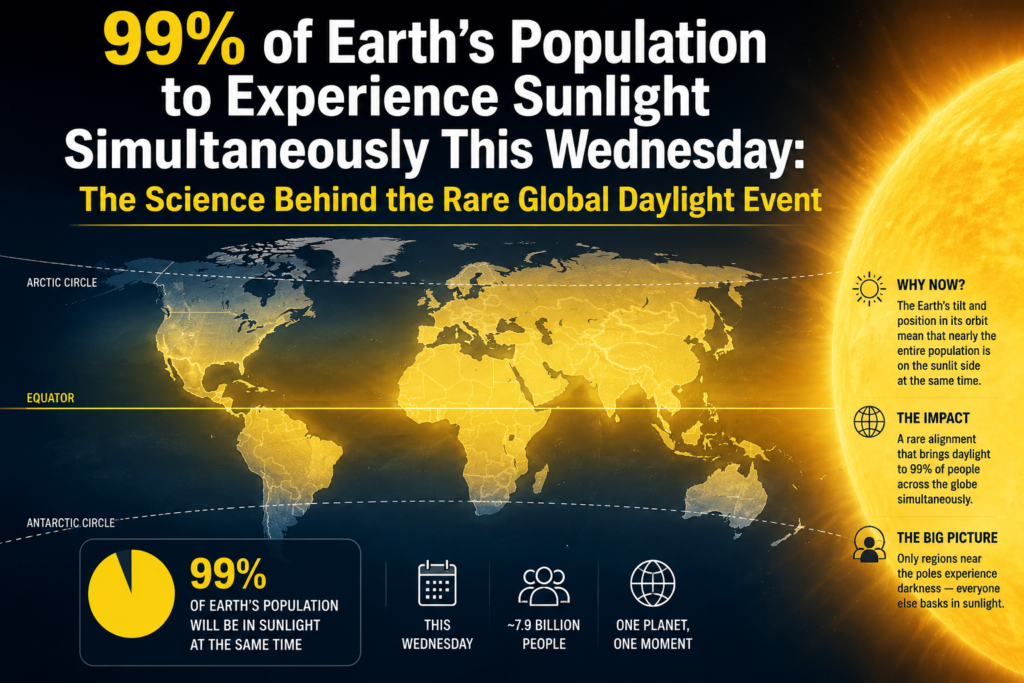
99% of Earth’s Population to Experience Sunlight Simultaneously This Wednesday
July 8, 2026 — In a striking reminder of humanity’s shared planetary home, approximately 99% of the world’s population — nearly 8.2 billion people — will be bathed in some form of sunlight at the exact same moment today, Wednesday, July 8, at around 11:15 UTC (7:15 a.m. EDT / 12:15 p.m. BST).
This annual phenomenon, which has captured public imagination through viral posts and fact-checks, occurs due to a unique alignment of Earth’s axial tilt, the timing of the Northern Hemisphere’s summer, and the global distribution of human populations. While the planet is always half-illuminated by the Sun, population density plays a crucial role: about 90% of humans live in the Northern Hemisphere, where days are longest in early July following the June solstice.
The Science Behind the Moment
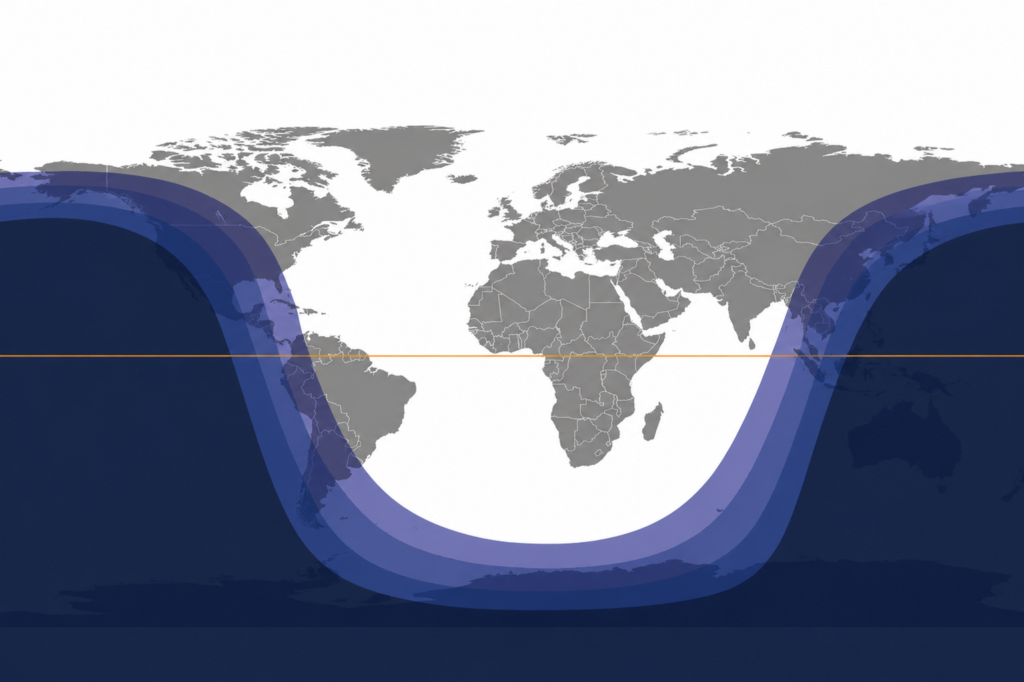
At precisely 11:15 UTC, the terminator line — the boundary between day and night — positions the vast majority of Earth’s landmasses and population centres on the sunlit side. Only a small fraction of the globe, primarily parts of Australia, New Zealand, some Pacific islands, and remote areas in Southeast Asia and Antarctica, remains in full darkness.
Timeanddate.com’s detailed analysis, using population data from sources like the Centre for International Earth Science Information Network, confirms that roughly 256 million people (about 3%) might be in complete darkness, leaving the rest experiencing daylight or twilight. Even including faint astronomical twilight (where the Sun is up to 18 degrees below the horizon but still contributes minimal light), the figure holds at around 99%.
Experts note this isn’t entirely unique to July 8. Similar peaks — exceeding 98% of the population in daylight or twilight — occur daily from mid-May to mid-July, typically around 11:00 UTC. However, July 8 stands out as one of the peak days in popular discourse.
“This moment highlights how unevenly humans are spread across the globe,” said an astronomer familiar with the calculations. “The concentration of people in Europe, Asia, and the Americas means that when the Sun is optimally positioned over the Northern Hemisphere, almost everyone gets a share of daylight at once.”
Local Times and Experiences
- UTC 11:15: The global reference point.
- North America: Early morning hours (e.g., 7:15 a.m. EDT), with most of the continent well into daylight.
- Europe and Africa: Midday to afternoon, peak sunlight for billions.
- Asia: Afternoon or evening, still bright for most.
- Australia/New Zealand: Deep night or pre-dawn, with the Southern Hemisphere’s winter contributing to longer nights.
For those in twilight zones, the light may be dim but technically counts as “sunlight” in these calculations. Direct, bright sunshine covers the majority.
A Global Unifier in a Divided World
This event serves as a poetic reminder of unity. While conflicts, politics, and daily struggles divide us, for a fleeting minute around this time, the Sun shines on nearly all of humanity together. Social media is abuzz with reactions, from awe at planetary mechanics to lighthearted jokes about Australians “missing out” again.
Climate and astronomy enthusiasts urge people to step outside, appreciate the daylight, and reflect on Earth’s place in the solar system. No special equipment or viewing events are needed — just being awake and on the sunlit side suffices for most.
As one viral post put it: “For a brief moment, 99% of us are under the same Sun.”
This phenomenon will return next year on July 8, 2027, and similar alignments occur throughout the northern summer months. For real-time visualisations, sites like timeanddate.com offer interactive day/night maps.
Sources include analyses from timeanddate.com, EarthSky, National Geographic, and global population data.
=