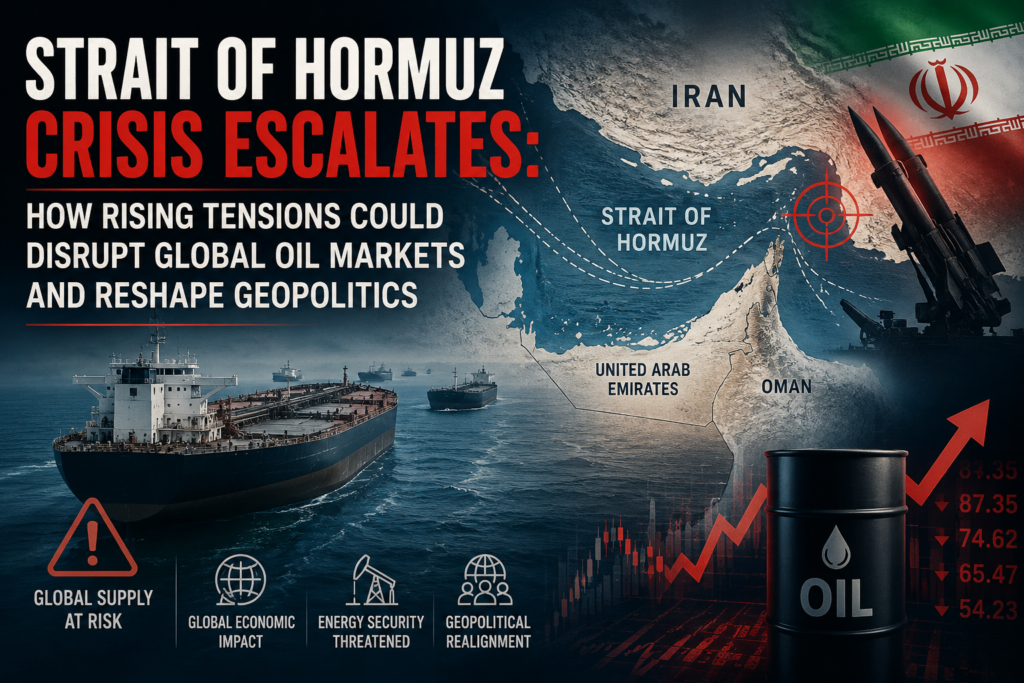
Escalating Conflict in the Strait of Hormuz: A Chokepoint That Could Reshape Global Energy and Geopolitics
July 9, 2026
The Strait of Hormuz, a narrow waterway separating Iran from Oman at the mouth of the Persian Gulf, has once again become the epicentre of international tension. This vital artery, through which roughly 20-25% of the world’s seaborne oil and significant volumes of liquefied natural gas (LNG) have historically flowed, is now a theatre of direct confrontation between Iran, the United States, and their allies. Recent attacks on commercial vessels, retaliatory U.S. strikes, and a fragile ceasefire have sent oil prices soaring, stranded thousands of seafarers, and raised fears of a broader regional war with devastating global economic consequences.
Over the past week, Iranian forces have been accused of striking multiple tankers, including a Qatari LNG carrier and a Saudi crude oil tanker, prompting swift U.S. military responses targeting Iranian assets. President Donald Trump has declared the ceasefire “over” at points, only to signal pauses, while Iran maintains its right to control transit through the strait. This report traces the history, recent escalations, human and economic toll, military dynamics, diplomatic manoeuvres, and potential futures of this crisis.
Historical Context: A Long-Standing Flashpoint
The Strait of Hormuz has been a strategic chokepoint for decades. At its narrowest, it is just 21 nautical miles wide, with shipping lanes even more constrained. Iran borders the northern coast, while Oman and the United Arab Emirates lie to the south. For years, Tehran has asserted influence over the waterway, occasionally threatening to close it during periods of heightened tension with the West.
Tensions trace back to the 1979 Iranian Revolution and the Iran-Iraq War (1980-1988), when tanker wars disrupted shipping. In more recent decades, Iran’s nuclear program, U.S. sanctions, and incidents like the 2019-2020 seizures of tankers kept the strait volatile. The 2025 skirmishes involving Iran, Israel, and the U.S. served as a precursor to the full-scale escalation in 2026.
The current crisis ignited on February 28, 2026, when U.S. and Israeli forces launched Operation Epic Fury and Operation Roaring Lion—coordinated strikes on Iranian military and nuclear sites. Iran retaliated across the region, declaring the strait “closed” on March 4. Iranian Revolutionary Guard Corps (IRGC) forces laid mines, deployed drones, and attacked commercial vessels, leading to a near-total halt in traffic. UK Maritime Trade Operations (UKMTO) reported over a dozen attacks in the initial weeks, with fatalities among crew members.
Shipping giants rerouted around the Cape of Good Hope, adding weeks and massive costs to voyages. Oil prices spiked dramatically, disrupting global supply chains. Stranded vessels in the Persian Gulf left up to 20,000 seafarers in limbo, turning the waterway into a “warlike operations area” as declared by maritime unions.
Timeline of Escalation: From Blockade to Fragile Ceasefire and Back
February-March 2026: Initial Closure
Following U.S.-Israeli strikes, Iran attacked ships, including the Palau-flagged Skylight (abandoned with fatalities) and others. Traffic plummeted by over 95%. The U.S. and allies issued joint statements condemning the actions and demanding compliance with UN resolutions. President Trump floated “Project Freedom” to escort vessels and reopen the strait.
April-May 2026: Attempts at Reopening and Clashes
A brief Iranian announcement of reopening on April 17 led to a surge of tankers, but the IRGC quickly reversed course. U.S. escorts succeeded in guiding some vessels, but Iran responded with drone and missile attacks. Clashes occurred, including strikes on targets in the UAE and Oman. A ceasefire took hold around April 8, but naval standoffs persisted.
June 2026: Memorandum of Understanding
On June 17, the U.S. and Iran signed an MoU for a 60-day negotiation period toward a permanent peace deal, including safe passage. Traffic began recovering, though Iran insisted on approved routes near its shores and threatened unapproved vessels.
Late June-July 2026: Renewed Attacks and Retaliation
Tensions reignited with Iranian drone and missile strikes on vessels. On July 6-7, three ships were hit: the Qatari Al-Rekayyat (fire reported), Saudi Wedyan, and another. The U.S. launched strikes on over 80 Iranian targets, including missile facilities, radar, and IRGC boats near the Strait and Qeshm Island. Iran retaliated against U.S. positions in the Gulf. Trump paused aspects of Project Freedom but warned of further action. As of July 8-9, shipping has again sharply declined, with tankers diverting.
Explosions have been reported at Iranian ports, including Bandar Abbas. International condemnation from Gulf states, the UK, France, Germany, and others has mounted, with calls for Iran to cease mining and attacks.
Military Dynamics: Asymmetrical Warfare at Sea
Iran’s strategy leverages its geography and asymmetric capabilities: fast-attack craft, anti-ship missiles, drones, and mines. The IRGC Navy has published maps claiming control and fired warning shots. U.S. forces, with superior naval presence including destroyers and air support from carriers, have downed drones and conducted precision strikes on coastal infrastructure.
CENTCOM has reported sinking Iranian vessels and hitting command networks. However, Iran’s ability to harass shipping persists, as seen in recent incidents. Allies like the UK and others have joined patrols. Risks include accidental escalation, such as misidentification of commercial vessels or strikes spilling into neighbouring territories.
Human costs are mounting: crew deaths, injuries, and psychological strain on mariners. Captains report immense pressure, with some vessels stranded for months.
Economic Impacts: Ripples Across the Globe
The Strait’s disruption has profound effects. Pre-crisis, it handled about one-fifth of global oil and significant LNG. Closures have driven oil prices up, contributing to inflation and slowing growth. Estimates suggest trillions in potential GDP losses if prolonged.
Gulf producers like Saudi Arabia and Qatar have been hit, with tankers targeted. Asia, Europe, and importers face higher energy costs. China has emerged as a relative beneficiary in some analyses, securing alternative supplies, but global markets suffer. Shipping insurance premiums have skyrocketed; rerouting adds fuel and time costs.
Fertiliser and chemical shortages loom, affecting food production. Stockpiles and alternative routes (e.g., pipelines) mitigate some pain, but experts warn of a “phantom ceasefire” scenario where volatility persists.
Diplomatic Efforts and International Response
A coalition including the U.S., UK, France, Germany, Japan, and Gulf states has pressured Iran. Joint statements demand an end to attacks and compliance with maritime law. The UN and IMO highlight risks to seafarers and freedom of navigation.
Talks continue amid the violence, focusing on nuclear issues, tolls (Iran seeks fees), and missiles. A permanent deal remains elusive. China and Russia have offered mediation or criticised Western actions. Regional players like Oman play quiet diplomatic roles.
Voices from the Ground: Seafarers and Locals
Stranded captains describe isolation and fear. One recounted vessels bunching up, waiting for escorts that may never come. In Iranian ports and Gulf cities, civilians express frustration over economic hardship and the cycle of violence. “We have to be patient,” one resident noted, highlighting war fatigue.
Families of crew members anxiously await news, with some vessels abandoned or damaged.
Expert Analysis: What Lies Ahead?
Analysts describe this as a “test of wills.” Iran uses the strait for leverage in peace talks; the U.S. insists on open navigation under international law. Prolonged closure risks regime instability in Iran, but also a global recession. Military options like full convoys carry escalation risks.
Scenarios range from renewed ceasefire with escorted traffic to full war, potentially involving Kharg Island or wider strikes. Oil markets price in uncertainty, with alternative energy acceleration possible in the long term.
Outlook: A Fragile Balance
As of July 9, 2026, the situation remains fluid. U.S. strikes continue in response to ship attacks, while Iran signals resolve. Traffic is minimal, and prices are volatile. Diplomatic windows exist, but are narrow.
The Strait of Hormuz underscores the world’s dependence on fragile chokepoints. Resolution requires compromise on security, economics, and sovereignty. Failure could plunge the region—and the global economy—into a deeper crisis. Stakeholders must prioritise de-escalation to safeguard lives, livelihoods, and stability.
This crisis is far from over. Developments will be watched closely by markets, militaries, and millions whose lives depend on the free flow of energy through these perilous waters.
==