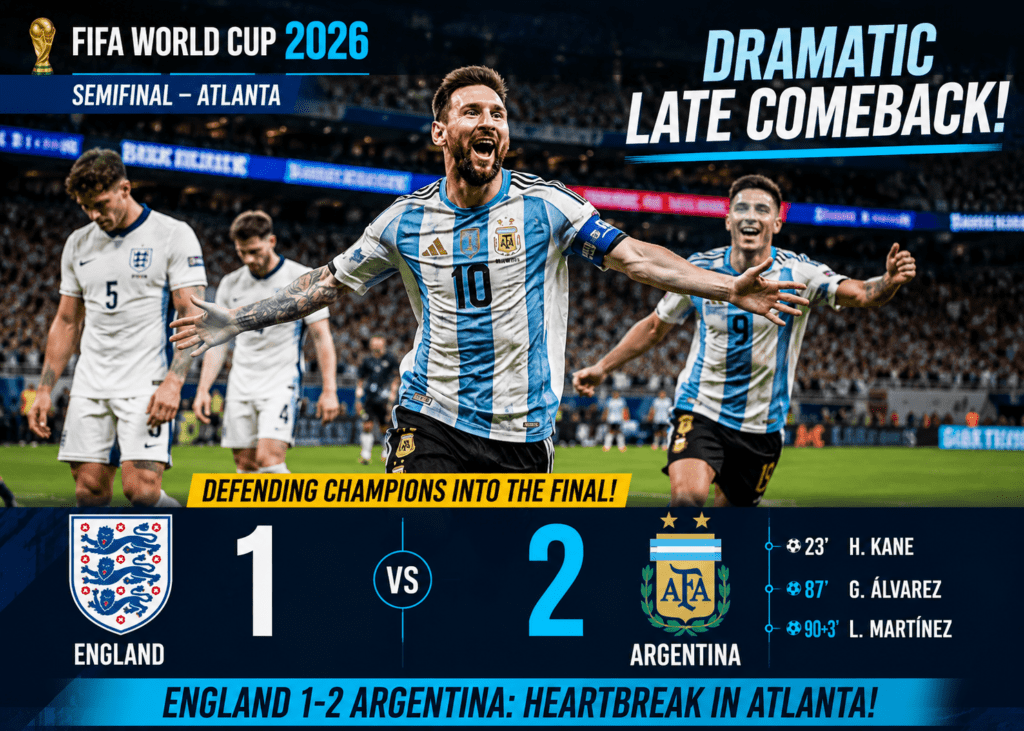
England 1-2 Argentina: Heartbreak in Atlanta as Defending Champions Stage Dramatic Late Comeback to Reach 2026 World Cup Final
Atlanta – July 16, 2026
In a match destined for football folklore, Argentina overturned a 1-0 deficit with two goals in the final seven minutes to defeat England 2-1 in the semi-final of the 2026 FIFA World Cup at Mercedes-Benz Stadium in Atlanta. Anthony Gordon’s second-half strike had England dreaming of a first final since 1966, but Lionel Messi’s influence, combined with clinical finishes from Enzo Fernández and Lautaro Martínez, sent the defending champions into Sunday’s final against Spain.
For England, under Thomas Tuchel, it was a chance to end decades of hurt. For Argentina, it was another display of Messi’s enduring aura. The 80,000-plus crowd witnessed a contest that swung like a pendulum before settling in favour of the Albiceleste.
The Road to Atlanta: Context and Build-Up

The 2026 World Cup, co-hosted by the United States, Canada, and Mexico, has been a tournament of surprises and reaffirmations. Argentina, reigning champions from Qatar 2022, entered as favourites despite a gruelling path. They topped their group and navigated the knockout stages with resilience, defeating Switzerland 3-1 in the quarter-finals. Messi, at 39, continued to defy age, delivering moments of genius that evoked his prime.
England, managed by the pragmatic Thomas Tuchel since late 2024, had been a model of efficiency rather than flair. They progressed steadily, beating Norway in the quarter-finals. Stars like Jude Bellingham, Harry Kane, and Jordan Pickford carried the weight of a nation still haunted by semi-final exits and penalty shootout woes. The Three Lions’ squad blended youth and experience, but questions lingered about their ability to break down deep defences or withstand late pressure.
This semi-final marked the sixth World Cup meeting between the sides, with a balanced historical record entering the match. Tensions were heightened by past encounters—the “Hand of God” in 1986, the 1998 quarter-final drama, and the political undertones of the Falklands/Malvinas dispute. Pre-match, both camps spoke of respect, but the atmosphere crackled with anticipation. Atlanta’s Mercedes-Benz Stadium, with its retractable roof and vibrant energy, provided a fitting coliseum.
Tuchel named a lineup designed for control: Pickford in goal; a back four of Kyle Walker, John Stones, Marc Guéhi, and Luke Shaw; midfield trio Declan Rice, Jude Bellingham, and Conor Gallagher; with Phil Foden, Harry Kane, and Anthony Gordon in attack. Argentina’s setup under Lionel Scaloni featured Emiliano Martínez; a defence including Lisandro Martínez and Nicolás Otamendi; midfield led by Rodrigo De Paul, Alexis Mac Allister, and Enzo Fernández; with Messi, Julián Álvarez, and others providing creativity.
First Half: Tension, Fouls, and Frustration
The opening 45 minutes were a cagey affair, defined by physicality and tactical discipline rather than open play. England started brightly, pressing high and looking to exploit spaces behind Argentina’s high defensive line. Bellingham won an early free-kick, but the delivery was dealt with comfortably.
Argentina quickly asserted control of the ball, circulating it patiently. Messi, operating in a roaming role, dropped deep to link play, drawing fouls and creating pockets of space. The first major flashpoint came around the 3rd minute when Leandro Paredes clashed with Bellingham, sparking a brief melee. Referee decisions drew ire from both benches, with four yellow cards issued early—three to Argentina—highlighting the high stakes and frayed tempers.
England’s defence, marshalled by Stones and Guéhi, stood firm. Pickford made several key interventions, notably denying Álvarez and dealing with dangerous crosses. Argentina hit the post once in the first half, a recurring theme. England created limited, clear chances; Kane was kept quiet by the Argentine centre-backs, and Gordon’s runs were monitored closely.
Possession favoured Argentina (around 55-64% overall, skewed higher in the first half), but England’s compactness made breakthroughs rare. Shots were limited: England managed a handful off-target, while Argentina’s efforts were repelled by a heroic Pickford and the woodwork. The half ended 0-0, with both sides heading to the dressing room aware that one moment of quality could decide the contest.
Second Half: Gordon’s Strike and England’s Defensive Shift
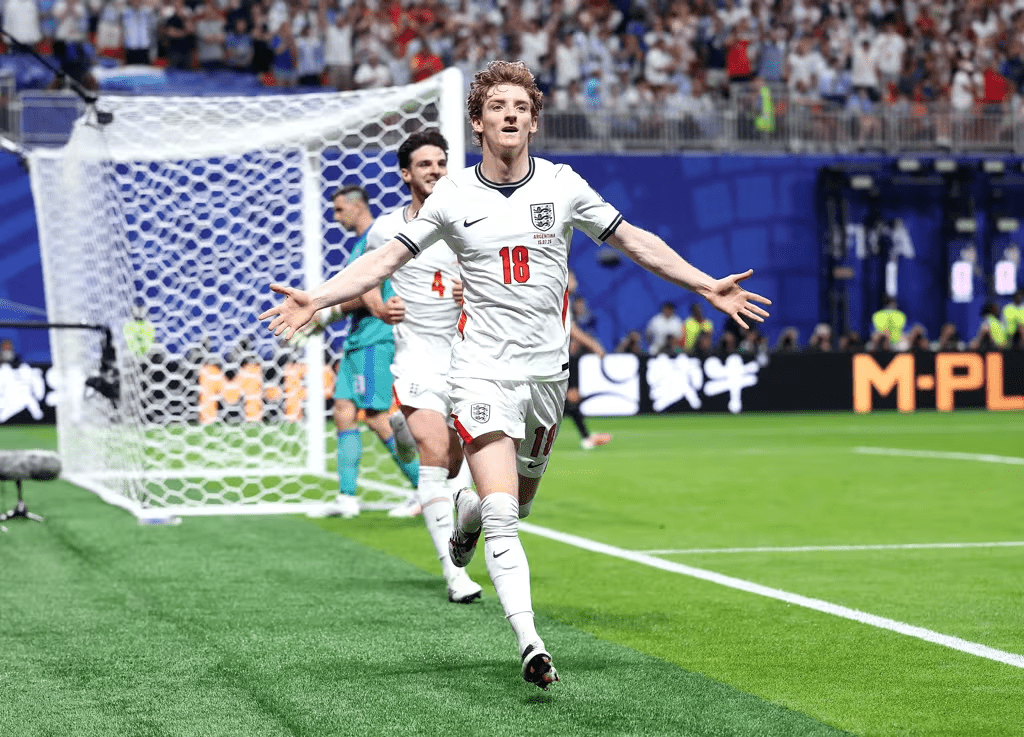
The second half exploded into life. England emerged with renewed intent, and in the 55th minute, they broke the deadlock. A deep build-up involving Rice found Morgan Rogers (who had entered earlier or featured in the move), whose pinpoint cross from the right was met by Anthony Gordon. The Newcastle forward volleyed home emphatically past Emiliano Martínez. Bedlam erupted among the England supporters. 1-0.
Gordon’s goal—his contribution in a tournament where he had grown into a key outlet—symbolised England’s counter-attacking threat. Celebrations were joyous but measured; Tuchel’s side knew the job was far from done.
What followed became the subject of intense post-match scrutiny. Rather than pushing for a second goal, England appeared to “park the bus,” dropping deeper and inviting pressure. Substitutions reinforced defence, with additional defensive-minded changes. Possession shifted heavily toward Argentina, which ramped up its attacking waves.
Messi orchestrated from the heart of the action. His vision and experience shone as he evaded challenges and delivered precise passes. England’s lead held precariously as Pickford produced world-class saves, including spectacular stops that kept the Three Lions in front. Argentina struck the post multiple times, testing the limits of fortune.
The Comeback: Messi Magic and Argentine Resilience
The tide turned inexorably in the 85th minute. Messi found space on the edge of the box and delivered a weighted pass to Enzo Fernández. The Chelsea midfielder, who had been probing all game, unleashed a powerful strike from 20 yards that flew past Pickford into the corner. 1-1. The Argentine bench erupted; Messi wheeled away in celebration.
England, visibly fatigued and tactically exposed, could not stem the momentum. In stoppage time (90+2), Messi once more provided the assist. A pinpoint cross found Lautaro Martínez, who had come off the bench, unmarked at the far post. The Inter striker powered a header into the net. 2-1. Pandemonium.
The final whistle blew shortly after amid Argentine jubilation and English despair. Argentina had done what they do best: refuse to lose. Messi, with two assists, was the architect. Fernández and Martínez were the finishers. For England, Gordon’s goal and Pickford’s heroics were bright spots in an otherwise agonising exit.
Match Statistics and Tactical Analysis
- Score: England 1-2 Argentina
- Goals: Gordon (55′), Fernández (85′), Martínez (90+2′)
- Possession: England ~36-45%, Argentina ~55-64%
- Shots: England 5, Argentina 15+
- Corners: England 1, Argentina 6
- Fouls: England 11, Argentina 15
- Saves: Pickford stands out with multiple key stops; Martínez is quieter.
Tactically, Tuchel’s shift to ultra-defensive play after taking the lead was criticised as overly cautious, allowing Argentina’s superior technical quality and depth to overwhelm. Scaloni’s side, despite Messi’s advancing years, showcased squad cohesion and late-game intensity honed over years together. England’s xG (expected goals) was low (~0.53 for their goal), while Argentina created higher-quality chances.
Player Ratings and Key Performances
England:
- Jordan Pickford (8/10): Heroic. Multiple stunning saves; unfortunate to concede late.
- Anthony Gordon (8/10): Scored the opener and provided energy.
- Jude Bellingham (7/10): Industrious but unable to dictate.
- Harry Kane (6/10): Isolated and subdued.
- Declan Rice (7/10): Solid until late fatigue.
Argentina:
- Lionel Messi (9.5/10): Transcendent. Two assists, constant threat. Oldest outfield player in a WC semi-final yet pivotal.
- Enzo Fernández (8.5/10): Equaliser, a moment of brilliance.
- Lautaro Martínez (8/10): Winner off the bench.
- Lisandro Martínez & Co.: Defensive resilience.
Post-Match Reactions
Thomas Tuchel accepted responsibility for the substitutions and defensive approach: “We got too passive… I take the blame.” He praised his players’ effort but acknowledged the heartbreak.
Messi, emotional, called reaching back-to-back finals “crazy” and credited the group’s achievement. Scaloni hailed the character shown.
English fans and pundits lamented another near-miss, with calls for reflection on mentality and squad depth. Argentine supporters celebrated wildly, some displaying banners referencing the Malvinas.
Broader Implications and Legacy
This result sets up a tantalising final: Argentina vs Spain on July 19 at MetLife Stadium. A potential third consecutive title for the Albiceleste would cement their dynasty; Spain represents a youthful, technical challenge.
For England, the journey ends in semi-final disappointment once more. Yet progress under Tuchel—reaching the last four with a young core—offers hope for Euro 2028 and beyond. The squad showed resilience, but the “nearly men” tag persists.
This match exemplified why football captivates: underdogs, comebacks, and legends. Messi’s legacy grows; England’s search for glory continues. As the sun sets on Atlanta, the football world turns its eyes to the final, where another epic awaits.
In-Depth Analysis Sections
The Rivalry Renewed: From 1966 to 2026, encounters between these nations transcend sport. This 2026 clash added another layer, with Argentina avenging past grievances on the pitch through skill rather than controversy.
Messi’s Twilight Brilliance: At an age when most retire, Messi produced assists that will feature in highlight reels forever. His dribbles, vision, and leadership inspired a nation and a continent.
England’s Tactical Dilemma: Tuchel’s “gamble” to defend the lead backfired against a side built for comebacks. Lessons for future tournaments: balance pragmatism with ambition.
Fan Experience in Atlanta: The atmosphere blended cultures—English chants meeting Argentine passion. Global viewership soared, underscoring the World Cup’s unifying power.
Historical Parallels: Argentina’s remontadas echo their 2022 triumphs. England’s exit mirrors painful precedents, yet builds character for a new generation, including Bellingham, Saka (if featured), and others.
Statistical Deep Dive: Argentina’s late dominance (post-70 minutes possession and shots) highlights superior fitness and bench impact. England’s set-piece threat was neutralized effectively.
What’s Next for Both Teams:
- Argentina: Pursue immortality against Spain.
- England: Regroup, possibly with Tuchel’s future under review, focusing on youth integration and mental fortitude.
In conclusion, while England exits with heads held high after their tournament run, Argentina advances as a worthy contender for back-to-back glory. The 2026 World Cup semi-final in Atlanta will forever be remembered as the night the defending champions refused to die—and a footballing giant named Messi wrote another unforgettable verse.
===