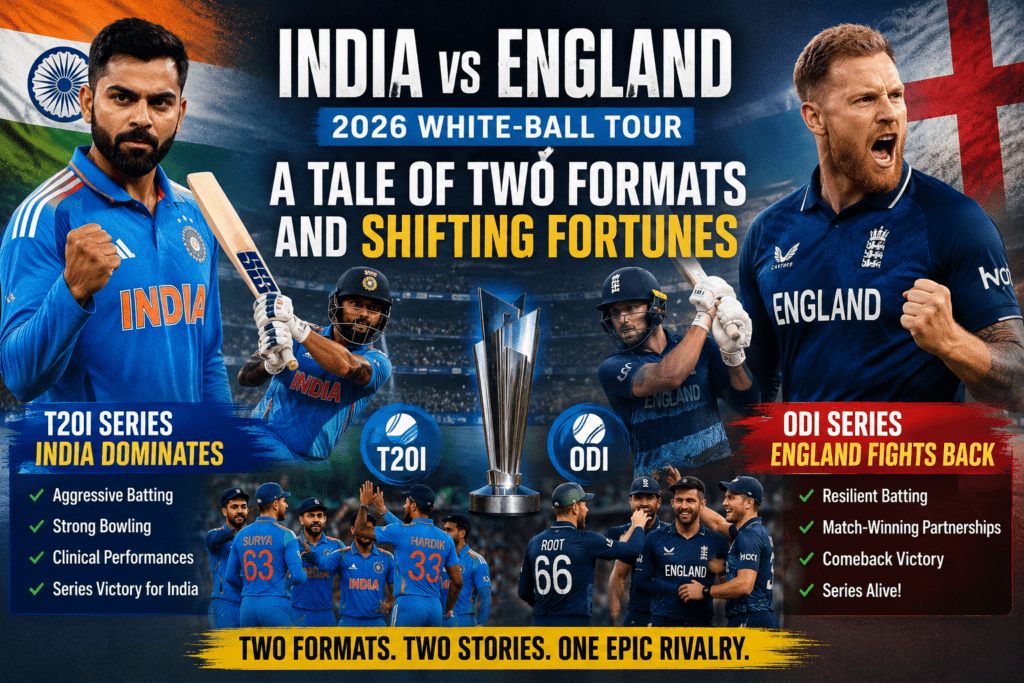
India vs England 2026 White-Ball Tour: A Tale of Two Formats and Shifting Fortunes
July 17, 2026
The Indian cricket team’s 2026 white-ball tour of England will be remembered as a stark study in contrasts. In the five-match T20I series, England delivered a resounding 4-0 thrashing, exposing vulnerabilities in India’s high-octane batting and claiming the No. 1 T20I ranking. Yet, the ensuing three-match ODI series opened with India asserting dominance in the longer format, only for England to hit back immediately, setting up a tense decider at Lord’s.
As the tour reaches its climax with the third ODI on July 19, this report delves into the key moments, performances, tactical battles, and broader implications for both teams heading into future ICC events.
The T20I Whitewash: England’s Mastery and India’s Struggles
The T20I leg began under overcast skies in Durham on July 1, with the first match abandoned due to rain. What followed was a nightmare for new T20I captain Shreyas Iyer, whose side entered the series as reigning T20 World Cup champions but left humbled.
Match 2, Old Trafford (July 4): India posted a competitive 190/7, with Ishan Kishan (49) and Abhishek Sharma (43) providing starts. However, Jacob Bethell’s unbeaten 76 off 46 balls steered England to a four-wicket win with six balls to spare. England’s chase highlighted their adaptability to English conditions.
Match 3, Trent Bridge (July 7): This was the nadir. England racked up 201/7, powered by Phil Salt’s 70. India crumbled to 76 all out in 11.4 overs—their second-lowest T20I total—suffering a record 125-run defeat. Jofra Archer (3 wickets) and Josh Tongue (4/28) exploited the bounce and seam movement, dismantling India’s top order.
England’s pacers consistently used hard lengths and short balls, tactics that India’s IPL-honed batters—accustomed to flatter tracks—struggled to counter. Cross-batted shots often led to catches or edges.
Match 4, Bristol (July 9): Shreyas Iyer’s unbeaten 80 offered resistance, but India managed only 158/7. Harry Brook (79*) and Phil Salt (59*) forged an unbroken 146-run stand, chasing the target in just 13.5 overs for a nine-wicket victory. This sealed the series and propelled England to the top of the T20I rankings.
Match 5, Southampton (July 11): England posted a mammoth 257/3, with Jos Buttler smashing 131 and Brook unbeaten on 95. Their 233-run second-wicket partnership set records. India replied with 201/8, falling short by 56 runs despite fifties from Ishan Kishan and Tilak Varma. This completed the 4-0 rout—India’s first bilateral T20I series loss of four or more matches.
Key Stats and Analysis: Harry Brook led with 229 runs, while England’s pace attack (Archer, Tongue, Curran) dominated. India’s batting, reliant on power-hitting, faltered against variable bounce. Fielding lapses compounded issues. Shreyas Iyer’s captaincy came under scrutiny, with questions about middle-order stability and overseas adaptability.
The whitewash echoed concerns from India’s recent 2-0 loss in Ireland. BCCI announced a post-tour review, signalling introspection ahead of the next T20 World Cup cycle.
Transition to ODIs: India Strikes First at Edgbaston
With Rohit Sharma, Virat Kohli, and Jasprit Bumrah (returning to ODIs) bolstering the side under Shubman Gill’s captaincy for the 50-over format, India showed renewed fight.
1st ODI, Edgbaston (July 14): England batted first and reached 258 in 47.5 overs. India triggered a collapse from 61/0 to 80/5 and 107/6, with Axar Patel claiming a career-best 4/62. Joe Root (76*) and Liam Dawson (68) rescued the innings with a 121-run seventh-wicket stand.
India’s chase of 259 was clinical. Gill scored a fluent 80 (retired hurt with cramp) before Washington Sundar (52*) and Axar Patel (57*) added an unbroken 102-run stand. India won by six wickets with 28 balls to spare, marking their first tour victory and sixth consecutive ODI win over England.
Axar Patel earned Player of the Match for his all-round brilliance. Gill’s Edgbaston affinity continued, and the win injected much-needed confidence after the T20 debacle.
2nd ODI, Cardiff (July 16): England Levels the Series
England responded strongly in the day-night encounter at Sophia Gardens. India were bowled out for 233 in 44 overs, with Virat Kohli and Shreyas Iyer scoring half-centuries, but a middle-order collapse proved costly. Jofra Archer (3/47), Gus Atkinson (3/50), and Saqib Mahmood starred with the ball.
Chasing 234, England reached the target with four wickets in hand and overs to spare. Joe Root remained unbeaten on 99, and Gus Atkinson’s all-round efforts shone. England levelled the series 1-1, showcasing superior depth and chasing prowess.
Tactical and Player Insights
England’s Strengths: Under Harry Brook (T20) and in ODIs, England’s pace battery—led by Archer’s express speed and Tongue’s seam—exploited conditions effectively. Middle-order anchors like Root and Brook provided stability. Fielding and adaptability were superior in T20S.
India’s Resilience: The ODI revival highlighted the value of experience (Kohli, Rohit) and all-rounders like Axar and Washington. Spin options and improved death bowling offered hope. However, top-order fragility and injury concerns (e.g., Gill’s cramp) persist.
Key Battles: Archer vs Indian openers; Gill/Kohli vs England’s seamers; Brook/Root vs Indian spinners.
Broader Implications
This tour underscores the challenges of transitioning between formats and conditions. India’s T20 struggles outside Asia raise questions about squad balance for future global events. England’s white-ball renaissance, post-Test inconsistencies, boosts morale.
The decider at Lord’s on July 19 promises fireworks. A series win for either side would carry significant momentum. For India, it’s about redemption; for England, consolidation as a white-ball force.
Looking Ahead: Post-tour, India faces selection debates and conditioning focus. England eyes consistency across formats. Cricket fans eagerly await the Lord’s climax in what has been a riveting, fluctua
==