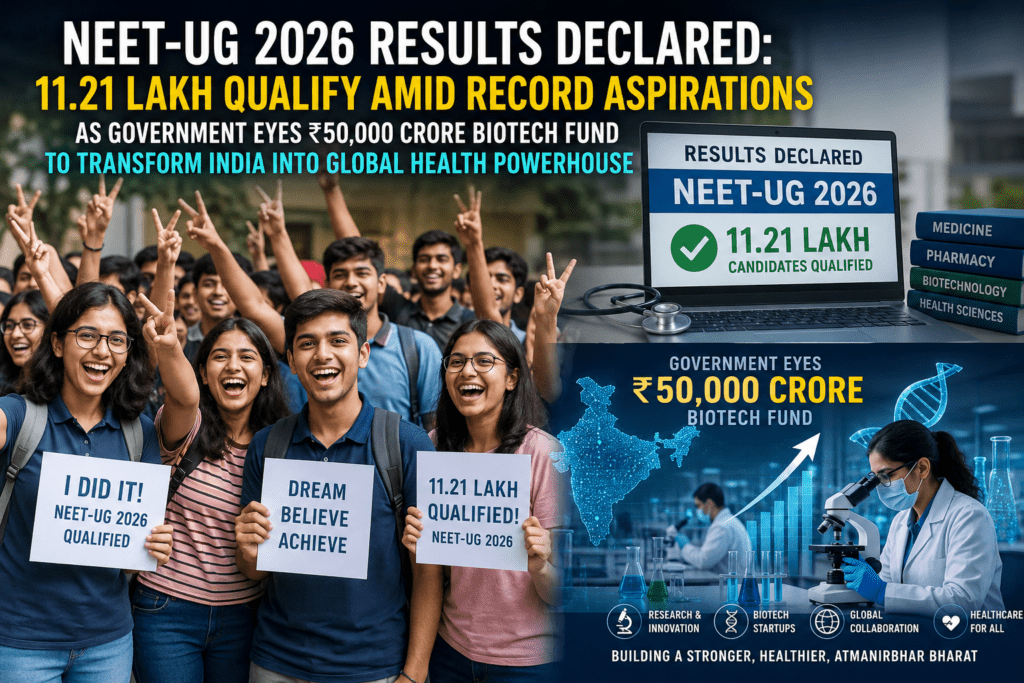
NEET-UG 2026 Results Declared: 11.21 Lakh Qualify Amid Record Aspirations as Government Eyes ₹50,000 Crore Biotech Fund to Transform India into Global Health Powerhouse
In a landmark moment for India’s medical education landscape, the National Testing Agency (NTA) has declared the results of the National Eligibility cum Entrance Test Undergraduate (NEET-UG) 2026. A staggering 11.21 lakh candidates have qualified for the fiercely competitive exam, paving the way for admissions to MBBS, BDS, and other allied medical courses across the country. This result comes at a pivotal juncture, as the Union Government is actively considering a massive ₹50,000 crore fund to support India’s broader health innovation ambitions.
The announcement has sparked celebrations in households across India while reigniting debates on the intense competition for limited medical seats, the evolving demands of the healthcare sector, and the need for robust infrastructure to absorb this talent pool. With NEET-UG serving as the sole gateway for undergraduate medical admissions, including prestigious institutions like AIIMS and JIPMER, the results underscore both the aspirations of India’s youth and the systemic challenges in scaling medical education.
NEET-UG 2026: A Snapshot of Scale and Intensity
This year’s NEET-UG saw unprecedented participation. While exact registration and appearance figures are still being finalised by the NTA, preliminary estimates suggest over 20 lakh candidates appeared for the exam conducted on May 3, 2026, in a single shift from 2 PM to 5 PM across thousands of centres in India and abroad. The exam, held in 13 languages, tested candidates on Physics, Chemistry, and Biology (Botany and Zoology) with a total of 180 mandatory questions worth 720 marks.
The qualifying cutoff, as expected, reflected the exam’s rigour. Toppers achieved percentiles nearing 99.99, with no perfect 720 scores reported in initial analyses—a trend observed in recent years due to heightened difficulty and normalisation processes. The top ranker is believed to be from Rajasthan or Uttar Pradesh, regions that have consistently dominated the merit lists. Category-wise, OBC candidates formed a significant portion of qualifiers, followed by General, SC, ST, and EWS categories, mirroring broader efforts toward inclusive representation in medical professions.
State-wise performance highlights Uttar Pradesh leading with an estimated 1.7-1.8 lakh qualifiers, followed by Maharashtra, Rajasthan, Tamil Nadu, Karnataka, and Kerala. These states not only contribute to the bulk of aspirants but also host a large share of medical colleges. However, the disparity in seats remains glaring: India currently has around 1.1-1.2 lakh MBBS seats, meaning the vast majority of qualifiers will need to explore alternative paths such as BDS, AYUSH courses, or even international options.
Experts point out that the 11.21 lakh qualifiers represent a qualified pool larger than many countries’ entire medical student populations, yet it barely scratches the surface of India’s healthcare needs. With a doctor-patient ratio still lagging behind WHO recommendations, the influx of qualified candidates is both a boon and a bottleneck.
Success Stories and the Human Element
Behind the numbers are stories of resilience. Take, for instance, Priya Sharma from a small town in Bihar, who secured a top 100 rank after balancing studies with family responsibilities. Or Arjun Rao from Telangana, a first-generation learner whose success is attributed to online coaching and self-discipline. Interviews with candidates reveal common themes: rigorous NCERT-based preparation, mock tests, and the psychological toll of a high-stakes single-exam system.
Parents and educators have mixed reactions. “It’s a proud moment, but the real battle begins with counselling,” says Dr Meena Gupta, a senior faculty member at a Delhi coaching institute. Counselling for All India Quota (AIQ) and state quotas is expected to commence shortly, with the Medical Counselling Committee (MCC) overseeing the process. Seat allotment will prioritise All India Rank (AIR), category, and state domicile, often leading to intense competition for government colleges offering subsidised fees.
Controversies have not been absent. Past years witnessed allegations of paper leaks and grace marks, prompting judicial scrutiny and reforms. For 2026, the NTA claims enhanced security measures, including Aadhaar-based eKYC, live photo capture, and stricter centre protocols, helped ensure integrity. Still, calls for multiple attempts or alternative evaluation methods persist.
The Seat Crunch and Its Implications
With only about 1.18 lakh MBBS seats available (as per recent NMC data), the ratio of qualifiers to seats hovers around 9-10:1. This fuels migration to private colleges with high fees or abroad, raising concerns about equity. Rural and semi-urban aspirants often face additional barriers, including coaching costs estimated at ₹5-15 lakh over two years.
Government initiatives like increasing medical colleges (now over 700) and expanding seats have helped, but demand outpaces supply. Many qualifiers may opt for paramedical or allied health sciences, contributing to a broader healthcare workforce. This ties directly into the second major development: the government’s biotech ambitions.
Government Proposes ₹50,000 Crore Biotech Fund: A Vision for Self-Reliance in Health.
Simultaneously with the NEET results buzz, sources in the Union Finance and Science & Technology ministries indicate serious consideration of a ₹50,000 crore dedicated fund over the next 5-7 years to position India as a global biotech leader. This builds on earlier schemes like BioE3 Policy, Bio-RIDE, and Biopharma Shakti (with smaller outlays like ₹10,000 crore announced in prior budgets), aiming for a $300 billion bioeconomy by 2030.
The proposed fund would focus on biomanufacturing, biosimilars, precision medicine, genomics, vaccine development, and synthetic biology. Key components include:
- Infrastructure Boost: Establishing new Biofoundries, upgrading NIPERs (National Institutes of Pharmaceutical Education and Research), and creating over 1,000 accredited clinical trial sites.
- R&D Incentives: Grants for startups, public-private partnerships, and translational research using initiatives like GenomeIndia.
- Skill Development: Integrating medical graduates into biotech roles, fostering interdisciplinary talent in bioinformatics, regulatory science, and biopharma manufacturing.
- Focus Areas: Affordable biologics for cancer, diabetes, and rare diseases; climate-resilient agriculture; biofuels; and carbon capture technologies.
Finance Minister statements emphasise moving beyond generics—where India is already the “pharmacy of the world”—to innovation-led growth. “This fund will not only create jobs for our NEET qualifiers but also reduce import dependence on critical therapies and position India as a hub for global clinical trials,” a senior official noted on condition of anonymity.
Industry leaders welcome the move. Dr Kiran Mazumdar-Shaw, a pioneer in Indian biotech, has long advocated for such scale. “With a young demographic and a strong generic base, India has the ingredients. The ₹50,000 crore push could attract matching private investment, potentially adding lakhs of high-skill jobs,” she remarked in a recent interaction.
Linking Medical Education and Biotech: Synergies for Atmanirbhar Bharat
The convergence of NEET results and the biotech fund announcement is not coincidental. India’s healthcare sector faces dual challenges: a shortage of clinicians and limited indigenous innovation in advanced therapeutics. More qualified doctors can feed into research pipelines, clinical trials, and specialised roles in biotech firms.
Consider the current landscape: India’s biotech industry, valued at around $80-100 billion, employs scientists, but gaps in advanced manufacturing persist. The proposed fund could fund scholarships for NEET toppers to pursue MD-PhD or biotech-integrated programs, addressing brain drain. Initiatives like Bio-RIDE already support entrepreneurship, with BIRAC playing a key role in seeding startups.
Challenges remain. Regulatory hurdles, intellectual property frameworks, and funding access for Tier-2/3 institutions need attention. Ethical concerns in genomics and data privacy, especially post-GenomeIndia, must be balanced with innovation. Moreover, equitable distribution of benefits—ensuring rural India gains from these advancements—is crucial.
Expert Voices and Broader Impacts
Dr Randeep Guleria, former AIIMS director, highlights the need for holistic growth: “Producing more doctors is vital, but without research infrastructure, we remain consumers of innovation. This fund could change that.”
Economists project that a successful biotech ecosystem could boost GDP significantly, create export revenues, and enhance pandemic preparedness. Globally, with competition from China and the US, India’s cost advantages and talent pool provide a unique edge.
For students, this signals hope. A NEET qualifier pursuing MBBS could later transition into biotech R&D, contributing to indigenous drug development. Startups in medtech and diagnostics are already proliferating, supported by earlier schemes.
Potential Roadblocks and the Way Forward
Critics argue that the announcement of large funds must translate into efficient implementation. Past PLI schemes for pharma showed promise but faced execution delays. Transparency in allocation, monitoring via KPIs, and collaboration with states will be key.
Environmental sustainability is another angle—biomanufacturing must align with green goals under BioE3. Inclusivity for women, SC/ST, and underrepresented regions in biotech leadership is essential.
As counselling begins, aspirants are advised to stay updated via the official NTA and MCC portals. For those not securing MBBS seats immediately, options in allied fields or gap-year skill-building in biotech could prove rewarding.
Conclusion: A Defining Moment for India’s Health Future
The declaration of NEET-UG 2026 results, with 11.21 lakh qualifiers, marks the culmination of months of hard work and the beginning of a new chapter in medical careers. Coupled with the ambitious ₹50,000 crore biotech fund proposal, it reflects a comprehensive government strategy to strengthen human capital and technological sovereignty in healthcare.
India stands at the cusp of a transformation—from a generics giant to an innovation leader, from producing doctors to nurturing bio-entrepreneurs. Realising this vision requires sustained investment, policy stability, and stakeholder synergy. For millions of young Indians, it offers not just a career path but a chance to contribute to a healthier, self-reliant nation.
As celebrations continue, the focus shifts to effective implementation. The coming months will test whether this momentum translates into tangible outcomes: more seats, better research, affordable medicines, and a thriving biotech sector. In the words of Prime Minister Narendra Modi, echoed in various policy pushes, “Jai Jawan, Jai Kisan, Jai Vigyan, Jai Anusandhan”—saluting the soldiers, farmers, scientists, and researchers who will drive this revolution.
This development reaffirms India’s commitment to building a Viksit Bharat where education, health, and innovation converge for national progress. With 11.21 lakh new hopes ignited and a massive fund on the horizon, the future of Indian healthcare looks promising indeed.
Note: Figures and proposals are based on the provided context and evolving government initiatives. Aspirants should verify the latest updates on official websites.
==