

Federal Reserve Holds Interest Rates Steady Amid Persistent Inflation as Markets Tumble

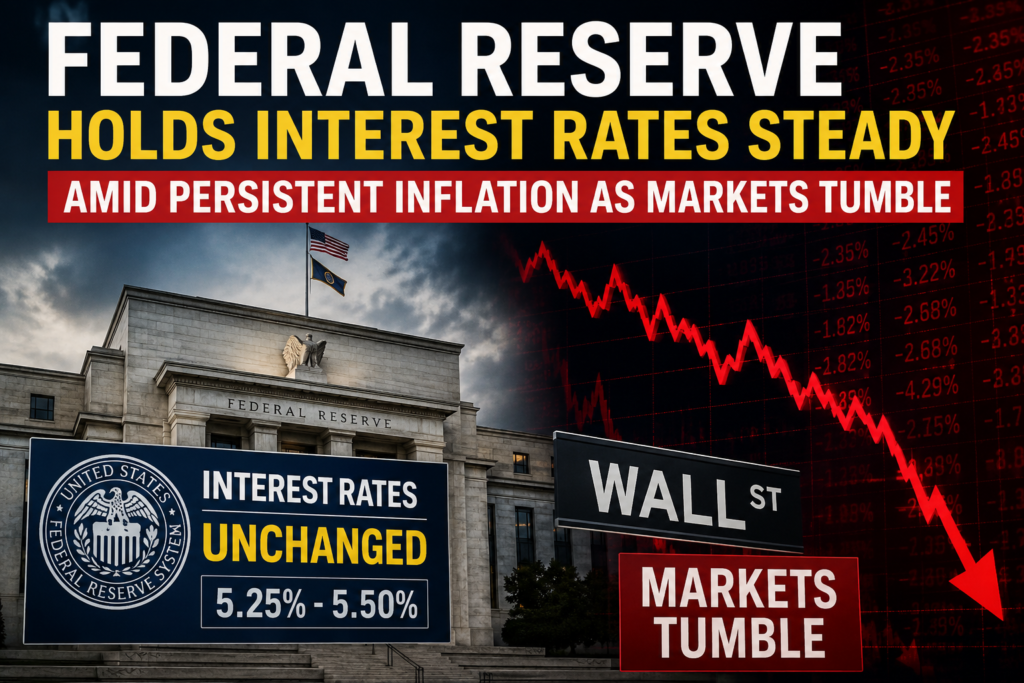
WASHINGTON — In a closely watched decision that underscored deepening divisions within the central bank and heightened investor anxiety over stubborn price pressures, the Federal Open Market Committee voted on July 29, 2026, to maintain the target range for the federal funds rate at 3½ to 3¾ per cent. The 9-3 decision, the fifth consecutive hold and the second under new Chairman Kevin Warsh, came against a backdrop of elevated inflation driven in part by energy supply shocks linked to ongoing conflict in the Middle East. Markets reacted sharply: the Dow Jones Industrial Average plunged 1,153 points, or 2.19 per cent, in its worst session of the year, while broader indexes also sold off and longer-term Treasury yields surged to multi-year highs.
The Federal Reserve’s policy statement was characteristically brief and factual under Warsh’s leadership. It noted that economic activity continues to expand at a solid pace despite elevated uncertainty, partly stemming from the conflict in the Middle East. Productivity growth and capital investment remain strong. Job gains have kept pace with the workforce, and the unemployment rate has changed little. Yet inflation “remains elevated relative to the Committee’s 2 per cent goal, in part reflecting supply shocks that have driven price increases in certain sectors, including energy.” The Committee reiterated its commitment: “The Committee will deliver price stability.”
Three regional Federal Reserve Bank presidents — Beth M. Hammack of Cleveland, Neel Kashkari of Minneapolis, and Lorie K. Logan of Dallas — dissented, preferring a quarter-percentage-point increase. It marked the most significant hawkish dissent in a single direction since 2016 and the first split vote of the Warsh era. The Board of Governors also maintained the interest rate paid on reserve balances at 3.65 per cent, effective July 30, while directing the New York Fed’s Open Market Desk to continue operations consistent with the existing target range and standing overnight repurchase agreements at 3.75 per cent.
Chairman Warsh, in his post-meeting press conference, struck an uncompromising tone on inflation while declining to offer forward guidance that might constrain the Committee’s flexibility. “There is no soft inflation target. There is no soft implicit target, not on this committee’s watch. There’s only a target, and it’s 2 per cent,” he said. “Not one of my FOMC colleagues is under any illusion. We have begun a new chapter. And we understand that the five-plus years of inflation above target cannot be cured in nine weeks or by a single month of modest price decreases. This Fed will not waver.”
Warsh described the internal debate as a “good family fight” that he had encouraged, emphasising robust discussion rather than division for its own sake. He characterised the current stance as a period of “watchful thinking” rather than passive waiting, stressing that the Committee would monitor inflation trends, the degree to which supply shocks were becoming more persistent, and signals from financial markets. He avoided committing to any specific timeline for potential action, noting that the policy statement deliberately steered clear of forecasting in uncertain times. “Where necessary and appropriate, we will not hesitate to act,” he added.
Market Turmoil and the Immediate Aftermath
Equity markets had been mixed heading into the decision, with some support from expectations of another hold. Once the statement and dissents were released, selling accelerated. The Dow closed at 51,594.14. The S&P 500 fell 1.52 per cent to 7,316.15, and the Nasdaq Composite dropped 1.74 per cent to 24,442.94. Technology and industrial shares led the declines, with chip-related names under particular pressure amid ongoing concerns about capital spending in artificial intelligence. Energy stocks were relative outperformers as oil prices jumped on renewed Middle East tensions.
Bond markets told a more hawkish story. The 10-year Treasury yield rose more than 7 basis points, while the 30-year yield climbed above 5.2 per cent, its highest level since 2007. Traders interpreted the three dissents and Warsh’s firm rhetoric as raising the odds of a rate increase later in the year. According to CME Group’s FedWatch tool, the probability of a September hike moved higher, with market pricing later settling around a better-than-even chance of tighter policy by the fall. Equity investors appeared to focus on the risk that higher-for-longer rates, combined with geopolitical uncertainty, could pressure valuations, particularly in growth-oriented sectors that had driven much of the market’s earlier gains in 2026.
The sell-off occurred against a backdrop of already elevated valuations in parts of the market and residual caution following earlier volatility tied to Middle East developments and energy prices. Analysts noted that the combination of a divided Fed, sticky inflation, and rising long-term yields created a challenging environment for risk assets. Sector performance reflected the dual pressures: industrials and information technology posted the steepest losses, while energy and consumer staples held up better.
Inflation’s Persistent Challenge
The decision unfolded against the most recent consumer price data available at the time of the meeting. The Consumer Price Index for All Urban Consumers rose 3.5 per cent over the 12 months ending in June 2026. On a monthly basis, the CPI fell 0.4 per cent seasonally adjusted in June, helped by a decline in gasoline prices. Core CPI, excluding food and energy, was unchanged month-over-month and up 2.6 per cent year-over-year. Energy prices, however, remained a major driver of the overall elevated reading, up 15.7 per cent over the year, with gasoline surging 26.7 per cent. Food prices rose 3.0 per cent over the same period.
These figures illustrated the uneven nature of disinflation. While some categories showed moderation, energy and certain supply-constrained goods continued to exert upward pressure. Officials have repeatedly cited the Middle East conflict as a source of such shocks. Oil prices had been volatile throughout the spring and summer, with renewed hostilities in late July pushing crude higher again and reinforcing concerns that energy inflation could feed into broader price measures if the conflict persisted or escalated.
Warsh and other officials have emphasised that five-plus years of inflation running above the 2 per cent target have left a durable imprint on expectations. Households and businesses, he suggested, may have begun to assume an implicit tolerance for higher inflation. The Committee’s messaging under the new leadership aims to reset that perception firmly. “Five years of high inflation have left a mistaken impression… that the Fed’s implicit inflation target was somehow above 2 per cent,” Warsh said. The central bank, he insisted, would not accommodate such a view.
Economists following the meeting noted that the June CPI decline offered some temporary relief but did little to resolve the underlying tension. Core services inflation, housing costs, and the pass-through potential from energy remain points of concern. Productivity gains and strong capital investment, highlighted in the FOMC statement, have helped support growth without generating the kind of labour-market overheating that characterised earlier post-pandemic periods. Unemployment has been relatively stable, and job gains have matched workforce expansion, reducing the urgency for rate cuts while still leaving room for debate over whether current policy is sufficiently restrictive.
Geopolitical Overhang and Economic Resilience
The Middle East conflict has become a recurring theme in recent FOMC communications. The July statement explicitly linked elevated uncertainty to that theatre, while noting the economy’s resilience. Strong productivity and capital investment have provided a buffer, allowing activity to expand even as energy costs and geopolitical risks weigh on sentiment. Corporate investment in technology, infrastructure, and capacity has remained robust in many sectors, supporting the “solid pace” characterisation.
At the same time, the conflict has contributed to oil-price volatility that feeds directly into inflation readings and consumer energy bills. Higher gasoline and heating costs reduce real purchasing power for households and raise input costs for businesses. The risk of broader supply-chain disruptions or secondary effects on food and transportation prices remains a live concern for policymakers. Officials have indicated they will assess whether these shocks prove temporary or begin to embed themselves more permanently in inflation dynamics.
The labour market continues to show balance rather than acute tightness or weakness. Job gains matching workforce growth and a largely unchanged unemployment rate suggest the dual mandate is not currently forcing a sharp trade-off. This balance has allowed the majority of the Committee to favour patience, even as the three dissenters argued that elevated inflation warranted an immediate tightening step.
Historical Context and the Warsh Transition
The July meeting represented a continuation of the policy pause that began after the final rate cut of late 2025. Rates have remained in the 3.50–3.75 per cent range since January 2026. The transition to Chairman Warsh earlier in the year brought a shift in communication style: shorter statements focused on observable facts, reduced emphasis on detailed forward guidance, and an explicit rejection of any perceived softening of the inflation target.
Previous FOMC cycles under different leadership had sometimes been criticised for appearing to tolerate above-target inflation for extended periods or for providing guidance that markets interpreted as overly accommodative. Warsh’s approach appears designed to restore credibility around the 2 per cent goal while preserving flexibility amid genuine uncertainty. The three dissents, while notable, were framed by the chair as evidence of healthy debate rather than institutional fracture.
Market participants have adjusted to the new regime. The absence of a detailed summary of economic projections or a “dot plot” style forecast in the immediate statement left investors to parse Warsh’s press-conference language and the vote itself. The rise in long-term yields after the meeting suggested that fixed-income markets took the hawkish elements seriously, pricing in a higher probability that policy could eventually tighten if inflation does not continue to moderate.
Broader Implications for Households, Businesses, and Global Markets
For American households, the decision means mortgage rates, auto loans, credit-card interest, and other borrowing costs are unlikely to decline in the near term and could rise if the Fed eventually hikes. Existing homeowners with fixed-rate mortgages are insulated, but prospective buyers and those with adjustable-rate debt face continued pressure. Higher energy costs compound the challenge for lower- and middle-income families, even as the overall economy expands.
Businesses confront a mixed picture. Strong productivity and capital investment create opportunities for expansion, yet higher financing costs and energy volatility raise the hurdle rate for new projects. Sectors sensitive to interest rates — housing, commercial real estate, and certain consumer durables — remain under pressure. Technology and growth companies that benefited from earlier rate cuts and abundant liquidity now face a less forgiving environment of elevated yields and potential further tightening.
Internationally, the Fed’s stance influences global capital flows, currency valuations, and policy choices by other central banks. A higher-for-longer U.S. rate path can strengthen the dollar, tighten financial conditions abroad, and complicate the outlook for emerging markets. Energy-importing economies feel the dual impact of higher oil prices and tighter dollar funding. The Middle East conflict itself carries global ramifications for energy markets, shipping, and geopolitical risk premiums that no single central bank can fully neutralise.
Analyst and Market Perspectives
Market strategists described the outcome as a “hawkish hold.” The combination of three dissents, firm language on the 2 per cent target, and rising long-term yields left many investors positioning for the possibility of tighter policy later in 2026. Some viewed the market sell-off as an overreaction to an expected hold, while others saw it as a rational reassessment of the inflation and policy outlook.
Economists following the Fed noted that the Committee is navigating a classic challenge: how to respond to supply-driven inflation without unnecessarily damaging a still-resilient real economy. Demand-side measures have limits when the primary shocks originate in energy and geopolitics. At the same time, allowing inflation expectations to drift higher risks a more costly eventual correction. Warsh’s insistence that the Fed will not accept a soft target is intended to anchor those expectations, even if the near-term path of policy remains data-dependent and deliberately opaque.
Looking ahead, attention turns to the next set of inflation and employment reports, developments in the Middle East, and the Jackson Hole symposium later in the summer, where central bankers traditionally offer broader reflections. The September FOMC meeting is already being viewed as a potential pivot point if inflation fails to show sustained progress or if energy shocks intensify.
Conclusion: A Test of Credibility and Patience
The Federal Reserve’s July 29 decision to hold interest rates unchanged reflects a deliberate choice to prioritise credibility on inflation while acknowledging the resilience of the U.S. economy and the genuine uncertainty created by geopolitical events. The sharp market pullback, particularly in the Dow, illustrates how sensitive investors have become to any signal that policy may eventually tighten further or that inflation pressures are proving more durable than hoped.
Chairman Warsh and the Committee have staked their approach on a clear message: the 2 per cent inflation goal is non-negotiable, five years of overshooting cannot be wished away, and the central bank will act when necessary. Whether that stance ultimately requires rate increases, extended holds, or eventual easing will depend on the evolution of prices, the labour market, and the external shocks that continue to buffet the global economy. For now, the message from Washington is one of resolve tempered by caution — a combination that left financial markets unsettled and the path of monetary policy still open to vigorous debate.
The full report above expands the core facts of the July 29, 2026, FOMC decision, market reaction, inflation data, geopolitical context, and policy implications into a detailed journalistic account.