


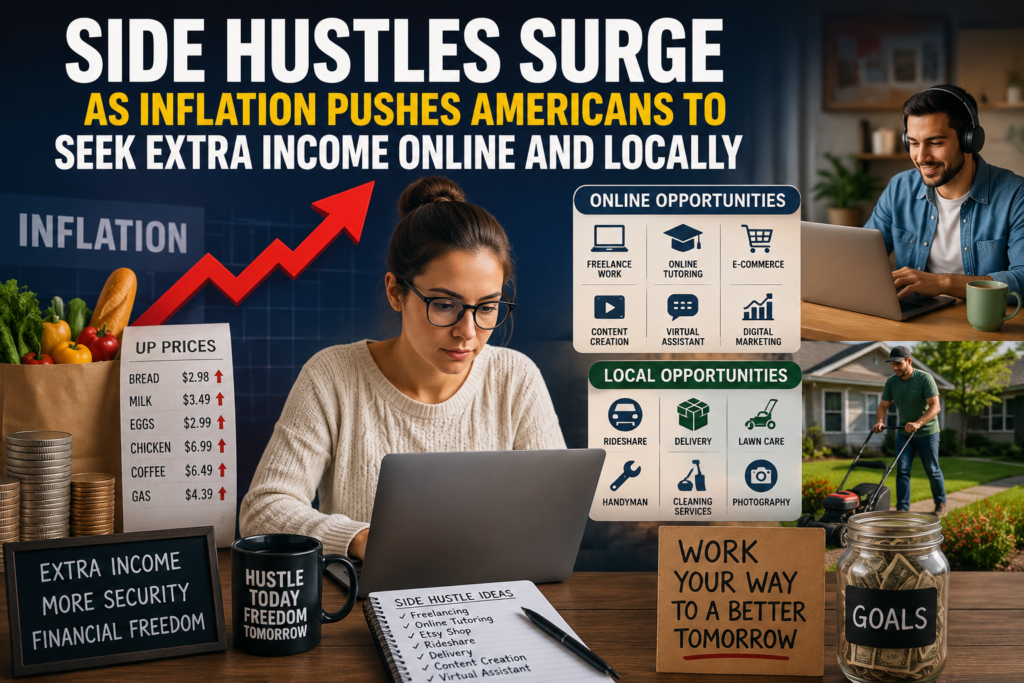
In the summer of 2026, the American paycheck is no longer a single, reliable deposit. For tens of millions of workers, it has fragmented into a patchwork of primary wages, gig payments, freelance invoices, and local service fees. Nearly two-thirds of U.S. consumers continue to live paycheck to paycheck, and a substantial share report that their main job alone cannot cover rising costs for housing, groceries, utilities, and transportation. Inflation, though cooler than the peaks of 2021–2022, remains stubbornly elevated around 3.5 per cent year-over-year as of June 2026, according to Consumer Price Index data. Energy prices have swung sharply, food costs continue climbing, and real wage growth has lagged for many households. The result is a sustained, structural demand for side hustles—extra work done online or in one’s own neighbourhood—to bridge the gap between earnings and expenses.
Surveys from LendingTree, The Penny Hoarder, Omnisend, PYMNTS, and others paint a consistent picture. Roughly 28 to 39 per cent of Americans currently maintain at least one side hustle, generating average monthly earnings of $1,200 to $1,275 for those who participate. In some datasets, 37 to 41 per cent of workers report having done side work in the past six months, while 20 percent hold two or more jobs. Younger cohorts, particularly millennials and Gen Z, show higher participation rates even as overall percentages have moderated slightly from pandemic-era highs. More than half of side hustlers say they would struggle to cover essential expenses without the extra income, and large majorities cite the current economy and inflation as primary drivers. The collective monthly earnings from these activities run into the tens of billions of dollars nationwide.
This is not a fleeting trend driven by temporary pandemic disruption. It reflects a deeper shift in how Americans earn, save, and absorb financial shocks. Primary wages have not kept pace with the cumulative rise in prices since 2020. Household expenses for a typical family can approach or exceed median full-time earnings, leaving little margin for unexpected costs. Many workers no longer wait for employers to deliver meaningful raises that match living costs. Instead, they construct their own supplemental income streams. The paycheck itself has become transactional and multipartite: a main salary or hourly wage supplemented by platform-based gigs, client-based freelancing, digital product sales, or recurring local service routes.
The Economic Backdrop: Inflation That Lingers
Headline CPI inflation stood at approximately 3.5 per cent in the 12 months through June 2026, with core measures excluding food and energy also running above the Federal Reserve’s long-term 2 per cent target. Month-to-month readings have been volatile—sometimes negative, sometimes elevated—driven by swings in energy and continued pressure in services and shelter. Consumer expectations for near-term inflation remain elevated, with one-year-ahead median expectations around 3.7 per cent in mid-2026 surveys. Real average weekly earnings have shown only modest gains in some periods and declines in others when adjusted for prices.
The cumulative effect matters more than any single monthly print. Prices for everyday necessities remain significantly higher than pre-pandemic levels. Housing costs, in particular, continue to strain budgets, as do groceries, insurance, and transportation. Lower- and middle-income households feel this most acutely because a larger share of their spending goes toward essentials. High-income households have maintained or increased real spending in some categories, contributing to a K-shaped pattern in consumer behaviour. For those living closer to the edge, even modest additional monthly income—$200 to $500—can meaningfully reduce stress around bills, debt payments, or emergency reserves.
Labour market data reinforces the pressure. Multiple-job holding has hovered near multi-decade highs at times, with about one in 20 workers formally recorded as holding more than one job. Broader measures that capture informal side work and platform participation show far higher engagement. Gig and independent work has grown as a share of total economic activity. App-based platforms for rideshare, delivery, and task work facilitate billions of transactions annually and support millions of earners. Independent contractors and freelancers form a substantial portion of the workforce, with many treating these activities as essential rather than optional.
Who Is Side Hustling and Why
Participation cuts across demographics but is especially pronounced among younger workers and those in lower-to-middle income brackets. Millennials in their 30s and early 40s often report the highest average side earnings. Gen Z enters the labour market already oriented toward multiple income streams. Retirees increasingly pick up micro-hustles to stretch fixed incomes against higher costs. Motivations cluster heavily around finances: covering cost-of-living expenses, paying primary bills, building savings or discretionary spending power, and responding to economic uncertainty. Inflation ranks near the top of cited reasons, alongside broader economic conditions and rising housing costs. A large majority of those with side income say it improves their quality of life, and many report that life would feel unaffordable without it.
The work itself has evolved. Early pandemic side hustles often involved simple platform gigs or selling unused items. In 2026, the landscape shows greater differentiation. Low-skill, time-for-money gigs remain popular for their speed to first dollar and flexibility. Skill-based freelancing, niche services, and digital product creation offer higher hourly potential and some scalability. Local, in-person services benefit from the inability of remote work or AI to fully replace physical labour and neighborhood relationships. AI tools have commoditised basic content and design work, pushing successful side hustlers toward higher-judgment tasks that combine human expertise with technology.
Online Side Hustles: Flexibility Meets Competition
Online opportunities dominate lists of accessible extra income. Freelancing on platforms such as Upwork, Fiverr, and specialised marketplaces remains a core category. Writing, editing, graphic design, video editing, web development, social media management, virtual assistance, bookkeeping, and tutoring all attract participants. Realistic earnings vary widely. Entry-level or commodity tasks may yield modest hourly rates under competitive pressure, while specialised or AI-augmented services—strategic content, technical writing, niche consulting, or complex project work—can command $50 to well over $100 per hour or project fees in the hundreds to thousands of dollars. Steady freelancers often report monthly side income of $2,000 to $6,000 once they establish clients and systems.
Content creation and digital products form another major cluster. YouTube, TikTok, Instagram, and newsletter platforms allow creators to monetise through advertising, sponsorships, affiliate links, memberships, and direct product sales. Online courses, templates, printables, stock photography, and software tools can generate recurring or semi-passive revenue after the initial creation effort. E-commerce—selling physical or digital goods via Etsy, eBay, Shopify, Amazon, or Facebook Marketplace—ranks among the most popular categories in multiple surveys. Print-on-demand and reselling reduce inventory risk. Success depends heavily on marketing, niche selection, and customer service; many participants earn only modest sums, while a minority scale into substantial businesses.
Other online options include online tutoring and education (strong demand in academic subjects, test prep, languages, and skills), virtual assistance for busy professionals or small businesses, website and app testing, transcription, data annotation, and customer support roles. Micro-hustles such as short paid consulting sessions, resume critiques, or quick feedback services have gained attention for their low time commitment and higher per-minute rates. AI assistance has lowered barriers for some tasks while intensifying competition in others; workers who use tools effectively to increase output and quality gain an edge, while pure commodity offerings face downward price pressure.
Local and In-Person Side Hustles: Demand That AI Cannot Fully Displace
Not every extra dollar comes through a screen. Local service businesses and neighbourhood gigs remain highly resilient because they require physical presence, tools, and trust. Lawn care and landscaping continue to rank among the most reliable, with hourly rates often $30 to $80 or more depending on market and complexity, and the potential for recurring weekly or biweekly clients. House cleaning, window cleaning, pressure washing, handyman services, junk removal, mobile car detailing, and pool service all show strong demand. Startup costs range from a few hundred dollars for basic cleaning supplies to several thousand for equipment-heavy services such as pressure washing or lawn care. Recurring routes create predictable income and assets that can eventually be sold.
Pet services—dog walking, pet sitting, boarding—benefit from high emotional attachment; owners cut other spending before reducing care for their animals. Rates commonly fall in the $20 to $40 range per walk or visit, with higher earnings for overnight or specialised care. Personal training, both in-person and hybrid online, continues to attract clients focused on health. Holiday light installation, seasonal decorating, and event-related services provide concentrated high-season income. Tutoring in local markets, childcare, house sitting, and notary services also appear frequently on high-earning lists in various states.
These local hustles often start through word of mouth, Nextdoor, Facebook groups, Craigslist, or specialised apps such as TaskRabbit or Airtasker equivalents. Pricing power exists in many markets because time-poor dual-income households value convenience. Barriers to entry are relatively low for many services, though licensing, insurance, and vehicle requirements apply in some cases. Physical work limits pure scalability without hiring help, yet it also insulates these gigs from remote competition and AI displacement.
Earnings Reality, Challenges, and Risks
Average side hustle income figures mask wide variation. Some participants earn a few hundred dollars monthly; others clear several thousand. Hourly rates reported across categories range from the low teens for certain delivery or survey work to $40-plus for specialised services such as dog walking in high-cost areas or skilled freelancing. Annualised side income of $10,000 to $15,000 is common for consistent part-timers working 10 hours weekly at solid rates. Higher earners treat the side activity more like a second business, investing in marketing, systems, and client retention.
Challenges are real. Time is the primary constraint for people already working full-time jobs. Burnout, family strain, and reduced leisure are frequent complaints. Platform gigs involve vehicle wear, fuel costs, and algorithm-driven pay variability. Freelancers face feast-or-famine income, late payments, and the need for continuous marketing. Local service providers manage weather, seasonality, physical demands, and customer acquisition. Tax complexity rises with 1099 income; self-employment taxes, quarterly estimated payments, and record-keeping become necessary. Lack of benefits—health insurance, retirement contributions, paid leave—remains a major concern for those heavily reliant on independent work. Some surveys show that a notable share of gig workers struggle to cover basic expenses even with the extra income, highlighting that side hustles often supplement rather than fully solve financial stress.
Competition has intensified. AI tools have reduced demand for basic writing, simple design, and certain administrative tasks. Oversupply on popular platforms can depress rates. Economic slowdowns or shifts in consumer spending can hit discretionary services harder than essentials such as repairs, basic cleaning, or pet care. Inflation itself affects costs for side hustlers—fuel for delivery drivers, materials for handymen, software subscriptions for freelancers—squeezing margins.
Strategies That Work in 2026
Successful participants tend to follow common patterns. They start with skills or assets they already possess rather than chasing every trend. They treat the side activity with professional discipline: clear pricing, reliable delivery, client communication, and basic systems for tracking time and money. Many combine multiple small streams—“side stacking”—rather than relying on a single source. Skill-based and specialised offerings outperform pure commodity work. Local service providers build recurring client lists. Online creators focus on niches with clear monetisation paths and use AI for leverage rather than the replacement of judgment.
Financial experts advising on FIRE (financial independence, retire early) and personal finance consistently emphasise increasing earnings alongside expense control. Side income can accelerate debt payoff, emergency fund building, and investment contributions. Micro-hustles and short high-value sessions appeal to time-constrained professionals. Digital products and content offer the theoretical path to less time-intensive income once established, though the upfront work is substantial.
Broader Implications for Personal Finance and the Economy
The normalisation of side hustles has altered household balance sheets and labour market dynamics. Income diversification provides a buffer against job loss or reduced hours. At the same time, the fragmentation of earnings reduces predictability, complicating budgeting, credit applications, and long-term planning. Employers face workers who are less dependent on a single paycheck and potentially more open to mobility. Platforms and marketplaces continue to intermediate a growing share of economic activity, capturing fees while providing access and flexibility.
Policymakers and researchers debate the implications for benefits, tax policy, and worker protections. The growth of independent work expands economic opportunity for many while leaving others exposed to income volatility and without traditional safety nets. Consumer spending data shows that much of the nominal growth in recent periods has been price-driven rather than volume-driven, underscoring that households are working harder simply to maintain purchasing power.
Looking ahead, demand for extra income streams appears durable. Inflation is expected to moderate further over time, yet the elevated level of prices and ongoing cost pressures in housing and services suggest that many households will continue seeking supplemental earnings. Technology will keep lowering barriers to certain online activities while raising the bar for differentiation. Local physical services should remain resilient. The most successful side hustlers will likely be those who treat the activity as a deliberate extension of their skills and market realities rather than a temporary fix.
In neighbourhoods across the country and on digital platforms serving global clients, Americans are rewriting the rules of personal finance one extra shift, one freelance project, and one local service call at a time. The side hustle is no longer a quirky lifestyle choice or a pandemic stopgap. For a large and growing share of the population, it has become a practical response to an economy in which a single paycheck often falls short. The constant demand for ways to make extra money—online or locally—reflects both the pressures of persistent inflation and the adaptive capacity of workers determined to close the gap themselves.
==