
New York and Washington, August 2, 2026 — The United States stock exchanges form the largest, deepest, and most influential equity marketplace on the planet. As of early August 2026, the total market capitalisation of U.S.-based public companies stands in the vicinity of $75 trillion, a figure that reflects both the extraordinary growth of American corporations over the past decade and the central role these markets play in global capital allocation. On Friday, August 1, the major indexes closed higher, with the Dow Jones Industrial Average finishing near 52,485, the S&P 500 around 7,490, and the Nasdaq Composite near 25,374, buoyed by strong earnings from key technology firms even as Treasury yields climbed and selective concerns about supply chains and valuations persisted.
This comprehensive news report examines the structure of U.S. stock exchanges, their historical development, regulatory architecture, recent performance through 2025 and the first seven months of 2026, the roles of major participants, ongoing structural debates, and the outlook for the remainder of the year and beyond. It is intended as a detailed reference for investors, policymakers, corporate executives, and anyone seeking to understand how the world’s premier equity markets operate and evolve.
Historical Evolution: From Informal Agreements to Global Infrastructure
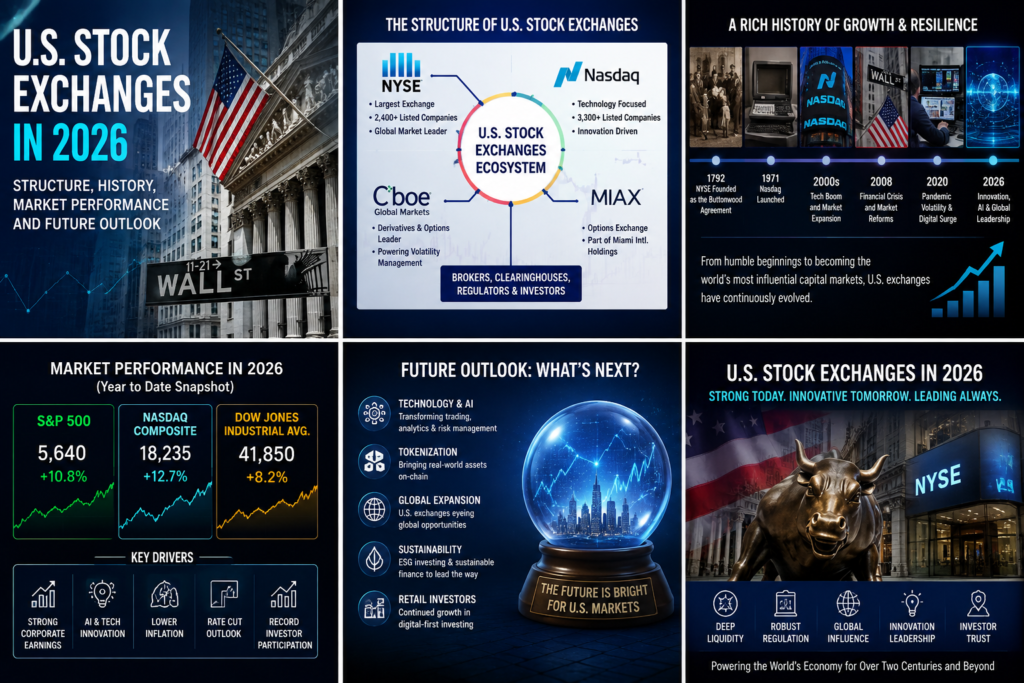
The roots of organised securities trading in the United States stretch back more than two centuries. On May 17, 1792, twenty-four stockbrokers and merchants gathered under a buttonwood tree on Wall Street in New York City and signed what became known as the Buttonwood Agreement. They pledged to trade only with one another and to charge a fixed commission rate of 0.25 per cent. This informal pact established the foundation for the New York Stock Exchange, then known simply as the New York Stock & Exchange Board. Trading initially focused on government securities issued to finance the Revolutionary War and early corporate shares.
Throughout the nineteenth century, the exchange matured alongside the American economy. The construction of railroads, the expansion of manufacturing, and the growth of banking created a steady supply of securities. The Civil War accelerated the need for capital markets, and by the late 1800s the NYSE had become the dominant venue for large industrial and railroad companies. Physical trading on the floor, with specialists maintaining orderly markets in assigned stocks, defined the model for generations.
The early twentieth century brought both boom and catastrophe. The 1920s bull market ended with the October 1929 crash, which wiped out fortunes and contributed to the Great Depression. Public outrage and economic devastation prompted landmark federal legislation. The Securities Act of 1933, often called the “truth in securities” law, required companies offering securities to the public to provide full and fair disclosure. The Securities Exchange Act of 1934 created the Securities and Exchange Commission and established a framework of continuous disclosure, antifraud rules, and oversight of exchanges as self-regulatory organisations. These statutes remain the bedrock of U.S. securities regulation.
For decades, the NYSE operated as a private membership organisation owned by its seat-holders. That model began to change in the late twentieth century. In 1971 the National Association of Securities Dealers launched the Nasdaq system—the National Association of Securities Dealers Automated Quotations—as the world’s first electronic stock market. Nasdaq automated price quotes for over-the-counter stocks and gradually evolved into a full-fledged exchange that specialised in growth companies, particularly those in technology and biotechnology. By the mid-2000s, Nasdaq had registered as an independent national securities exchange, and its parent company had become a publicly traded technology and market-infrastructure firm.
The 1990s and 2000s brought further transformation. Decimalisation reduced the minimum price increment from fractions of a dollar to one cent, dramatically narrowing spreads. The Unlisted Trading Privileges Act of 1994 allowed any exchange to trade stocks listed on another exchange, intensifying competition. Electronic communication networks and alternative trading systems proliferated. High-frequency trading firms emerged as major liquidity providers. The NYSE demutualised, merged with the electronic platform Archipelago, joined with Euronext, and ultimately became a subsidiary of Intercontinental Exchange. Ownership shifted from member firms to public shareholders, aligning incentives with efficiency and technology investment.
By 2026, the U.S. equity market had grown into a complex, multi-venue ecosystem. Approximately twenty-nine national securities exchanges are registered with the SEC under Section 6 of the Exchange Act, supplemented by dozens of alternative trading systems and dark pools. The primary listing venues remain the NYSE and Nasdaq, but trading in any listed stock can occur across the network of exchanges and off-exchange venues. Newer entrants, including the Texas Stock Exchange (approved in 2025) and 24X National Exchange (which offers extended trading hours), continue to challenge traditional models.
Contemporary Structure: Fragmentation, Competition, and Connectivity
Modern U.S. equity market structure is characterised by fragmentation tempered by connectivity and regulation. A company chooses one primary listing venue—typically the NYSE or Nasdaq—based on prestige, listing standards, fees, and industry peer group. Once listed, however, its shares may trade on any national securities exchange or alternative system. Trade reporting is organised into three tapes: Tape A for NYSE-listed securities, Tape C for Nasdaq listings, and Tape B for securities listed on other exchanges, including many exchange-traded funds and smaller companies.
The New York Stock Exchange continues to operate a hybrid model that combines high-speed electronic matching with a physical trading floor at 11 Wall Street. Floor brokers and designated market makers still play roles in price discovery for certain stocks and during periods of stress, although the vast majority of volume is electronic. The NYSE and its affiliated venues (NYSE Arca, which is a major platform for ETFs, and NYSE American for smaller companies) emphasise listing standards that favour larger, more established issuers with substantial public floats and earnings histories.
Nasdaq, by contrast, has been fully electronic since its inception. It operates three listing tiers—the Global Select Market with the most rigorous requirements, the Global Market, and the Capital Market for smaller growth companies. Technology, internet, software, biotechnology, and innovative industrial firms predominate among Nasdaq listings. Nasdaq’s parent company also supplies trading technology and data services to exchanges and market participants around the world.
Beyond these two giants, Cboe Global Markets operates several equity exchanges that compete aggressively on fees, speed, and order types. The Investors Exchange (IEX) introduced a deliberate speed bump to reduce the advantages of the fastest high-frequency traders. MEMX, MIAX platforms, the Long-Term Stock Exchange, and others offer differentiated value propositions. Dark pools and wholesale market-making arrangements handle a substantial portion of retail order flow, allowing many individual investors to receive price improvement relative to the displayed national best bid and offer, while also raising questions about transparency and the quality of the public quote.
Trading hours traditionally run from 9:30 a.m. to 4:00 p.m. Eastern Time, with limited pre-market and after-hours sessions. In 2025 and 2026, proposals for significantly extended or near-continuous trading gained momentum. 24X National Exchange already offers trading from early morning until evening, and both Nasdaq and other operators have filed for regulatory approval of 23-hour or longer equity trading sessions, aiming to accommodate global investors whose business days do not align with New York time.
Indexes provide the primary performance benchmarks. The Dow Jones Industrial Average, a price-weighted index of thirty large blue-chip companies, remains a widely followed barometer of industrial and financial strength. The S&P 500, a market-capitalisation-weighted index of approximately five hundred leading companies across all major sectors, is regarded by most professionals as the best single proxy for the overall U.S. equity market. The Nasdaq Composite includes nearly all stocks listed on Nasdaq and is heavily influenced by technology. The Russell 2000 tracks smaller companies. Thousands of exchange-traded funds and sector indexes allow investors to gain precise exposure to industries, themes, factors, and international markets.
The Regulatory Framework: Investor Protection and Market Integrity
The Securities and Exchange Commission stands at the centre of U.S. securities regulation. Its statutory mission is to protect investors, maintain fair, orderly, and efficient markets, and facilitate capital formation. The Division of Trading and Markets oversees exchanges, broker-dealers, clearing agencies, transfer agents, and alternative trading systems. Exchanges function as self-regulatory organisations: they write and enforce rules for their members and listed companies, but those rules are subject to SEC review and approval. FINRA regulates broker-dealers and conducts much of the day-to-day examination and enforcement work.
Public companies must register securities offerings, file periodic reports (annual Form 10-K, quarterly Form 10-Q, and current Form 8-K), and comply with proxy rules, beneficial-ownership disclosure, and governance standards. Listing exchanges impose additional quantitative and qualitative requirements covering market capitalisation or shareholders’ equity, public float, number of shareholders, share price, and board independence. Continued-listing standards prevent companies that fall below minimum thresholds from remaining on the major boards indefinitely. In 2026, both Nasdaq and the NYSE advanced proposals to strengthen certain continued-listing criteria, including higher minimum market-value thresholds and minimum trading-price standards.
Market-wide circuit breakers and the Limit Up-Limit Down mechanism help contain extreme volatility. Declines of 7 per cent, 13 per cent, and 20 per cent in the S&P 500 from the previous close trigger sequential trading halts. Individual stocks are constrained by dynamic price bands that prevent trades far outside recent prices. These tools, refined after the 2010 Flash Crash and other episodes, have generally performed as designed during periods of stress.
Antifraud provisions under Section 10(b) of the Exchange Act and Rule 10b-5 prohibit insider trading, market manipulation, and deceptive practices. Enforcement actions, civil penalties, and criminal referrals remain active components of the regulatory toolkit. The SEC also oversees the Public Company Accounting Oversight Board and works with other agencies on systemic-risk issues.
Scale, Participants, and Capital Formation in 2026
The sheer size of the U.S. equity market is difficult to overstate. At approximately $75 trillion in mid-2026, it dwarfs every other national equity market and accounts for a dominant share—often estimated above 60 per cent—of global free-float market capitalisation in broad international indexes. This scale provides unmatched liquidity, allowing large institutional orders to be executed with relatively limited market impact, and supports a deep ecosystem of research, data, and ancillary services.
Issuers range from the largest technology and industrial conglomerates to emerging growth companies and real-estate investment trusts. Initial public offering activity recovered markedly after the quieter years of the early 2020s. 2025 saw a substantial increase in both deal count and proceeds relative to 2024, and 2026 continued with strong capital-raising volumes, particularly among companies tied to artificial intelligence, cloud computing, and related infrastructure, even as the number of transactions fluctuated by quarter.
Investors span the spectrum from individual retail participants—empowered by zero-commission trading, fractional shares, and mobile applications—to enormous institutional pools of capital. Public pension funds, corporate defined-contribution plans, mutual funds, exchange-traded funds, hedge funds, endowments, foundations, and sovereign wealth funds all allocate significant portions of their portfolios to U.S. equities. The rise of passive investing has been one of the defining trends of the past two decades. Index funds and ETFs now hold large percentages of many major companies, influencing both ownership concentration and the mechanics of price discovery.
Market makers, high-frequency trading firms, and wholesalers supply continuous liquidity. Clearing and settlement occur primarily through the systems of the Depository Trust & Clearing Corporation, with the standard settlement cycle having shortened to T+1 in recent years, reducing counterparty risk and capital requirements.
Performance Through 2025 and Mid-2026: Strength Amid Volatility
The year 2025 delivered robust returns for the major indexes despite episodes of tariff-related uncertainty and other policy debates. All three major averages posted double-digit percentage gains, marking the third consecutive year of positive performance—a streak last seen in the late 2010s and early 2020s. Artificial-intelligence enthusiasm, strong corporate earnings, and resilient consumer and business spending supported the advance.
2026 opened with continued momentum but quickly encountered volatility. Geopolitical tensions, including developments involving Iran, produced significant drawdowns in the first quarter, with major indexes declining approximately 10 per cent at their worst points before recovering. The second quarter proved exceptionally strong. The Nasdaq 100 recorded one of its best three-month performances in decades, advancing roughly 18 per cent in a single quarter, while the S&P 500 and Dow also posted solid gains. Small-capitalisation stocks, as measured by the Russell 2000, enjoyed periods of relative outperformance.
By the end of July and into early August, year-to-date leadership had rotated at times. Technology and semiconductor stocks drove much of the earlier advance, fueled by earnings reports that validated heavy capital spending on AI infrastructure. Later in the summer, concerns about valuations, rising long-term interest rates, oil-price movements, and selective supply-chain constraints—particularly affecting certain consumer-electronics companies—produced periods of rotation into other sectors. On August 1, the indexes closed higher, with the Dow advancing approximately 0.53 per cent, the S&P 500 0.70 per cent, and the Nasdaq Composite 1.00 per cent, as strong results from Amazon and other technology leaders reassured investors about returns on AI investment. Apple shares, however, declined sharply after management flagged potential component shortages.
Market concentration remains a central feature. A relatively small number of mega-capitalisation technology and AI-related companies account for a disproportionate share of both market capitalisation and index returns. This concentration amplifies gains during periods of optimism and increases vulnerability during rotations or earnings disappointments. Passive investment flows tend to reinforce the pattern by channelling capital proportionally into the largest names.
Volatility spikes in recent years have often been shorter in duration than in earlier decades, partly because of rapid policy responses, deep liquidity, and the willingness of many investors to buy weakness. At the same time, dispersion among individual stocks has frequently remained elevated even when index-level volatility appears moderate, creating opportunities for active stock selection.
Economic Significance and Global Position
U.S. stock exchanges perform indispensable economic functions. They enable corporations to raise permanent equity capital for research, expansion, acquisitions, and innovation without the fixed repayment obligations of debt. Secondary-market trading provides continuous liquidity and price discovery, allowing investors to reallocate capital efficiently and establishing valuation signals that guide broader economic decisions. The discipline of public disclosure and independent board oversight can improve corporate governance relative to purely private ownership.
Retirement systems rely heavily on equity returns. Millions of American workers hold equity exposure through 401(k) plans, IRAs, and pension funds. Corporate executives receive significant portions of compensation in the form of stock and options, aligning incentives with long-term shareholder value. Equity markets also serve as a sensitive barometer of economic confidence, influencing consumer spending through wealth effects and informing monetary-policy deliberations at the Federal Reserve.
Internationally, the depth, liquidity, and perceived institutional quality of U.S. markets continue to attract foreign issuers and investors. Many non-U.S. companies list shares or American Depositary Receipts in New York to access larger pools of capital and higher valuations. Global asset-allocation models routinely assign heavy weightings to U.S. equities.
Persistent Challenges and Policy Debates
Several structural issues remain subjects of active discussion among regulators, market participants, and academics. Fragmentation across dozens of trading venues and the significant volume executed in dark pools raise questions about the quality of public price discovery and the fairness of the displayed national best bid and offer. The dominance of passive investing alters the traditional relationship between fundamental research and security prices and can exacerbate concentration risk.
High-frequency and algorithmic trading improve liquidity and reduce spreads for many participants but continue to generate concerns about technological arms races, complexity, and the potential for sudden liquidity evaporation. Valuation levels for growth-oriented technology stocks prompt periodic warnings about sustainability, particularly if earnings growth fails to meet elevated expectations. Geopolitical risks, the path of inflation and interest rates, fiscal policy, and supply-chain constraints—especially those related to advanced semiconductors and AI infrastructure—introduce ongoing uncertainty.
Competition among exchanges is intensifying with the arrival of new platforms offering extended hours or specialised listing models. At the same time, private capital markets have expanded dramatically, allowing many companies to remain private longer and potentially reducing the traditional pipeline of initial public offerings. Cybersecurity, operational resilience, and evolving disclosure requirements around climate and other non-financial risks add further layers of complexity for both issuers and intermediaries.
Outlook for the Remainder of 2026 and Beyond
As of early August 2026, the U.S. equity market stands at elevated absolute levels after several years of strong gains. The combination of technological transformation—particularly the commercial application of artificial intelligence—corporate earnings resilience, and the structural advantages of liquidity and institutional frameworks provides a supportive backdrop. Near-term performance will hinge on several variables: the trajectory of inflation and Federal Reserve policy, the durability of AI-related capital expenditure and the productivity gains it ultimately delivers, the resolution or escalation of geopolitical tensions, the breadth of market participation beyond the largest technology names, and the evolution of long-term interest rates.
Longer-term, the exchanges themselves are likely to continue evolving. Extended trading hours, refined listing standards, enhanced technology, and intensified competition among venues appear probable. Regulatory efforts will focus on balancing investor protection, market integrity, and the need to maintain vibrant capital formation. The ability of U.S. markets to attract both domestic and international capital, while adapting to technological and structural change, will remain a critical determinant of American economic dynamism.
The United States stock exchanges are far more than venues for buying and selling shares. They constitute essential national infrastructure for mobilising savings, allocating capital, disciplining corporate management, and signalling economic conditions to policymakers and the public. Their continued success in fulfilling these roles—while navigating concentration risks, technological disruption, and geopolitical uncertainty—will help shape the trajectory of the American and global economies in the years ahead.
In summary, the U.S. equity market in 2026 is characterised by extraordinary scale, sophisticated structure, robust but selective performance, and a dynamic interplay between innovation and regulation. Investors, companies, and policymakers will continue to watch these markets closely as they navigate the opportunities and challenges of the mid-2020s.
(This report is based on publicly available market data, regulatory information, exchange disclosures, and performance figures current as of early August 2026. Equity markets are inherently dynamic; readers should consult primary sources, official filings, and qualified professional advice before making investment or policy decisions.)