
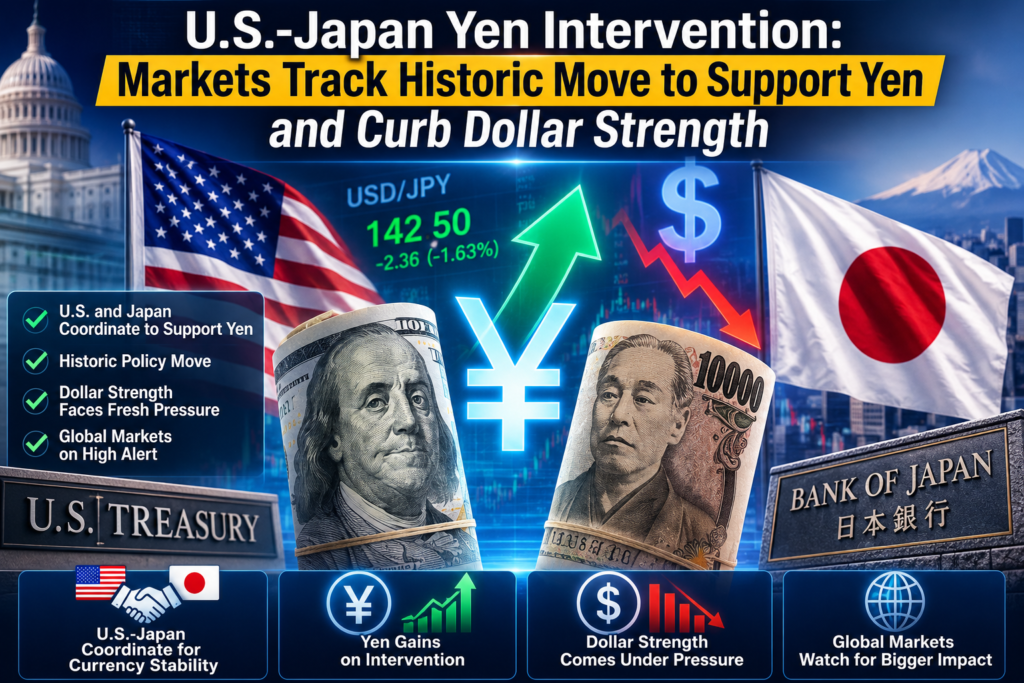
Global financial markets are closely monitoring the confirmed coordinated currency intervention by the United States and Japan aimed at supporting the yen and addressing excessive dollar strength, marking a rare bilateral action that has shifted sentiment across foreign exchange, bond, and equity markets. On Monday, Japanese authorities formally confirmed that Tokyo and Washington jointly intervened in the foreign exchange market on Friday to buy yen, the first such coordinated yen-support operation in nearly three decades and the first joint intervention of any kind since 2011. Officials from both countries signalled they stand ready to take further action if disorderly moves in the yen persist, heightening traders’ vigilance and elevating the prospect of sustained policy coordination.
The yen had slumped to multi-decade lows against the dollar in late July, approaching the psychologically significant 164 level and its weakest point since 1986. The depreciation intensified pressures on Japanese households and businesses through higher import costs, particularly for energy, amid broader inflationary challenges. Japanese authorities conducted yen-buying operations during New York trading hours on Thursday, with Bank of Japan data and market estimates indicating that dollar sales could have totalled up to $59 billion. Reports indicated follow-up action the next day, coinciding with U.S. involvement.
U.S. Treasury Secretary Scott Bessent and Japanese Finance Minister Satsuki Katayama both confirmed the joint effort. Japan’s Finance Ministry stated that the Friday intervention with the U.S. Treasury Department “countered excessive volatility and disorderly movements in the Japanese yen in recent months.” Katayama told reporters that authorities “will not hesitate to conduct further coordinated intervention” and remain in close communication with their U.S. counterparts. Bessent echoed the resolve, stating Washington “will not hesitate to participate in further joint intervention” and expressing strong support for Japan’s “decisive market and monetary steps to correct the substantial undervaluation of the yen.” He reiterated calls for further interest-rate increases by the Bank of Japan.
Market participants noted that the U.S. action involved the Federal Reserve Bank of New York selling euros to purchase yen on behalf of the Treasury, executed through major banks including Goldman Sachs and Morgan Stanley, according to people familiar with the matter. Earlier signals included rate checks by U.S. authorities and a handwritten note on Bessent’s notepad during a cabinet meeting referencing a potential purchase of Japanese yen in the range of $5 billion to $10 billion. The coordination extended beyond verbal support, with Japanese officials describing U.S. backing as going beyond psychological assistance.
Following the confirmation, the yen strengthened sharply. It surged more than 1 per cent to levels around 155.20 per dollar at one point, its strongest since early May and well clear of the recent lows near 164. In New York trading around the time of the operations, the dollar fell notably against the yen, with moves of nearly 2 per cent reported in some sessions. Traders remained on high alert for possible additional intervention, contributing to reduced speculative short positions in the yen and a more cautious approach to dollar longs.
President Donald Trump characterised the assistance as a sign of friendship, stating that Japan “wanted a little bit of help” with its weakening yen and that the United States is “always there for Japan.” He suggested the move would benefit both economies and the broader global economy. The intervention comes against a backdrop of close high-level contacts, including Bessent’s anticipated meetings with Bank of Japan Governor Kazuo Ueda at upcoming international gatherings.
Background: Yen Weakness and Policy Pressures
The yen’s prolonged decline has been driven by a combination of interest-rate differentials, shifts in global risk sentiment, and domestic Japanese factors. While the Bank of Japan has gradually moved away from ultra-loose policy, raising rates to 1 per cent, the pace has lagged expectations in some quarters relative to other major central banks. Persistent yen weakness raised import prices, contributing to cost-of-living pressures that weighed on public sentiment and political considerations in Tokyo. Energy market volatility linked to geopolitical developments further amplified the impact on Japan’s terms of trade.
Japanese officials had issued repeated warnings about excessive volatility and the readiness to take decisive action. Rate checks and close coordination signals with U.S. counterparts in preceding months had already put markets on notice. South Korean authorities were also reported to have sold dollars in parallel on certain days, adding a regional dimension to efforts to stabilise Asian currencies. Analysts viewed the alignment of interests as particularly significant given the tight coupling sometimes observed between the yen and other regional currencies.
Concerns about potential spillovers featured prominently in the decision-making. A sharp further selloff in the yen risked triggering disorderly moves in Japanese government bonds, which could in turn exert upward pressure on U.S. Treasury yields at a time when those markets already faced sensitivity. Japan’s large holdings of U.S. Treasuries in its foreign exchange reserves mean that large-scale yen-buying interventions typically involve selling dollars and potentially adjusting those holdings, creating a delicate balance. Officials highlighted tools available to address liquidity needs, including access to Federal Reserve facilities.
Details of the Operations and Official Messaging
The sequence of events unfolded over several days. On Thursday, Japanese authorities intervened during New York hours. Estimates derived from Bank of Japan account data and broker forecasts suggested a substantial operation, on the order of several trillion yen. The following day, with the Bank of Japan holding its policy rate steady at 1 per cent while signalling potential readiness to adjust further, U.S. authorities moved in coordination. The New York Fed’s involvement in selling euros for yen represented an unusual operational choice that broadened the intervention beyond a pure dollar-yen focus.
Confirmation came in formal statements on Monday. The Japanese Ministry of Finance emphasised that it remains attentive and in close contact with the U.S. Treasury. Both sides framed the action as targeting disorderly market conditions rather than seeking a specific exchange-rate level. This distinction is important in the context of longstanding international understandings around currency policy, which generally discourage competitive devaluations or targeting of levels while permitting action against excess volatility.
Bessent’s public comments linked the intervention to broader support for Japanese monetary policy normalisation. By encouraging further Bank of Japan rate hikes, U.S. officials appear to view the combination of market operations and domestic policy tightening as mutually reinforcing for correcting what they describe as substantial undervaluation of the yen. Katayama declined to comment on whether additional intervention occurred on the day of the announcement, consistent with authorities’ typical practice of maintaining tactical ambiguity about day-to-day operations.
Market Reactions Across Asset Classes

Currency markets reacted with an immediate strengthening of the yen and a corresponding softening of the dollar against it. The move disrupted crowded short-yen positions that had built up over preceding months. Volatility in the pair increased in the short term as participants recalibrated positions and monitored for follow-through action. Cross rates involving the yen against the euro and other currencies also shifted, reflecting the multi-currency nature of some of the reported U.S. operations.
In fixed-income markets, the intervention’s implications for Japanese government bonds and U.S. Treasuries drew close attention. Stabilisation of the yen reduces the urgency of large reserve adjustments that could otherwise pressure bond yields. At the same time, heightened expectations of Bank of Japan policy tightening contributed to upward pressure on Japanese yields in some maturities. U.S. Treasury yields faced a complex set of influences, including reduced selling pressure from Japanese official accounts and broader risk sentiment.
Equity markets in Japan and globally absorbed the news with a mix of relief and caution. A stronger yen can pressure the earnings of major Japanese exporters in local-currency terms, yet it also eases cost pressures and can support domestic demand. Broader risk assets tracked the reduction in disorderly currency moves as a modest positive for global financial stability. Commodity markets, particularly energy, remained sensitive given Japan’s import dependence and the prior role of energy price spikes in exacerbating yen weakness.
Analysts noted that while coordinated intervention can deliver a powerful short-term signal and clear speculative positions, lasting trends in exchange rates typically require supporting shifts in fundamentals, including interest-rate differentials, growth differentials, and current-account dynamics. Historical episodes of joint yen intervention have sometimes coincided with turning points, though the durability of moves has varied.
Historical Context of Coordinated Interventions
Joint U.S.-Japan currency operations are infrequent. The most recent prior coordinated action occurred in 2011, when G7 partners intervened to weaken the yen following the devastating Tohoku earthquake and tsunami, aiming to prevent excessive appreciation that could hinder Japan’s recovery. The last significant joint effort to support the yen through purchases dated to the late 1990s amid the Asian financial crisis, when the yen had weakened sharply.
Earlier episodes in the 1990s and 2000s involved various combinations of unilateral Japanese action, U.S. participation, and broader G7 coordination, sometimes to support the dollar or to manage yen strength. The 1985 Plaza Accord remains a landmark example of multilateral efforts to address currency misalignments, though the institutional and economic context has evolved considerably since then. In more recent years, Japan conducted sizable unilateral yen-buying interventions in 2022 and 2024, deploying tens of billions of dollars in total, yet those efforts faced challenges in reversing the broader trend without concurrent shifts in monetary policy.
The current operation stands out for the explicit confirmation of U.S. participation in yen purchases and the public signalling of readiness for further joint steps. It reflects years of diplomatic engagement aimed at aligning views on when volatility justifies intervention. Japanese officials had worked to secure understanding that action against excessive moves would not be viewed as contrary to shared principles on exchange-rate policy.
Implications for Monetary Policy and Global Coordination
The intervention has raised market expectations for a potential Bank of Japan rate increase as early as September, according to some analysts. Governor Ueda has emphasised that the central bank would not fall behind the curve and could adjust the pace of policy normalisation as warranted. Closer coordination between fiscal and monetary authorities in Japan, as well as with U.S. counterparts, appears to be a feature of the current approach. Statements from currency diplomats have stressed the importance of aligning market operations with the broader policy stance.
For the Federal Reserve and U.S. Treasury, the decision to participate underscores the priority placed on financial stability and the avoidance of disorderly spillovers into U.S. markets. The use of euro sales to acquire yen illustrates operational flexibility and coordination with European counterparts, who were reportedly informed. Discussions around potential expansion of Federal Reserve repurchase facilities for dollar liquidity further highlight the toolkit available to manage funding conditions.
Broader G7 and international discussions on currency markets are likely to reference the episode. While the action was bilateral, the principles invoked—countering excessive volatility rather than targeting levels—align with existing frameworks. Markets will watch for any follow-up statements from other major economies and for data releases that clarify the exact scale of operations once official figures become available in coming weeks or months.
Analyst Perspectives and Forward Outlook
Currency strategists have described the joint intervention as historic and significant for the short term, capable of forcing a reassessment of short-yen positioning. However, many emphasise that durable appreciation of the yen would benefit from continued progress on Japanese monetary policy normalisation, narrowing of yield differentials, and stabilisation of external factors such as energy prices. One assessment noted that while the move provides an important signal, underlying fundamentals still need to evolve for a sustained trend change.
Risks remain in both directions. Renewed speculative pressure against the yen could prompt further official action, reinforcing the deterrent effect. Conversely, if the yen strengthens too rapidly or disorderly in the opposite direction, authorities would face a different set of considerations. Political and economic calendars in both countries, including fiscal discussions in Japan and data-dependent policy decisions in the United States, will influence the backdrop.
Traders and portfolio managers are adjusting hedges, reviewing exposure to Japanese assets, and monitoring cross-asset correlations more closely. The episode has underscored the potential for official sector coordination to influence market dynamics even in deep and liquid currency markets. Liquidity conditions, particularly around major data releases or geopolitical developments, will remain a focus.
In equity and credit markets, Japanese financial institutions and exporters are under particular scrutiny for the balance-sheet and earnings effects of currency moves. Global investors with significant yen exposure or carry-trade positions have faced rapid mark-to-market adjustments. The reduction in extreme yen weakness may also ease some pressures on inflation-sensitive segments of the Japanese economy, supporting the case for a measured policy path.
Broader Economic and Geopolitical Dimensions
The intervention occurs within a complex geopolitical environment. Energy market dynamics, trade relationships, and alliance considerations all form part of the backdrop. U.S. support for Japanese currency stability is framed in terms of mutual economic benefit and the strength of the bilateral relationship. Japanese officials have highlighted continuous contact with U.S. counterparts as a key element of their strategy.
For emerging-market currencies and other Asian markets, the stabilisation of the yen can have indirect effects through risk sentiment and regional trade linkages. Coordinated action involving South Korea in earlier sessions illustrated the potential for wider regional responses when currency pressures intensify.
Looking ahead, markets will parse upcoming economic data from both countries, Bank of Japan communications, and any further official remarks on currency policy. The confirmation of readiness for additional joint intervention has established a higher bar for speculative positioning against the yen in the near term. Whether the current episode marks a durable inflexion or a temporary pause will depend on the interplay of policy actions, economic fundamentals, and market psychology in the weeks and months to come.
The scale of official resources available remains substantial. Japan holds large foreign-exchange reserves, predominantly in dollar assets, providing capacity for further operations if needed. U.S. participation adds both financial weight and significant signalling power. The combination has already produced a tangible market response, with the yen recovering from extreme levels and volatility patterns shifting.
As trading continues, participants are balancing the deterrent effect of confirmed coordinated action against the structural factors that contributed to the yen’s earlier decline. Interest-rate paths in the United States and Japan will remain central. Any acceleration in Bank of Japan tightening, supported by the currency stabilisation, could further narrow differentials and reinforce yen support. Conversely, shifts in U.S. policy expectations or global risk appetite could reintroduce pressures.
Officials on both sides have stressed close ongoing communication. This institutional channel reduces the likelihood of surprise divergences in approach and allows for calibrated responses to market developments. The public nature of the confirmation itself serves as a communication tool, clarifying the seriousness with which authorities view excessive volatility.
In summary, the confirmed U.S.-Japan coordinated intervention to support the yen represents a significant policy development that markets are tracking intensively. It has delivered an immediate strengthening of the Japanese currency, prompted position adjustments, and raised the profile of potential further joint action. While short-term effects are evident, the longer-term trajectory of the yen and the dollar will hinge on the evolution of monetary policies, economic data, and the persistence of official resolve against disorderly market conditions. Financial markets across asset classes will continue to price in these dynamics as the situation develops.
The episode also serves as a reminder of the interconnected nature of global currency markets and the capacity of major economies to coordinate when shared interests in financial stability are at stake. Traders, investors, and policymakers alike will be watching closely for the next signals from Tokyo and Washington.
==