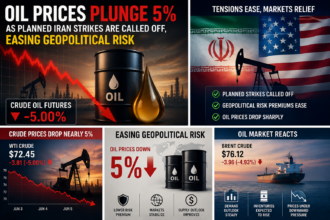

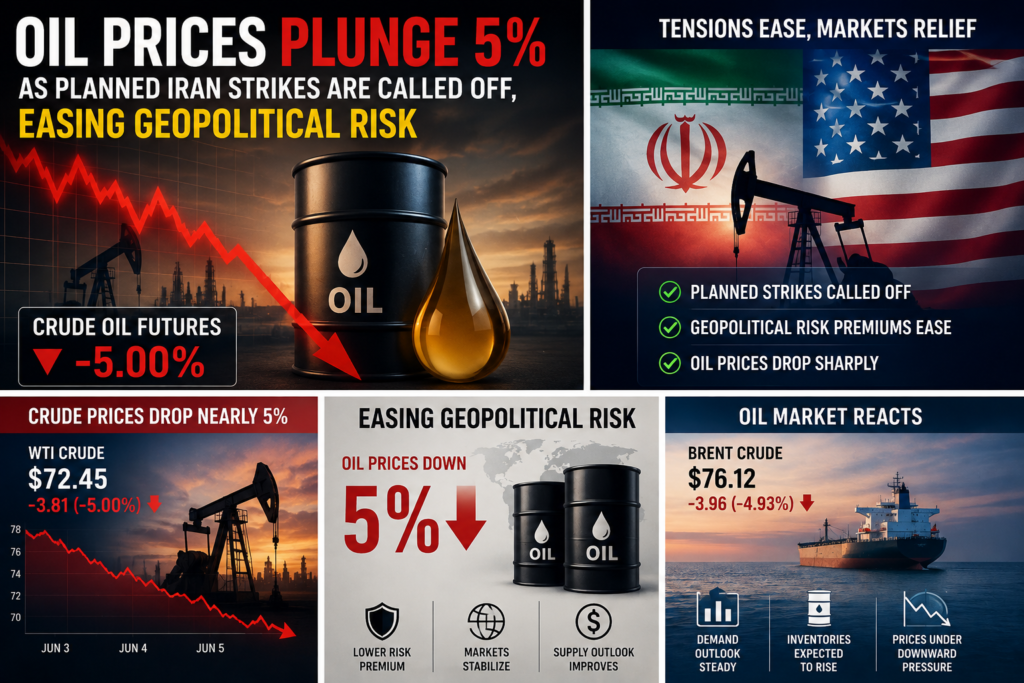
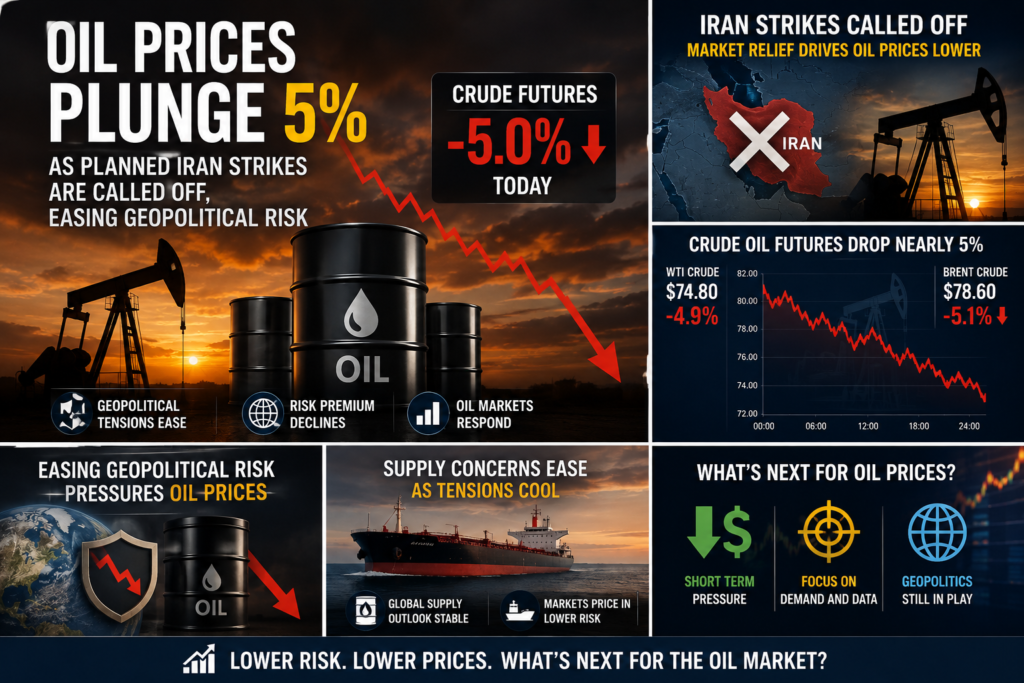
Crude oil futures plunged roughly 5% in early trading after President Donald Trump abruptly cancelled planned U.S. military strikes against Iran. The decision quickly reduced the geopolitical risk premium that had been built into oil prices for months amid tit-for-tat attacks, threats to the Strait of Hormuz, and fears of a broader regional conflagration. Benchmark contracts retreated sharply as traders recalibrated expectations for supply disruptions, shifting from acute scarcity risk toward cautious optimism about de-escalation.
Brent crude, the international benchmark, and West Texas Intermediate (WTI), the U.S. marker, both registered steep declines. Reports from the period indicated Brent settling lower by several percentage points, with some sessions showing drops exceeding 4% intraday before stabilising, while WTI mirrored the move. Weekly losses compounded the single-day impact, with both benchmarks shedding more than 4% over the trading week as the news filtered through. Prices that had been elevated by concerns over Hormuz shipping lanes and potential Iranian retaliation found themselves testing multi-week or multi-month lows relative to the peaks seen earlier in the conflict cycle.
The catalyst was clear and market-moving. Earlier in the day, Trump had signalled aggressive intent, warning of strikes that would hit Iran “very hard” and even floating the possibility of controlling Iranian oil infrastructure. Social media posts and Oval Office comments heightened tensions. By late afternoon, however, the president announced that the scheduled strikes and bombings had been cancelled. He cited progress toward a memorandum of understanding with Iran, describing the emerging documents as “very detailed” and expressing confidence that finalisation could occur within days. The pivot removed the immediate threat of escalation and opened a window for diplomacy.
Market reaction was swift and decisive. Analysts noted that the risk premium— the extra amount buyers are willing to pay to insure against sudden supply interruptions—unwound rapidly. IG market analyst Tony Sycamore captured the sentiment: while acknowledging the possibility of another false dawn, he observed that the market’s response had been both immediate and emphatic. Other observers highlighted how headlines alone were driving price action, with confidence growing that an eventual deal could restore more normal flows through critical waterways.
Background: Months of Heightened Risk
The episode did not occur in isolation. For months, oil markets had operated under the shadow of U.S.-Iran hostilities that began intensifying in late February 2026. U.S. and Israeli strikes on Iranian targets had prompted Iranian responses that effectively constrained shipping through the Strait of Hormuz, a narrow chokepoint through which roughly one-fifth of global oil and liquefied natural gas shipments normally pass. Tanker traffic slowed dramatically. Insurance costs soared. Freight rates spiked. Gulf producers raced to find alternative routes or waited for safer passage. The result was a sustained elevation in prices that at times approached or exceeded $100–$120 per barrel at peaks, far above pre-conflict levels near $70–$73.
Iran’s announcement of a formal closure of the strait—threatening to fire on vessels attempting transit—had further tightened the noose. Although commercial ships continued some movement and U.S. military statements indicated ongoing transit, the physical market remained constrained. Hundreds of vessels were reported stranded or delayed in the Persian Gulf at various points. The blockade’s impact was not total, but it was sufficient to keep a significant war risk premium intact. Traders priced in the possibility of further Iranian retaliation, potential damage to infrastructure, or expanded conflict involving proxies such as the Houthis in the Red Sea.
Against this backdrop, any signal of de-escalation carried outsized weight. Trump’s earlier threats had reinforced the premium. His sudden cancellation of strikes, paired with talk of an imminent memorandum of understanding covering nuclear, economic, and potentially shipping issues, reversed the narrative almost overnight. Iranian semi-official media pushed back, with Fars News Agency reporting that Tehran had not approved any final text. Nonetheless, the market chose to price the reduction in near-term kinetic risk rather than the remaining uncertainties.
Price Action in Detail
On the day of the announcement and the subsequent session, the sell-off was broad-based. Brent futures fell by approximately 2.9% to settle near $90.38 in one report, while WTI dropped about 2.6% to $87.71. The following day extended the losses: Brent declined another $1.21 or 1.3% toward $89.17, with WTI off $1.23 or 1.4% near $86.48. Cumulative moves pushed some contracts to their lowest levels in nearly two months. In certain sessions, the intraday percentage decline approached or exceeded 5% from recent highs as algorithmic trading and stop-loss orders amplified the move.
The weekly picture confirmed the shift. Brent was down roughly 4.2% and WTI about 4.4% for the week. Broader energy complexes followed: European gas prices also eased on hopes of a framework deal, and refined product futures softened. Equity markets, particularly energy-sensitive and broader indices, responded positively in many cases as lower oil prices reduced inflation fears and supported consumer spending power.
Physical market signals lagged the futures reaction but later began to reflect the change in tone. Reports indicated surges of tankers exiting the Strait of Hormuz once diplomatic progress advanced further. Gulf countries accelerated efforts to resume exports. Major importers proceeded with less urgency to secure alternative supplies. The psychological shift was as important as any immediate volume increase: the fear of a sudden, severe cut in seaborne crude from the Gulf had diminished.
Drivers of the Risk Premium Unwind
Geopolitical risk premiums in oil are inherently fragile. They rise quickly on credible threats of disruption and fall equally fast when those threats recede. In this case, several reinforcing factors accelerated the decline. First, the explicit cancellation of planned strikes removed the most immediate catalyst for Iranian retaliation against shipping or energy infrastructure. Second, the prospect of a memorandum of understanding—even if incomplete—suggested a pathway to reopen Hormuz more fully. Third, the absence of immediate kinetic action allowed inventories and alternative supply sources to provide a buffer that markets had previously discounted.
Analysts emphasised that the market had been “headline-driven.” Every statement from Washington or Tehran moved the needle. When Trump described progress at the highest levels of Iranian leadership and involvement of a regional coalition, traders interpreted it as a genuine off-ramp. When Iranian sources later disputed the terms, prices partially retraced but did not fully reverse the earlier drop. The net effect remained a substantial easing of the premium.
Structural factors also played a role. Global oil balances were not uniformly tight. Chinese crude imports had shown weakness in some months, and refinery runs faced constraints. U.S. production remained robust. Strategic petroleum reserves and commercial stocks offered some cushion. These underlying fundamentals meant that once the acute geopolitical overlay lightened, prices had room to fall without immediately encountering physical shortages.
Broader Market and Economic Implications
The oil price retreat carried implications far beyond the energy complex. Lower crude prices translate into reduced input costs for transportation, manufacturing, and petrochemicals. In consumer economies, cheaper gasoline and diesel support household budgets and can temper inflation readings. Central banks monitoring energy-driven price pressures gained breathing room. Equity markets in oil-importing nations often cheered the development, while energy equities and oil-exporting currencies faced headwinds.
For Gulf producers, the situation was double-edged. Easier passage through Hormuz promised higher export volumes and revenue recovery after months of constrained shipments. At the same time, lower prices reduced the per-barrel realisation. Saudi Arabia, the UAE, Kuwait, and others had every incentive to support de-escalation that restored normal trade flows. Iranian oil itself, long constrained by sanctions, stood to benefit if any deal included economic relief, though verification and implementation remained distant.
Shipping and insurance markets also adjusted. War-risk premiums on hull and cargo policies for Gulf voyages had inflated costs dramatically. A credible reduction in hostilities promised lower premiums, cheaper freight, and more willing participation by major tanker operators. Reports of commercial vessels continuing transit even during peak tension periods suggested that operators were prepared to resume fuller schedules once political cover improved.
Analyst Perspectives and Remaining Risks
Market commentators struck a note of cautious relief rather than outright celebration. “While this could, of course, be yet another false dawn,” one analyst observed, “the market’s reaction has been both swift and decisive.” Others warned that support levels in the low $80s for Brent remained critical; a break below could invite further selling, but a hold would keep upside risks alive should diplomacy falter.
The durability of any memorandum of understanding was the central uncertainty. Iranian statements indicated that final negotiations would focus on nuclear and economic issues while excluding the missile program. U.S. demands historically included broader constraints. Gaps of this nature had derailed previous efforts. Moreover, the physical reopening of Hormuz would take time even under ideal political conditions—clearing backlogs, restoring insurance markets, and rebuilding confidence among shipowners.
Proxy activity posed another risk. Houthi actions in the Red Sea or Iranian-aligned groups elsewhere could reintroduce disruption independently of direct U.S.-Iran engagement. Inventory draws, unexpected demand strength from Asia, or OPEC+ policy shifts could also reassert upward pressure. In short, the 5% slide removed a significant layer of risk premium but did not eliminate volatility.
Historical Context and Parallels
Oil markets have long exhibited extreme sensitivity to Middle East events. The 1973 embargo, the 1979 Iranian Revolution, the Iran-Iraq War tanker wars of the 1980s, the 1990–91 Gulf War, and more recent episodes involving Hormuz tensions all produced rapid price spikes followed by sharp corrections once supply fears eased. The 2026 episode fit the pattern: a rapid premium build on credible threat, followed by an equally rapid unwind on credible de-escalation signals.
What distinguished the latest move was the speed of the policy pivot. Markets had priced in the possibility of strikes; the cancellation arrived within hours of heightened rhetoric. The resulting intraday and multi-session percentage declines ranked among the sharper risk-premium unwind events of the year. Subsequent weeks saw further declines as diplomatic progress continued, with prices eventually approaching or testing pre-war levels in some benchmarks before later volatility returned with renewed hostilities.
Looking Ahead: Pathways and Scenarios
Traders and policymakers now face a bifurcated outlook. In a constructive scenario, the memorandum of understanding solidifies, Hormuz traffic normalises over weeks rather than months, and the residual risk premium continues to erode. Prices could grind lower toward the mid-to-high $70s or below, contingent on demand and OPEC+ discipline. In a less favourable path, negotiations stall, limited strikes resume, or proxy attacks intensify, rapidly reinserting the premium and potentially driving prices back above $100.
Energy agencies and investment banks updated forecasts accordingly. Some trimmed near-term price expectations while stressing that full normalisation of Gulf flows would take longer than markets initially hoped. Physical tightness in certain grades and regions could persist even as paper markets celebrated the diplomatic thaw.
For consumers and businesses, the immediate effect was welcome relief at the pump and in fuel budgets. For producers, the message was clear: geopolitical stability remains a prerequisite for sustained revenue. For governments, the episode reinforced the strategic importance of the Strait of Hormuz and the value of diplomatic off-ramps.
Conclusion
The roughly 5% slide in crude oil futures after the cancellation of planned strikes on Iran illustrated once again how quickly geopolitical risk premiums can expand and contract. What had been a market braced for escalation became, within hours, a market pricing de-escalation. The move eased inflationary pressures, supported broader risk assets, and offered a temporary respite from the supply anxieties that had dominated energy markets for months.
Yet the underlying vulnerabilities remain. The Strait of Hormuz continues to carry a disproportionate share of global energy trade. Diplomatic agreements are fragile until implemented and verified. Physical logistics recover more slowly than futures prices adjust. Until those deeper factors stabilise, oil markets will remain susceptible to sharp swings on political headlines. The latest price action provided a textbook demonstration of risk-premium dynamics—and a reminder that in oil, as in geopolitics, the distance between threat and relief can be measured in a single announcement.
(The report synthesises contemporaneous market reporting, price data, official statements, and analyst commentary from the June 2026 period surrounding the cancellation of planned U.S. strikes on Iran and the associated oil price reaction.)