

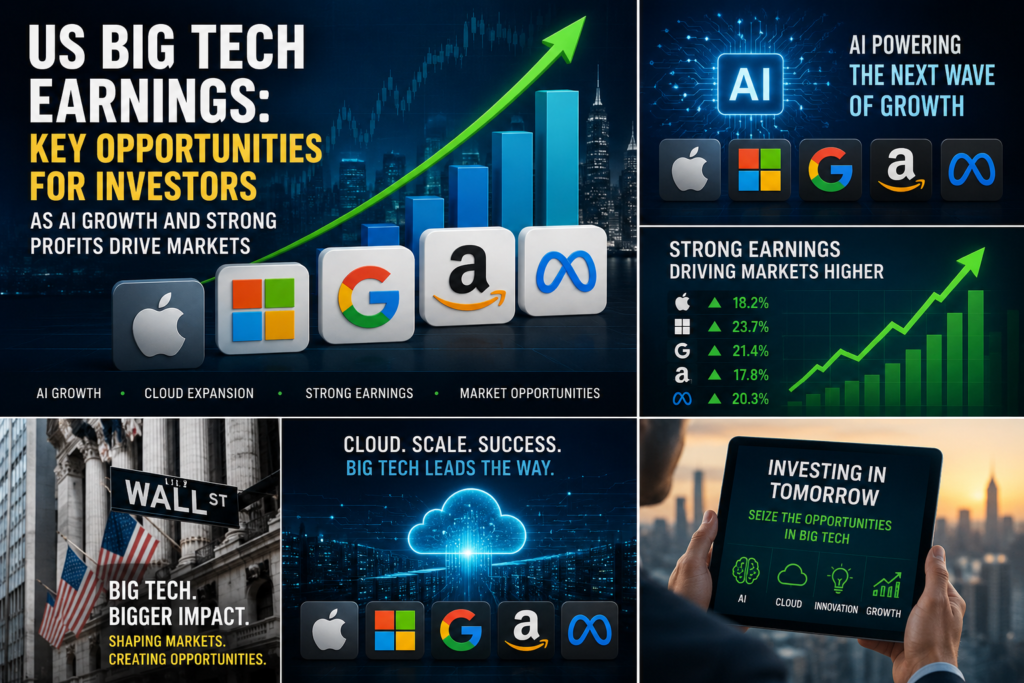
The second-quarter 2026 earnings season for America’s technology giants has delivered a familiar yet evolving narrative: extraordinary growth powered by artificial intelligence, paired with record capital expenditure that is reshaping free cash flow profiles and testing investor patience. As the “Magnificent Seven” and their peers reported results through late July and early August, the central question for investors shifted from whether AI demand exists to whether the massive infrastructure buildout will generate durable returns at acceptable timelines.
Alphabet, Microsoft, Amazon, Meta, Apple and others posted strong revenue and, in most cases, earnings beats. Yet market reactions were highly differentiated. Stocks that successfully framed elevated spending as necessary to capture constrained supply and accelerating monetisation were rewarded. Those that raised capex guidance while showing softer near-term free cash flow or decelerating growth faced sharper scrutiny. The result is a clearer map of opportunities and risks for the remainder of 2026 and into 2027.
This report examines the key results, the underlying AI dynamics, the capital intensity challenge, and the investment implications emerging from the data.
The Broader Context: Earnings Growth Remains Concentrated but Broadening
S&P 500 earnings for the second quarter of 2026 have been robust. Blended year-over-year growth has climbed well above earlier estimates, helped significantly by large positive surprises from Alphabet and Amazon. Communication Services and Consumer Discretionary sectors saw particularly sharp upward revisions in growth rates after results. Information Technology also contributed meaningfully through beats from Microsoft, Apple and others.
The Magnificent Seven continue to punch above their weight. With six of the seven having reported (Nvidia’s results due later in August), the group is tracking toward very strong aggregate earnings growth on solid revenue expansion. The concentration of AI-driven profits remains high, yet the broader market has shown more participation than in prior cycles. Still, the hyperscalers’ spending plans—collectively tracking toward roughly $700–750 billion in 2026 and potentially approaching $1 trillion in 2027—dominate the conversation.
The defining tension is straightforward. Revenue and AI-related metrics are accelerating for cloud and advertising platforms. At the same time, capital expenditures have risen so sharply that free cash flow has turned negative or declined meaningfully at several firms for the first time in years. Investors are no longer content with abstract promises of future AI monetisation; they want evidence that today’s outlays will convert into sustainable high-margin revenue streams without indefinite dilution of returns.
Alphabet: Blowout Numbers Meet Capex Reality
Alphabet kicked off the major reports with a standout quarter. Revenue rose 24% year-over-year to approximately $119.8 billion, ahead of expectations. Reported earnings per share of $9.11 dramatically exceeded consensus, though the figure included a very large non-operating gain of roughly $98 billion primarily from net unrealised gains on equity securities. Excluding that item, the underlying EPS was far closer to expectations.
Google Cloud delivered the standout operating performance, with growth accelerating sharply—reports indicated rates in the 80%+ range in some analyses, a significant step-up from prior periods. The backlog in cloud reached hundreds of billions, underscoring multi-year visibility. Search and other advertising remained resilient.
The market’s reaction, however, focused heavily on capital expenditure. Capex came in slightly above expectations at nearly $45 billion for the quarter. More importantly, management’s comments and implied trajectory suggested elevated spending would persist. Free cash flow turned negative for the first time in the company’s public history, a direct consequence of the infrastructure buildout. Alphabet’s stock sold off sharply in the aftermath, reflecting investor discomfort with the combination of accounting gains boosting headline EPS and genuine cash burn on AI capacity.
The opportunity here lies in the acceleration of Google Cloud, and the scale of the model training and inference demand the company is capturing. Alphabet’s TPU investments and DeepMind capabilities give it a differentiated stack. The risk is that the market will continue to penalise negative free cash flow until clearer evidence emerges that incremental AI revenue is covering the cost of capital on new data centres at an acceptable payback period.
Microsoft: Azure Strength and a Clearer Narrative on Capex
Microsoft delivered one of the cleaner reports of the season. Revenue reached roughly $90 billion for the fiscal fourth quarter, up about 18% year-over-year and ahead of consensus. Earnings also beat, with EPS coming in above the $4.24 expectation.
Azure growth remained robust, with rates in the low-to-mid 40% range in some disclosures, supported by AI services. Microsoft highlighted that its AI business had reached a substantial run rate (reports cited figures around $37 billion annualised in recent periods), with strong sequential momentum. Paid Microsoft 365 Copilot seats surpassed 30 million, with net additions accelerating. Commercial remaining performance obligations climbed significantly, providing multi-year visibility.
Management successfully framed elevated capital spending as a response to genuine supply constraints rather than speculative overbuild. Investors largely accepted the narrative. The stock responded positively, gaining in the high single digits to low double digits in the immediate aftermath, according to various market summaries.
Microsoft continues to demonstrate the most balanced AI story among the hyperscalers: strong existing cloud franchise, enterprise distribution advantage through Office and GitHub, and a partnership ecosystem (including OpenAI) that accelerates productisation. The opportunity for investors remains the compounding of high-margin software and cloud revenue as AI features move from experimental to mission-critical across enterprises. The primary watch item is the trajectory of gross margins and free cash flow as depreciation from the new capacity begins to flow through.
Amazon: AWS Acceleration and the Anthropic Gain
Amazon posted strong top-line results. Net sales rose approximately 20% to $200.6 billion. AWS was the clear highlight, growing 37% to about $42.2 billion—its fastest pace in more than four years. Operating income in the cloud segment expanded significantly, with margins improving.
Reported net income of $62.6 billion, or $5.75 per share, included a large pre-tax gain of roughly $53.4 billion primarily related to the company’s investment in Anthropic. Excluding that item, the underlying profitability picture was still solid but less spectacular. Free cash flow over the trailing twelve months swung to an outflow, driven by heavy AI infrastructure spending.
Amazon’s ability to show accelerating AWS growth while simultaneously investing aggressively resonated with the market. The stock advanced strongly after the report. The company’s dual engines—retail efficiency and high-margin advertising on one side, and cloud/AI on the other—provide multiple levers. Custom silicon (Trainium and Inferentia) offers a potential cost and performance edge over pure GPU reliance.
The opportunity is the continued reacceleration of AWS and the potential for AI services and chips to become material contributors. The risk is the sheer scale of planned spending (guidance and analyst estimates point to very large 2026 outlays) and the corresponding pressure on free cash flow in the near term.
Meta: Revenue Growth Meets Cost Expansion
Meta delivered solid revenue growth of 28% to approximately $60.8 billion, slightly ahead of some estimates. Advertising remained the core engine. However, total costs and expenses rose much faster—around 55% in some reports—compressing profitability. Free cash flow declined sharply. Third-quarter revenue guidance came in somewhat softer than the most optimistic expectations.
The market reaction was negative. Investors focused on the combination of decelerating growth relative to prior periods, rising costs tied to AI infrastructure and Reality Labs, and guidance that did not fully offset concerns. Meta has raised its capex outlook substantially, consistent with the broader hyperscaler trend.
Meta’s AI investments in recommendation systems, advertising tools (Advantage+), and large language models continue to drive engagement and monetisation. The long-term opportunity in AI-powered advertising efficiency and new product surfaces remains intact. Near-term, the company faces a higher bar for proving that incremental spending is translating into accelerating, high-quality revenue rather than simply higher fixed costs.
Apple: Record Revenue, Services Softness, and Relative Capex Discipline
Apple reported record revenue of roughly $109.4 billion for its fiscal third quarter, up 16%. Earnings rose more sharply, with EPS of $2.02 beating consensus. iPhone performed well, and growth was broad-based across regions and categories. Services revenue, however, came in below some expectations.
Apple’s capital expenditure remains a fraction of the sums being deployed by the hyperscalers. This relative discipline has been viewed by some as a strength—Apple is not burning cash on speculative data centre capacity at the same scale. Others see it as a lag in the AI arms race.
The stock reaction was modestly negative, reflecting concerns about China momentum, services trajectory, and the lack of a dramatic AI narrative to match peers. Apple’s opportunity lies in on-device AI features, services expansion, and the potential to leverage its installed base and silicon expertise without matching the absolute dollar spend of cloud providers. The risk is that the market continues to assign a lower multiple until clearer evidence of AI-driven incremental growth emerges.
Nvidia and the Supply Chain: The Primary Beneficiaries So Far
Although Nvidia had not yet reported its full fiscal results as of early August (expected later in the month), prior quarterly data and guidance already positioned it as the clearest near-term winner. Data centre revenue has been running at extraordinary levels, with Blackwell architecture driving sequential gains. Gross margins remain elevated. Guidance has consistently pointed to continued strong demand.
The broader AI supply chain—semiconductors, networking, power, cooling, and construction—continues to capture a disproportionate share of the economic value created by hyperscaler spending in the current phase. Analysts have noted that free cash flow generation at leading chip and equipment companies is expected to remain robust even as hyperscaler free cash flow turns negative or soft. This divergence is one of the more important themes for portfolio construction.
Cross-Cutting Themes: Monetisation Progress Versus Capital Intensity
Several consistent threads run through the reports:
AI revenue is real and accelerating. Cloud growth rates at Microsoft, Alphabet and Amazon have reaccelerated. AI-specific run rates (tokens processed, Copilot seats, AI services revenue) are climbing rapidly. Advertising platforms are embedding AI more deeply into targeting and creative tools.
Capital expenditure is at historic scale. Combined spending by the largest hyperscalers is tracking toward levels rarely seen outside wartime or major infrastructure booms. Data centre construction, power availability, and specialised chips remain constraints. Management teams argue that current spending is necessary to meet demand that already exceeds available capacity.
Free cash flow is the new focal point. Headline EPS has been flattered in some cases by investment gains. Investors are increasingly looking through to cash generation after maintenance and growth capex. Negative or declining free cash flow is being tolerated only when accompanied by clear evidence of accelerating high-margin revenue and multi-year backlog visibility.
Valuation and positioning have reset. The premium of the Magnificent Seven relative to the rest of the S&P 500 has compressed compared with earlier peaks in the cycle. This creates a more balanced risk-reward for selective exposure, provided investors underwrite the duration of the spending cycle correctly.
Reading the Opportunity
For investors, the post-earnings landscape offers several distinct pathways.
First, the hyperscalers that have demonstrated the clearest link between spending and accelerating monetisation—particularly Microsoft and Amazon on the latest evidence—warrant continued attention. Their existing distribution, enterprise relationships, and ability to layer AI on top of already profitable cloud franchises reduce execution risk relative to pure-play infrastructure plays.
Second, the AI supply chain remains attractive on a near-to-medium-term basis. Companies providing the critical scarce inputs (advanced GPUs and accelerators, high-bandwidth memory, networking silicon, power infrastructure) are converting hyperscaler capex into high-margin revenue and strong free cash flow today. The risk is eventual overcapacity if spending slows abruptly; the opportunity is that current backlog and multi-year customer commitments provide visibility.
Third, selective exposure to platforms with underappreciated AI leverage or relative capital discipline (certain aspects of Apple’s ecosystem, or Meta’s advertising efficiency if costs stabilise) may offer asymmetric upside if the market’s current scepticism proves overdone.
Fourth, the broadening of earnings growth beyond the absolute largest names creates opportunities in second-order beneficiaries—software companies embedding AI features, industrials and utilities supporting data centre power and construction, and selected semiconductor equipment and materials providers.
Risks remain material. An abrupt slowdown in hyperscaler spending, higher-than-expected cost of capital, power or permitting constraints that delay capacity, or a failure of AI applications to deliver productivity gains at scale could pressure multiples across the complex. Geopolitical and regulatory developments around AI, data, and competition also warrant monitoring.
Outlook and Conclusion
The Q2 2026 earnings season has not resolved the fundamental debate over the ultimate returns on the AI infrastructure supercycle. It has, however, provided clearer evidence that demand is robust, monetisation is progressing, and the capital intensity is higher and more prolonged than many expected even a year ago.
Century Financial views the current environment as one that rewards selectivity and a focus on cash flow quality and competitive positioning rather than indiscriminate exposure to the “AI theme.” The companies that can demonstrate a credible path from today’s elevated spending to sustainable free cash flow expansion and high returns on invested capital will likely command premium valuations. Those that cannot will face ongoing multiple compression even if revenue growth remains solid.
As Nvidia reports later in August and the third-quarter guidance season unfolds, the market will continue to refine its assessment of the duration and returns of this cycle. For now, the data support a constructive but discriminating stance: the opportunity is real, the scale of investment is unprecedented, and the winners will be those that convert capacity into durable, high-margin revenue streams most efficiently.
Investors should remain focused on the fundamentals that matter most in this phase—growth in AI-related revenue and backlog, trends in free cash flow after growth capex, and evidence that incremental dollars of spending are generating incremental dollars of high-quality earnings. The second-quarter results have advanced that analysis meaningfully. The opportunity is there for those prepared to read it carefully.
=