

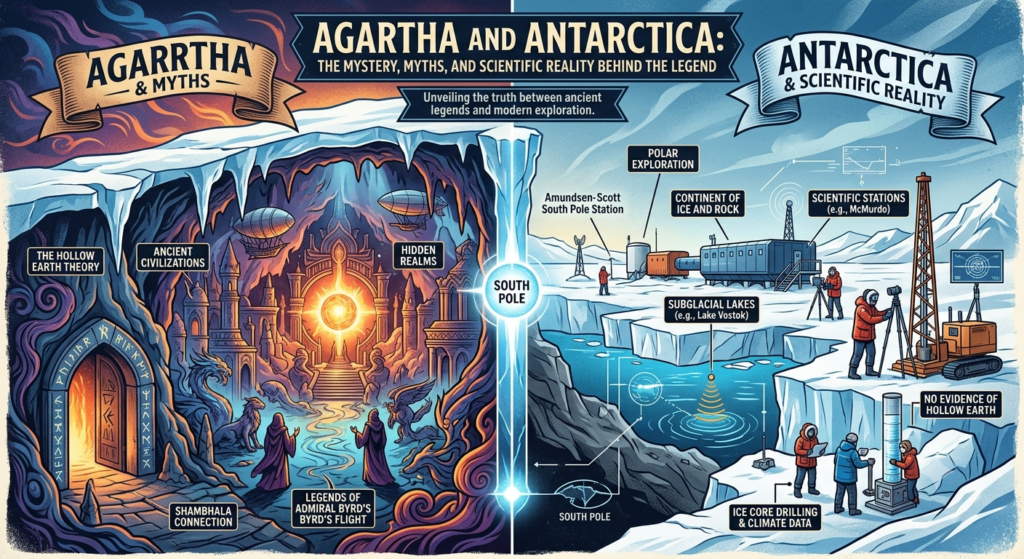
The legend of Agartha describes a mythical, highly advanced subterranean civilisation housed within a hollow Earth. According to folklore and esoteric traditions, this hidden realm is a paradise of enlightened beings, glowing crystals, advanced technology, and spiritual wisdom, connected to the surface world through a network of tunnels and portals scattered across the globe. In modern internet lore, the myth has become tightly linked to Antarctica through fictitious diaries attributed to the American polar explorer Admiral Richard E. Byrd, who allegedly flew into a warm green paradise during a 1947 expedition and met its inhabitants. These stories captivate the imagination, blending adventure, conspiracy, and the allure of lost civilisations. Yet they stand in stark contrast to established science and historical record. Seismology, gravity data, and planetary physics demonstrate that Earth is not hollow. Byrd’s actual missions were rigorous military and scientific undertakings focused on mapping the icy continent. Meanwhile, genuine discoveries beneath Antarctic ice shelves reveal thriving dark ecosystems and ancient marine microbes—remarkable real-world phenomena that require no mythical framework. This report examines the origins and evolution of the Agartha legend, the fabricated Byrd connection, the documented historical reality, and the extraordinary scientific findings that illuminate life in one of Earth’s most extreme environments.
Historical Origins of the Agartha Myth
The concept of Agartha, also spelt Agharta, Agharti, Agarttha, or similar variants, entered Western consciousness primarily through late-nineteenth-century occult literature, though its roots draw on older Eastern and speculative ideas. French esoteric philosopher Alexandre Saint-Yves d’Alveydre provided one of the most influential early accounts in his 1886 manuscript Mission de l’Inde en Europe (Mission of India in Europe). Saint-Yves described Agartha as a vast underground kingdom located deep beneath the Himalayas or Central Asia. Ruled by a sovereign pontiff known as the Brahâtma or “King of the World,” it housed millions of inhabitants organised according to synarchic principles—an ideal of hierarchical yet harmonious governance. These beings possessed extraordinary longevity, telepathic abilities, profound spiritual insight, and technologies far surpassing those of surface humanity. According to the narrative, the kingdom had once flourished on the surface but withdrew underground as the world entered a period of violence and instability associated with the Kali Yuga, the age of darkness in Hindu cosmology. From their hidden domain, the Agarthans preserved ancient knowledge in immense libraries and occasionally influenced surface events through emissaries, while largely remaining observers rather than interveners.
Saint-Yves claimed to have received this information from an Eastern initiate, though scholars note that the work reflects a synthesis of contemporary Orientalist interests, Theosophical ideas, and utopian political philosophy. The manuscript was initially suppressed by its author amid personal and esoteric concerns, but its ideas circulated within occult circles. Earlier precursors include references by French writer Louis Jacolliot in the 1870s to “Asgartha,” an ancient city drawn loosely from Indian mythology, and broader nineteenth-century fascination with lost civilisations such as Atlantis and Lemuria. Russian Theosophist Helena Blavatsky and other esoteric writers further linked underground realms to spiritual hierarchies and “White Lodges,” sometimes conflating Agartha with the Tibetan Buddhist concept of Shambhala—a hidden pure land of enlightened beings. Western occultists often merged these traditions, transforming Shambhala from a spiritual or subtle realm into a physical subterranean city.
By the early twentieth century, Agartha had become entangled with Hollow Earth theories. American writer Raymond Bernard (the pen name of Walter Siegmeister) played a significant role in popularising this fusion in his 1964 book The Hollow Earth. Bernard claimed that UFOs originated from Agartha and that polar openings provided access to the inner world. He also helped disseminate the fabricated “Secret Diary of Admiral Byrd,” which would later fuel Antarctic-specific versions of the legend. Other writers, including French author Robert Charroux and Chilean esoteric fascist Miguel Serrano, incorporated Agartha into broader narratives of Hyperborea, polar origins, and secret knowledge. Nazi-era occult interests occasionally touched on related ideas, with some fringe elements exploring Hollow Earth concepts or searching for mythical realms in Tibet and Central Asia, though claims of systematic Nazi belief in Agartha as the capital of a hollow Earth are often exaggerated in popular retellings.
The myth evolved further in the postwar period through pulp fiction, conspiracy literature, and eventually the internet. Proponents described Agartha not merely as a single city but as a network of subterranean colonies or an entire inner-Earth civilisation. Inhabitants were variously portrayed as survivors of Atlantis or Lemuria, spiritually ascended humans, or even non-human beings. Descriptions frequently emphasised glowing crystal architecture, advanced flying craft, vast libraries of forbidden knowledge, and a society free from war, disease, and material scarcity. Some modern accounts claim telepathic contact with Agarthans or assert that world governments already know of the realm’s existence. Despite the absence of any physical evidence, the legend persists because it satisfies deep psychological and cultural needs: the desire for hidden wisdom, the fantasy of superior beings watching over humanity, and the romance of unexplored frontiers.
Hollow Earth Theories and the Subterranean Metropolis
Agartha is inextricably linked to the broader Hollow Earth hypothesis, which posits that the planet is not a solid sphere but a hollow shell with an inhabitable interior, often illuminated by an internal sun or central light source. The idea has ancient and early modern antecedents. In the late seventeenth century, astronomer Edmond Halley proposed a hollow Earth consisting of concentric spheres to explain anomalous magnetic observations. In the early nineteenth century, American John Cleves Symmes Jr. vigorously promoted a hollow Earth with large polar openings, advocating expeditions to enter the interior. These scientific (or proto-scientific) speculations inspired literary works, including novels depicting lush inner worlds populated by advanced or prehistoric races.
In the Agarthan version, the subterranean metropolis is typically depicted as a paradise. Glowing crystals provide illumination and perhaps energy. Architecture features luminous, rainbow-hued structures formed of crystal-like materials. Transportation includes advanced vehicles capable of rapid travel through tunnel networks linking every continent. The inhabitants are described as taller than surface humans, longer-lived, telepathic, and spiritually enlightened. They are said to possess technologies that harness natural forces in ways lost to the outer world, and their society prioritises harmony, knowledge, and spiritual evolution over conflict or exploitation. Some accounts place the capital, sometimes identified as Shambhala or a related city, at the centre of this network, with satellite colonies beneath mountains or closer to the crust.
Folklore and modern claims locate entrances in numerous places: the North and South Poles, the Himalayas, the Gobi Desert, Mount Shasta in California, the Amazon basin, Kentucky’s Mammoth Cave, the Great Pyramid of Giza, Ayers Rock (Uluru), and various caves in South America, Turkey, and elsewhere. Polar openings feature prominently in Hollow Earth lore, imagined as vast holes hundreds or thousands of miles across, through which ships or aircraft could pass into the interior without realising the transition. Gravity is sometimes explained as holding oceans and atmosphere to the inner surface. These details, while imaginative, conflict fundamentally with established geophysics. Seismic waves from earthquakes travel through Earth’s interior in patterns consistent with a solid inner core, liquid outer core, and solid mantle. Earth’s mass, moment of inertia, and gravitational field match a dense, differentiated solid planet, not a thin shell surrounding an empty cavity. Satellite observations and polar exploration have revealed no openings. The Hollow Earth and Agartha thus remain purely mythical constructs.
The Byrd Diary Myth and Its Antarctic Link

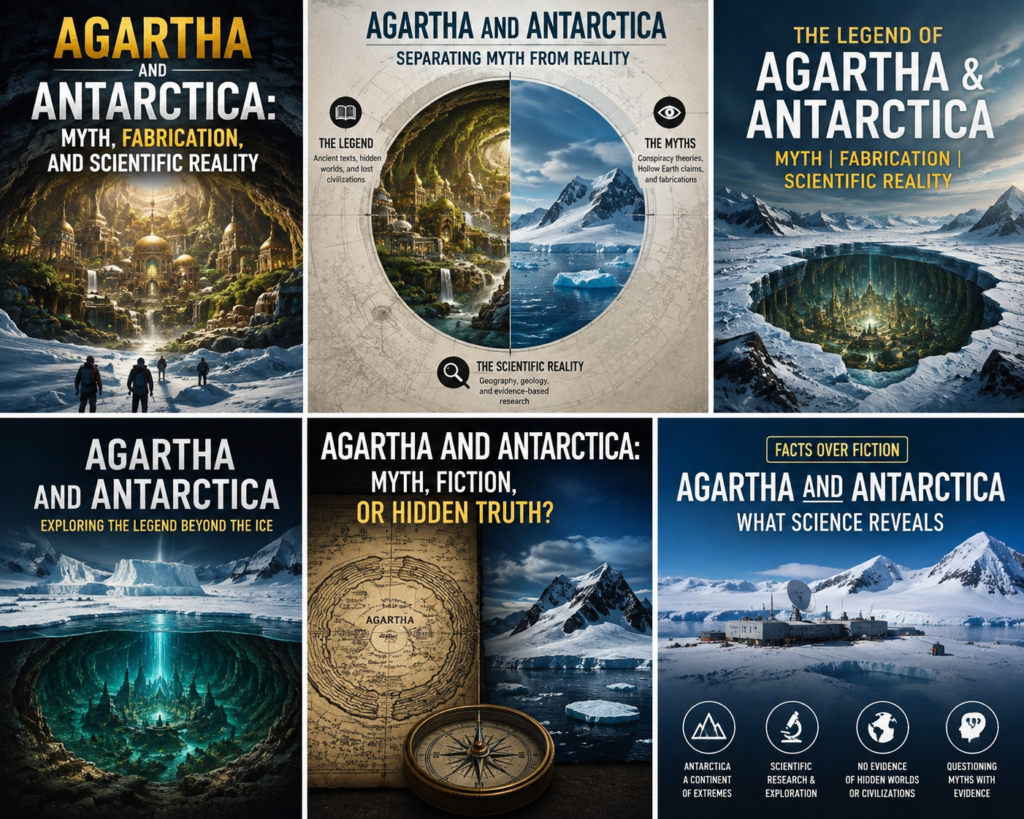
Modern internet culture has forged a particularly strong association between Agartha and Antarctica through stories involving Admiral Richard E. Byrd. According to these narratives, during the U.S. Navy’s Operation Highjump in early 1947, Byrd flew over or into a secret polar opening and discovered a warm, green landscape of forests, rivers, and mountains illuminated by an inner sun. His instruments allegedly malfunctioned, his radio was taken over by advanced beings, and he was invited to land and visit a glittering subterranean or inner-Earth city of crystal. There he met tall, fair-haired Agarthans or similar enlightened beings who expressed concern over humanity’s wars and nuclear weapons, warning of potential catastrophe. Byrd was supposedly ordered to remain silent about the encounter, only revealing it later through a secret diary that circulated decades after his death.
These accounts often blend with other conspiracy themes: surviving Nazi bases in Antarctica, UFO origins, government cover-ups, and the idea that Operation Highjump was a military invasion repelled by superior inner-Earth or extraterrestrial technology. The “secret diary” is frequently quoted with dramatic passages describing the transition from icy desolation to temperate paradise and the awe-inspiring architecture of the hidden civilisation. The stories gained traction in the 1990s and proliferated online, appearing in books, websites, videos, and social media. They appeal because they transform a real historical figure and a large polar expedition into evidence for a hidden world, while casting official accounts as deliberate suppression.
Historical Reality: Admiral Byrd and Operation Highjump
The actual historical record presents a very different picture. Richard Evelyn Byrd (1888–1957) was a distinguished U.S. Navy officer, aviator, and polar explorer. He gained fame for claimed flights over the North Pole in 1926 (later subject to scholarly debate regarding exact reach) and the South Pole in 1929, as well as for organising multiple Antarctic expeditions. His 1934 experience wintering alone at an advanced base, where he nearly died from carbon monoxide poisoning, became the subject of his book Alone. Byrd’s career combined genuine exploratory achievement with careful self-promotion and institutional support from the Navy and private backers.
Operation Highjump, officially the United States Navy Antarctic Developments Program, 1946–1947 (Task Force 68), was the largest Antarctic expedition of its time. It involved approximately 4,700 personnel, 13 ships (including an aircraft carrier and seaplane tenders), and around 25 to 33 aircraft. Organized under Byrd’s overall direction as Officer in Charge, with Rear Admiral Richard H. Cruzen as the operational commander of the task force, the mission’s objectives were practical and strategic: establish the Little America IV research base on the Ross Ice Shelf; test ships, aircraft, vehicles, and logistics under polar conditions; conduct extensive aerial photography and mapping of the coastline and interior; gather meteorological, hydrographic, and other scientific data; and evaluate the feasibility of sustained operations in Antarctica for potential future military or research purposes in the emerging Cold War context.
The Central Group of ships reached the Bay of Whales in January 1947 and began constructing the base. Aircraft conducted extensive reconnaissance and mapping flights, ultimately photographing and charting hundreds of thousands of square miles, much of it previously unexplored in detail. The expedition faced the severe challenges of Antarctic weather, including whiteout conditions that contributed to accidents (notably the crash of a PBM Mariner seaplane with loss of life). Operations were terminated earlier than some plans had envisioned because of the rapid approach of winter and the risk of ships becoming trapped in thickening sea ice. Personnel and vessels returned to the United States in late February 1947. A documentary film, The Secret Land, was produced about the expedition and released publicly, underscoring that the mission was not a clandestine invasion but a large-scale, documented naval and scientific effort.
Byrd gave interviews during and after the operation. One frequently misquoted exchange with journalist Lee van Atta, published in a Chilean newspaper, has been distorted in conspiracy literature to suggest warnings about polar flying objects or hostile advanced craft. Accurate translations and context show Byrd discussing the strategic implications of polar regions in an era of rapid technological change and the end of geographic isolation as a reliable defence. He emphasised the need for preparedness in a shrinking world, not encounters with inner-Earth civilisations. No contemporary accounts from the thousands of participants describe green oases, crystal cities, or meetings with advanced beings. Byrd’s authenticated papers and diaries, preserved in archives including the Byrd Polar and Climate Research Centre at Ohio State University, contain no such material.
Debunking the Fabricated Diary
The so-called “Secret Diary of Admiral Richard E. Byrd” is a later fabrication. It surfaced in conspiracy and UFO literature decades after Byrd’s death in 1957, with no verifiable chain of custody or original manuscript. The Byrd family has not authenticated it. Archives holding Byrd’s papers report no record of any such document and regularly receive inquiries about hollow-Earth claims, which they consistently state are unsupported. The writing style diverges from Byrd’s known prose. Specific dates and events in the diary do not align with the documented flight schedules and operations of Highjump. Claims that Byrd’s son provided the diary have not been substantiated, and related rumours of suspicious circumstances surrounding family members belong to the realm of conspiracy embellishment rather than evidence.
The diary’s content mirrors classic Hollow Earth tropes already circulating in mid-twentieth-century fringe literature: polar openings, inner suns, temperate valleys with prehistoric or advanced life, and admonitions from superior beings about surface humanity’s folly. Its appearance in the 1990s coincided with growing internet dissemination of alternative history and conspiracy material. Independent examinations by researchers and fact-checkers have concluded that it is almost certainly a hoax designed to lend an aura of authority to pre-existing myths by attaching them to a famous explorer. No corroborating testimony from Byrd’s radioman, fellow officers, or the thousands of other expedition members has ever emerged. The absence of evidence across such a large, well-documented operation is decisive.
Scientific Reality: Ecosystems Beneath Antarctic Ice
While the mythical Agartha does not exist, Antarctica conceals genuine scientific wonders in the form of dark, isolated ecosystems. Floating ice shelves—massive extensions of the ice sheet that rest on the ocean—create vast cavities of seawater sealed from sunlight and largely isolated from open ocean circulation. Subglacial lakes, trapped beneath the ice sheet itself, represent even more extreme environments of cold, darkness, high pressure, and limited nutrient input. Research over recent decades, using boreholes, remotely operated vehicles (ROVs), ice cores, and genomic techniques, has revealed that these habitats support active microbial life and, in some cases, complex benthic communities.
Under the Ross Ice Shelf, the largest Antarctic ice shelf, multi-omics studies (metagenomics, metatranscriptomics, and single-cell genomics) have documented diverse microbial assemblages. Primary production is driven not by photosynthesis but by chemolithoautotrophy: microorganisms that obtain energy by oxidising inorganic compounds such as ammonium and sulfur. Key players include ammonia-oxidising archaea of the genus Nitrosopumilus and sulfur-oxidising bacteria such as Thioglobus. These organisms form the base of a food web in an oligotrophic (nutrient-scarce) environment. Viral communities are also active, infecting dominant microbial hosts and potentially influencing nutrient cycling through “kill-the-winner” dynamics and the carriage of auxiliary metabolic genes related to nitrogen, sulfur, and phosphorus metabolism. The microbial composition under the shelf is distinct from open-ocean communities at similar depths, reflecting adaptation to the unique chemistry and isolation of the cavity waters.
Subglacial lakes, such as Mercer Subglacial Lake in West Antarctica, have yielded hundreds of single-cell amplified genomes. Many of these represent previously unknown species that are genetically isolated from marine and surface relatives, indicating long-term evolutionary separation—possibly dating back to the expansion of the Antarctic ice sheet tens of millions of years ago. These microbes display remarkable metabolic flexibility. They can utilise organic carbon or fix inorganic carbon, operate under aerobic or anaerobic conditions, and derive energy from the oxidation of iron, sulfur, ammonium, and other compounds released by the grinding of rock beneath the ice. Some belong to groups such as Patescibacteria, characterised by small cells and streamlined genomes. The discovery of such diverse and adaptable life in environments once thought nearly sterile has expanded understanding of the limits of habitability on Earth and provided analogues for potential life in icy ocean worlds elsewhere in the solar system.
Where ice shelves have retreated or where ROVs and cameras have accessed the seafloor beneath or near the ice, richer communities of macroscopic life have been observed. These include sponges, slow-growing cup corals, bryozoans, icefish, giant sea spiders, octopuses, and other invertebrates. Some coral and sponge communities appear to have persisted for decades or even centuries, suggesting that sub-ice-shelf habitats can support long-term ecological stability when organic matter is available through lateral advection or in-situ production. Borehole studies under ice shelves such as the Ekström have recovered dozens of benthic species, demonstrating greater richness and persistence than previously assumed. Ancient marine microbes preserved in marine ice cores, some dating back centuries, allow scientists to reconstruct past community composition and even estimate evolutionary rates for key genes involved in chemolithotrophy.
These findings are the product of careful, collaborative international science under the framework of the Antarctic Treaty System, which prioritises peaceful research and environmental protection. They reveal a continent whose hidden aquatic realms are dynamic, biologically active, and integral to global biogeochemical cycles, particularly carbon and nutrient fluxes. The real under-ice world is dark, cold, chemically driven, and microbial-dominated in its most isolated reaches—yet it is also capable of supporting surprising diversity and resilience. No glowing crystal cities or enlightened humanoid civilisations are required to explain it.
Cultural Persistence and the Appeal of the Myth
The endurance of the Agartha legend, and its specific linkage to Antarctica via the Byrd myth, reflects broader patterns in how humans construct meaning around the unknown. Polar regions have long served as blank spaces on the map onto which fantasies of lost worlds, advanced races, and hidden knowledge could be projected. Nineteenth-century exploration literature, occult revival movements, and twentieth-century science fiction all contributed motifs that later conspiracy culture reassembled. The internet accelerated the process by allowing rapid sharing of unverified documents, selective quotation, and narrative embellishment. Attachment of the story to a real, celebrated figure like Byrd lends an appearance of credibility that purely fictional accounts lack.
At the same time, the scientific discoveries beneath the ice demonstrate that the unknown continues to yield genuine surprises. Extremophile microbiology, subglacial hydrology, and ice-shelf ecology are active research frontiers with implications for climate science, evolutionary biology, and astrobiology. The contrast between the mythical paradise of Agartha and the actual dark, chemosynthetic ecosystems is instructive: one offers comforting narratives of superior guardians and secret wisdom; the other demands rigorous observation, technological innovation, and acceptance of a universe that is indifferent yet richly complex.
Conclusion

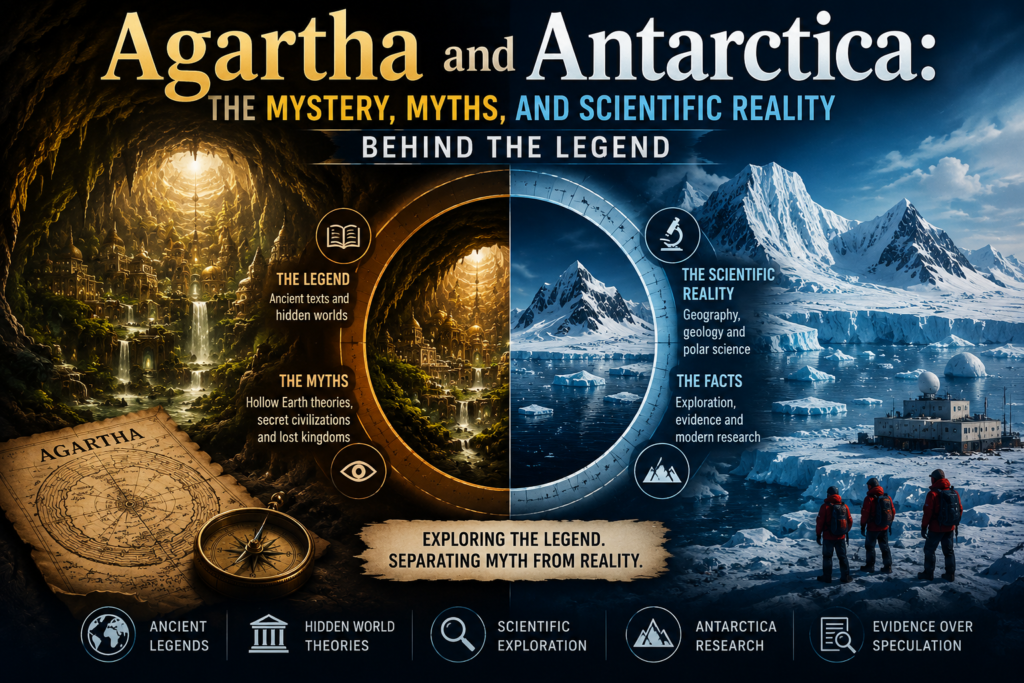
The legend of Agartha presents a compelling vision of a highly advanced subterranean civilisation within a hollow Earth, complete with glowing crystals, enlightened beings, and global portals. Modern internet lore has grafted this myth onto Antarctica through fabricated diaries of Admiral Richard E. Byrd, claiming he encountered a warm green paradise and its inhabitants in 1947. Historical evidence demonstrates that Byrd’s Operation Highjump was a large-scale, documented naval expedition focused on mapping, logistics testing, and scientific data collection under extreme conditions; no contemporary records support encounters with inner-Earth civilisations. The so-called secret diary is a posthumous fabrication lacking provenance or archival support. Geophysically, a hollow, habitable Earth is incompatible with seismic, gravitational, and observational data.
In place of the myth, science has revealed extraordinary real ecosystems beneath Antarctic ice shelves and in subglacial lakes: microbial communities sustained by chemical energy in perpetual darkness, genetically isolated populations with flexible metabolisms, ancient microbes preserved in ice, and, in accessible seafloor areas, diverse assemblages of sponges, corals, and other marine life. These discoveries expand our understanding of life’s adaptability and Earth’s interconnected systems. The Agartha legend remains a fascinating cultural artefact—a product of occult speculation, adventure fiction, and conspiracy creativity. The true wonders of Antarctica’s hidden realms, uncovered through painstaking research, offer a more substantial and continuing source of awe.