

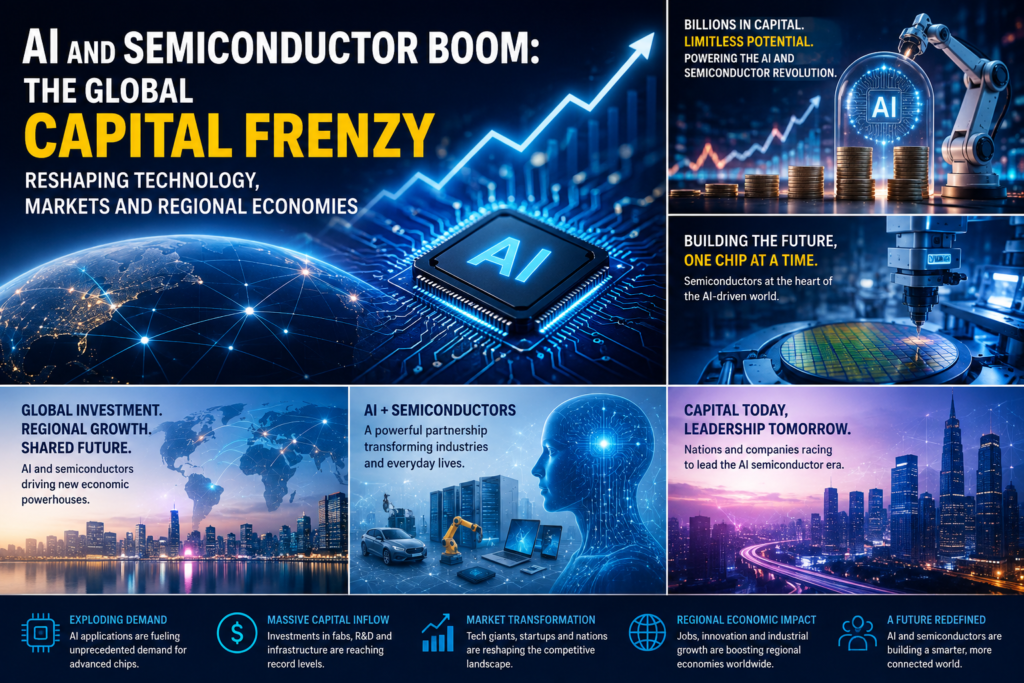
In the summer of 2026, the intersection of artificial intelligence and semiconductor technology has evolved into one of the defining economic forces of the decade. What began as incremental advances in chip design and machine learning models has accelerated into a full-scale infrastructure supercycle. Hyperscale technology companies are committing hundreds of billions of dollars annually to chips, data centres, power systems, and advanced packaging. Wall Street is lining up financing packages worth trillions. Economies tightly linked to the AI hardware supply chain—particularly Singapore and South Korea—are experiencing upward revisions to growth forecasts and sharp rebounds in technology equities, even as broader global uncertainties persist.
This report examines how semiconductor scaling in the AI era is constrained by the technological limits of the hardware stack, how unprecedented financing is supporting the build-out, how regional economic impacts are diverging, and which structural challenges may determine whether the current boom proves sustainable or becomes a cautionary tale of over-investment.
The Long Arc of Semiconductor Scaling and Its Current Limits
For more than half a century, progress in computing rested on Moore’s Law—the observation, later treated as a target, that the number of transistors on a chip roughly doubles every two years while costs fall. That trajectory enabled the personal computer revolution, the internet, smartphones, and cloud computing. By the mid-2010s, pure geometric scaling of planar transistors had slowed, and foundries shifted to FinFET architectures, then to gate-all-around designs at the 3-nanometer and 2-nanometer nodes. Physical limits around quantum tunnelling, heat dissipation, and manufacturing complexity became more binding.
In 2026, the industry is operating at the leading edge of these constraints. Atomic-level simulations from research groups, including work at KAIST, suggest that transistors can still shrink meaningfully—potentially below 4 nanometers in certain contact structures—but practical commercial devices remain constrained by interconnects, power delivery, and packaging rather than the transistor itself. IBM has demonstrated sub-1-nanometer (7-angstrom) technology featuring three-dimensional nanostack architectures that pack nearly 100 billion transistors into a fingernail-sized die, promising substantial gains in performance or energy efficiency compared with earlier 2-nanometer designs. Yet these breakthroughs remain years from high-volume production.
The AI workload has fundamentally altered the scaling equation. Training and inference for large language models and multimodal systems demand not merely denser logic but extreme memory bandwidth, low-latency interconnects between dies, and massive parallelism. High-bandwidth memory (HBM) stacks, advanced packaging technologies such as TSMC’s CoWoS (chip-on-wafer-on-substrate), and chiplet architectures have become the new bottlenecks. TSMC’s CoWoS capacity has lagged demand by significant margins throughout 2025 and into 2026; executives have publicly acknowledged that full catch-up may not occur until 2027 or later. Nvidia’s latest processors integrate multiple large AI dies with multiple stacks of HBM, creating packages containing hundreds of billions of transistors. Packaging costs alone for advanced modules can reach hundreds of dollars per unit.
Industry panels at conferences such as VLSI 2026 have emphasised that compute scaling now spans the full stack: devices, memory, packaging, networking, power delivery, and software orchestration. Data movement has emerged as a critical limiter. As AI shifts toward agentic systems and physical AI applications requiring real-time response, the energy and latency costs of moving data between memory and compute units grow disproportionately. Vertical memory architectures, denser stacking, and new interconnect materials are under active development, yet the near-term reality is scarcity of the most advanced packaging and HBM capacity.
The AI Infrastructure Financing Wave
The technological constraints have not deterred investment; they have intensified it. The four largest U.S. hyperscalers—Amazon, Microsoft, Alphabet, and Meta—have collectively guided capital expenditures toward roughly $745 billion for calendar 2026, with some estimates placing the broader group of major cloud providers near $800 billion when including leases and related commitments. Amazon has raised its outlook to around $220 billion, Alphabet to $195–205 billion, Microsoft toward $190 billion, and Meta into the $130–145 billion range. These figures represent total company capex, of which a substantial majority is AI- and cloud-related. Chips account for a large share—roughly 60 per cent of total AI data-centre investment according to some analyses—while power, cooling, construction, networking, and land make up the remainder.
Longer-term commitments are even larger. The same companies have disclosed nearly $2.4 trillion in future spending obligations spanning equipment purchase commitments, energy contracts, and multi-decade leases. Alphabet alone has reported more than $900 billion in such obligations. Meta has disclosed nearly $700 billion. These are not speculative projections; they are contractual and planning figures already on the books.
Wall Street has responded with an aggressive financing apparatus. Hyperscalers, whose free cash flow is under pressure from the sheer scale of spending, have turned to external capital. Debt issuance has risen sharply; the largest builders of AI data centres collectively added hundreds of billions in debt obligations over recent years. Equity raises have returned to the mix, including a major Alphabet offering. Private capital firms—Apollo, Blackstone, BlackRock, Brookfield, KKR, and others—are assembling large packages. One high-profile effort involves a consortium working with Nvidia on a potential $500 billion funding structure for AI infrastructure. Banks report that AI-related capital raising has become a dominant fee generator, with individual institutions claiming hundreds of billions in AI-linked underwriting and lending since 2025.
The financing structures are evolving beyond traditional balance-sheet funding. Lease arrangements, special-purpose vehicles, and vendor-backed guarantees allow hyperscalers and AI labs to secure capacity without immediate full cash outlays. Chipmakers themselves are increasingly involved in the capital side: Broadcom has structured deals involving guarantees on AI rack leases, and Nvidia has explored similar arrangements for large data-centre projects. OpenAI and other frontier labs have signed multi-year infrastructure agreements whose total notional value approaches or exceeds a trillion dollars when aggregated across suppliers.
Projections for the broader cycle vary but remain elevated. Some bank forecasts place cumulative AI-related capital expenditure in the multi-trillion-dollar range through the end of the decade. Goldman Sachs has cited figures approaching $7–8 trillion in certain infrastructure categories between 2026 and 2031. Morgan Stanley and others emphasise that power generation and grid upgrades form a parallel investment wave of comparable magnitude. The consensus view among major banks is that the AI infrastructure build-out constitutes a multi-year supercycle rather than a one- or two-year spike.
Scepticism exists. Equity markets have shown volatility; shares of some hyperscalers and related chipmakers have experienced significant drawdowns from peaks as investors question the pace at which AI revenues will catch up to capital intensity. Free cash flow compression is real. Power constraints, permitting delays, and component shortages (particularly HBM and advanced packaging) create execution risk. Yet the management teams of the major spenders continue to raise guidance, citing persistent excess demand for compute capacity that even elevated spending cannot fully satisfy.
Regional Growth Divergence: Asia’s Hardware Supply Chain Advantage
The capital flowing into AI hardware is not evenly distributed geographically. The physical production of advanced semiconductors, high-bandwidth memory, networking components, and related equipment remains concentrated in a handful of East and Southeast Asian economies. This concentration has produced clear growth divergence in 2026.
Singapore has been a prominent beneficiary. In August 2026, the Ministry of Trade and Industry raised its full-year GDP growth forecast to 4.5–5.5 per cent, up from an earlier 2–4 per cent range. First-half growth reached 6.1 per cent year-on-year, with second-quarter expansion at 5.9 percent. Manufacturing output surged more than 12 per cent, driven by the electronics and precision engineering clusters. Non-oil domestic exports rose sharply—27.4 per cent in the second quarter—led by integrated circuits (up more than 90 per cent in some periods) and disk media products. Enterprise Singapore correspondingly upgraded its non-oil domestic export growth forecast to 14–16 per cent for the year. Officials explicitly attributed the strength to robust global demand for AI-related semiconductors, networking chips, and memory. The acceleration in global AI capital expenditure is expected to continue supporting the outlook for the remainder of 2026, even amid external risks such as energy price volatility and geopolitical tensions.
South Korea has experienced a parallel revision. The government raised its 2026 growth outlook to 3 per cent, a full percentage point higher than prior guidance, citing a semiconductor supercycle and AI-related export strength. Outbound shipments are projected to rise substantially—potentially around 40 per cent in some official scenarios—on the back of AI demand. Memory giants, Samsung Electronics and SK Hynix, sit at the centre of the HBM market that is essential for AI accelerators. Equity markets have reflected the underlying strength even through periods of broader volatility; the technology-heavy Kospi has shown sensitivity to AI and memory news flow. Policy responses include targeted support for semiconductor, AI data-centre, and physical AI industries, alongside efforts to secure domestic production of strategic items.
Other economies in the regional supply chain have seen similar dynamics. Taiwan’s electronics exports have posted very strong growth rates tied to advanced GPU and packaging demand. Malaysia has benefited from assembly, testing, and component production. The common thread is exposure to the high-value segments of AI hardware rather than purely consumer electronics cycles of previous decades.
Equity markets in these jurisdictions have registered major rebounds relative to earlier periods of inventory correction or demand softness. The AI-driven demand for leading-edge logic, HBM, and advanced packaging has reversed prior overhangs and created multi-year visibility for capacity expansions. Capital expenditure by the foundries and memory makers themselves has risen in response, further amplifying the regional economic impulse.
This divergence stands in contrast to economies less directly plugged into the advanced semiconductor value chain. While AI software and services create productivity opportunities more broadly, the near-term growth impulse from physical infrastructure spending has been most pronounced in the hardware production hubs of Asia.
Market Structure, Equity Dynamics, and the Collector vs. Financier Split
Within public markets, a distinction has emerged between the “financiers” of the build-out—the hyperscalers spending the capital—and the “collectors” that supply the critical hardware. Nvidia, TSMC, Broadcom, SK Hynix, Samsung, and related equipment suppliers have captured a disproportionate share of the economic value created by the spending wave. Nvidia’s data-centre business has grown at extreme rates; TSMC’s advanced-node and packaging revenues have set records; Broadcom’s custom AI silicon revenue trajectory points toward very large absolute numbers by the late 2020s; memory makers have benefited from HBM pricing power and volume.
Stock performance has reflected this split. Periods of concern about hyperscaler free-cash-flow compression or the timeline for AI monetisation have pressured the spenders more than the suppliers. Conversely, evidence of sustained or accelerating demand has lifted the hardware names. Analysts at major banks have framed semiconductors as a secular rather than purely cyclical opportunity under current scarcity conditions for power, wafers, packaging, and memory.
The financing ecosystem itself has become a market. Private credit, infrastructure funds, and traditional banks are competing to fund data-centre construction, power projects, and equipment leases. Fee income from AI-related capital markets activity has become a material contributor to bank earnings in 2026.
Structural Challenges and Risks
Despite the momentum, several constraints threaten to slow or raise the cost of the build-out. Power is frequently cited as the binding near-term limit. Data-centre electricity demand is growing faster than grid capacity in many regions; new generation, transmission, and cooling solutions are required at scale. Water usage for cooling, land availability, and permitting timelines add friction. Component shortages—especially HBM and CoWoS-style packaging—have forced allocation decisions and multi-year capacity reservations.
Technological risk remains. Scaling beyond current nodes is expensive, and yields are uncertain. Alternative architectures (optical interconnects, new memory technologies, specialised accelerators) may eventually disrupt the current GPU-centric paradigm, but the installed base and software ecosystem create high switching costs in the near term. Geopolitical concentration of advanced manufacturing in Taiwan and related supply-chain nodes introduces strategic risk that governments are attempting to mitigate through subsidies and diversification, yet meaningful capacity relocation takes years.
On the demand side, the critical uncertainty is the translation of infrastructure spending into sustainable end-user revenue and productivity gains. If AI capabilities and adoption lag the capital deployment schedule, returns on the current wave of investment could disappoint. Some market participants already express concern that a portion of current demand is circular—hyperscalers and AI labs funding one another’s capacity—rather than purely exogenous.
Outlook
Looking ahead from mid-2026, the most probable path is continued elevated capital intensity for several more years. Guidance from the major hyperscalers points to further increases into 2027. Semiconductor capacity expansions currently under construction will gradually ease some bottlenecks, but new generations of AI models are expected to raise compute requirements further. Regional economies tightly integrated into the hardware supply chain are positioned to continue outperforming relative to baseline forecasts, provided the AI investment cycle does not reverse abruptly.
Semiconductor scaling itself is shifting from pure transistor density toward system-level optimisation—chiplets, advanced packaging, vertical integration of memory, and co-design of hardware with software and models. The companies and regions that master these multi-dimensional challenges will capture the largest share of value.
The current moment represents one of the largest coordinated capital deployment episodes in technology history. Whether it ultimately ranks among the most productive or becomes a cautionary example of capital intensity outrunning returns will depend on the pace of AI capability improvement, the resolution of physical constraints around power and packaging, and the ability of financial markets to intermediate the enormous funding needs without excessive fragility. For now, the money continues to flow, the fabs continue to expand, and the growth forecasts of the key Asian hardware hubs continue to be revised higher. The AI-semiconductor complex has become not merely a technology story but a macro variable of first-order importance.
===