

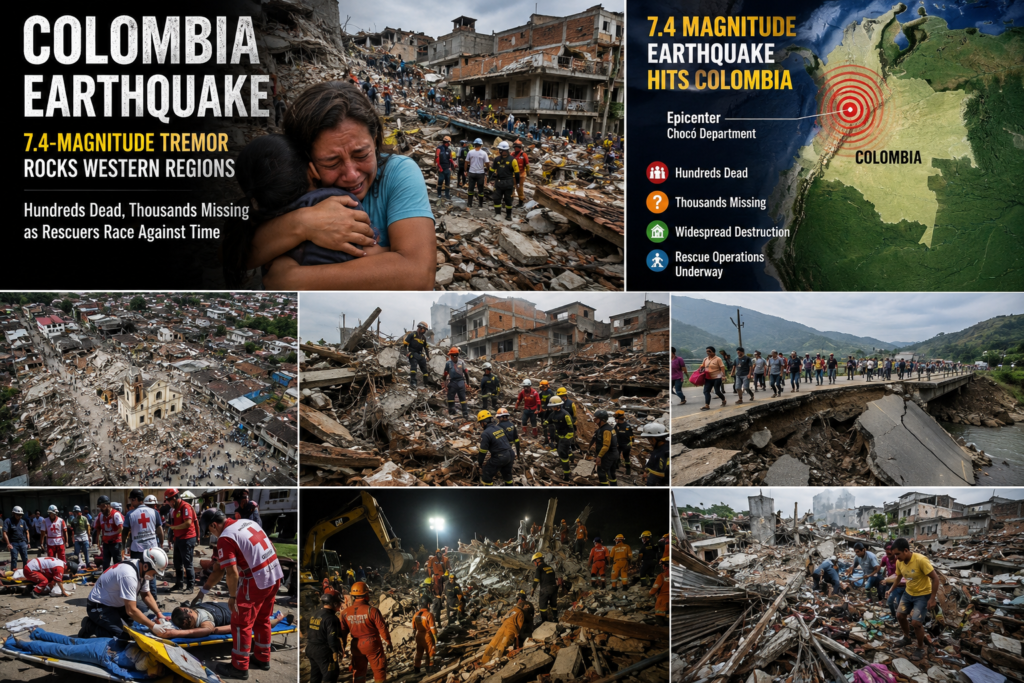
Bogotá / Cali / Pereira, August 12, 2026 — A powerful 7.4-magnitude earthquake struck western Colombia on the morning of Monday, August 10, 2026, triggering widespread collapse of buildings, damaging critical infrastructure, and leaving at least 254 people dead, more than 2,500 injured, and over 4,000 reported missing as frantic search-and-rescue operations continued into a third day. The quake, the strongest recorded in the country this century and the largest in more than a decade, originated near the town of San José del Palmar in the remote Chocó department and was felt hundreds of kilometres away across much of Colombia and into neighbouring Ecuador, Panama, and parts of Venezuela.
The United States Geological Survey (USGS) and Colombia’s Geological Service recorded the main shock at 07:34 local time (12:34 GMT), with a hypocenter depth of approximately 96 to 110 kilometres. The intermediate-depth, primarily strike-slip event occurred within the subducting Nazca plate as it descends beneath the South American plate along the seismically active Pacific Ring of Fire. Shaking lasted up to two minutes in some areas and reached Modified Mercalli intensities of VII to VIII (very strong to severe) in the hardest-hit zones. Dozens of aftershocks followed, the largest around magnitude 5.0, keeping residents on edge and complicating rescue work.
President Abelardo de la Espriella, who had been sworn into office only days earlier, declared a national state of emergency and disaster. He mobilised soldiers, specialised rescue units, medical teams, and heavy equipment while appealing for calm and coordinated efforts. “The priority is to try to rescue the people who are still under the rubble,” the president said in an address, confirming early national figures that later climbed as local authorities in multiple departments reported higher tolls. By Tuesday and into Wednesday, aggregated reports from mayors and governors put the confirmed death toll above 250, with Cali and Pereira accounting for the largest shares. Civilian-run missing-persons databases listed more than 4,000 people unaccounted for, though officials cautioned that some of those figures reflected temporary loss of contact rather than confirmed disappearances.
Widespread Destruction Across the Coffee Region and Beyond
The epicentre lay in a sparsely populated rural area of Chocó, roughly 400 kilometres west of Bogotá and near a community of about 4,800–5,000 people. Local officials in San José del Palmar reported that roads were damaged and dozens of buildings collapsed or were heavily compromised, yet initial accounts from the immediate vicinity noted relatively limited confirmed fatalities compared with more distant urban centres—an outcome attributed in part to the quake’s depth and the lower population density. Farther afield, the impact was catastrophic.
Pereira, capital of the Risaralda department and a hub of Colombia’s renowned coffee-growing region, suffered some of the worst damage. Local authorities reported more than 100 deaths in the broader area, with dozens of buildings reduced to rubble in and around the city centre, including structures near Plaza Bolívar. Videos verified by international media showed debris and dust choking the main square. At least 65 buildings collapsed in the metropolitan zone, trapping people in 15 of them. Matecaña International Airport sustained partial collapse and fatalities. Hospitals were overwhelmed; officials urged residents to avoid certain clinics that were already flooded with the injured. A nighttime curfew was imposed to facilitate rescue operations and prevent looting.
Cali, Colombia’s third-largest city with a population exceeding two million and located roughly 160–200 kilometres from the epicentre, recorded around 95 deaths and nearly 950 injuries according to city officials. Mayor Alejandro Eder reported more than 30 to 40 buildings fully or partially collapsed, with hundreds of people still believed trapped under debris more than 24 hours later. One residential building in the El Lido neighbourhood suffered complete collapse. Sections of the University Hospital of Valle, including upper floors housing pediatric units, failed, forcing the evacuation of more than 600 patients who were treated outdoors. Firefighters, soldiers, and civilian volunteers formed human chains to pass concrete slabs and debris by hand. Thermal-imaging drones and search dogs were deployed. In one dramatic overnight operation, teams pulled a 35-year-old man alive from under a concrete beam nearly a full day after the quake; onlookers applauded before being urged back into silence so rescuers could listen for further signs of life. A partial hotel collapse also yielded civilian-led rescues of several survivors.
Quibdó, capital of Chocó, and surrounding municipalities reported significant structural damage described by the departmental governor as “monstrous” in some areas. At least a dozen deaths and more than 100 injuries were tallied early, with limited access complicating full assessments of rural zones reachable mainly by boat or air. Manizales in Caldas department saw at least five deaths, the partial collapse of a four-story building, and damage to the Cathedral Basilica of Our Lady of the Rosary, where one tower fell into the nave. Armenia and other towns in the coffee belt recorded building collapses, airport damage, and hundreds of injuries. Across the affected departments, more than 1,500 homes were damaged or destroyed, dozens of schools and health centres were compromised, and multiple roads and bridges were disrupted. At least seven airports—including those in Pereira, Manizales, Quibdó, Armenia, Cartago, and Buenaventura—suspended operations due to structural concerns.
In Bogotá, more than 150 kilometres from the epicentre, the shaking prompted mass evacuations of office towers and residential buildings. Mayor Carlos Fernando Galán reported cracked structures but no catastrophic collapses. Similar scenes of panic and temporary flight from buildings unfolded in Medellín and other cities. Rockfalls claimed at least one life in Antioquia. Neighbouring countries experienced milder effects: limited structural damage and anxiety-related incidents in Panama and Ecuador, with temporary suspension of some metro services in Panama City for safety checks.
Human Toll and Stories of Survival and Loss
The human cost extended far beyond official tallies. Families searched frantically for relatives, posting photographs and details on social media and citizen platforms. In rural areas near the epicentre, such as El Cairo, reports indicated that up to 80 per cent of homes suffered damage. One woman shared an image of her missing 60-year-old uncle, a farmer last seen with his dog. In Pereira and Cali, exhausted volunteers and professional rescuers worked under floodlights and headlamps through the night, periodically calling for absolute silence to detect faint cries or tapping from beneath the debris. Successful extractions—two women and two children from one site, a dusty and scraped survivor named Diana Troncoso from another—provided fleeting moments of hope amid mounting grim discoveries.
Hospitals operated under extreme strain. In Cali and Pereira, staff treated patients outdoors or in makeshift facilities after structural damage compromised buildings. At least three of the early confirmed deaths in Valle del Cauca were children. Spanish authorities noted that 164 of their nationals remained among the missing, with no confirmed casualties among them at the time of reporting. The psychological impact was widespread: survivors described the prolonged shaking as unlike anything previously experienced, with many refusing to re-enter damaged homes even after aftershocks subsided.
Geological Context and Why the Damage Was So Extensive
Colombia sits at a complex junction of tectonic plates, including the Nazca, South American, Caribbean, and smaller microplates. The region experiences thousands of mostly minor earthquakes each month. Intermediate-depth events such as this one typically produce less intense surface shaking than shallow quakes of comparable magnitude because energy dissipates over a greater distance. Yet the 7.4 magnitude, the strike-slip mechanism, the inland location relative to population centres in the Cauca and coffee valleys, and local soil conditions combined to amplify damage. Seismologists noted that the event occurred within the subducting slab rather than on the shallow plate interface, consistent with the Cauca earthquake cluster studied in the region. Historical parallels include a 1979 magnitude 7.2 event in a similar area that produced strong shaking across Pereira, Armenia, and Manizales, and the devastating 1999 Armenia earthquake that killed more than 1,000 people.
Peak ground accelerations exceeding 0.4 g were recorded at some stations more than 200 kilometres from the hypocenter. The Colombian Geological Service characterised the event as the strongest in the country in the 21st century. More than 50 aftershocks were recorded in the first 48 hours, raising concerns about further collapses of already weakened structures.
Government Response, Logistics, and International Support
President de la Espriella activated the National Unit for Disaster Risk Management, established unified command posts in key cities, and ordered the deployment of more than 1,000 troops to maintain order amid isolated reports of looting. Bogotá sent specialised rescuers to Cali. Military engineers and fine units of the army joined firefighters and civil defence teams. Curfews in Cali and Pereira aimed to clear streets for heavy machinery and search teams. The government suspended the Petronio Álvarez Pacific Music Festival scheduled for Cali and postponed professional football matches involving Colombian clubs.
Access challenges were acute in Chocó, where terrain and limited infrastructure delayed full assessments and aid delivery. Airports remained closed or restricted, forcing reliance on alternative transport. Footballer Jhon Arias, a native of Quibdó, arranged aircraft to fly medical personnel and supplies into the affected zone.
International offers of assistance arrived quickly. The United States announced $15.5 million in relief support. The European Commission activated the Copernicus satellite program to aid mapping and response. El Salvador prepared planes carrying humanitarian supplies. Israel, Mexico, Ecuador, France, and others extended offers of help. Some reports indicated early coordination difficulties, with certain governments noting that Colombia initially prioritised financial aid over foreign rescue teams. Chinese diplomats publicly referenced challenges in arranging assistance.
Ongoing Challenges and Outlook
As of August 12, the critical 72-hour window for finding survivors alive under rubble was closing, though experts note that trapped individuals with access to air pockets, water, or limited food can sometimes endure longer. Rescuers continued using listening devices, dogs, drones, and careful manual excavation. The risk of secondary collapses from aftershocks remained high. Thousands of people were displaced, living in temporary shelters or with relatives. Economic impacts—particularly to the coffee sector, tourism, and urban commerce in western Colombia—were expected to be substantial, though full assessments would take weeks.
The disaster posed an immediate test for the new presidential administration. De la Espriella travelled to Quibdó and Cali to survey damage personally and coordinate with local leaders. Public messaging emphasised unity, the primacy of life-saving operations, and the need for accurate information amid circulating rumours and unverified missing-person counts.
Colombia’s history of seismic resilience, improved building codes in some urban areas, and existing disaster-management frameworks mitigated what could have been an even higher toll. Yet the concentration of deaths and collapses in older or non-compliant structures underscored persistent vulnerabilities, especially in secondary cities and rural departments. Long-term recovery will require reconstruction of housing, hospitals, schools, and transport links, alongside psychological support for survivors and communities.
For now, the focus remains on the rubble piles in Pereira, Cali, Quibdó, and surrounding towns. Every successful extraction renews hope; every recovered body deepens the national grief. As one firefighter in Cali put it while calling for silence above a debris field: “Every minute counts.” International partners, domestic responders, and ordinary Colombians continue the painstaking work of searching, consoling, and beginning to rebuild in the aftermath of the country’s most powerful earthquake of the century.
(Figures continue to evolve as official tallies are updated and rural assessments expand; readers are advised to consult primary Colombian government and geological service sources for the latest confirmed data.)