

Beijing / Guwahati / Shanghai – August 12, 2026
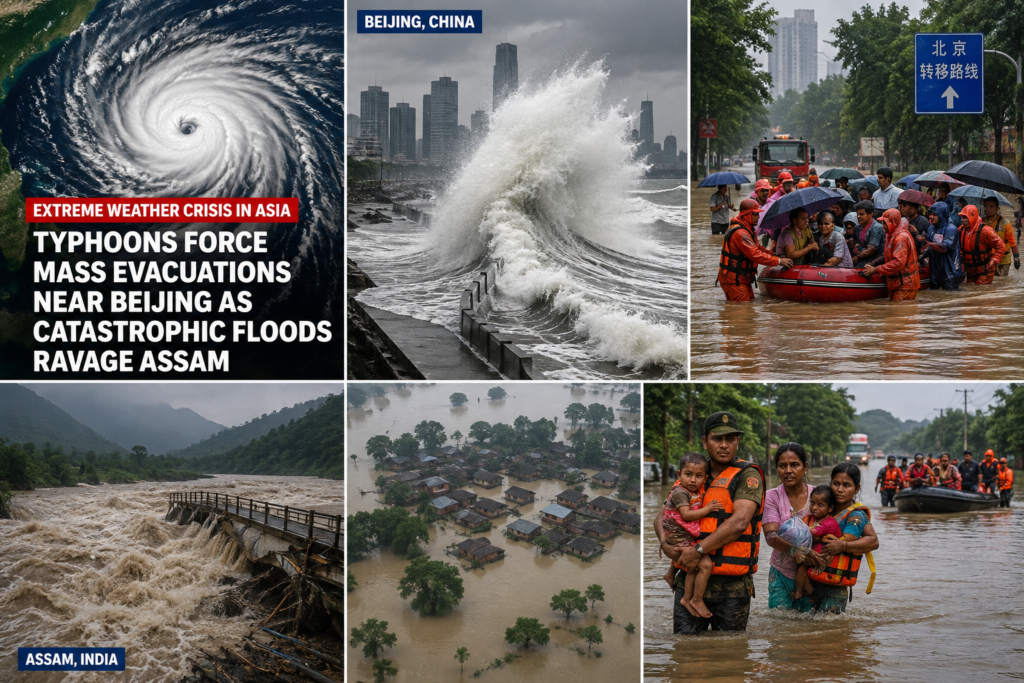
A relentless sequence of powerful typhoons has swept across East and South Asia in recent weeks, unleashing torrential rains, catastrophic flooding, and widespread disruption that has forced millions from their homes. The latest and strongest of these storms, Typhoon Dolphin, made landfall on China’s eastern coast over the weekend before pushing deep inland, triggering mass evacuations in and around Beijing and inundating parts of central China. Simultaneously, in India’s northeastern state of Assam, monsoon rains intensified by regional weather patterns have driven death tolls past 100 and left more than a hundred thousand people displaced amid swollen rivers and submerged villages.
The convergence of these events underscores a season of extreme weather that meteorologists link to a combination of active typhoon activity in the western Pacific, an intensified southwest monsoon, and broader climate patterns amplifying rainfall intensity. From the flooded streets of Beijing’s suburbs to the inundated farmlands of Assam’s Brahmaputra valley, communities are grappling with the human, economic, and infrastructural toll of cascading storms.
Typhoon Dolphin: From Pacific Waters to China’s Heartland
Typhoon Dolphin, designated the 13th named storm of the 2026 Pacific typhoon season, emerged as an unusually resilient system. Forming far out in the western Pacific near the Marshall Islands, it travelled nearly 6,000 kilometres—more than three times the average lifespan distance of a typical typhoon—before slamming into China’s Zhejiang province on Sunday, August 9. Packing maximum sustained winds of around 150–151 km/h (94 mph) at landfall near Yuhuan, it made a second landfall near Wenzhou shortly afterwards. Authorities described it as the strongest typhoon to strike China so far this year.
The storm’s sprawling cloud field and intense moisture capacity proved more destructive than its peak winds alone. In Shanghai, a weather station recorded nearly 313 mm of rain in 24 hours—the highest in more than 150 years of records at that location—while another site logged close to 400 mm. Social media hashtags such as “Shanghai turns into the sea” trended as videos showed iconic landmarks like the Wukang Mansion surrounded by floodwaters.
Chinese authorities responded with one of the largest preemptive evacuations in recent memory. More than one million people were moved from high-risk areas across eastern China. In Wenzhou alone, over 900,000 residents were relocated, and more than 1,000 emergency shelters opened. Taizhou evacuated around 390,000, Shanghai moved approximately 215,600 people, and Fujian province reported tens of thousands more shifted from vulnerable coastal and inland zones. Transportation ground to a near halt: roughly 1,400 flights were cancelled in Shanghai, passenger ferries suspended, and offshore construction projects halted.
By Monday, Dolphin had weakened to a tropical storm, and then a tropical depression, yet its remnants continued to channel extreme rainfall inland. On Tuesday, the system reached Hubei province in central China, flooding streets in cities such as Xiangyang, forcing the closure of scenic sites including areas around the Three Gorges Dam, and suspending 26 high-risk highway and waterway construction projects. Forecasts warned of up to 250 mm of rain in 24 hours in northwestern Hubei, raising landslide and flash-flood risks in mountainous terrain. Neighbouring Henan province issued red flash-flood alerts, with some areas expected to receive up to 350 mm.
Beijing Braces and Evacuates as Rain Threatens Record Deluge
The storm’s moisture plume extended more than 1,000 km northward, reaching the Chinese capital. Beijing activated a Level II flood-control emergency response—the second-highest level—on Tuesday as meteorologists warned that most parts of the city could receive more than 100 mm of rain within six hours and over 150 mm within 24 hours from Tuesday evening through Thursday. Some districts, including Tongzhou, Daxing, Fangshan, Mentougou, Huairou, and Fengtai, faced forecasts exceeding 200 mm—more than one-third of Beijing’s average annual rainfall of approximately 528 mm.
Four districts on the capital’s outskirts activated the highest-level (Level I) emergency flood responses. Red rainstorm alerts were issued in several areas, while the city overall remained under an orange warning. Authorities ordered the evacuation of residents from mountainous villages, low-lying courtyards, and other flood- and landslide-prone locations. More than 5,000 elderly people were moved from care facilities, and around 1,800 people living near construction projects in risky areas were relocated. Hundreds of tourist attractions and campsites closed, with over 1,300 tourists evacuated or turned away. Operations at more than 4,100 rural homestays were suspended. Some 250 bus routes were halted, trains on 10 subway lines ran at reduced speeds, and all sightseeing boat services stopped. All 3,357 construction sites across the city suspended work. Reservoirs released water in advance to create storage capacity, and 252 flood-control teams stood ready, with flood barriers installed at hundreds of subway stations, hospitals, and elderly care facilities.
By Tuesday evening, severe flooding had already appeared in parts of Beijing, notably Shunyi district northeast of the main financial area. The highest hourly rainfall recorded reached 88.5 mm in Houshayu in Shunyi between 3 p.m. and 4 p.m. Images circulated of large buses and cars partially submerged. On Wednesday, heavy rain continued, with the city recording an average of 23.5 mm from noon Tuesday to Wednesday morning, though localised intensities were far higher. Flexible working arrangements and staggered commuting were encouraged to reduce travel risks.
The National Meteorological Centre maintained an orange alert for rainstorms covering a broad swathe of the country, including Zhejiang, Shanghai, Shandong, Beijing, and Tianjin. Officials repeatedly urged residents to stay indoors, avoid rivers and mountains, and evacuate promptly from threatened areas.
Parallel Crisis in Assam: Monsoon Floods Claim Lives and Livelihoods
While China confronted the inland march of Dolphin, India’s Assam state faced its own prolonged monsoon catastrophe. Heavy rains, part of the broader seasonal monsoon intensified by regional weather systems, have swollen major rivers including the Brahmaputra and its tributaries. By mid-August, the death toll from this year’s floods had climbed to 100–101, with two additional fatalities reported in Golaghat and Karbi Anglong districts in a recent 24-hour period.
As of August 12, more than 112,700 people remained affected across four districts—Golaghat, Jorhat, Nagaon, and Sivasagar—though earlier peaks had seen over 155,000 affected across 13 districts and nearly 1.4 lakh (140,000) in seven districts. Golaghat has consistently been the worst-hit, with 65,000–70,000 people impacted at various points, followed by Sivasagar (around 20,000–40,000) and others. At least 441–456 villages remained inundated, and between 10,879 and 11,933 hectares of cropland had been damaged. Embankments, roads, bridges, and other infrastructure suffered widespread harm. Tens of thousands of domestic animals and poultry were also affected.
The Assam State Disaster Management Authority (ASDMA) reported rivers such as the Dhansiri (at Golaghat and Numaligarh) and the Kushiyara (at Sribhumi) flowing above danger levels, posing ongoing threats of fresh inundation. Authorities operated 92–125 relief camps and distribution centres, sheltering and assisting 30,000–49,000 people at different stages. In recent 24-hour periods, they distributed hundreds of quintals of rice, dal, and salt, along with thousands of litres of mustard oil.
The floods, which began intensifying last month, have at times displaced more than 700,000 people cumulatively and forced nearly 300,000 into camps at peak. As waters receded in some areas, returning families found homes buried under thick layers of silt—sometimes two to three feet deep—complicating recovery. Chief Minister Himanta Biswa Sarma ordered door-to-door damage assessments in the worst-hit eastern districts to expedite rehabilitation funds. The India Meteorological Department forecast additional rain over already flooded areas, keeping the situation serious.
A Season of Cascading Storms Across Asia
Dolphin did not arrive in isolation. The 2026 season has featured multiple powerful systems. Earlier, Typhoon Bavi in July prompted the evacuation of more than two million people in eastern China, with Beijing alone relocating nearly 96,000 amid heavy rains. Typhoon Noul struck Guangdong as the then-strongest storm of the year, forcing over 715,000 evacuations and contributing to flash floods that killed 10 in Gansu. In the Philippines, the southwest monsoon combined with tropical cyclones such as Luis (and others) has caused flooding, landslides, and at least 16–26 deaths, affecting hundreds of thousands and damaging houses, roads, and bridges. Japan has also faced impacts from systems including Chan-hom, which lashed the Kanto region including Tokyo.
BBC reporting highlighted three storms—Dolphin, Chan-hom, and Peilou—churning across the region simultaneously in early August, battering millions with heavy rain and strong winds. A new system, Nangka, was also monitored south of Japan. In the Philippines, the National Disaster Risk Reduction and Management Council raised alert levels and activated response clusters as combined effects displaced tens of thousands.
These events reflect an active western North Pacific typhoon season and a vigorous Asian monsoon. Climate scientists note that warmer ocean temperatures can fuel stronger storms with greater rainfall capacity, while atmospheric patterns can steer moisture inland over already saturated ground, amplifying flood risks. China’s National Meteorological Centre and regional agencies have issued repeated high-level alerts, emphasising the unprecedented moisture transport of systems like Dolphin.
Human and Economic Toll
The human cost is measured in lives lost, families displaced, and livelihoods disrupted. In Assam, the 100-plus deaths include drownings and related incidents amid repeated flooding cycles that erode resilience year after year. Farmers face ruined crops—thousands of hectares of paddy and other produce submerged—threatening food security and incomes in a predominantly agricultural region. Livestock losses compound the hardship. Infrastructure damage to roads, bridges, and embankments isolates communities and slows relief.
In China, while official reports for Dolphin have not highlighted high casualty figures—thanks in part to massive preemptive evacuations—the economic disruption is significant. Flight cancellations, halted construction, closed tourist sites (including major attractions), suspended transport, and flooded urban districts interrupt commerce, manufacturing, and daily life in some of the country’s most economically vital regions. Shanghai’s record rainfall and Beijing’s emergency measures illustrate the vulnerability of even major metropolitan areas. Emergency teams, drainage equipment, and prepositioned supplies have been mobilised on a large scale, yet recovery from urban waterlogging, landslides, and agricultural losses will take weeks or months.
Vulnerable populations—the elderly, those in low-lying or mountainous areas, rural farmers, and urban poor in informal settlements—bear disproportionate burdens. Relief camps provide temporary shelter and basic supplies, but long-term rehabilitation, including rebuilding homes and restoring farmland, remains a challenge.
Response and Resilience Efforts
Governments have prioritised early warning, evacuation, and emergency response. China’s multi-tiered alert system (red, orange, yellow, blue) and coordinated flood-control headquarters enabled the rapid relocation of over a million people before Dolphin’s full impact. Drainage teams, reservoir management, and construction suspensions aimed to mitigate secondary disasters. In Assam, the ASDMA’s daily bulletins, relief camps, and distribution of food essentials form the core of response, supplemented by state-level damage assessments for rehabilitation funding.
International and regional monitoring through bodies tracking ASEAN disasters and global flood assessments has provided additional situational awareness. Yet the frequency of these events tests preparedness. Experts stress the need for strengthened infrastructure—better drainage in cities, reinforced embankments along major rivers, improved early-warning dissemination to remote areas—and climate-adaptive agriculture and urban planning.
Looking Ahead: More Rain and the Long Recovery
As of August 12, Beijing remained under rainstorm warnings with the heaviest rainfall expected in the morning hours, while Assam faced forecasts of further precipitation over flood-hit districts. The remnants of Dolphin continued to influence central and northern China, and other tropical systems remained under watch in the Pacific. Rivers in Assam stayed elevated, sustaining the risk of renewed flooding.
Recovery will require sustained effort. In Beijing and eastern China, clearing floodwaters, repairing transport links, and assessing structural damage to buildings and infrastructure will dominate the coming days. In Assam, the focus shifts to helping families return to silt-laden homes, restoring agricultural land, and addressing the cumulative impact of a season that has already claimed over a hundred lives.
This cascade of typhoons and monsoon floods serves as a stark reminder of Asia’s exposure to extreme weather. Densely populated river basins, coastal megacities, and monsoon-dependent agricultural economies face intensifying pressures. While immediate responses have saved lives through timely evacuations and alerts, the scale of disruption highlights the growing urgency of building long-term resilience against a changing climate that is making such events more frequent and severe.
Authorities across the region continue to urge vigilance. Residents in affected areas are advised to monitor official forecasts, avoid unnecessary travel, steer clear of swollen rivers and unstable slopes, and follow evacuation orders without delay. For millions already displaced or impacted, the path back to normalcy will be measured not in days, but in the weeks and months of rebuilding that lie ahead.