

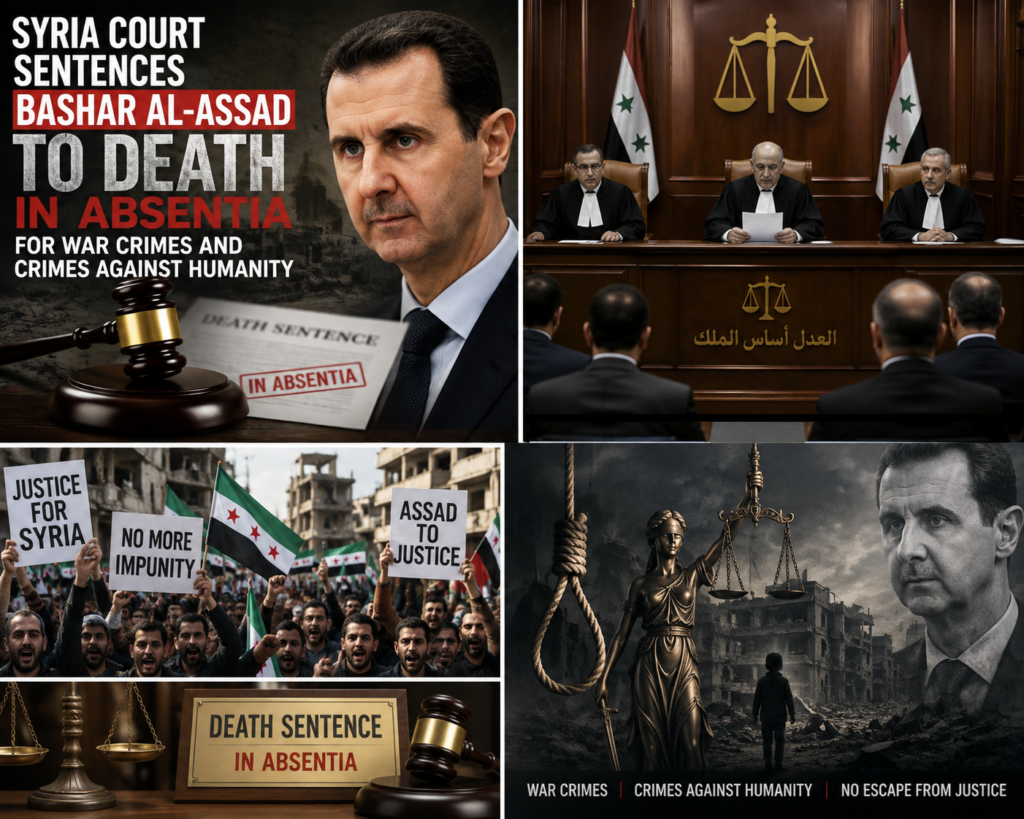
Damascus, August 11, 2026 — In a landmark ruling that marks the first formal conviction of Syria’s longtime ruler by a domestic court, the Fourth Criminal Court in Damascus on Tuesday sentenced former President Bashar al-Assad to death in absentia. The court convicted him of a litany of grave offences committed during the country’s nearly 14-year civil war, including premeditated murder, the intentional killing of children under the age of 15, torture, torture leading to death, and the unlawful deprivation of liberty on multiple occasions. These acts were classified by the court as both crimes against humanity and war crimes.
Presiding Judge Fakhr al-Din al-Aryan (also referred to in some reports as Fakhareddine al-Aryan) declared that Assad had used the full apparatus of the Syrian state to perpetrate systematic violence against civilians. “Bashar Assad used state agencies to commit war crimes and crimes against humanity,” the judge stated during a session broadcast live on state television. The contribution of the former president, the court found, was that of the ultimate decision-maker who mobilised institutions to carry out the crimes.
Assad, who has lived in exile in Russia since the dramatic collapse of his regime in December 2024, was not present. The same death sentence was handed down in absentia to his younger brother, Maher al-Assad, former commander of the elite Fourth Armoured Division, and to several other senior military and security officials from the old regime. Among those tried in person and also sentenced to death was Assad’s maternal cousin, Atef Najib, the former head of political security in Daraa province. Najib appeared in court wearing a striped prisoner’s uniform inside a metal cage as the verdict was read.
The ruling represents the first major judicial reckoning with the Assad family’s decades-long rule and the brutal repression that defined the civil war. Outside the Palace of Justice in central Damascus, crowds gathered under tight security, carrying photographs of relatives killed or disappeared during the conflict, chanting, clapping, and waving the Syrian flag. Many described the moment as a long-awaited victory of justice over tyranny.
The Fall of the Assad Dynasty
Bashar al-Assad assumed the presidency in July 2000 following the death of his father, Hafez al-Assad, who had ruled Syria with an iron fist since 1970. The family, drawn from the Alawite minority in a Sunni-majority country, maintained power through a tightly controlled security apparatus, the Ba’ath Party, and strategic alliances with Russia and Iran. Bashar’s early years raised some hopes of reform, but those faded as the regime cracked down on dissent.
The spark that ignited the civil war came in March 2011 in the southern city of Daraa. Teenagers who scrawled anti-regime graffiti on school walls were arrested and tortured by security forces under Atef Najib’s command. Protests demanding their release and broader political reforms were met with lethal force. What began as peaceful demonstrations inspired by the Arab Spring rapidly escalated into a full-scale armed conflict as the government responded with mass arrests, indiscriminate shelling, and the deployment of elite units.
Over the ensuing years, the war claimed hundreds of thousands of lives. Estimates from the Syrian Observatory for Human Rights place the total death toll at more than 650,000 by early 2025, including nearly 200,000 civilians. Other monitors and United Nations figures have cited ranges from roughly 500,000 to over 600,000. Tens of thousands more were forcibly disappeared into a vast network of prisons and detention centres notorious for systematic torture. Mass graves discovered after the regime’s fall, including a major site at al-Qutayfah north of Damascus estimated to hold the remains of tens of thousands, underscored the scale of the killing. Human rights organisations documented the regime’s use of chemical weapons, barrel bombs, and starvation sieges against civilian populations.
Assad’s forces, supported by Russian air power and Iranian-backed militias including Hezbollah, regained significant territory after 2015. Yet the underlying grievances—corruption, economic collapse, and repression—never disappeared. By late 2024, the regime’s military was demoralised, its economy hollowed out in part by the illicit Captagon trade, and its external patrons distracted or weakened.
On November 27, 2024, a coalition of opposition forces led by Hay’at Tahrir al-Sham (HTS) under Ahmed al-Sharaa (also known by his nom de guerre Abu Mohammed al-Jolani) launched a lightning offensive from Idlib. Within days, they seized Aleppo, then Hama, Homs, and finally Damascus on December 8. Assad fled first to a Russian base in Latakia and then to Moscow, where he and his family were granted asylum. The five-decade Assad dynasty ended in less than two weeks of rapid advances that met surprisingly little organised resistance.
Al-Sharaa, a former al-Qaeda affiliate who had rebranded and moderated his public posture, emerged as the de facto leader and was later formally named transitional president. His administration dissolved the Ba’ath Party and the old parliament, issued a constitutional declaration for a five-year transition, and began the difficult process of integrating armed groups, addressing minority concerns, and establishing new institutions. By 2026, a transitional parliament had been formed through a mix of indirect elections and presidential appointments, and Syria had begun tentative steps toward international re-engagement, including meetings with Western leaders and discussions of security arrangements with Israel.
The Trial and the Verdict
Proceedings against senior Assad-era figures began in earnest in April 2026. The case centred on events in Daraa in early 2011 that helped trigger the nationwide uprising, but the charges against Assad encompassed the broader pattern of state-orchestrated violence throughout the war. The court heard testimony from witnesses, including individuals who had been minors at the time of their detention, describing beatings, electric shocks, suspension, and other forms of torture. Najib was accused of personal involvement in interrogations, ordering the use of live fire against protesters, positioning snipers, preventing the evacuation of the wounded, and overseeing detention centres where people died under torture.
Assad was held responsible as the ultimate authority who directed state institutions to commit these acts. The court convicted him of premeditated and intentional murder of more than one person and of children, torture, arbitrary arrest, and the classification of these as crimes against humanity and war crimes. Maher al-Assad faced similar charges tied to the operations of the Fourth Division, long accused of leading crackdowns, running detention facilities, and involvement in the Captagon trade that enriched the regime.
Najib, arrested in early 2025 and the only senior defendant physically present, was sentenced to death after conviction on multiple counts including the intentional killing of children under 15 and torture leading to death. The court noted he could appeal. Six other former officials, including figures such as former Defence Minister Fahd al-Freij and other security chiefs, received the same penalty in absentia.
The session was conducted under heavy security. Crowds outside celebrated what many called a historic turning point. Families of the disappeared and the dead held photographs and placards. In Daraa, the cradle of the 2011 protests, residents marked the occasion with particular intensity.
Accountability, Limitations, and International Context
The sentences carry profound symbolic weight. For millions of Syrians who lost loved ones, endured imprisonment, or fled as refugees, the formal legal condemnation of Assad and his inner circle represents official recognition of their suffering after years in which the regime denied or justified its actions. Assad had once compared his crackdown to a surgeon cutting into a wound, arguing the blood on his hands was necessary to save the patient.
Yet the practical enforcement of the death sentences against Assad and Maher remains highly uncertain. Both reside in Russia under political asylum. Syrian authorities have formally requested their extradition, but Moscow has shown no inclination to comply. Analysts note that the verdict against Najib, who is in custody, is the only one immediately enforceable. The court indicated it would pursue international legal avenues, but success depends on cooperation from foreign governments and the evolution of Syria’s own transitional justice framework.
The broader process of accountability is still in its early stages. Thousands of lower-level officials and security personnel have been detained since 2024. Mass graves continue to be investigated. Human rights groups have documented more than 100,000 forced disappearances under the old regime, with estimates of tens of thousands killed in detention. The new authorities face the immense challenge of balancing the demand for justice with the need for national reconciliation in a society fractured along sectarian, regional, and political lines. Alawite communities, long associated with the regime, have faced periods of violence and fear of reprisals. The transitional government has repeatedly pledged to protect minorities and build an inclusive state, though implementation remains uneven.
Internationally, the ruling has been welcomed by many Syrian diaspora communities and human rights organisations as a step toward ending impunity. It also raises complex questions about the legitimacy and fairness of trials conducted under a transitional administration still consolidating power. Some legal observers have noted concerns about due process guarantees, the characterisation of crimes under domestic law versus international standards, and the challenges of trying high-level figures in absentia. Others emphasise that the public nature of the proceedings, the live broadcast, and the involvement of civilian plaintiffs mark a significant departure from the closed, politicised justice of the Assad era.
The Long Shadow of the War
The civil war left Syria devastated. Cities such as Aleppo, Homs, and parts of Damascus still bear the scars of bombardment. More than 13 million people remain displaced, either internally or as refugees in neighbouring countries and further afield. The economy is shattered. Infrastructure is ruined. The social fabric has been torn by years of mutual suspicion and violence.
Chemical weapons attacks, most notoriously the 2013 sarin attack on Ghouta, drew international condemnation and limited military responses, yet the regime largely survived those moments with Russian and Iranian support. The rise and eventual territorial defeat of the Islamic State added another layer of horror. Kurdish-led forces in the northeast, Turkish interventions in the north, and Israeli strikes on Iranian-linked targets further complicated the battlefield.
Assad’s survival for so long was a testament to the resilience of authoritarian systems backed by external powers and internal security networks. His fall demonstrated the fragility of those same systems when popular support and military cohesion erode. The speed of the 2024 collapse surprised almost everyone, including many of the opposition fighters who suddenly found themselves responsible for governing a complex, traumatised country.
Looking Ahead
The death sentences against Bashar al-Assad, Maher al-Assad, and Atef Najib will not by themselves heal Syria. They do, however, establish a legal record and a public affirmation that the systematic killing and torture carried out under the previous regime constituted crimes for which the highest authorities bear responsibility. Whether this becomes the foundation for a more comprehensive transitional justice process—including truth-seeking mechanisms, reparations, and institutional reform—or remains a largely symbolic act will depend on the political choices of the current leadership and the degree of domestic and international support it receives.
For the families who waited outside the courthouse on Tuesday, holding pictures of the dead and the disappeared, the verdict was more personal. It was an official declaration that what happened to their loved ones was not collateral damage or the necessary cost of stability, but criminal acts for which the former president and his closest associates have been judged and condemned. In a country still struggling to emerge from the wreckage of war and dictatorship, that declaration carries weight that no sentence, however severe, can fully measure.
As Syria continues its uncertain transition under President Ahmed al-Sharaa, the August 11 ruling will stand as a defining moment in the effort to confront the past. The man who once ruled from the presidential palace in Damascus has been sentenced to death by a court in the same city he fled. Whether he ever faces the consequences of that judgment remains beyond the court’s control. The historical record, however, has been written.