
August 12, 2026
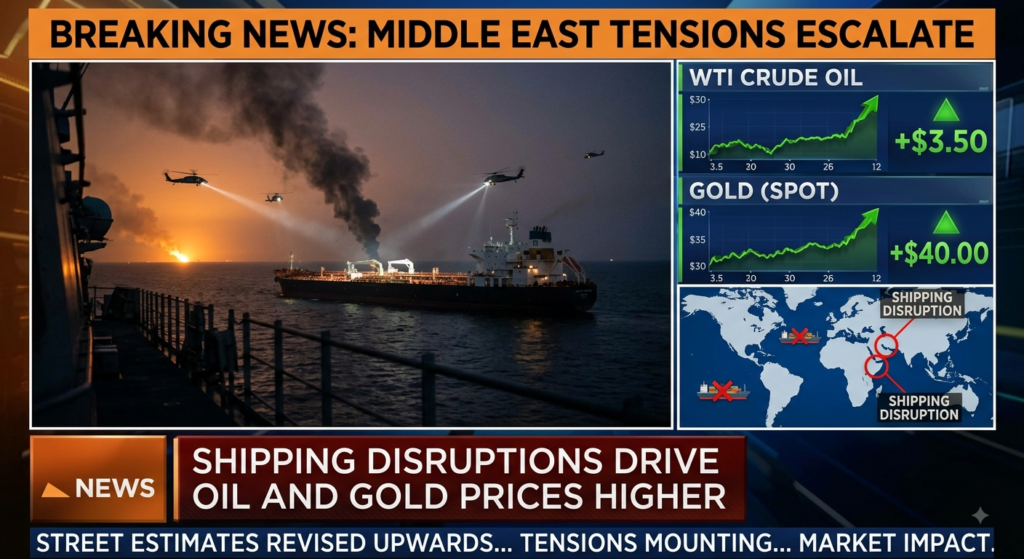
Global energy and precious metals markets remained under pressure on Wednesday as persistent military friction in the Middle East, combined with severe shipping disruptions at two of the world’s most critical maritime chokepoints, reinforced a risk premium that has kept oil and gold prices elevated for much of 2026. Brent crude advanced to approximately $89.60 a barrel while U.S. West Texas Intermediate rose to about $83.94, extending gains from earlier sessions. Spot gold climbed to around $4,387 an ounce. Both commodities drew support from renewed reports of attacks on commercial vessels and the continued effective restriction of traffic through the Strait of Hormuz, alongside escalating threats and strikes in the Red Sea and Bab el-Mandeb Strait.
The latest developments underscored how a conflict that began with U.S. and Israeli military operations against Iran on February 28 has evolved into a prolonged crisis with direct consequences for global energy flows, shipping costs, insurance premiums, and investor demand for safe-haven assets. Iran has repeatedly asserted control over the Strait of Hormuz, a narrow waterway at the entrance to the Persian Gulf that normally carries roughly one-fifth of the world’s oil and significant volumes of liquefied natural gas. Parallel actions by Iran-aligned Houthi forces in Yemen have targeted shipping linked to Saudi Arabia and other commercial vessels in the Red Sea corridor, complicating alternative export routes that Gulf producers have relied upon to bypass the Gulf chokepoint.
Shipping data on Tuesday illustrated the severity of the Hormuz disruption. The number of vessels tracked in the strait fell to a one-week low of eight, according to maritime analytics firm Kpler, well below a recent 10-day average of about 12 and a tiny fraction of the 130 to 140 ships that typically transited daily before the conflict. Separate data from LSEG showed 11 transits, down from 14 the previous day. Only one coal carrier was recorded exiting, while the remainder were still in transit; the seven vessels entering all used the Iranian route. Pre-war normality remains distant.
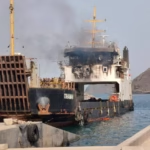
At the southern end of the Red Sea, the Bab el-Mandeb Strait saw 30 vessel crossings on Tuesday, above its recent 10-day average of 25, yet the corridor remains under elevated threat. On Tuesday, Yemen’s transport ministry reported that four crew members of an Egyptian-owned ship were killed in an attack attributed to the Houthis in the Bab el-Mandeb area—the first fatalities from a Houthi strike on shipping since the broader Iran-related war began in late February. Concurrently, the U.S. military reported that a Navy helicopter fired missiles to disable the steering of a Panama-flagged container ship attempting to sail toward an Iranian port, enforcing a naval blockade. These parallel incidents reinforced market perceptions that both major energy corridors remain vulnerable.
A Conflict That Reshaped Energy Geography
The crisis traces its roots to the U.S.-Israeli campaign against Iranian targets that began at the end of February 2026. Iranian forces responded by effectively closing or severely restricting the Strait of Hormuz, threatening and attacking vessels attempting transit without adherence to Tehran’s conditions. Commercial traffic collapsed. Analysts estimated that flows through the strait, which had carried on the order of 14–21 million barrels per day of crude and products in normal times, fell dramatically. Some assessments put the reduction in effective Gulf oil exports at several million barrels per day even after partial rerouting, with production shut-ins and storage constraints compounding the impact.
Saudi Arabia and other Gulf producers responded by maximising alternative outlets. Saudi Arabia sharply increased loadings at its Red Sea terminal of Yanbu, fed by the East-West Pipeline, which allowed several million barrels per day to bypass the Gulf entirely. Pre-crisis Yanbu volumes were far lower; during the peak of Hormuz restrictions, they rose substantially, at times approaching or exceeding 4 million barrels per day of crude and condensate. This workaround, however, funnelled greater volumes through the Red Sea and Bab el-Mandeb, precisely the corridor where Houthi forces have demonstrated the ability and willingness to strike.
Houthi activity intensified in July. The group declared a maritime embargo against Saudi-linked shipping and claimed attacks on Saudi oil tankers in the Red Sea. One vessel was reported ablaze. Tankers turned around or diverted. War-risk insurance premiums rose sharply, and some insurers grew more selective. The dual-chokepoint problem became clear: when Hormuz is constrained, reliance on the Red Sea rises; when the Red Sea is threatened, the remaining escape routes lengthen dramatically. Ships that avoid both corridors must sail around the Cape of Good Hope, adding weeks to voyage times, millions of dollars in extra fuel and opportunity costs, and further pressure on tanker availability and freight rates.
A temporary de-escalation attempt in mid-June produced a memorandum of understanding between the United States and Iran that included a ceasefire extension, steps toward reopening Hormuz, and limited sanctions relief. Markets responded with relief; oil prices retreated toward pre-war levels for a period. The arrangement frayed. Renewed strikes, mutual accusations of non-compliance, and Iran’s insistence that the strait would remain closed unless Washington accepted its conditions—including the release of frozen assets and broader regional de-escalation—returned uncertainty to the forefront. By early August, Tehran’s senior officials were reiterating that Hormuz would stay restricted without those concessions. U.S. rhetoric hardened in parallel, with demands for reparations and continued military posture.
Oil Markets: Elevated Prices and Persistent Risk Premium
Oil prices have been highly sensitive to every shift in the conflict narrative. When the war began, Brent jumped sharply from levels near $70. Subsequent spikes pushed the benchmark above $100 on multiple occasions, including a July close above $100 after Houthi attacks on Saudi tankers. Goldman Sachs and other houses at various points warned that sustained dual disruptions could drive prices toward $120 or higher in the fourth quarter, with elevated averages possible into 2027 if recovery lagged. Actual prices have been volatile rather than monotonically higher: relief rallies on diplomatic progress have repeatedly given way to renewed gains when talks stalled or kinetic activity resumed.
As of mid-August, Brent hovered near $89–90 and WTI near $84, levels that still embed a significant geopolitical premium relative to a no-conflict baseline. Both contracts had settled more than $1 higher on Tuesday and extended gains into Wednesday’s Asian session. Analysts noted that the absence of substantial progress in talks, combined with Iran’s continued assertion of authority over Hormuz, kept the risk skewed to the upside. Inventory draws, refining constraints, and the higher cost of longer-haul shipping have supported the physical market even when paper prices fluctuated.
The structure of the disruption matters. Not every barrel that once moved through Hormuz is permanently lost. Some Iranian exports have continued, often via shadow-fleet or sanctioned vessels, primarily to China. Saudi and other Gulf volumes have been partially rerouted. Strategic petroleum reserve releases in the United States and elsewhere provided temporary buffers earlier in the crisis. Yet the net effect has been tighter balances, higher freight and insurance costs, and greater volatility. Refined product markets have at times shown even more pronounced stress than crude, reflecting logistical bottlenecks and the difficulty of quickly substituting specific grades and product streams.
Longer-term supply responses are underway. Higher prices incentivise additional production from U.S. shale, Brazilian, Guyanese, and Canadian sources, among others. Forecasts from various institutions have revised medium-term output expectations upward on the expectation that elevated prices will eventually elicit a supply response. The lag, however, is measured in months to years, and near-term market clearing continues to depend heavily on the status of the two Middle Eastern chokepoints.
Gold as Safe Haven Amid Inflation and Geopolitical Stress
Gold has traded in a complex relationship with the oil-driven inflation narrative and pure geopolitical risk. Early in the conflict, gold had already been elevated on earlier speculative and central-bank demand; subsequent moves have reflected competing forces. Rising oil prices raise inflation expectations and can support higher interest-rate paths, which typically weigh on non-yielding bullion. At the same time, outright military friction and shipping insecurity drive traditional safe-haven flows.
In recent sessions, the geopolitical and uncertainty channels have dominated. Spot gold rose 0.46 per cent to approximately $4,387 an ounce on the same day oil advanced. Earlier in the week, gold had tested levels near two-month highs above $4,400–$4,495 before consolidating. The metal remains far above pre-2025 levels even after periods of consolidation, supported by central-bank purchases, residual safe-haven demand, and periodic shifts in rate expectations. When oil spikes raise the odds of tighter monetary policy, gold can face headwinds; when conflict intensity rises without a clear inflation-policy feedback, bullion tends to firm. The current environment has produced a net positive bias for gold as diplomatic stalemate and maritime incidents keep risk elevated.
Broader Shipping, Economic, and Regional Implications
Beyond the headline crude and gold prices, the crisis has reshaped maritime commerce. War-risk premiums that once sat near 0.3 per cent of hull value climbed well above 1 per cent at peaks of tension. Some insurers restricted coverage for Saudi-linked or high-risk voyages. Major carriers that had tentatively resumed Red Sea transit after earlier Houthi campaigns reconsidered or reversed course. Circumnavigation of Africa has become a routine contingency for Asia-Europe and Asia-Gulf trades that can no longer rely on the Suez–Red Sea–Bab el-Mandeb corridor or the Gulf exit.
The economic transmission channels are multiple. Higher oil prices feed into gasoline, diesel, jet fuel, and petrochemical costs. Longer shipping times and higher freight rates raise the landed cost of goods and intermediate inputs. Asian economies heavily dependent on Middle Eastern crude have felt particular pressure on refining margins and energy security. European natural gas markets, already sensitive to global LNG flows that also transit Hormuz in normal times, experienced sharp moves earlier in the conflict. Macro forecasts have incorporated the possibility of slower global growth if elevated energy prices persist; some earlier assessments pointed to potential reductions of several tenths of a percentage point in 2026 GDP growth under sustained high-price scenarios.
Regional actors face difficult trade-offs. Saudi Arabia’s ability to redirect volumes through Yanbu has been a critical shock absorber, yet it increases exposure to Houthi threats. Iran has leveraged Hormuz as a strategic asset while absorbing military strikes and sanctions pressure. The Houthis have used Red Sea operations both to pressure adversaries and, according to some analyses, to manage domestic and regional political dynamics. Oman and other mediators have continued quiet diplomacy aimed at defining safe transit corridors or conditions for reopening, but tangible results have proven elusive amid hardline public statements from the principal parties.
Diplomatic Outlook and Market Scenarios
As of August 12, prospects for a rapid resolution appeared limited. Iranian officials continued to condition any reopening of Hormuz on acceptance of their demands. U.S. statements emphasised accountability and military readiness. Pakistan and other intermediaries have at times signalled possible progress, only for subsequent rhetoric or incidents to reset expectations. Markets have learned to treat diplomatic headlines with caution; optimism has repeatedly proven fragile.
Analysts outline a range of scenarios. A durable agreement that restores free transit through Hormuz and calms the Red Sea would allow oil prices to retrace toward a lower equilibrium, potentially in the $70s or low $80s over time, depending on inventory rebuilding and demand. Persistent dual disruptions could sustain prices in a higher band—$90–$110 or above—with further upside risks if physical shortages intensify. Gold would likely remain supported in elevated-conflict scenarios and face greater competition from higher real rates if oil-driven inflation forces tighter policy.
For now, the market’s baseline assumption appears to be prolonged friction rather than imminent normalisation. Shipping traffic through Hormuz remains a fraction of normal. Red Sea risks have not disappeared. Every new attack or diplomatic setback reinforces the risk premium embedded in oil and the safe-haven bid supporting gold. Until the two chokepoints regain reliable commercial status, global energy markets and related assets will continue to trade under the shadow of Middle Eastern military and maritime instability.
The human cost is also real. Crew members have been killed. Thousands of seafarers have faced extended periods of uncertainty or stranding in the Gulf at various stages of the crisis. Insurance markets, shipowners, charterers, refiners, and consuming nations all confront higher costs and greater unpredictability. The Strait of Hormuz and the Red Sea corridor have once again demonstrated their outsized importance to the functioning of the global economy—and the severe consequences when that importance is leveraged in conflict.
As traders and policymakers await the next round of inflation data, diplomatic signals, and maritime incident reports, the central message from the markets remains consistent with the pattern of the past five and a half months: ongoing military friction and shipping disruptions near the Strait of Hormuz and Red Sea continue to push global oil and gold prices higher, with no clear near-term resolution in sight.