
American Agriculture and Grain Production: A Comprehensive Overview
American agriculture stands as one of the most productive and influential sectors in the global food system. The United States produces a substantial share of the world’s corn, soybeans, and significant volumes of wheat and other grains, feeding not only its own population of over 330 million but also supporting food security, livestock industries, and biofuel production across dozens of countries. Grain production forms the backbone of this system. Corn, soybeans, and wheat dominate planted acreage and export value, shaping rural economies, trade balances, and agricultural policy. This article examines the history, structure, production dynamics, technology, economic contributions, policy framework, challenges, and prospects of American agriculture with a particular focus on grains.
Historical Foundations of American Agriculture
Agriculture in what became the United States began long before European settlement. Indigenous peoples cultivated maize (corn), beans, squash, and other crops using sophisticated systems adapted to local environments. European colonists introduced wheat, barley, oats, livestock, and new tools, while also adopting Native American crops, especially corn, which became a staple due to its high yields and versatility.
In the colonial era and early republic, farming was largely subsistence-oriented or oriented toward local markets, with export crops such as tobacco, rice, and later cotton dominating commercial production in the South. The 19th century transformed the landscape. The Homestead Acts, beginning in 1862, distributed vast tracts of public land to settlers willing to farm them, accelerating westward expansion and the conversion of prairie into grain fields. Railroads linked Midwestern and Plains farms to eastern markets and ports, enabling commercial grain production on a large scale.
Mechanisation marked successive revolutions. Horse-drawn implements gave way to steam and then internal-combustion tractors in the early-to-mid 20th century. Hybrid corn varieties, developed in the early 1900s and widely adopted by the 1930s–1940s, dramatically raised yields. The post-World War II period brought synthetic fertilisers, pesticides, improved seeds, and further mechanisation—often called the second agricultural revolution. Government programs, research through land-grant universities and the USDA, and infrastructure investment supported steady productivity gains.
The late 20th and early 21st centuries introduced genetically engineered crops (especially herbicide-tolerant and insect-resistant corn and soybeans), precision agriculture, and GPS-guided equipment. These advances allowed fewer farmers to manage more land while producing ever-larger harvests. The number of farms declined sharply from peaks in the early 20th century, while average farm size increased and output soared. Today’s American grain farmer operates in a capital-intensive, technology-driven, globally integrated industry far removed from the homestead era, yet still rooted in the same fundamental crops.
The Structure of Modern U.S. Agriculture
U.S. agriculture is highly diverse yet concentrated in certain regions and commodities. Farms range from small speciality operations to large commercial grain enterprises covering thousands of acres. Crop production, particularly grains and oilseeds, accounts for a major share of the value of agricultural output, alongside livestock, dairy, poultry, fruits, vegetables, and speciality crops.
The Midwest and Great Plains form the core of grain production. The Corn Belt—centred on Iowa, Illinois, Indiana, Nebraska, Minnesota, and parts of surrounding states—produces the bulk of the nation’s corn and a large share of soybeans. The Great Plains states, including Kansas, North Dakota, South Dakota, Montana, and Oklahoma, dominate wheat production, especially hard red winter and spring wheat. Rice is concentrated in the Mississippi Delta (Arkansas, Louisiana, Mississippi, Missouri) and California. Sorghum is important in the southern Plains.
California leads overall agricultural cash receipts due to high-value speciality crops, but Midwestern and Plains states dominate volume production of grains. Agriculture contributes hundreds of billions of dollars annually in farm cash receipts and supports a much larger food and fibre system encompassing processing, transportation, input manufacturing, and retail. Recent analyses of the broader food and agriculture sector place its total economic contribution in the trillions of dollars and millions of jobs when upstream and downstream linkages are included.
Major Grain Crops: Production, Uses, and Trends
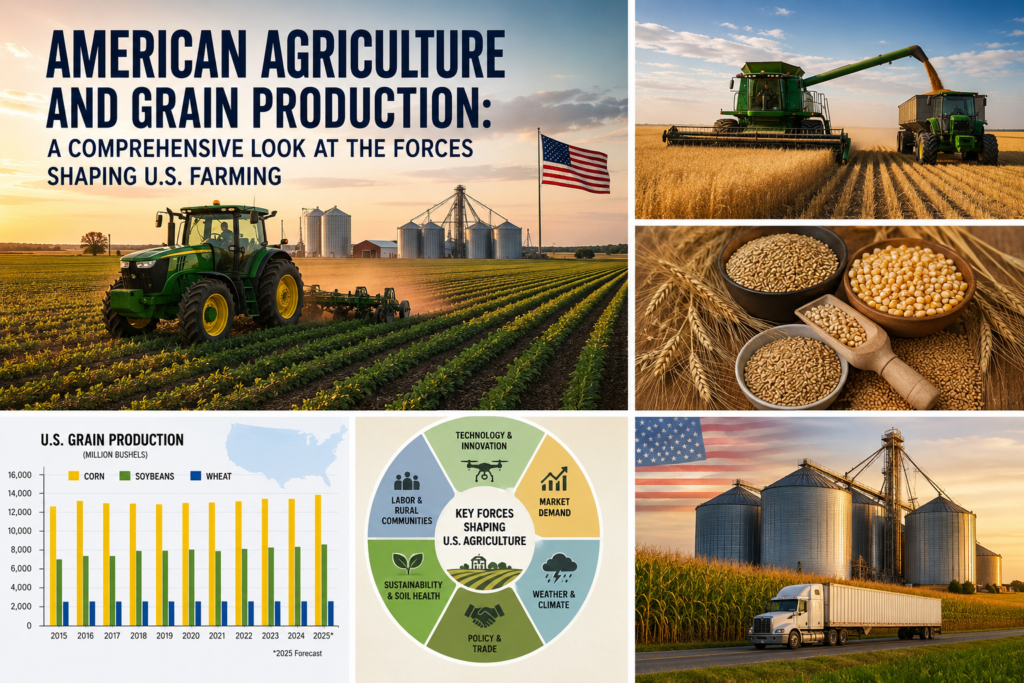
Corn is the dominant U.S. crop by volume and value. In 2024, corn for grain production was estimated at approximately 14.9 billion bushels with a record average yield of 179.3 bushels per acre on about 82.9 million harvested acres. The 2025 crop reached a new record of roughly 17.0 billion bushels with an average yield near 186.5 bushels per acre on expanded harvested area. The United States typically accounts for around one-third of global corn production.
Most U.S. corn is used domestically: roughly 30–40 per cent for livestock and poultry feed, a large share for ethanol and co-products (distillers grains), and the remainder for food, industrial uses, and residual. Exports are substantial, with Mexico, Japan, South Korea, Colombia, and other markets as key destinations. Corn’s dual role in food/feed and energy systems makes it highly sensitive to policy (Renewable Fuel Standard), energy prices, and global demand.
Soybeans rank second in importance among field crops. Production in 2024 reached about 4.37 billion bushels at an average yield of 50.7 bushels per acre; 2025 production was slightly lower at around 4.26 billion bushels. The U.S. is one of the world’s top producers and exporters, though Brazil has overtaken it as the leading soybean exporter in recent years. Soybeans are crushed primarily for meal (animal feed) and oil (food and industrial uses, including biodiesel). China has long been the largest single market for U.S. soybeans, though volumes fluctuate with trade relations, Chinese domestic production, and competition from South America.
Wheat production is smaller in volume but culturally and economically significant. All-wheat production in 2024 totalled about 1.97 billion bushels at an average yield of 51.2 bushels per acre on 38.5 million harvested acres. Classes include hard red winter (bread wheat, dominant in the southern Plains), hard red spring (northern Plains), soft red winter (eastern U.S.), white wheat, and durum (pasta). Wheat acreage has declined over decades as corn and soybeans offered stronger returns in many areas. The U.S. remains a notable exporter, though its global market share has fallen amid competition from the European Union, Russia, Ukraine, Canada, and Australia.
Other grains include rice (production around 200–220 million hundredweight in recent years, concentrated in the South and California), sorghum (important in the southern Plains for feed and export), barley, oats, and rye. These play specialised roles in food, feed, malting, and rotation systems but occupy far less acreage than the “big three.”
Yield trends have been strongly upward over the long term, driven by genetics, agronomy, and management. Corn yields have multiplied several-fold since the early 20th century. Continued gains depend on weather, technology adoption, and soil health.
Key Producing Regions and Farming Systems
The Corn Belt’s deep, fertile soils, favourable rainfall patterns, and infrastructure support intensive corn–soybean rotations. Many farms practice continuous corn or corn–soy with varying degrees of tillage reduction, cover crops, and precision nutrient management. The Plains wheat systems are often more extensive, with fallow periods in drier areas and greater reliance on winter wheat.
Irrigation is critical in parts of the western Corn Belt, High Plains (drawing on the Ogallala Aquifer), and California. Conservation practices—no-till or reduced tillage, cover crops, buffer strips, and precision application of inputs—have expanded, though adoption varies widely. Larger farms dominate commercial grain production, achieving economies of scale in equipment, marketing, and risk management.
Technology, Innovation, and Productivity
Modern grain farming relies on advanced genetics (conventional breeding plus transgenic and, increasingly, gene-edited traits), precision agriculture (GPS guidance, variable-rate application, yield mapping, remote sensing), and digital tools for decision support. Autonomous or semi-autonomous equipment, drones, and data analytics are expanding. These technologies raise yields, improve input efficiency, and help manage labour constraints.
Biotechnology has been especially transformative for corn and soybeans, with high adoption rates of insect-resistant and herbicide-tolerant varieties. Research continues on drought tolerance, nitrogen-use efficiency, and disease resistance. Public and private investment in seed, equipment, and agronomic research underpins long-term productivity growth.
Economic Contributions and Trade
Agriculture’s direct farm-level output is substantial, but the full economic footprint is far larger. Corn farming alone has been estimated to support tens of billions in economic output and hundreds of thousands of jobs when multiplier effects are included. The broader food and agriculture system supports tens of millions of jobs and generates trillions in economic activity.
Exports are vital. U.S. agricultural exports have recently totalled in the range of $170–180 billion annually, with grains and oilseeds (including soybeans) forming a major component of bulk commodity trade. Mexico is a leading destination for corn; China, Mexico, the EU, and others for soybeans; and various markets for wheat. Trade supports farm income, rural economies, and the U.S. trade balance in agriculture, though the overall agricultural trade balance has shifted toward deficit in some recent years due to rising imports of consumer-oriented products.
Competition has intensified. Brazil has become the world’s top soybean exporter and a major corn exporter. Black Sea suppliers and others have gained wheat market share. U.S. producers compete on quality, reliability, and logistics but face challenges from relative costs, currency movements, and trade policy.
Government Policy and the Farm Safety Net
Federal policy has shaped American agriculture since the New Deal. Periodic farm bills authorise commodity programs, crop insurance, conservation, research, nutrition assistance, and trade promotion. Key tools for grain producers include Price Loss Coverage (PLC) and Agricultural Risk Coverage (ARC), which provide payments when prices or revenues fall below reference levels; marketing assistance loans; and highly subsidised crop insurance.
Recent legislation has adjusted reference prices upward for major commodities and modified program parameters. Ad hoc or supplemental assistance has also been provided in response to market disruptions, high input costs, or weather events. Conservation programs encourage practices that protect soil, water, and habitat. Biofuel policy, particularly the Renewable Fuel Standard, has been a major demand driver for corn.
These programs stabilise farm income and encourage production but are subjects of ongoing debate regarding cost, equity, environmental outcomes, and market distortions.
Challenges Facing Grain Production
American grain agriculture faces multiple, interacting challenges.
Climate and weather variability rank among the most pressing. Extreme heat, drought, heavy precipitation, flooding, and shifting growing seasons affect yields and quality. Projections suggest climate change could slow yield growth or reduce productivity in key regions without successful adaptation. The Corn Belt and Plains are already experiencing more variable conditions. Soil health, water availability (especially groundwater), and pest/disease pressures are linked concerns.
Market volatility and profitability cycles are inherent. Periods of high prices (as in 2020–2022) are followed by lower prices amid large supplies and strong competition. Input costs (fertiliser, seed, fuel, machinery, labour) have been elevated, squeezing margins even when yields are strong. Many analyses in recent years have shown principal crops facing negative returns over total costs without government support.
Labour shortages and rising wages affect operations, particularly for certain tasks, though grain production is more mechanised than speciality crops. Immigration policy and domestic workforce trends influence availability.
Sustainability and environmental impacts draw increasing scrutiny. Nutrient runoff contributes to water quality issues (including the Gulf of Mexico hypoxic zone). Greenhouse gas emissions from fertiliser production and use, soil management, and related activities are under examination. Demand for climate-smart or low-carbon commodities is growing, creating both challenges and market opportunities.
Global competition and trade policy uncertainties affect export demand. Shifts in Chinese purchasing patterns, Brazilian expansion, and geopolitical events influence prices and volumes.
Infrastructure and logistics—rail, barge, ports, and elevators—must keep pace with large harvests. Ageing systems and weather-related disruptions can create bottlenecks.
Adaptation, Sustainability, and Future Outlook
Producers, researchers, and policymakers are pursuing multiple pathways. Precision technologies and improved genetics continue to raise efficiency. Expanded use of cover crops, diversified rotations (including small grains where viable), reduced tillage, and edge-of-field practices improve resilience and environmental performance. Carbon markets, ecosystem service payments, and private-sector sustainability programs offer potential new revenue streams.
Demand drivers include global population growth, rising protein consumption in emerging markets, biofuels (including potential sustainable aviation fuel pathways), and industrial uses of grain-derived products. Domestic livestock and ethanol sectors remain core outlets.
Yield potential remains high in favourable environments, and the U.S. retains advantages in research capacity, infrastructure, and institutional support. However, maintaining competitiveness will require continued innovation, effective risk management, adaptation to climate trends, and policies that balance productivity, environmental stewardship, and economic viability for producers.
Long-term success depends on managing the tension between intensifying production to meet demand and reducing negative externalities. A more diversified crop mix in some regions, greater emphasis on soil carbon and water-use efficiency, and robust public–private research partnerships can help. Trade agreements and market access remain critical for a sector that produces far more grain than the domestic market can absorb.
Conclusion
American agriculture, and grain production in particular, represents a remarkable achievement of productivity, scale, and integration into global markets. From the Homestead era to the age of precision farming and biotechnology, successive waves of innovation and policy support have made the United States a leading supplier of corn, soybeans, wheat, and related products. Record or near-record harvests in recent years underscore the system’s capacity, while declining wheat acreage, rising competition, climate pressures, and margin challenges highlight its vulnerabilities.
The sector’s economic reach extends far beyond the farm gate, supporting jobs, rural communities, manufacturing, and food security at home and abroad. Its future will be shaped by how effectively farmers, scientists, businesses, and policymakers address climate adaptation, resource stewardship, market access, and profitability. Grain production will remain central to American agriculture for the foreseeable future, but the form it takes—more precise, more resilient, and more responsive to environmental and market signals—will determine its sustainability and global standing in the decades ahead. The amber waves of grain continue to define much of the American agricultural landscape, even as the tools, challenges, and opportunities surrounding them evolve