
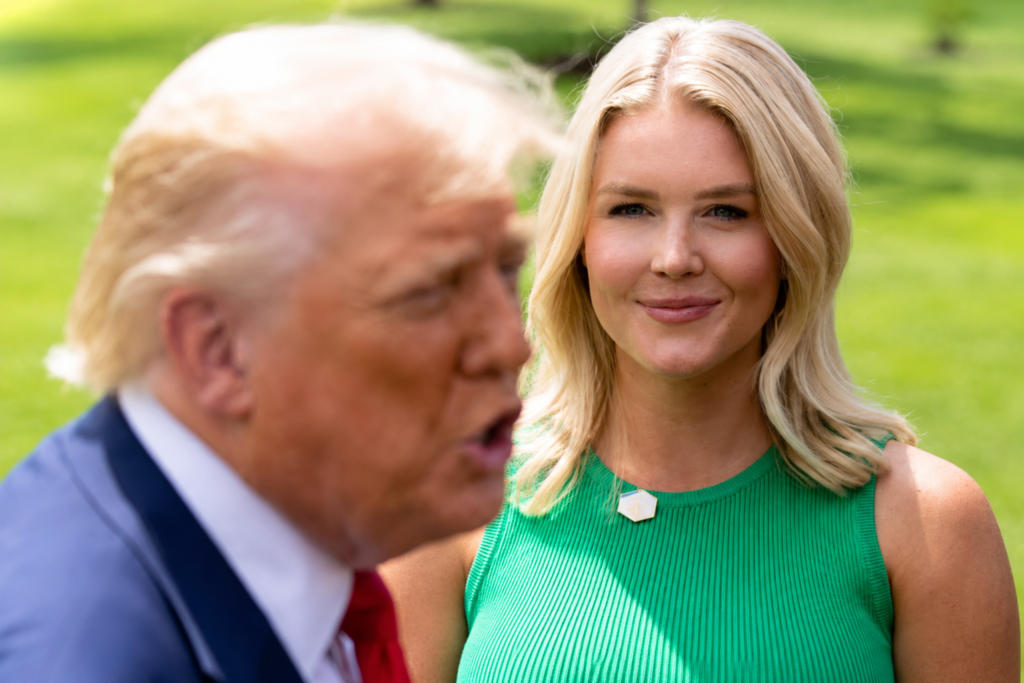
WASHINGTON — President Donald Trump faces one of the more delicate personnel challenges of his second term with the impending departure of White House Press Secretary Karoline Leavitt, the 28-year-old who has defined the administration’s combative public voice since Inauguration Day 2025. Announced by Trump on Truth Social on August 12, 2026, Leavitt will step down at the end of the month to spend more time with her two young children after recently returning from maternity leave following the birth of her daughter in May. Trump called her “one of my most trusted aides” and “one of the best White House Press Secretaries in the History of the Office,” while confirming she will remain a top outside adviser and influential Republican voice ahead of the midterm elections.
The timing could scarcely be more awkward. With less than three months until voters head to the polls, the administration is navigating economic discontent, a grinding conflict involving Iran, and the usual intensity of a Trump White House. Leavitt’s exit creates a vacuum that underscores just how uniquely suited she proved to a role that has historically chewed through spokespeople. Replacing her will not be a simple matter of promoting a deputy or recruiting another skilled communicator. Her combination of unwavering loyalty, fluency in the president’s personal style, inner-circle access, and ability to turn daily briefings into performances of MAGA defiance may prove extraordinarily difficult to replicate.
Leavitt arrived in the job as a calculated gamble that paid off handsomely for Trump. Born in 1997 in Atkinson, New Hampshire, to a family that ran an ice cream shop and used-truck dealership, she was the first in her immediate family to earn a college degree. She attended Saint Anselm College on a softball scholarship, studying communications and politics, interning at Fox News and in the Trump White House correspondence office during the first term. After graduation, she advanced to assistant press secretary under Kayleigh McEnany, then served as communications director for Rep. Elise Stefanik. A 2022 congressional bid in New Hampshire’s 1st District ended in a primary win but general-election loss. She returned to the Trump orbit as a spokeswoman for the MAGA Inc. super PAC and later as national press secretary for the 2024 campaign. Trump named her White House press secretary shortly after the election, making her the youngest person ever to hold the post—younger even than Ronald Ziegler under Nixon.
She also became the first press secretary to serve while pregnant and to give birth in office. Her willingness to delay leave and return quickly after both pregnancies reinforced her image as a total loyalist. During the 2024 campaign, she had cut short maternity leave after the assassination attempt in Butler, Pennsylvania. In the White House, she brought a similar intensity: no binder of notes at the podium, preferring to absorb information directly so she could respond fluidly. Briefings under her tenure often felt less like traditional policy explanations and more like demonstrations of Trumpian resistance to the mainstream press. She expanded access for “new media”—podcasters, influencers, and conservative outlets—while restricting or clashing with legacy organisations, including the Associated Press over nomenclature disputes and other access fights.
That style resonated powerfully with Trump’s base. Supporters viewed her as a sharp, unflappable, photogenic defender who spoke their language without apology. Trump himself praised her repeatedly, once describing her in vivid, admiring terms on Newsmax and joking that she would never be replaced. Allies such as Vice President JD Vance and Interior Secretary Doug Burgum publicly lauded her courage and professionalism upon the departure announcement. Within MAGA circles, she became a star in her own right, a young mother balancing high-stakes public combat with family life in a way that reinforced the movement’s cultural messaging.
The job itself is notoriously brutal under any president, but especially under Trump. Message discipline is an oxymoron when the principal can upend talking points with a single social-media post or off-the-cuff remark. Press secretaries must simultaneously interpret an unpredictable president for the public, manage a sceptical or hostile press corps, and stay in the good graces of a demanding boss. In Trump’s first term, the role saw rapid turnover: Sean Spicer lasted roughly six months, Sarah Huckabee Sanders nearly two years, Stephanie Grisham about ten months, and Kayleigh McEnany eight months. Leavitt’s roughly 19 months make her the second-longest serving under Trump, a relative island of stability in a White House that otherwise experienced less senior-level churn than the first term.
What made Leavitt unusually effective was the rare intersection of traits. She possessed genuine proximity to the president—enough to understand his instincts and priorities without constant intermediaries. She demonstrated absolute loyalty, defending him even when facts were contested by independent fact-checkers who frequently rated her claims as false or misleading on topics ranging from tariffs to foreign aid to legal matters. She displayed political instinct attuned not primarily to Washington journalists but to the audience that matters most to Trump: his supporters. And she performed the role with a combative flair that mirrored the president’s own approach, turning briefings into arenas where reporters’ motives were questioned as readily as policy details were discussed. As one former Trump communications aide put it after the announcement, few could match how she “spoke Trump fluently” while feeding the media cycle in ways that primarily served the president’s interests.
Critics saw a different picture. Journalists and progressive observers accused her of amplifying misinformation, degrading norms of transparency, and treating the briefing room as a stage for political theatre rather than accountability. Changes to the press pool and invitations to friendly voices drew charges of favouritism. Some Democrats framed her departure with sarcasm about truth-telling. Independent analysts noted that while she excelled at defending the administration’s narrative, the long-term cost to institutional credibility and press relations could be significant. Even so, within the logic of the Trump White House, effectiveness is measured by loyalty, message amplification, and base enthusiasm more than by traditional metrics of accuracy or bipartisan respect.
Finding a successor who checks the same boxes will be challenging. Potential names floated in early speculation include deputy press secretary Anna Kelly, who shares a similar age and combative posture; communications director Steven Cheung; figures such as Alina Habba, Matt Boyle of Breitbart, Katie Miller, Monica Crowley, or others from the broader orbit. Yet none currently appear to combine Leavitt’s proven track record of daily podium performance, personal trust from the president, and authentic MAGA fluency in quite the same way. Most White Houses cultivate deputies for eventual promotion; the relative absence of a clear, visible succession plan for Leavitt has already fueled talk that Trump might lean more heavily on himself, on rotating senior officials, or on outside voices. During her recent maternity leave, briefings became less frequent and often featured high-level guests such as Vance or Secretary of State Marco Rubio, with mixed results.
The practical stakes are elevated by the calendar. Midterm elections typically test an incumbent president’s party, and Trump’s approval has faced pressure from inflation concerns and foreign policy. A seamless public voice helps maintain narrative control. Leavitt’s departure also removes one of the most visible women in a senior role at a moment when the administration has seen attrition among high-profile female aides. She will not vanish from the political scene—Trump has positioned her as an outside adviser precisely to retain her influence—but the daily grind of the briefing room, the constant preparation, the television hits, and the physical presence at the White House are unique demands.
Historically, press secretaries rarely achieve the kind of personal brand Leavitt built so quickly. Some become governors or cable hosts; others fade. Her youth, rapid rise, and cultural resonance within the conservative movement position her for continued relevance whether as a surrogate, commentator, or future candidate. For Trump, however, the immediate problem is operational. The president is the ultimate messenger, using social media and rallies to bypass traditional filters in ways no predecessor matched. Still, the formal apparatus of the White House communications operation requires a reliable face and voice to translate, defend, and sometimes absorb the heat. Leavitt did that with a particular blend of authenticity and aggression that matched the boss’s temperament.
Trump has already indicated he respects her family decision and values her continued counsel. That continuity softens the blow. Yet the search for a permanent replacement will test whether the administration can find someone who can stand at the podium day after day, absorb the hostility, deliver the message with comparable conviction, and retain the president’s full confidence. In an era when the press secretary’s role has evolved from information conduit to partisan combatant, the qualities that made Leavitt successful may be rarer than the title itself. For a president who prizes loyalty and stylistic alignment above almost all else, she may indeed prove singular—an indispensable interpreter of his political identity whose shoes will be hard to fill as the midterms approach and the daily demands of governing continue.
The coming weeks will reveal Trump’s choice and the new dynamic in the Brady Briefing Room. Whatever the outcome, Leavitt’s tenure has already left a clear imprint: a younger generation of MAGA communicators can rise rapidly, perform under intense scrutiny, and shape the public presentation of a Trump presidency in ways that previous spokespeople struggled to sustain. Whether that model can be reproduced remains the central open question of her departure.