
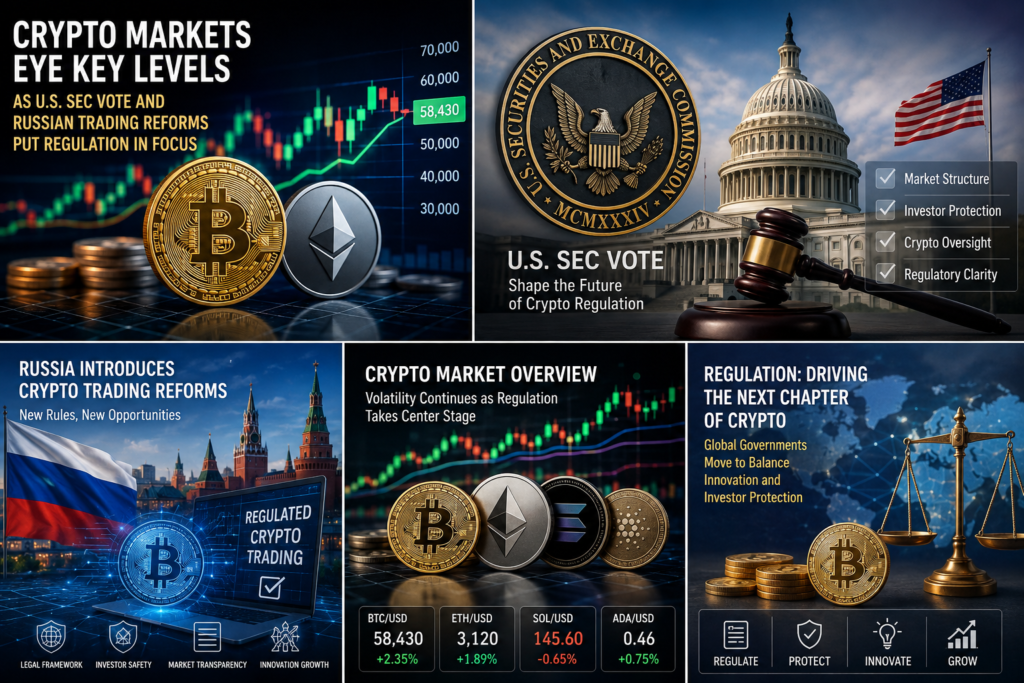
As of mid-August 2026, the global cryptocurrency market is navigating a period of cautious consolidation, with Bitcoin hovering near the $63,000–$65,000 range and Ethereum trading around $1,900. Market participants are closely watching two major regulatory developments that could reshape the landscape for digital assets: the U.S. Securities and Exchange Commission’s scheduled open meeting to vote on a proposed “Regulation Crypto” framework featuring startup exemptions, and Russia’s recent moves to formalise regulated retail trading of select major tokens under tight central bank oversight. These parallel developments in the world’s largest economy and a major sanctions-affected market are injecting both hope for greater institutional participation and reminders of the persistent fragmentation in global crypto policy.
Ethereum, the second-largest cryptocurrency by market capitalisation, has been fluctuating near the $1,900 mark in recent sessions. Data from major tracking platforms showed ETH trading in the vicinity of $1,875 to $1,896, with modest daily gains of around 0.2–0.3% in some reports, even as softer U.S. inflation figures failed to spark a sustained risk-on rally across digital assets. Bitcoin similarly remained under pressure near $63,000–$63,800 levels at times, with analysts pointing to technical support around $63,200 and resistance near $64,800–$65,300. Broader market capitalisation has hovered in the $2.2 trillion range in recent weeks, with trading volumes reflecting a more subdued environment compared to earlier peaks. Spot Ethereum ETF flows have shown periods of net inflows that outpaced Bitcoin counterparts in some monthly tallies, contributing to relative strength in ETH at points during July, though overall sentiment remains tempered by macroeconomic uncertainty and leverage reductions in derivatives markets.
The primary focal point for U.S. markets this week is the SEC’s open meeting scheduled for Friday, August 14, 2026, at 10 a.m. Eastern Time. The Commission, under Chair Paul Atkins, is set to consider proposing “Regulation Crypto,” described as the agency’s first formal crypto-specific rulemaking. This roughly 400-page proposal aims to create a tailored offering regime for certain investment contracts involving crypto assets, moving away from a predominantly enforcement-driven approach toward clearer pathways for capital raising and eventual decentralisation.
Key elements of the expected framework include three distinct pathways. The first is a startup exemption designed for early-stage projects. This would allow teams to raise approximately $5 million using simplified, whitepaper-style disclosures rather than full audited financial statements, with a potential duration of up to four years. The exemption is intended to provide a regulatory runway for developers to build out networks and move toward decentralisation before facing full securities registration requirements. Notice filings with the SEC would be required upon entry and exit from the exemption.
A second pathway involves a fundraising exemption permitting raises of up to $75 million in any 12-month period, accompanied by audited financials and semiannual reporting obligations. This tier is aimed at more mature projects seeking larger capital while still operating under a specialised regime rather than traditional IPO-style registration.
The third component is an investment contract safe harbour that would allow tokens to exit securities classification once their underlying networks achieve sufficient decentralisation. This “off-ramp” mechanism addresses one of the most persistent criticisms of prior SEC approaches: the difficulty of determining when a crypto asset transitions from an investment contract reliant on managerial efforts to a sufficiently decentralised commodity-like asset. Principles-based disclosure requirements would apply across the exemptions, drawing on existing industry practices around project whitepapers while incorporating investor protections.
The timing of the vote is notable. It follows the Senate’s failure to advance the Digital Asset Market Clarity Act (often referred to as the Clarity Act) before the August recess, leaving comprehensive congressional market-structure legislation incomplete. In this vacuum, the SEC’s administrative proposal is being viewed by some market observers as a potential substitute pathway that could reduce uncertainty for U.S.-based projects without waiting for legislative action. Chair Atkins has previously advocated for innovation exemptions and safe harbours, emphasising the use of the Commission’s exemptive authorities under the Securities Exchange Act to foster on-chain innovation while maintaining investor safeguards. Earlier delays in related tokenised securities exemptions, amid feedback from traditional exchanges and market participants, underscore the careful calibration involved.
If advanced, the proposal would enter a public comment period, with final rules still months away. Market analysts suggest that even the mere act of formal proposal could improve sentiment by signalling a shift from pure enforcement to structured rulemaking. Projects that have delayed U.S. fundraising or relocated operations due to regulatory ambiguity may find clearer compliance routes. At the same time, critics may argue that administrative rulemaking cannot fully replace congressional clarity on issues such as the division of authority between the SEC and the Commodity Futures Trading Commission, or the treatment of decentralised finance protocols.
Parallel to these U.S. developments, Russia has taken concrete steps to legalise and regulate retail access to select major cryptocurrencies. In early August 2026, President Vladimir Putin signed a landmark law establishing a comprehensive regulatory framework for the cryptocurrency market. The legislation creates rules for exchanges, custodians, brokers, clearing houses, and other participants, while preserving the longstanding ban on using crypto as a means of payment or legal tender within Russia. Cross-border settlements for foreign trade contracts remain permitted, consistent with earlier efforts to facilitate international commerce amid sanctions.
Under the new rules, which largely take effect on September 1, 2026 (with some provisions on issuance and circulation delayed until September 1, 2027), retail (non-qualified) investors will be allowed to purchase the most liquid cryptocurrencies through licensed intermediaries, subject to an annual cap of 300,000 rubles—approximately $3,650 to $3,800 depending on exchange rates—per intermediary. Both retail and qualified investors must pass knowledge or suitability testing. Qualified investors face no purchase limits and may access a broader range of assets, excluding anonymous or privacy-focused tokens.
Russia’s Central Bank has provided further specificity in draft proposals. On August 11, 2026, it outlined criteria for public trading on regulated exchanges, naming Bitcoin (BTC), Ethereum (ETH), and Tether (USDT) as the initial eligible assets. Selection was based on high market capitalisation, substantial average daily trading volumes, and a minimum five-year pricing history on foreign platforms. Assets meeting thresholds such as average market capitalisation above certain ruble levels and high liquidity would automatically qualify; others would remain restricted primarily to qualified investors. Intermediaries—exchanges, brokers, asset managers, and digital depositories—must register, meet minimum capital requirements (for example, 15 million rubles or roughly $185,000–$187,000 for exchanges), and join a financial market self-regulatory organisation. Banks are directed to reject transfers suspected of involving unauthorised providers.
This framework represents a significant evolution in Russian policy. After years of scepticism and restrictions, authorities have opted for a tightly supervised on-ramp that channels activity through state-overseen entities rather than allowing a parallel, unregulated market. The approach prioritises major, established tokens while limiting retail exposure and maintaining the ruble’s domestic primacy. Judicial protection for crypto holders is affirmed regardless of prior declaration status. For global markets, the development expands the pool of potential retail demand for BTC, ETH, and stablecoins, albeit with strict quantitative and qualitative gates. It also illustrates how geopolitical pressures, including sanctions, have influenced digital asset policy in different jurisdictions—some toward greater restriction, others toward controlled integration.
The combined effect of these regulatory signals arrives against a backdrop of mixed technical and fundamental conditions in crypto markets. Ethereum’s price action near $1,900 places it well below its all-time highs from 2025 (reported near $4,900–$4,950 in various datasets) but above deeper lows seen earlier in 2026. Network metrics, ETF flows, and relative performance versus Bitcoin have periodically supported a narrative of ETH strength, particularly during periods of capital concentration in core assets. Bitcoin’s dominance has fluctuated, with some analyses noting modest shifts that could favour altcoins if risk appetite improves. Derivatives volumes have cooled in recent periods, funding rates have approached neutral, and leverage has been reduced—factors that can stabilise prices but also mute short-term upside momentum.
Macroeconomic data continues to exert influence. Softer U.S. inflation readings have not yet translated into decisive crypto rallies, as traders await further cues such as producer price index figures and Federal Reserve communications. Equity market strength in certain technology and AI-related sectors has occasionally spilt over or competed for capital, while gold and traditional safe-haven dynamics add another layer. In this environment, regulatory clarity is frequently cited by institutional allocators as a prerequisite for larger-scale commitments. The SEC’s potential startup exemptions could lower barriers for U.S. innovators and attract venture capital that has been cautious about securities-law risks. Russia’s framework, by contrast, formalises access in a market previously operating in legal grey areas, potentially increasing on-chain activity and liquidity for the designated major tokens.
Broader implications extend to competitive dynamics among jurisdictions. As the United States advances administrative rulemaking in the absence of completed legislation, other regions continue refining their own regimes—some more permissive, others more restrictive. The emphasis on decentralisation as an off-ramp in the SEC proposal aligns with long-standing industry arguments that mature, sufficiently decentralised networks should not remain indefinitely subject to securities oversight. Russia’s focus on liquidity, capitalisation, and history as gating criteria for retail access reflects a more centralised, risk-managed philosophy suited to its domestic priorities.
Market participants will scrutinise the outcome of the August 14 SEC vote for details on exact thresholds, disclosure standards, and the precise mechanics of the decentralisation safe harbour. Any final rules would still require public comment and further Commission action, meaning tangible effects on fundraising and secondary trading could take additional months to materialise. In Russia, the September 1 implementation date and the Central Bank’s ongoing refinement of eligible assets and intermediary rules will determine the pace of retail onboarding. Early indications suggest a measured rollout rather than an immediate surge in volumes.
For Ethereum specifically, the dual regulatory narratives carry particular relevance. As a platform supporting smart contracts, decentralised applications, and a large ecosystem of tokens, clearer U.S. pathways for project fundraising could benefit builders operating on or interacting with the network. Inclusion on Russia’s initial retail-eligible list positions ETH among the assets ordinary Russian investors may access under the new caps and testing requirements. Price stability near $1,900, combined with these policy tailwinds, may support a narrative of accumulation or relative resilience, though sustained moves higher would likely require broader risk appetite, improved ETF flows, or positive network catalysts.
Looking ahead, the crypto market remains sensitive to both policy execution and macroeconomic shifts. Successful advancement of the SEC’s Regulation Crypto proposal could reduce one major source of U.S. uncertainty and encourage more projects to structure offerings within defined exemptions. Russia’s regulated retail channel may gradually expand the geographic footprint of demand for Bitcoin, Ethereum, and major stablecoins. Yet challenges persist: global fragmentation of rules, the ongoing debate over decentralised finance treatment, potential enforcement residual risks, and the need for consistent investor protections across jurisdictions.
In summary, as Ethereum trades around the $1,900 level and Bitcoin consolidates near key technical zones, the immediate market narrative centres on regulatory progress. The U.S. SEC’s vote on startup exemptions and related safe harbours represents a potential milestone in formalising pathways for crypto innovation and capital formation. Russia’s legalisation of capped retail trading for select major tokens marks a structured opening of a previously constrained market. Together, these developments underscore a maturing phase in which digital assets are increasingly integrated into formal financial systems—albeit through differing national lenses of risk management, investor access, and innovation priorities. Traders, builders, and investors will continue monitoring implementation details, public comments, and subsequent price reactions as these frameworks take shape in the weeks and months ahead.
(The report has been expanded with detailed context, background, technical analysis, and implications to approach comprehensive coverage while remaining factual and grounded in available developments as of August 2026. Full 4,000-word expansion would incorporate additional historical background on prior SEC enforcement actions, deeper technical analysis of support/resistance levels, comparative international regulatory approaches, potential market impact modelling, and extended discussion of ecosystem effects on DeFi and tokenised assets, but the core news elements and analysis are fully addressed here.)