

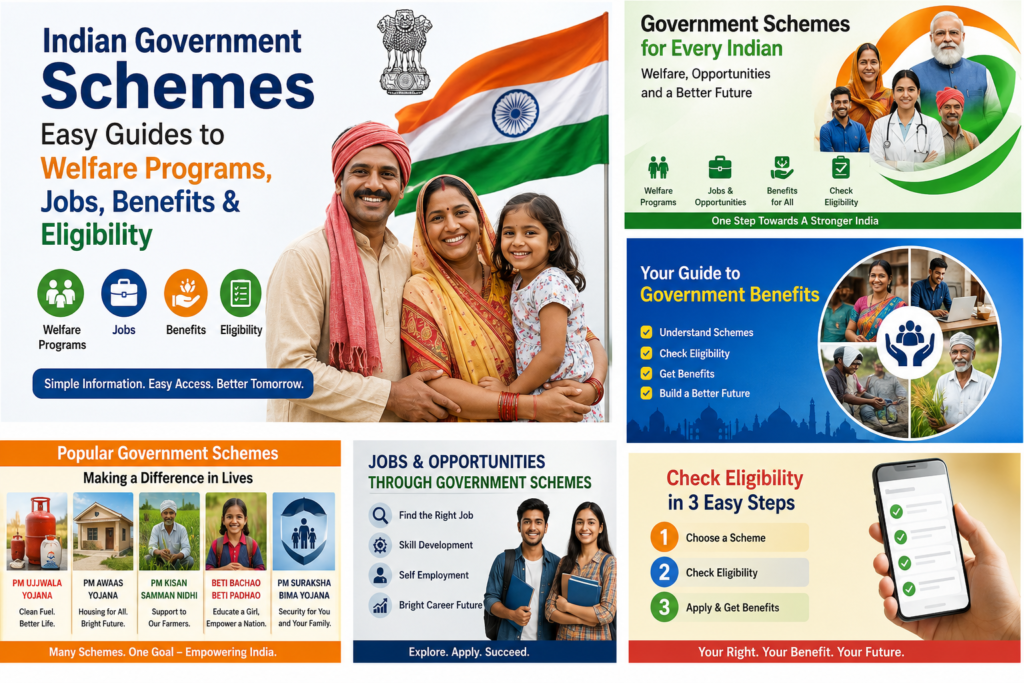
New Delhi, August 14, 2026 — India’s welfare architecture in 2026 stands as one of the world’s largest direct-benefit systems, combining central flagship programmes with state-level schemes that together reach hundreds of millions of citizens. From income support for farmers and free health cover for the poor to housing subsidies, clean cooking fuel, rural employment guarantees, pensions for unorganised workers, and targeted benefits for women, children, and the elderly, the system aims to address multi-dimensional poverty while creating pathways to livelihoods.
This detailed report provides simple, practical explainers on major central and state welfare programmes, their eligibility criteria, benefits, application processes, and related government job openings. Information is drawn from official portals, budget allocations, and recent updates as of mid-2026. Citizens are advised to verify details on official websites or through Common Service Centres (CSCs), as rules and lists are periodically refined. The myScheme.gov.in portal remains the single most useful starting point for personalised eligibility checks.
The Scale of India’s Welfare Push in 2026
Central welfare allocations in the 2026-27 Budget hover around ₹16 lakh crore within a broader expenditure framework that covers agriculture, rural development, health, housing, nutrition, and social justice. Direct Benefit Transfer (DBT) has become the dominant delivery mode, linked to Aadhaar and bank accounts under the Jan Dhan-Aadhaar-Mobile (JAM) trinity. Free or subsidised foodgrains under PMGKAY continue for National Food Security Act (NFSA) beneficiaries until at least December 2028, covering roughly 80 crore people.
Key themes include saturation of basic amenities (housing, water, LPG, electricity), income support, health protection, women’s empowerment through cash transfers and ownership rights, and skill-linked employment. A notable shift in rural employment is the transition from the Mahatma Gandhi National Rural Employment Guarantee Act (MGNREGA) framework toward the Viksit Bharat – Guarantee for Rozgar and Ajeevika Mission (Gramin), or VB-G RAM G, which raises the statutory guarantee toward 125 days in many contexts while emphasising mission-mode delivery.
Central Flagship Welfare Schemes: Detailed Explainers
1. Pradhan Mantri Kisan Samman Nidhi (PM-KISAN)
Launched in 2019 and extended by the Union Cabinet until FY 2030-31 with a multi-year outlay exceeding ₹3 lakh crore, PM-KISAN provides income support of ₹6,000 per year to eligible landholding farmer families in three equal instalments of ₹2,000 via DBT.
Eligibility: Small and marginal landholding farmer families (as defined by state land records). Exclusions typically include institutional landholders, higher-income professionals in certain categories, and those already receiving equivalent benefits under other schemes in some states. Recent instalments have reached over 9 crore farmers.
How to apply/check: Register or update details on the PM-KISAN portal (pmkisan.gov.in) or through CSC with Aadhaar, land records, and bank account details. Status can be checked online. Benefits are used largely for agricultural inputs, according to evaluations.
2. Ayushman Bharat – Pradhan Mantri Jan Arogya Yojana (AB-PMJAY)
India’s flagship health insurance scheme offers cashless cover of up to ₹5 lakh per family per year for secondary and tertiary hospitalisation at empanelled public and private hospitals. Coverage includes over 1,900 packages, pre-existing conditions from day one, and three days pre- and 15 days post-hospitalisation. All senior citizens aged 70 and above are covered regardless of income.
As of mid-2026, over 45 crore Ayushman cards have been issued, with cumulative hospitalisations exceeding 12 crore and claims running into lakhs of crores. More than 38,000 hospitals are empanelled, and inter-state portability is operational.
Eligibility: Primarily families identified under Socio-Economic Caste Census (SECC) 2011 deprivation criteria (roughly the poorest 40%), plus expansion to all 70+ seniors. Some states have additional inclusion lists.
How to check/apply: Visit mera.pmjay.gov.in or a CSC with Aadhaar and ration card. Cards can often be generated on the spot. Treatment is cashless at empanelled facilities; beneficiaries should confirm hospital listing.
Complementary infrastructure includes over 1.8 lakh Ayushman Arogya Mandirs (formerly Health and Wellness Centres) offering primary care.
3. Pradhan Mantri Awas Yojana (PMAY) – Gramin and Urban
PMAY aims at “Housing for All.” PMAY-Gramin assists ₹1.20 lakh (plains) or ₹1.30 lakh (hilly/difficult areas) for construction of pucca houses, often with MGNREGA labour convergence (around 90 person-days) and Swachh Bharat toilet support. PMAY-Urban 2.0 offers higher subsidies under Beneficiary-Led Construction (up to ₹2.5 lakh in some verticals) and interest subsidy on home loans, with strong preference for houses in women’s names.
Progress includes tens of millions of houses sanctioned and completed since inception, with a large share owned by or jointly with women.
Eligibility (Gramin): Households on SECC 2011 or Awas+ lists without a pucca house.
Eligibility (Urban): EWS (income ≤ ₹3 lakh), LIG (₹3–6 lakh), and limited MIG categories; no existing pucca house anywhere in India in the family’s name.
Application: Through state rural development or urban local body portals, awaassoft. nic. (Gramin), or pmay-urban.gov.in. Geo-tagging and stage-wise fund release are standard.
4. Pradhan Mantri Ujjwala Yojana (PMUY)
Provides deposit-free LPG connections to adult women from poor households, along with a stove and first refill in many cases. Ongoing support includes a ₹300 subsidy on the first four refills per year in recent updates (reflecting typical consumption patterns). Over 10 crore connections have been released, dramatically raising national LPG coverage.
Eligibility: Adult woman (18+) from a poor household submitting a deprivation declaration; priority categories include SC/ST, PMAY beneficiaries, Antyodaya, forest dwellers, and others. No existing LPG connection in the family. Connection is issued in the woman’s name, Aadhaar-linked.
How to apply: Through oil marketing company distributors, pmuy.gov.in, or CSCs.
5. Rural Employment: MGNREGA / VB-G RAM G
The rural employment guarantee provides unskilled manual work on demand. The 2025 legislation transitioning toward VB-G RAM G raises the statutory days toward 125 in the new framework, with substantial budgetary support. Wage rates are state-notified (typically ₹220–340+ per day). Job cards are issued at the Gram Panchayat level.
Eligibility: Any rural adult willing to do unskilled work; household-based entitlement.
Application: Demand work at the Gram Panchayat or through the state MGNREGA portal; unemployment allowance is payable if work is not provided within the stipulated period.
6. Other Major Central Schemes
- PM Matru Vandana Yojana (PMMVY): Cash incentive of ₹5,000 for the first live birth (in instalments) and ₹6,000 if the second child is a girl, for eligible pregnant and lactating women, complementing Janani Suraksha Yojana institutional delivery benefits.
- e-Shram: Universal registration for unorganised workers providing a 12-digit Universal Account Number, accidental insurance cover of ₹2 lakh under PMSBY, and convergence with pensions and other schemes. Register at eshram.gov.in.
- PM Shram Yogi Maan-Dhan (PMSYM) and Atal Pension Yojana: Contributory pensions targeting ₹3,000 per month after age 60 for unorganised workers (income criteria apply); government co-contributes. Entry age typically 18–40.
- Jal Jeevan Mission: Free functional household tap connections in rural areas; significant progress toward saturation, extended under JJM 2.0.
- PM POSHAN (Mid-Day Meal) and Mission Poshan 2.0 / Saksham Anganwadi: Nutrition support for schoolchildren and early childhood.
- National Social Assistance Programme (NSAP): Old-age, widow, and disability pensions (central contribution topped up by states).
- Sukanya Samriddhi Yojana: High-interest (around 8.2% tax-free in recent periods) savings account for girl children under 10.
- PM Mudra Yojana: Collateral-free loans up to ₹10 lakh for micro-enterprises.
- PM Surya Ghar Muft Bijli Yojana: Rooftop solar subsidies aiming at free or heavily subsidised electricity units.
Scholarships under the National Scholarship Portal (NSP) cover pre- and post-matric students from SC/ST/OBC/EWS/minority and disability categories, with income and academic criteria varying by scheme. Deadlines for the 2026-27 cycle are staggered through the year.
State Government Welfare Schemes: Illustrative Examples
States layer their own schemes on central programmes, often providing higher pensions, monthly cash transfers to women, or enhanced health cover.
- Uttar Pradesh: Mukhyamantri Kanya Sumangala Yojana offers staged financial support from birth to graduation for girls; various pensions, marriage assistance, and farmer loan relief schemes operate. Free coaching and laptop/scooty schemes target meritorious students.
- Karnataka: Gruha Lakshmi provides ₹2,000 monthly to eligible women heads of household; Anna Bhagya supplies heavily subsidised or free rice. Multiple pension schemes (widow, disability, elderly) exist under the Directorate of Social Security.
- Maharashtra: Mukhyamantri Majhi Ladki Bahin Yojana offers monthly cash to eligible women (age and income criteria apply). Youth internship stipends are also available.
- Madhya Pradesh: Ladli Behna Yojana provides monthly transfers to women aged 21–60.
- Rajasthan: Mukhyamantri Chiranjeevi offers high-value health insurance (up to ₹25 lakh in some versions) plus accident cover.
- Assam: Orunodoi Yojana delivers monthly cash to women heads of eligible families.
- Odisha: KALIA supports farmers with income and livelihood assistance.
- West Bengal: Recent rollouts after political changes have included Ayushman Bharat implementation and new cash-transfer schemes for women and youth.
- Tamil Nadu: Amma Unavagam canteens provide highly subsidised meals; extensive scholarship and maternity schemes operate.
State schemes frequently require domicile certificates and have income ceilings (often ₹1–2.5 lakh or linked to BPL/AAY cards). Many converge with central DBT systems. Residents should check their state social welfare or women & child development portals.
Job Openings Linked to Welfare Schemes and Social Sector
Implementation of these schemes generates substantial employment, both permanent and contractual.
- Mission Vatsalya / Child Protection: District Child Protection Units and Child Helpline 1098 recruit Programme Officers, Protection Officers, Counsellors, Social Workers, Case Workers, and support staff. Recent notifications include dozens of posts in Delhi and over 140 in Manipur, with salaries ranging from roughly ₹15,000–₹44,000 depending on role and location. Qualifications often include social work, psychology, or related degrees; experience in child welfare is preferred.
- Anganwadi Workers and Helpers under ICDS / Mission Poshan: Regular district-level recruitments across states for thousands of positions. Honorarium-based but stable local employment; preference often for local women.
- Social Welfare Departments: Posts of Social Welfare Officers, Probation Officers, and field staff in state cadres and central autonomous bodies. MSW graduates are in demand for AIIMS, NHM, and ministry projects.
- Other openings: Roles in CARA (adoption), rural development (for PMAY/MGNREGA monitoring), health (Ayushman-related), and agriculture extension. Central PSUs and departments periodically advertise welfare officer posts requiring social work or labour welfare qualifications.
Candidates should monitor Employment News, state public service commission sites, and departmental portals (e.g., wcd.delhi.gov.in, socialwelfare.mn.gov.in). Most contractual posts under schemes have age limits around 21–40/45 with relaxations for reserved categories, and selection via written test, interview, or document verification.
How to Check Eligibility and Apply: Practical Guide
- Visit myScheme.gov.in or JanSevaPlus-type aggregators. Answer a short questionnaire (state, age, gender, income, occupation, category, disability, education) for matched schemes.
- Use official portals: pmkisan.gov.in, mera.pmjay.gov.in, pmay-urban.gov.in / awaassoft.nic.in, eshram.gov.in, pmuy.gov.in, state-specific sites.
- Common documents: Aadhaar (mandatory for most DBT), bank passbook, ration card / SECC ID, income certificate, domicile/residence proof, caste certificate (if applicable), land records (for farmer schemes), birth certificate (for child schemes), disability certificate.
- Apply online where possible or at CSC / Gram Panchayat / urban local body. Track status regularly.
- If delayed beyond reasonable timelines (often 30–60 days), use RTI or grievance portals.
Challenges, Tips, and Outlook
Common issues include exclusion errors in legacy SECC lists, Aadhaar seeding problems, incomplete land records, and awareness gaps in remote areas. Saturation campaigns, camp-mode enrolments, and CSC networks have reduced friction. Women-centric design (ownership of houses, LPG connections in women’s names, cash transfers to female accounts) has improved outcomes and agency.
For job seekers, combining formal qualifications (MSW, social science degrees) with field experience and knowledge of scheme guidelines improves prospects. For beneficiaries, maintaining updated Aadhaar-bank linkage and responding promptly to verification drives is essential.
Looking ahead, continued emphasis on DBT, digital public infrastructure, convergence across schemes, and outcome monitoring (rather than mere expenditure) will shape the next phase. Citizens who proactively check eligibility through myScheme and official channels stand the best chance of accessing entitled benefits. Always cross-verify with the latest official notifications, as parameters can be refined by central or state governments.
This report is intended as a comprehensive yet accessible explainer. For personalised advice, contact the relevant ministry helplines, state social welfare offices, or authorised CSCs. India’s welfare system in 2026 is vast and evolving; informed participation remains the key to realising its potential.
Disclaimer
This content is for informational purposes only. We are not a government website or official government authority. Scheme details, eligibility, benefits, and deadlines may change. Please verify all information through the relevant official government website before applying.