

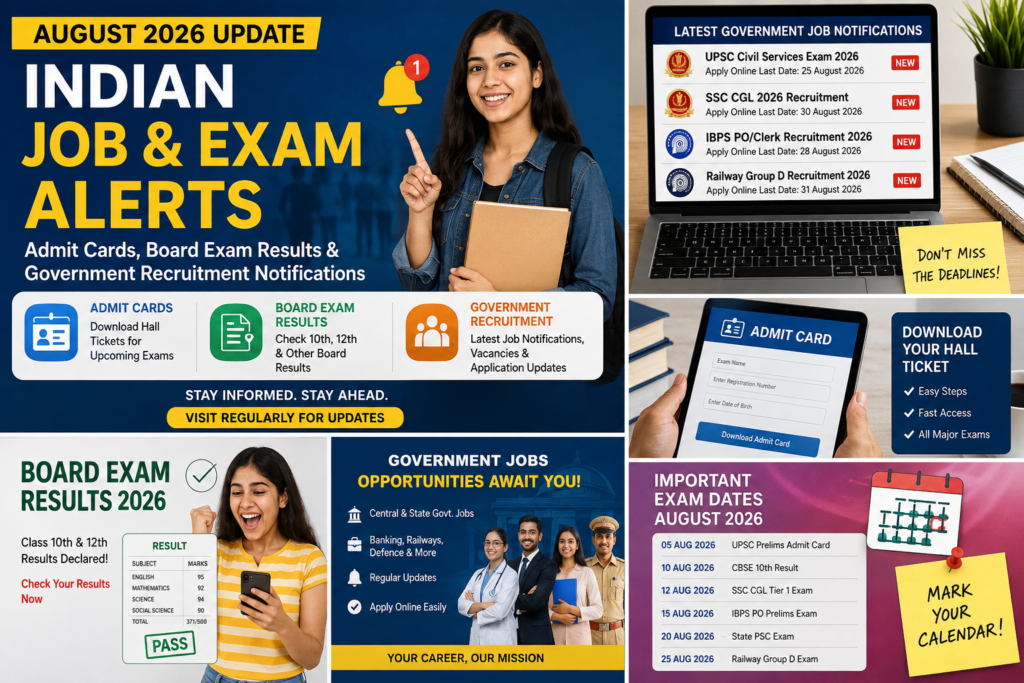
New Delhi, August 14, 2026 — August 2026 has emerged as a high-activity month for Indian job seekers, students, and aspirants tracking government recruitment, competitive examinations, and academic results. Banking giants, central recruitment bodies, the railways, defence forces, public sector undertakings, and state agencies have opened multiple windows for applications, while education boards continue releasing supplementary and improvement results. Admit card releases for several ongoing and upcoming examinations are keeping candidates on alert. This comprehensive report consolidates the major developments as of mid-August 2026, drawing on official notifications and verified public announcements.
Banking Sector Leads with Mega Vacancies
The State Bank of India (SBI) has dominated headlines with one of the largest single recruitment drives of the year. SBI is recruiting 9,766 Junior Associates (Clerks), covering both regular and backlog vacancies. Applications opened on August 11 and close on August 31, 2026. Eligibility requires a graduate degree, with the age limit generally set between 20 and 28 years (relaxations applicable as per government norms). The selection process involves a preliminary examination, main examination, and a language proficiency test. Candidates must apply through the official SBI careers portal.
SBI had earlier notified a special recruitment drive for 1,538 backlog vacancies, which forms part of its broader hiring push but should not be double-counted with the main 9,766 figure. In parallel, the Institute of Banking Personnel Selection (IBPS) is conducting the Common Recruitment Process for Customer Service Associates (Clerks). Registration ran from August 1 to August 21, 2026, with bank-wise vacancies to be announced. The process again follows the preliminary-plus-mains pattern, targeting graduates in the 20–28 age bracket.
Other banking and financial sector openings include specialist cadre officers at SBI (multiple posts with varying eligibility and selection methods involving shortlisting, written tests where applicable, and interviews) and various professional roles at institutions such as Bank of Baroda and Union Bank of India. These opportunities underscore the continued expansion and attrition-driven hiring needs in public sector banks.
UPSC and Central Government Direct Recruitment
The Union Public Service Commission continues its regular cycle of direct recruitments. Advertisement No. 10/2026 invites applications for various Group A and Group B posts across ministries and departments. The application window opened on August 8, 2026, and closes on August 28, 2026, for most posts (extended to September 4 for certain posts under the administration of the Union Territory of Ladakh). Candidates must apply through the UPSC Online Recruitment Application portal.
Earlier advertisements in 2026 had already notified over 100 posts spanning ministries of agriculture, civil aviation, corporate affairs, defence, health, AYUSH, culture, and others. Posts include specialist medical roles, engineering positions, legal officers, company prosecutors, archaeologists, security officers, and administrative roles. Selection typically involves scrutiny of applications, written tests or interviews as specified, and final recommendation by the Commission.
A broader parliamentary panel update earlier in the year indicated that recruitment processes were underway for approximately 1.83 lakh central government vacancies, with the railways accounting for the largest share (over 1 lakh posts) and the Staff Selection Commission handling tens of thousands of Group B and C positions. These figures reflect the cumulative pipeline rather than new August-only openings, but they illustrate the scale of ongoing central hiring.
Railways, Defence, and Public Sector Undertakings
Railway Recruitment Boards continue to drive large-volume hiring. Notifications and application windows for various categories, including Section Controller posts (around 119 vacancies with a mid-August closing date in some reports) and Junior Engineer categories, have been active. Broader railway recruitment pipelines remain substantial given the organisation’s status as one of India’s largest employers. Apprentice drives and other zonal notifications have also appeared in the August calendar.
Defence recruitment remains active. The Indian Army has notified Short Service Commission (Technical) entries for both men and women, NCC Special Entry schemes, and various tradesman, fireman, and civilian posts under formations such as the Army Ordnance Corps. Application windows for several of these closed or are closing in August, with last dates clustered around early to mid-month for some technical entries. Candidates are directed to the official joinindianarmy. nic. in portal.
Public sector undertakings and specialised agencies have posted multiple openings. Hindustan Aeronautics Limited (HAL) notified Management Trainee and related posts with mid-August deadlines. ISRO advertised Scientist/Engineer ‘SC’ positions (around 90+ vacancies) and support roles with deadlines in the second half of August. Other entities including HPCL, ONGC, CERT-In (Scientist-B posts), and various research and technology organisations under MeitY and related ministries have active or recently closed windows. Digital India BHASHINI and related divisions under the Ministry of Electronics and Information Technology have sought professionals with deadlines extending into late August and early September.
State-level and specialised drives include forest range officer posts, nursing and health mission recruitments (notably large numbers in Assam), police and constable recruitments in several states, and technical services examinations such as those notified by TNPSC. Candidates are advised to track respective state public service commission and departmental websites for exact vacancy numbers, eligibility, and deadlines, as these vary significantly by state.
Staff Selection Commission Calendar and Upcoming Exams
The Staff Selection Commission released an updated examination calendar for 2026-27. Key examinations already notified or scheduled include the Combined Graduate Level Examination 2026 (notification earlier in the year, examinations expected in the August–September window or as per revised schedule), Stenographer Grade C & D (examinations in early to mid-September), Combined Hindi Translators Examination, and Selection Post Phase-XIV. Notifications for Junior Engineer, Multi-Tasking Staff, and other categories are anticipated or in process according to the calendar. Candidates should monitor ssc.gov.in for region-wise admit card releases and precise dates.
Board Examination Results: CBSE and State Boards
Academic results have remained in focus through the summer and into August. The Central Board of Secondary Education introduced two Board Examinations for Class X from 2026 in line with National Education Policy recommendations. The Main Board Examination was held in February–March, followed by a Second Board Examination in May. Results of the Class X Second Board Examination were declared on July 18, 2026. Statistics indicated high participation, with a significant percentage of improvement candidates raising their scores and an overall combined pass percentage exceeding 96 per cent after both examinations. Results are accessible via the DigiLocker portal.
For Class XII, CBSE declared the Supplementary Examination Results on August 12, 2026. Candidates who appeared in the compartment or improvement categories can check their outcomes on the DigiLocker Results Portal. Official communications noted participation figures in the hundreds of thousands and provided pass percentages for the compartment category. School-wise results are communicated to institutions, and digital documents remain available through DigiLocker for both domestic and overseas affiliated schools.
State boards have been releasing supplementary and compartment results on staggered schedules through June, July, and early August. Tamil Nadu SSLC and higher secondary supplementary results, Kerala SAY results, and several other state board outcomes have been notified. Students should check the respective board websites or DigiLocker, where integrated. Post-result processes such as applications for scanned answer copies, verification, and re-evaluation continue for CBSE and several state boards, with specific windows and fees announced by each authority.
Admit Card Notifications
Admit card releases form a critical part of the August alert cycle. Hall tickets for various non-teaching posts under Central Sanskrit University (Delhi) were released in early August for examinations scheduled around that period. UPSC CAPF Assistant Commandant written examination admit cards had been issued earlier in the cycle. For banking examinations such as IBPS and SBI Clerk, admit cards typically become available one to two weeks before the preliminary examinations; candidates should watch the respective portals closely once examination dates are finalised.
Railway and SSC region-wise admit cards follow their own schedules, often released 4–15 days before the examination. Standard advice applies across all bodies: download the admit card from the official website only, verify personal details, photograph, signature, examination centre, date, and reporting time, and carry a printed copy along with a valid photo identity proof. Discrepancies must be reported immediately to the issuing authority. Candidates are reminded that no physical admit cards are usually sent by post.
Practical Guidance for Aspirants
The concentration of deadlines in the second half of August requires careful prioritisation. Candidates applying to multiple examinations should maintain a personal calendar of last dates, application fees, and document requirements. Most central and banking applications are entirely online; incomplete forms or payment failures close the window permanently. Age relaxations, reservation benefits, and eligibility certificates must be ready in the prescribed formats.
Preparation strategies differ by examination. Banking prelims emphasise speed in quantitative aptitude, reasoning, and English; mains add descriptive or professional knowledge components. SSC and railway examinations test general awareness, quantitative ability, reasoning, and, where applicable, technical subjects. UPSC direct recruitments often rely more heavily on domain expertise and interview performance. Regular practice with previous-year papers, mock tests under timed conditions, and official syllabi remains essential.
Aspirants should rely exclusively on official websites—sbi.co.in, ibps.in, upsc.gov.in, ssc.gov.in, rrb.indianrailways.gov.in or zonal RRB sites, cbse.gov.in, digilocker.gov.in, and the respective state board or departmental portals. Unofficial apps and social media channels frequently circulate outdated or fabricated notifications. Enabling SMS and email alerts from official portals, where available, helps track updates.
Broader Context and Outlook
The volume of vacancies reflects both replacement hiring for retirements and expansion in priority sectors such as banking services, infrastructure, defence, health, and digital governance. The railways’ large share of the central vacancy pipeline continues a long-term trend. Simultaneously, the education sector’s move toward multiple examination opportunities under NEP 2020 aims to reduce high-stakes pressure while giving students additional chances to improve scores.
Looking ahead, September is expected to bring examination dates for several SSC and banking prelims, further UPSC advertisements, and continued state-level drives. Candidates who miss current windows should monitor the next cycles for SBI, IBPS, SSC, and railway notifications, which typically follow annual patterns with some variation.
For students awaiting final mark sheets or migration certificates after supplementary results, timely collection from schools or boards is advisable for higher education admissions and competitive examination applications that require Class X or XII certificates.
This August 2026 update captures a dynamic landscape in which timely action on applications, careful tracking of admit cards, and prompt checking of results can significantly affect career and academic trajectories. Aspirants are encouraged to cross-verify every detail on the official portals and to prepare systematically for the examinations that follow successful applications.
( All dates, vacancy figures, and procedural details are based on publicly available notifications and reports current as of mid-August 2026. Candidates must always confirm the latest information directly from the official websites of the respective recruiting or examining bodies, as schedules and numbers can be revised.)
Disclaimer
Information is provided for general awareness only. Please verify official exam, admit card, result, and recruitment details on the respective government or official authority websites before applying.