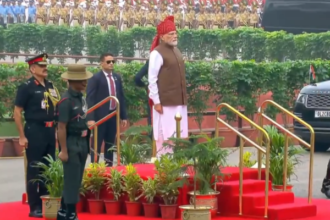


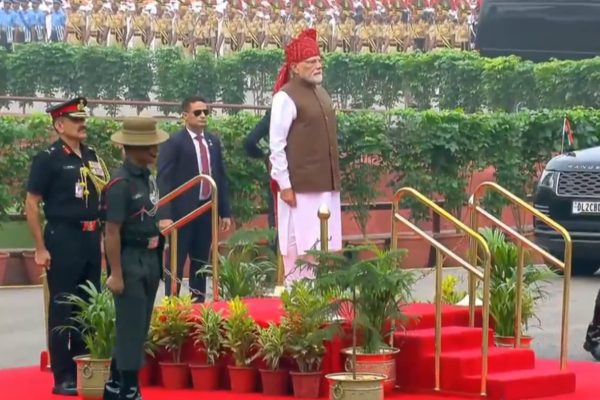
New Delhi, August 15, 2026: The nation marked its 80th Independence Day with traditional fervour and a distinct sense of forward-looking resolve as Prime Minister Narendra Modi led the main national celebrations from the historic ramparts of the Red Fort in the national capital. In a ceremony steeped in symbolism and carefully orchestrated grandeur, the Prime Minister hoisted the National Flag, the national anthem rang out across the fort complex, and for the first time in the history of free India, the national song Vande Mataram was rendered at the Red Fort upon the Prime Minister’s arrival. The day’s events also underscored the theme of Yuva Shakti, recognising the decisive role of India’s young generation in the collective national project to build a Viksit Bharat by 2047.
The Red Fort, that enduring monument of Mughal architecture and the chosen stage for India’s Independence Day addresses since the first years after 1947, once again became the focal point of national attention. Crowds began assembling in the early hours under tight security arrangements. From the viewing galleries and designated public enclosures, citizens, schoolchildren, members of the armed forces, civil officials, diplomats and guests watched as the ceremonial sequence unfolded with precision. The morning sky over Old Delhi was clear, the red sandstone of the fort glowing in the monsoon light, as the Prime Minister’s motorcade arrived.
Upon the Prime Minister’s arrival, a notable departure from past practice took place. For the first time, the national song Vande Mataram was rendered at the Red Fort. The stirring verses, long associated with the freedom struggle and the emotional core of Indian nationalism, echoed across the complex. Observers widely noted the decision to include the song at this stage of the programme as both a cultural affirmation and a deliberate historical marker. In his subsequent address, the Prime Minister himself underlined the significance of the moment, observing that for the first time since Independence, Vande Mataram was echoing from the Red Fort.
Following the rendering of the national song, Prime Minister Modi proceeded to hoist the National Flag. The tricolour unfurled against the backdrop of the fort’s battlements in a moment synchronised with a 21-gun salute. The deep, measured reports of the artillery rolled across the grounds as the flag rose. Almost simultaneously, two Mi-17 helicopters of the Indian Air Force flew overhead, showering the complex with flower petals. The petals drifted down in a colourful cascade, adding a visual flourish to the solemn military precision of the salute and the flag-hoisting. The national anthem was then sung, the assembled gathering standing in unison as the familiar notes filled the air.
The ceremony this year carried an explicit thematic emphasis on Yuva Shakti. Official statements and the framing of the day’s events highlighted the contribution of young India to the national goal of becoming a developed nation, Viksit Bharat, by the centenary of Independence in 2047. The 80th Independence Day was presented not merely as a retrospective celebration of freedom won in 1947 but as a waypoint on a longer journey in which the energy, skills, aspirations and innovations of the country’s youth are regarded as central. From educational institutions to startups, from sports fields to scientific laboratories, from agricultural innovation to digital public infrastructure, the narrative of the day repeatedly returned to the idea that India’s demographic advantage and the agency of its younger citizens form a decisive national asset.
Addressing the nation from the ramparts, Prime Minister Modi began by noting the historic first of Vande Mataram at the Red Fort. He then turned to a more immediate human concern. In recent days, he said, some parts of the country had witnessed severe floods and landslides that had affected many families. The Prime Minister assured those families that the entire nation stood firmly with them. The reference was direct and empathetic, acknowledging the suffering caused by natural calamities even as the country marked a day of national pride. Relief and rehabilitation efforts, he indicated, would continue with the full support of the national community.
The Prime Minister then developed a broader argument about national greatness. A nation becomes great, he said, when it moves forward on the strength of its resolve and capabilities. The formulation linked the emotional and historical resonance of Independence Day with a practical, forward-looking ethic of self-reliance, determination and the systematic building of national capacity. In the context of the 80th anniversary and the stated horizon of 2047, the remarks positioned resolve and capability as the twin engines of progress. They also implicitly connected the struggles of the freedom movement with the contemporary tasks of development, technological advancement, social cohesion and economic transformation.
The atmosphere at the Red Fort combined solemnity with celebration. Security was elaborate, as is customary for the occasion, with layered arrangements involving multiple agencies. The presence of the armed forces was visible and disciplined. Contingents representing different services and units participated in the ceremonial aspects. Schoolchildren and young people featured prominently among the attendees, consistent with the Yuva Shakti theme. The visual imagery of the day—the flag against the fort, the helicopters releasing petals, the gun salute, the massed singing of the anthem—was carried live across television channels, digital platforms and social media, allowing citizens across the country and the diaspora to participate at a distance.
Independence Day at the Red Fort has, over the decades, acquired a settled ritual form while also evolving in emphasis according to the priorities of successive governments and the changing circumstances of the nation. The inclusion of Vande Mataram at the point of the Prime Minister’s arrival added a new element to that ritual this year. The song itself has a long and complex history within the freedom movement and in independent India’s cultural life. Its association with the struggle against colonial rule, its adoption as the national song, and the debates that have occasionally surrounded its public performance give the decision to render it at the Red Fort particular weight. By framing the moment as a first since Independence, the Prime Minister’s address invited the public to register the continuity of national sentiment across nearly eight decades.
The reference to floods and landslides grounded the high symbolism of the day in the concrete realities faced by citizens in affected regions. Monsoon-related disasters are a recurring challenge in several parts of India. The Prime Minister’s assurance that the nation stands with the affected families served both as an expression of solidarity and as a signal that the machinery of relief and support remained engaged even on a day of national celebration. In the broader narrative of the speech, the point illustrated that national resolve must encompass both long-term developmental ambitions and the immediate duty of care toward those struck by calamity.
The theme of Yuva Shakti and the 2047 horizon invite reflection on India’s demographic profile and the policy architecture built around it. India remains a young country by global standards. Large cohorts of young people are entering education, the workforce and entrepreneurial activity each year. Successive policy initiatives in recent years have sought to expand access to skills, higher education, digital tools, credit and markets. The framing of the 80th Independence Day around youth contribution suggests an intention to keep that demographic reality at the centre of the national development story. Whether in the expansion of digital public goods, the growth of the startup ecosystem, the participation of young athletes on the international stage, or the engagement of youth in social and environmental initiatives, the day’s messaging treated the energy of the young as a strategic national resource rather than a passive demographic fact.
The idea of Viksit Bharat by 2047 has been articulated in official discourse as a comprehensive vision encompassing economic prosperity, social equity, technological capability, environmental sustainability and a stronger role for India in the world. Setting the centenary of Independence as the target year gives the ambition a clear chronological frame. The 80th anniversary, falling roughly midway between the 75th celebrations of 2022 and the centenary, offers a natural moment for stocktaking and renewed commitment. The Prime Minister’s emphasis on resolve and capabilities can be read as an attempt to translate that long-term vision into the language of national character and practical capacity-building.
Historically, the Red Fort address has served multiple functions. It is a constitutional and ceremonial affirmation of the continuity of the Indian state. It is an occasion for the head of government to speak directly to the nation on matters of policy, principle and national mood. It is also a performative renewal of the social contract between the state and the citizen, conducted in the presence of the armed forces, the civil administration and representatives of the public. The addition of Vande Mataram to the arrival sequence this year added a layer of cultural and historical resonance to that annual renewal.
The logistics of the ceremony reflected the accumulated experience of decades. The synchronisation of the flag-hoisting with the 21-gun salute, the aerial petal shower by Mi-17 helicopters, the positioning of the guard of honour, and the sequencing of the national song, the anthem and the address all required detailed planning and inter-agency coordination. The Indian Air Force’s participation through the helicopter fly-past and petal drop linked the ceremonial military tradition with a visually striking public spectacle. The choice of the Mi-17, a workhorse of the IAF’s transport and utility fleet, underscored the professional and operational character of the armed forces’ contribution to the national day.
Public response to the day’s events, as reflected in media coverage and social media commentary, mixed pride in the ceremonial dignity of the occasion with attention to the specific new elements—particularly the rendering of Vande Mataram and the explicit youth theme. The Prime Minister’s reference to the flood- and landslide-affected families was noted as a necessary acknowledgment of ongoing distress. The broader message about national greatness resting on resolve and capabilities was interpreted by many as a call to collective effort rather than a purely governmental claim.
In the wider context of India’s post-Independence journey, the 80th anniversary invites comparison with earlier milestones. The early decades after 1947 were marked by the challenges of consolidation, institution-building, and the management of scarcity. Later periods saw liberalisation, the expansion of the middle class, the information technology boom, and a more assertive international posture. The present phase is often described in official language as one of accelerated development, infrastructure expansion, digital transformation and the pursuit of strategic autonomy. The 2047 target gathers these strands into a single, long-horizon objective. By placing Yuva Shakti at the centre of the 80th Independence Day, the celebrations sought to connect that objective to the lived experience and future agency of the country’s youngest citizens.
The Red Fort itself remains a powerful symbol. Its walls have witnessed the proclamation of Independence, the annual ritual of the flag-hoisting, and the evolving rhetoric of successive Prime Ministers. To hear Vande Mataram rendered there for the first time as part of the official arrival sequence is to add a new acoustic and emotional layer to that accumulated symbolism. The song’s association with the freedom struggle, its status as the national song, and its capacity to evoke a sense of civilisational continuity give the moment a particular charge.
As the ceremony concluded and the Prime Minister’s address drew to a close, the tricolour continued to fly over the fort. The petals had settled. The echoes of the gun salute had faded. Across the country, similar flag-hoisting ceremonies took place at state capitals, district headquarters, schools, colleges, military stations and public institutions. The national conversation turned, as it does every year, from the ceremonial high point of the morning to the practical tasks of governance, development and social life that occupy the remaining 364 days. Yet the images and words of the Red Fort ceremony—the first rendering of Vande Mataram, the synchronised salute and petal shower, the assurance to disaster-affected families, the invocation of resolve and capability, and the explicit celebration of Yuva Shakti—remained as the defining markers of India’s 80th Independence Day.
The day affirmed both continuity and change. Continuity in the form of the Red Fort ritual, the national flag, the anthem, the armed forces’ participation, and the democratic transfer of the right to address the nation from the ramparts. Change in the deliberate inclusion of Vande Mataram at a new point in the sequence, in the thematic stress on youth power, and in the framing of the occasion as a step toward the 2047 horizon. In the Prime Minister’s words, a nation becomes great when it moves forward on the strength of its resolve and capabilities. On the 80th anniversary of Independence, that formulation was offered as both description and aspiration—an assessment of the sources of national strength and an invitation to the country’s citizens, especially its young people, to continue the work of building the India of 2047.
The celebrations of 15 August 2026 thus combined the familiar grammar of the national day with specific contemporary emphases. The historic first of Vande Mataram at the Red Fort, the visual drama of the flag, the salute and the helicopters, the solidarity extended to those affected by natural disasters, and the sustained focus on Yuva Shakti together composed the public meaning of the occasion. As the nation looked back on nearly eight decades of freedom and forward to the centenary, the Red Fort once again served as the stage on which that dual perspective was articulated and enacted.