[Photo -sources]
The only member of the Texas power trio without a beard, he propelled the band’s blend of boogie, Southern rock and blues for more than a half-century.
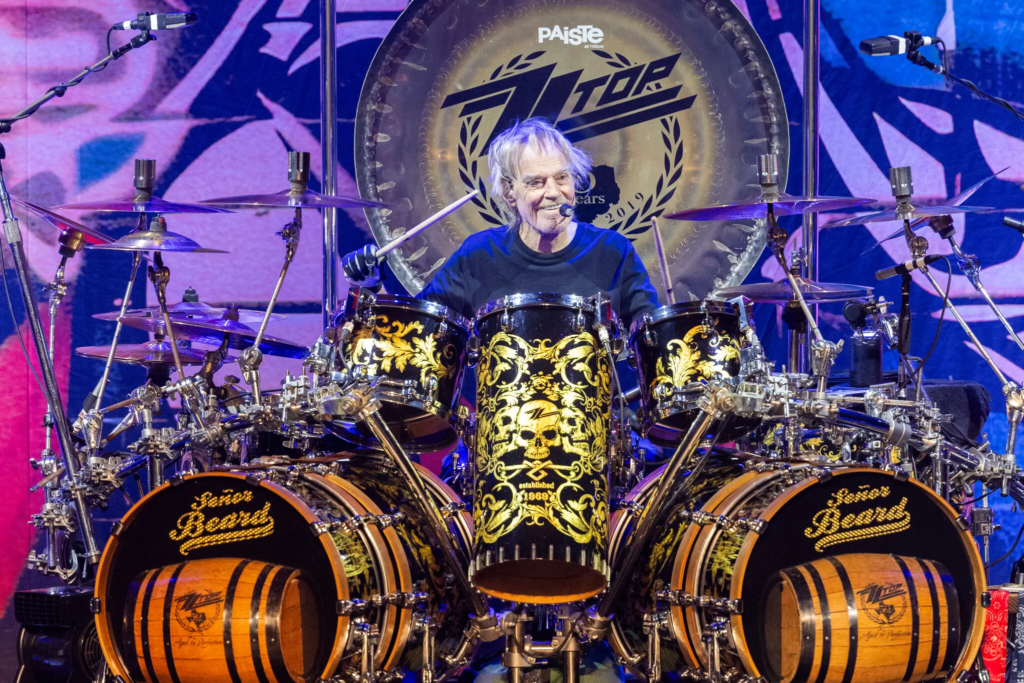
Frank Lee Beard, the longtime drummer of the iconic Texas rock band ZZ Top and the sole member of the classic trio who typically went without the group’s trademark flowing facial hair, died on Monday, August 17, 2026. He was 77. Beard passed away in hospice care at his ranch in Richmond, Texas, surrounded by family members. The cause of death was not publicly disclosed.
A statement from the band confirmed the news, noting that his passing necessitated the cancellation of tour dates that week in Utah and Colorado. ZZ Top planned to resume its “The Big One!” tour over the weekend with shows at Austin City Limits, described as one of Beard’s favourite venues in a city that had long felt like a second home. Guitarist and vocalist Billy Gibbons paid tribute: “Today, Elwood and I lost a great friend and collaborator, and the world lost one of the most naturally innovative drummers and a great and true son of Texas. His signature backbeat was key to keeping ZZ on top. The band of which he was a part for six decades is going to keep on keeping on as he had wished.”
Beard’s death leaves Gibbons as the last surviving member of ZZ Top’s classic lineup. Bassist and vocalist Dusty Hill died in 2021 at age 72; at Hill’s request, longtime bass technician Elwood Francis took over on bass. In recent years, Beard has stepped away from the road multiple times due to health issues, including an absence in 2025 related to foot and ankle problems and the cancellation of an early-August 2026 show at the Hollywood Bowl. Replacement drummers filled in as needed.
Born on June 11, 1949, in the small East Texas town of Frankston, Beard was raised in Irving, near Dallas, and attended Irving High School. A seventh-generation Texan with deep roots in the state’s working-class culture, he discovered drums as a teenager, drawn first by the Beatles and then by the blues. He immersed himself in the Dallas-area club scene, playing in local groups and absorbing the sounds of blues joints where artists like Freddie King performed.
In the late 1960s, Beard connected with Dusty Hill. The two played together in several bands, including the Cellar Dwellers, the Hustlers, the Warlocks, and American Blues. They even participated in an unauthorised “fake Zombies” touring act after the original British group disbanded. Beard also spent time in the Outlaws with Hill. These formative years in the Texas music circuit shaped his straightforward, groove-oriented style—rooted in the Texas shuffle. This deceptively precise approach combined rolling triplet figures on the snare with a steady pulse.
In 1969, Beard joined Billy Gibbons’ band, then known as the Moving Sidewalks (which soon evolved into ZZ Top). It was Beard who suggested Gibbons audition Hill for the bass chair. The three jammed for hours at Gibbons’ Houston home on a blues shuffle in D and found an immediate chemistry they would sustain for more than five decades. Their first paid performance came on February 10, 1970, at the Knights of Columbus Hall in Beaumont, Texas. The classic lineup—Gibbons on guitar and vocals, Hill on bass and vocals, Beard on drums—was locked in.
ZZ Top released its debut, ZZ Top’s First Album, in 1971 on London Records. Early credits sometimes listed Beard under the nickname “Rube Beard.” The band refined its “Texas boogie-blues-rock” sound across subsequent releases. Rio Grande Mud (1972) and especially Tres Hombres (1973) established their reputation. The latter reached the Billboard Top 10 and featured the enduring hit “La Grange,” a raunchy tribute to a notorious Texas bordello, powered by Beard’s propulsive shuffle. Fandango! (1975), a hybrid of studio and live tracks recorded in part in New Orleans, delivered “Tush,” the group’s first Top 40 single. The elaborate Worldwide Texas Tour that followed featured livestock onstage and cemented ZZ Top as a major concert draw.
Success brought personal challenges. By the mid-to-late 1970s, as the band’s profile rose, Beard struggled with substance abuse, including LSD, cocaine, and heroin. He later recounted spending his entire first major paycheck—$72,000—on drugs, selling his original Ludwig drum kit, and damaging relationships. After the 1976 album Tejas, ZZ Top took an extended hiatus of roughly three years. Beard entered a 12-step program, seeking sobriety so he could live a quieter life like people he admired who simply watched television and went to bed. He returned clean for Degüello in 1979. The band never replaced him during that period.
The 1980s brought commercial transformation and peak popularity. Albums such as El Loco (1981) introduced synthesisers and a more modern edge. Then came Eliminator (1983), a diamond-certified blockbuster that sold more than 10 million copies in the United States alone and spent 183 weeks on the charts. Hits including “Gimme All Your Lovin’,” “Sharp Dressed Man,” and “Legs” dominated rock radio and MTV, with stylish videos featuring Gibbons’ 1933 Ford coupe (the Eliminator) and leggy models. Beard’s disciplined backbeat—often locked to click tracks and headphones onstage—anchored the sleek, dance-inflected production while retaining the heavy Southern blues undertow. Afterburner (1985) and Recycler (1990) continued the success with further hits such as “Sleeping Bag” and “Stages.”
Throughout, Beard remained the steady rhythmic foundation. His playing was rarely flashy; it was precise, propulsive, and essential to the trio’s chemistry. The band sold more than 50 million records worldwide, earned multiple gold and platinum certifications, and became one of rock’s most enduring acts. In 2004, ZZ Top was inducted into the Rock and Roll Hall of Fame. Keith Richards presented them, joking about their beards as a “disguise.” Beard’s brief acceptance remarks captured his characteristic humility: “All I have to say is that most of my life has been a pleasant surprise, and so is this. Thank you.” In 2018, the group earned a Guinness World Record as the longest-running band with an unchanged lineup (until Hill’s death).
Ironically, given his surname, Beard was the only member of the classic trio who usually did not wear a long beard. Gibbons and Hill cultivated their signature hirsute look; Beard typically sported a moustache and curly hair, though he briefly grew a short beard in later years. Gibbons once quipped that “Frank’s beard is on his driver’s license.” The contrast became part of the band’s mythology and visual identity.
Offstage, Beard kept a relatively private life centred in Texas. He married Catherine Alexander in 1978; they divorced in 1981 amid the strains of his addiction. In November 1982, he married Debbie Meredith; they remained together for more than four decades and raised three children, including twin sons Rory and Nico, born in 1985, as well as a daughter from an earlier relationship. Beard owned and operated the Top 40 Ranch in Richmond, southwest of Houston. An avid and skilled amateur golfer (a scratch player), he participated in local tournaments and community events. He also maintained an interest in automobiles and racing.
In later years, ZZ Top continued touring extensively across North America, Europe, and South America, releasing albums such as La Futura (2012), their final studio effort with the classic trio, and subsequent live recordings. Beard’s health challenges in 2025 and 2026 led to temporary absences, but the band emphasised continuity in line with his wishes.
Beard’s legacy rests in the relentless, swinging groove that underpinned ZZ Top’s blend of boogie, Southern rock, and blues for more than half a century. From the raw Texas roadhouses of the early 1970s through the MTV-driven global stardom of the 1980s and decades of arena tours, his signature backbeat kept the little ol’ band from Texas on top. He is survived by his wife, Debbie Meredith, and their three children. The band has indicated it will continue performing, honouring the longevity and spirit Beard helped define.