

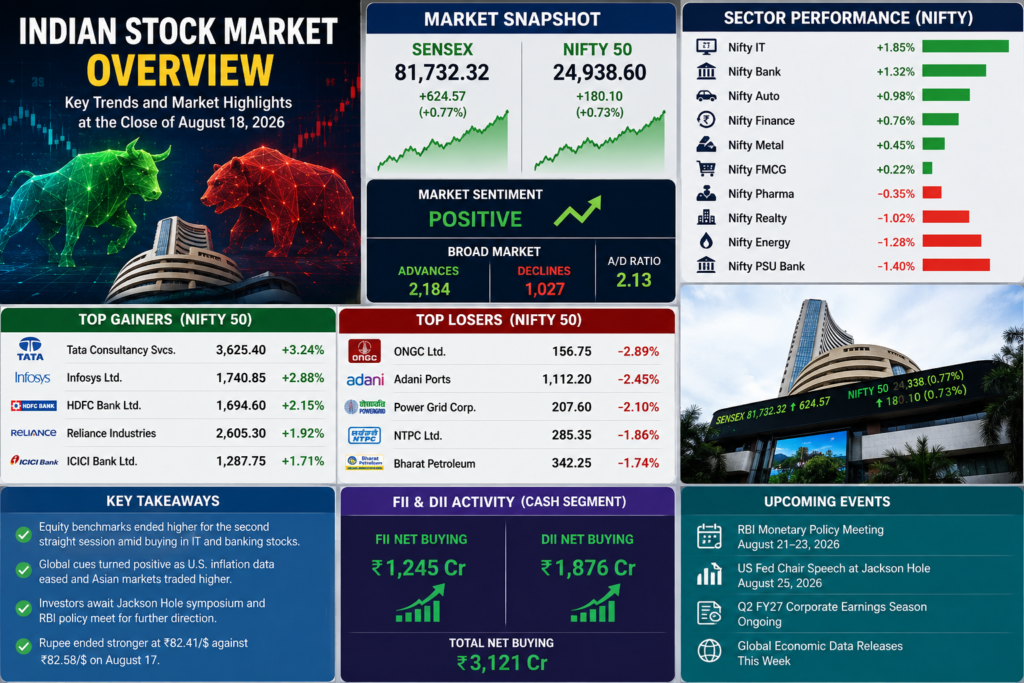
The Indian equity markets extended their recent weakness on Tuesday, August 18, 2026, with benchmark indices closing lower amid elevated crude oil prices, geopolitical tensions in West Asia, and selling pressure in information technology (IT) and realty stocks. The BSE Sensex declined 492.70 points, or 0.63%, to settle at 77,235.46, while the NSE Nifty 50 fell 132.75 points, or 0.55%, to 24,154.90. This marked the Nifty’s sixth consecutive losing session and continued pressure on the Sensex, which has declined in five of the last six sessions. The Nifty has lost approximately 1.7% over this six-session stretch, its weakest such run in recent weeks.
Bank Nifty closed around 57,262, down about 0.41% or 235 points. Broader markets showed mixed but subdued action: the Nifty Midcap index shed roughly 0.4%, while the Smallcap index ended largely flat. Market breadth was weak, with only about 10 of the 50 Nifty stocks finishing in the green and selling pressure evident across most sectors.
Year-to-date, the Nifty is down around 7.25%, and the Sensex has underperformed relative to its longer-term averages and global peers in recent months, reflecting a combination of foreign portfolio outflows earlier in the year, high valuations in parts of the market, and external shocks from energy prices and geopolitics. One-year returns for the Sensex stood negative in the mid-single digits as of the latest close.
Key Market Drivers: Crude Oil, Geopolitics, and Global Yields
The dominant near-term pressure came from crude oil. Brent crude traded around $91 per barrel (rising about 9% in less than two weeks in some reports), with WTI near $85. Prices surged after the expiry of a temporary US-Iran ceasefire, with Iran hardening its stance and the US ruling out an extension. Concerns over the Strait of Hormuz and potential supply disruptions heightened inflation worries for India, a major oil importer. Analysts noted that investor anxiety rose as hopes for a West Asia resolution faded.
Rising US Treasury yields (10-year around 4.73%) further weighed on sentiment by making dollar assets more attractive relative to emerging-market equities. Weak global cues, including declines in US indices the prior session, added to the risk-off mood. Private weather forecasts also cut monsoon expectations (one report cited a reduction to 85%), raising concerns about agricultural output, rural demand, and inflation.
Domestic institutional support provided a partial offset. On August 18, foreign institutional investors (FIIs/FPIs) turned net buyers of approximately ₹1,652 crore, while domestic institutional investors (DIIs) were net buyers of about ₹2,579 crore (provisional data). This followed a day of heavier FII selling (around ₹2,535 crore on August 17). Year-to-date, FIIs remain substantial net sellers (around ₹3.4 lakh crore in some estimates), while DIIs have provided strong counterbalancing support with inflows near ₹5.17 lakh crore.
The Indian rupee traded near 95.6–95.7 against the US dollar, under pressure from higher oil import costs and equity market weakness.
Sectoral Performance
Selling was broad-based. The Nifty IT index was the biggest laggard, falling nearly 1.9–2% for a third straight session. Realty declined around 1.4%, PSU Banks about 1%, FMCG roughly 0.8%, and Metals around 0.6%. Private banks and the broader Bank Nifty also closed lower.
Outperformers included Auto (up ~0.3%), Media (~0.3%), Pharma (~0.2%), and pockets of Oil & Gas and Healthcare. Utilities showed relative resilience with only marginal losses in some reports. Defence-related stocks saw selective interest amid government indigenous manufacturing lists, with names like Cochin Shipyard gaining.
IT weakness stemmed from concerns that persistently high global interest rates could curb technology spending, particularly in key markets. Realty faced profit-booking and rate-sensitive pressures. Auto benefited from domestic demand resilience and specific company news flow.
Top Gainers and Losers (Nifty 50 / Sensex Focus)
Top gainers included Axis Bank (up ~1.3% to around ₹1,243), Max Healthcare Institute (~1.1%), Mahindra & Mahindra (~0.9–1%), Grasim Industries (~0.9%), and Power Grid Corporation (~0.7%). Bajaj Finance, Larsen & Toubro, and Reliance Industries also posted modest gains in some sessions.
Top losers featured Tata Motors Passenger Vehicles (TMPV, down over 2% to around ₹323), Asian Paints (~2.2–2.4%), Infosys (~2–2.2%), Wipro (~2.1%), HCL Technologies (~2%), and other IT names like TCS (down ~1.5%). Bharti Airtel, Hindustan Unilever, and ITC also declined.
Only a handful of Nifty constituents closed higher, underscoring the breadth of the sell-off. Nearly 180 stocks across the broader market touched 52-week highs, indicating selective strength in mid- and small-caps or specific themes (e.g., certain industrials, pharma, and consumption names like Welspun, Bosch, Solar Industries, and others).
Corporate and IPO Highlights
A bright spot was the listing of Milky Mist Dairy Food. The Tamil Nadu-based dairy products company (Temasek-backed) debuted strongly. Shares listed at ₹165 (about 18% premium to the ₹140 issue price) and extended gains toward ₹180–181 (nearly 30% above issue in some trades), taking the market capitalisation significantly higher. The ₹1,553 crore IPO (fresh issue dominant) was heavily subscribed (reports of 56x overall, with QIBs far higher). Proceeds are earmarked for debt repayment, expansion of the Perundurai facility, and cold-chain strengthening. This was noted as one of the larger dairy-sector IPOs.
Other activity included block deals (e.g., Paytm/One 97 Communications seeing stake sales with the stock under pressure) and selective strength in defence and certain manufacturing names. Earnings season had largely concluded, with some reports noting solid Q1 performance in parts of the market earlier.
Macroeconomic Backdrop and RBI Policy
The Reserve Bank of India (RBI) held the policy repo rate steady at 5.25% in its early August 2026 meeting (MPC August 3–5), retaining a neutral stance. This was the fourth consecutive hold. The central bank projected FY27 GDP growth at 6.7% (slightly raised) and CPI inflation at 5.0% (modestly lowered). Core inflation remained relatively contained, though headline readings had moved above the 4% target primarily due to food and fuel. Governor Sanjay Malhotra emphasised the need for greater clarity on the inflation outlook amid geopolitical and supply-side risks before any policy shift.
Higher crude prices raise imported inflation risks and could pressure the current account and rupee, though OMCs retain some buffer before operating profits turn deeply negative (estimates around $115/barrel in one rating agency view, assuming no further retail price adjustments). Monsoon progress remains a key domestic variable for rural incomes and food prices.
Technical Picture and Levels
Nifty closed near session lows after testing and breaking the 24,200 support that had held for much of the prior week. Analysts flagged 24,150–24,175 as immediate support, with next levels at 24,000 and then 23,800. Resistance is seen near 24,250–24,300 on any recovery, with 24,270 as a reclaim level for bulls. The index has shifted toward a more distributive structure with lower highs and lower lows in recent sessions. India VIX remained relatively low (around 11.4, up modestly), indicating limited panic but also limited demand for protection.
Gift Nifty indications post-close suggested a potentially modestly higher open for the next session, though crude and geopolitics remain the swing factors.
Global Context and Comparative Performance
Global equities faced similar pressures from energy prices and yields. US markets had closed lower the prior session. Asian markets were mixed to lower. India’s relative performance has been challenged by FII outflows earlier in 2026 and the oil shock, though domestic flows and structural growth drivers (consumption, infrastructure, manufacturing push) continue to provide underlying support compared with some emerging peers.
Outlook and Key Watchpoints
Near-term direction hinges heavily on crude oil trajectory and any developments regarding the US-Iran situation or Strait of Hormuz. A sustained move higher in oil toward $100 could intensify inflation and margin concerns, particularly for rate-sensitive and oil-import-dependent sectors. Conversely, any de-escalation could trigger relief rallies, especially if combined with stabilising US yields.
Domestic factors to monitor include monsoon updates, further institutional flow data, any residual earnings commentary, and primary market activity (IPOs, QIPs, block deals), which have added supply pressure at times. RBI remains data-dependent; a prolonged pause supports financial conditions, but elevated oil could complicate the inflation path.
Structurally, India’s equity market benefits from strong domestic institutional participation, a growing retail investor base, and long-term themes in manufacturing, digital, energy transition, and consumption. Valuations in large-caps have moderated somewhat with the recent correction, though selectivity remains important. Mid- and small-caps have shown resilience in pockets but are more sensitive to liquidity and risk appetite.
Investors are advised to watch support levels closely, maintain focus on quality balance sheets and earnings visibility, and size positions according to risk tolerance. Short-term volatility is likely to persist until clarity emerges on energy prices and geopolitics. The market’s ability to absorb FII selling via DII and retail demand has been a hallmark of recent years and will be tested again if external pressures intensify.
In summary, August 18 closed as a risk-off session driven primarily by crude and IT weakness, extending a multi-day decline. While institutional buying on the day and selective stock strength offered some cushion, the breach of key supports and external headwinds keep the near-term tone cautious. Broader economic resilience, supportive domestic flows, and eventual resolution of geopolitical uncertainties remain the longer-term positives for Indian equities.
[Report synthesises closing data and analysis as of August 18, 2026. Markets open on August 19, and subsequent sessions may alter levels. This is not investment advice; consult professionals and review the latest data.]