
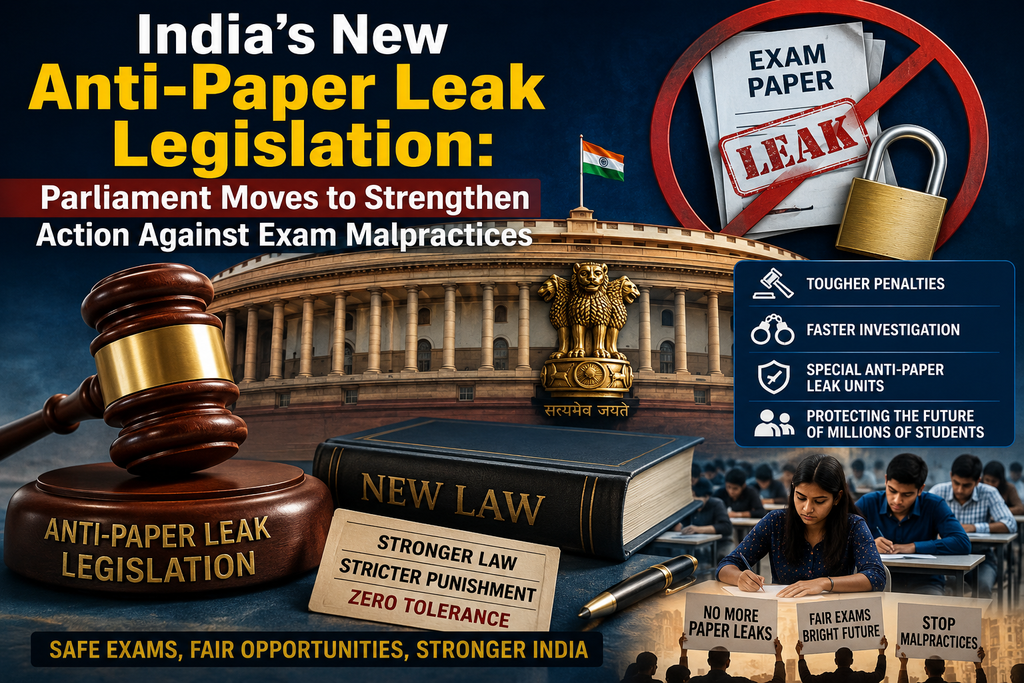
In a significant legislative response to recurring crises in India’s competitive examination system, Parliament has cleared, and the President has assented to the Public Examinations (Prevention of Unfair Means) Amendment Bill, 2026. The amended law, which builds on the 2024 Act of the same name, substantially raises penalties, mandates time-bound investigations and trials, and creates institutional mechanisms for faster justice in cases of paper leaks and organised exam fraud. The legislation came into force in early August 2026 following presidential assent, marking a major national-policy development in education and public recruitment integrity.
The move follows intense public and political pressure after the alleged paper leak in the National Eligibility-cum-Entrance Test (NEET-UG) 2026, which triggered nationwide student protests, cancellation and re-conduct of the exam in some contexts, and the resignation of Union Education Minister Dharmendra Pradhan. Protests, including those associated with the Cockroach Janta Party, highlighted deep student anxiety over fairness in high-stakes examinations that determine access to medical colleges, engineering seats, government jobs, and other career pathways. The government positioned the amendment as evidence of zero tolerance for malpractice and a willingness to learn from the operational experience of the 2024 law.
Background: The 2024 Act and Persistent Challenges
The original Public Examinations (Prevention of Unfair Means) Act, 2024, was enacted after a series of high-profile leaks and irregularities in central examinations. It received presidential assent in February 2024 and came into force on 21 June 2024. The Act was the first comprehensive central legislation specifically targeting unfair means in public examinations conducted by bodies such as the National Testing Agency (NTA), Union Public Service Commission (UPSC), Staff Selection Commission (SSC), Railway Recruitment Boards, and the Institute of Banking Personnel Selection, among others notified by the Centre.
It criminalised a wide range of acts, including leakage of question papers or answer keys, unauthorised access to exam materials, tampering with OMR sheets or computer systems, impersonation, conducting fake examinations, issuing fake admit cards or offer letters, and collusion or conspiracy for monetary or wrongful gain. Offences were made cognisable, non-bailable, and non-compoundable. Candidates themselves were kept outside the direct purview of the criminal provisions in many respects, with the focus on facilitators, service providers, and organised networks.
Under the 2024 law, individuals resorting to unfair means faced imprisonment of three to five years and a fine of up to ₹10 lakh. Organised crime attracted five to ten years’ imprisonment and a minimum fine of ₹1 crore. Service providers involved in malpractice could be fined up to ₹1 crore, required to bear the proportionate cost of the examination, and debarred from future examination-related work for four years. Despite these provisions and the registration of dozens of FIRs under the new law, high-profile controversies—most notably surrounding NEET—exposed gaps in deterrence, investigation speed, and trial timelines. Critics argued that delays in probes and trials undermined confidence, while organised rackets continued to exploit systemic vulnerabilities.
The 2026 Amendment: Key Provisions and Changes
The Public Examinations (Prevention of Unfair Means) Amendment Bill, 2026, was introduced in the Lok Sabha by Minister of State Jitendra Singh on 27 July 2026 during the Monsoon Session. It was passed by the Lok Sabha on 29 July by voice vote amid opposition protests and disruptions, cleared by the Rajya Sabha shortly thereafter (with a walkout by some INDIA bloc parties), and received presidential assent from Droupadi Murmu, coming into force around 1 August 2026.
The amendments do not alter the fundamental scope of covered examinations or the core definitions of unfair means but significantly toughen enforcement and accelerate the justice process. For individuals convicted of using unfair means (including paper leaks), the minimum imprisonment rises from three to five years, the maximum from five to ten years, and the fine ceiling increases from ₹10 lakh to ₹50 lakh. For organised paper-leak networks and coordinated attempts to compromise examinations, the minimum sentence moves to seven years, with fines of up to ₹10 crore (or not less than ₹10 crore in some reports of the final text). Service providers face higher fines—up to ₹5 crore in some accounts—and longer debarment periods, extended to eight years from four.
Two new provisions establish firm procedural timelines. Investigations into paper-leak and related cases must be completed within two months of a case being referred by the Centre, whether handled by existing agencies or a newly enabled Special Task Force route. Every state and Union Territory is required to designate Fast Track Courts (in consultation with the concerned High Court) to try these cases on a day-to-day basis. Trials are expected to conclude within three months of the filing of the chargesheet. Appeals are to be heard by at least two-judge High Court benches and disposed of within a defined period. The Centre is empowered to constitute a special task force for investigating major offences, and states may appoint special public prosecutors.
The law continues to cover leakage of papers or keys, tampering with answer sheets or systems, hacking or network interference, manipulation of results or merit lists, creation of fake websites or admit cards, impersonation, and organised facilitation of unfair means. It retains the character of offences as cognisable, non-bailable, and non-compoundable.
Parliamentary Debate and Political Context
The Bill passed against a backdrop of heated exchanges. The government emphasised swift action in the NEET case (citing multiple FIRs under the 2024 law), a commitment to students’ futures, and openness to strengthening the framework based on experience. Ministers noted reduced suicide rates linked to paper-leak anxieties in recent years as partial evidence of progress, while stressing zero tolerance. Opposition parties raised concerns over police action during student protests, questioned the government’s overall handling of examination integrity, and in some cases staged walkouts or protests during the debate. Leader of the Opposition Rahul Gandhi and others criticised aspects of the government’s response to the NEET controversy and related protests. The Speaker intervened to keep discussion focused on the Bill itself. Despite the acrimony, the measure cleared both Houses by voice vote.
Prime Minister Narendra Modi publicly welcomed the completion of the legislative process, framing it as an important step to protect the integrity of public examinations. The Education Minister’s earlier resignation underscored the issue’s political sensitivity; the amendment was presented as part of a broader cleanup, including action against officials in the NTA and related bodies.
Broader Implications for Education and National Policy
India’s competitive examination ecosystem is vast and high-stakes. Millions of aspirants appear annually for NEET, JEE, UPSC, SSC, railway, banking, and other recruitment or entrance tests. Paper leaks and organised cheating not only distort merit but erode public trust, fuel student distress, and impose high social and economic costs through re-examinations, litigation, and lost opportunities. The 2024 Act filled a legislative vacuum by creating specific offences beyond general criminal law provisions. The 2026 amendments address implementation weaknesses—particularly delays—that had limited its deterrent effect.
Fast-track courts and strict timelines aim to deliver visible and swift justice, reducing the sense of impunity that organised networks have historically enjoyed. Higher financial penalties target the economic incentives of paper-leak rackets, while longer jail terms raise the personal cost of involvement. The Special Task Force provision allows specialised, centralised investigation capacity for complex, multi-state cases. Debarment of service providers seeks to clean the vendor ecosystem that supports examination logistics, printing, IT systems, and centre management.
Challenges remain. Effective implementation depends on states designating and resourcing the fast-track courts promptly, building investigative capacity, and ensuring coordination between central and state agencies. Coverage is primarily of central public examinations; many state-level recruitment and entrance tests fall under separate state laws, some of which already prescribe harsh penalties including life imprisonment or high fines in certain jurisdictions. Harmonisation and capacity-building will be necessary for uniform credibility. Technology-related offences (hacking, digital manipulation) will require continuous updating of investigative skills and forensic capabilities. Balancing stringent enforcement with protection against misuse or overreach will also be important, given the non-bailable nature of the offences.
Student organisations and education reformers have broadly welcomed stronger deterrence while continuing to demand deeper systemic reforms: greater transparency in question-paper setting and logistics, reduced reliance on a small number of vendors, improved cybersecurity, more robust grievance redressal, and long-term improvements in the quality and accessibility of higher education and employment opportunities so that a single examination does not become an existential make-or-break event.
Conclusion
The Public Examinations (Prevention of Unfair Means) Amendment Act, 2026, represents a decisive parliamentary intervention in a domain of acute national concern. By raising penalties, compressing investigation and trial timelines, and institutionalising specialised courts and task forces, it seeks to restore and reinforce the credibility of public examinations that shape the life chances of millions of young Indians. Whether the law succeeds will depend less on the text itself than on consistent, fair, and efficient enforcement across the country. In the wake of the NEET controversy and the political costs it exacted, the legislation signals that examination integrity has moved firmly onto the centre stage of national education and governance policy. Students, parents, and the broader public will now watch closely to see whether the tougher framework delivers the deterrence and justice that earlier measures alone could not fully achieve.