

AI PCs Are Taking Over India: Why Millions of Consumers and Businesses Are Upgrading Their Computers
India’s personal computer market has entered a new era. In 2025, the country shipped a record 15.9 million traditional PCs—desktops, notebooks and workstations—marking 10.2% year-over-year growth and surpassing the pandemic-era peaks of 2021 and 2022 for the first time. The milestone is more than a volume story. It signals a structural shift: AI-capable PCs are moving from niche premium devices into the mainstream of both consumer upgrades and enterprise refresh cycles.
AI-enabled notebooks led the charge. Shipments of these machines surged 129.3% in 2025. Basic AI notebooks accounted for the bulk of the volume, driven by enterprise adoption and consumer promotions, while higher-end generative AI models gained traction, particularly among premium buyers. The momentum has continued into 2026. In the second quarter alone, overall PC shipments rose 12.1% to 3.9 million units, with AI notebook shipments jumping another 109.9%. Premium notebooks priced above $1,000 grew nearly 79%, with consumer premium models nearly doubling.
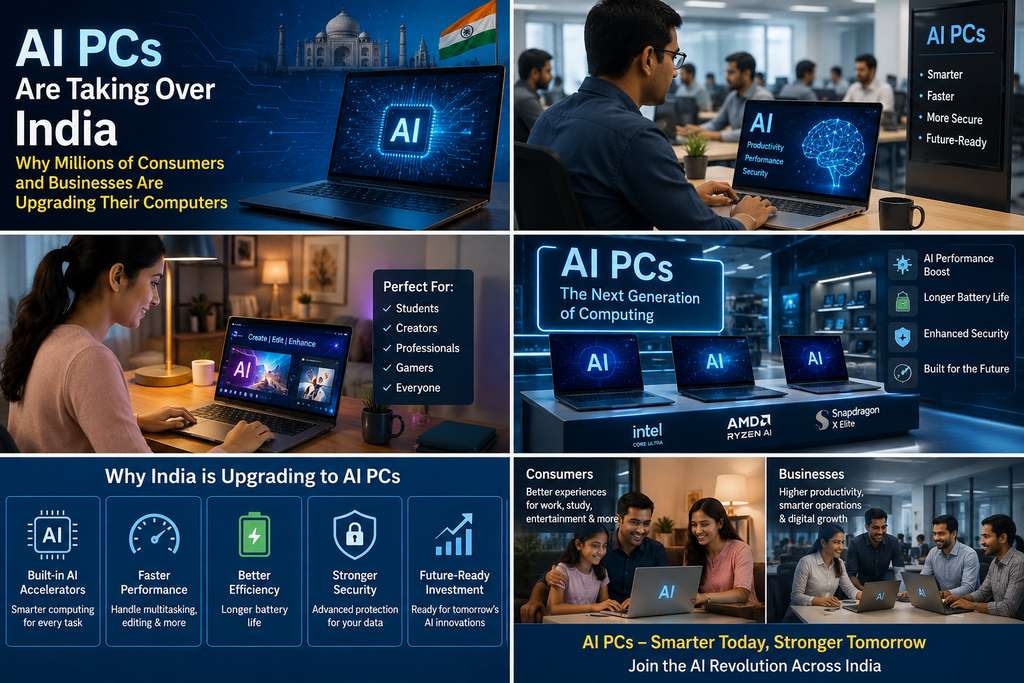
This is not a fleeting spike. India’s share of global PC shipments climbed to 5.6% in 2025 from 3.3% in 2020. Millions of first-time buyers who purchased devices during the COVID lockdowns are now replacing ageing machines. Businesses are modernising fleets for hybrid work, security and productivity. Content creators, students, gamers and small enterprises are seeking machines that can handle heavier local workloads. And vendors are responding by embedding neural processing units (NPUs) across more of their portfolios, turning “AI PC” from a marketing label into a practical hardware baseline for mid-to-high-end devices.
The Upgrade Cycle: From Pandemic Peak to AI Refresh
The foundation of today’s boom is demographic and technological. Lockdowns forced many Indian households and small offices to buy their first laptops. Those machines, often entry-level models purchased between 2020 and 2022, are now four to six years old. Performance has degraded relative to modern software demands. Battery life has declined. Security updates for older operating systems are ending. The natural replacement cycle has coincided with the arrival of AI-capable silicon from Intel, AMD and Qualcomm.
Commercial buyers have been particularly decisive. In 2025, the commercial segment accounted for roughly 53% of shipments. Enterprises refreshed hardware partly because of the Windows 11 transition and the need for stronger security and manageability. Small and medium businesses followed, seeking devices that could support distributed teams without constant cloud dependency. Education tenders, including large state programs, added further volume. Workstations, used for design, engineering and high-performance computing, grew more than 24% in 2025—the fastest category.
Consumers have contributed steadily, if more selectively. Notebooks remain the dominant form factor, growing 12.4% overall in 2025 and accelerating further in later quarters. Demand is strongest for devices that can handle content creation, media consumption, gaming and virtual learning. Premium models have outpaced the broader market as buyers trade up for better displays, longer battery life, more memory and, increasingly, dedicated AI acceleration.
Analysts note that pure “AI features” are not always the primary purchase driver for every buyer. Many customers still prioritise performance, battery life, build quality and price. Yet the hardware reality is shifting: most new mid-to-high-end Windows PCs now ship with NPUs capable of tens of trillions of operations per second. Once the silicon is present, software experiences—Microsoft Copilot features, local image and video tools, smarter search, noise cancellation, and on-device summarisation—become available without additional cloud cost or latency. The result is a quiet but powerful upgrade incentive.
What Makes an AI PC Different—and Why It Matters in India
An AI PC is defined by the presence of a dedicated Neural Processing Unit alongside the traditional CPU and GPU. Microsoft’s Copilot+ PC standard requires an NPU delivering at least 40 TOPS, along with minimum memory and storage thresholds. Devices meeting this bar can run advanced on-device models for tasks such as real-time transcription, local image generation and editing, semantic search across files, and background noise suppression during video calls—all while keeping sensitive data on the machine rather than sending it to the cloud.
For Indian users, this architecture carries practical advantages. Connectivity can be uneven outside major metros. Data privacy remains a concern for businesses handling customer or financial information. Cloud AI services incur recurring costs and latency. On-device processing reduces both. Battery efficiency improves because NPUs are far more power-efficient than CPUs or GPUs for inference workloads. Hybrid work, which remains widespread, benefits from devices that stay responsive offline or on limited bandwidth.
Vendors have expanded portfolios aggressively. HP, the market leader with roughly 29% share in 2025, has pushed AI-capable models across its EliteBook, ProBook and OmniBook lines and even experimental form factors. Lenovo, Dell, Acer and ASUS have followed with multi-silicon strategies—Intel Core Ultra, AMD Ryzen AI and Qualcomm Snapdragon X series—covering different price and performance tiers. Apple’s MacBooks have captured a large share of the higher-end generative AI notebook segment among consumers. Local assembly capacity is expanding, supported by production-linked incentives, though critical components such as processors and advanced memory remain largely imported.
Prices remain a friction point. True high-TOPS AI PCs still command a 20–40% premium over comparable non-AI models in some cases. Entry-level AI-capable machines are appearing closer to ₹70,000–₹80,000, and vendors argue that scale will bring costs down. Memory and component shortages in late 2025 and into 2026 have pushed prices higher and occasionally constrained supply, prompting some buyers and channel partners to accelerate purchases ahead of further increases.
Business Adoption: Productivity, Security and Future-Proofing
For enterprises and SMBs, the calculus is clearer. Refresh cycles that were already due now deliver measurable AI benefits. On-device Copilot experiences speed up document drafting, meeting summarisation and data analysis. Local processing reduces reliance on cloud credits and improves compliance posture. Security features tied to modern silicon and Windows 11 Pro—credential protection, hardware-rooted trust—address rising cyber risks. Hybrid and remote teams gain more consistent performance regardless of network conditions.
High-performance workstations have seen particularly strong demand from sectors such as engineering, design, animation and product development. India’s growing digital services and creative industries need local compute for rendering, simulation and model fine-tuning. SMBs, which form a large part of the commercial market, are adopting AI PCs less as experimental projects and more as practical tools that fit existing Windows workflows. Features such as natural-language file search and intelligent camera and audio enhancements deliver immediate day-to-day value without requiring specialised AI teams.
Government and education procurement has provided additional volume spikes. Large state education projects have driven notebook shipments in certain quarters, accelerating the replacement of older classroom devices with more capable machines. As digital literacy and online learning continue to expand, the installed base of AI-ready hardware grows.
Consumer Drivers: Creators, Students, Gamers and Everyday Upgrades
On the consumer side, the story is more varied but equally compelling. Content creators—YouTubers, graphic designers, video editors and social media professionals—benefit from local AI tools that accelerate editing and generation without constant internet dependency. Students and professionals in smaller cities are upgrading as devices become more widely available through online and retail channels and as performance expectations rise with richer digital content.
Gaming remains a meaningful secondary driver. While dedicated gaming laptops still emphasise discrete GPUs, AI features increasingly appear in the form of smarter upscaling, noise reduction and system optimisation. Everyday users notice improved video call quality, longer battery life on modern silicon, and faster responsiveness when multitasking with browser tabs, office applications and media.
The pandemic-era first-time buyers are a particularly important cohort. Many of those machines are now due for replacement. When they return to the market, the available options at similar price points often include AI acceleration that did not exist five years ago. The upgrade feels like a natural step rather than a speculative leap.
Challenges on the Road to Mainstream
Adoption is not frictionless. Global forecasts for AI PC share have been revised downward in some cases as buyers wait for more mature software experiences that clearly justify the price premium. In India, pure AI-driven demand has lagged the most optimistic early projections, though the trend is positive. Component cost inflation, especially memory, has raised device prices and reduced availability of the lowest-priced models. Channel partners and businesses have front-loaded inventories in anticipation of further increases, which can distort short-term shipment figures.
Software maturity remains a work in progress. While Copilot experiences and third-party tools are improving rapidly, many everyday users still experience AI features as incremental rather than transformative. Vendors and platform providers are racing to close that gap by shipping more practical on-device agents and workflows. Analysts expect clearer use cases and broader software support to accelerate adoption later in 2026 and beyond.
Supply constraints and rising input costs also create near-term uncertainty. Some forecasts for 2026 suggest possible moderation after the strong 2025 base, even as AI-capable devices become a larger percentage of the mix. Consumer demand is more sensitive to price than commercial demand, so further cost increases could slow household upgrades.
The Longer View: From Information to Intelligence Era
Despite near-term headwinds, the structural direction is clear. India’s PC penetration remains far lower than in mature markets—still well below 20% in many estimates—leaving substantial headroom. Digital transformation across government, education, SMBs and large enterprises continues. The creator economy and hybrid work patterns show no sign of reversing. Local manufacturing and assembly capacity is expanding under policy support.
Vendors are treating AI capability as a baseline rather than a differentiator for new mid- and high-end models. As volumes scale, prices are expected to moderate. On-device AI models will grow more capable. Hybrid cloud-edge architectures will become standard. For businesses, the ability to process sensitive workloads locally while still leveraging cloud resources when needed offers a practical path to AI adoption without massive infrastructure projects.
For consumers, the value proposition will broaden as software catches up with hardware. Features that today feel experimental—intelligent photo organisation, real-time language tools, personalised productivity assistants—will become ordinary. The same devices that handle schoolwork, office tasks and entertainment will increasingly feel “smarter” without requiring constant connectivity or subscription fees for basic AI functions.
India’s PC market has already demonstrated resilience and growth potential. The record 15.9 million units in 2025, the continued double-digit AI notebook expansion into 2026, and the shift toward higher-value premium and AI-capable machines all point to a multi-year transition. Millions of consumers and businesses are not merely buying new computers; they are equipping themselves for a computing environment in which local intelligence becomes as expected as a fast processor or a sharp display.
The transition will not be uniform or instantaneous. Price sensitivity, software readiness and supply dynamics will shape the pace. Yet the underlying drivers—replacement of ageing pandemic-era devices, enterprise modernisation, the rise of content creation and hybrid work, and the steady embedding of AI silicon—are durable. AI PCs are no longer a futuristic category in India. They are becoming the practical next step for a large and growing installed base. The numbers already show the shift is underway. The coming years will determine how completely the market converts to this new baseline.