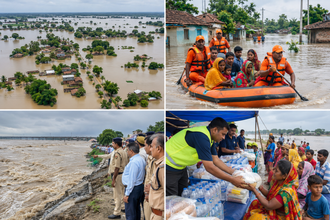

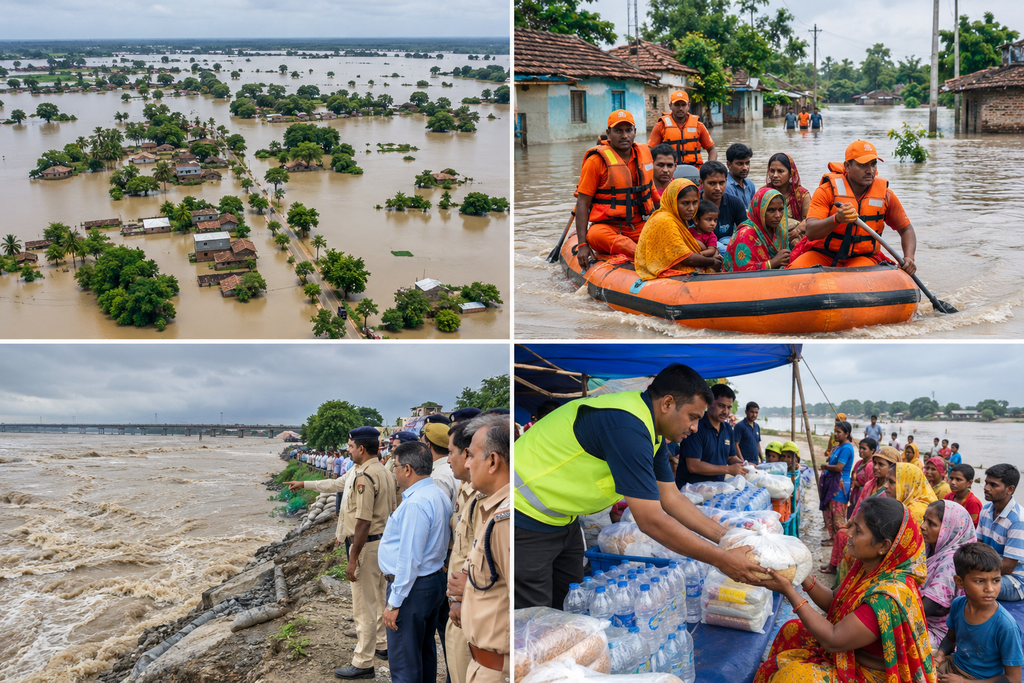
Patna, September 8, 2026 — Bihar’s flood situation remained critical on Tuesday, with major rivers including the Ganga, Gandak, Kosi, Budhi Gandak, Punpun, Bagmati and Ghaghra still above danger levels at multiple locations. More than 34 lakh people across 13 districts were affected, and authorities issued alerts for downstream areas after the Ganga crossed its previous highest flood level at Sultanganj in Bhagalpur district.
Official figures from the Bihar Disaster Management Department indicated that around 34.31 lakh people in 480 gram panchayats spanning 79 blocks of 13 districts were impacted. The number had risen from approximately 29 lakh the previous day and from over 22 lakh earlier in the weekend, reflecting the expanding reach of inundation as water levels stayed elevated.
The affected districts include Patna, Bhojpur, Saran, Vaishali, Bhagalpur, Begusarai, Buxar, Samastipur, Munger, Katihar, Lakhisarai, Khagaria and Arwal. Low-lying areas, riverine villages, and parts of urban centres have seen homes, roads, agricultural fields, and infrastructure submerged. In several places, embankments came under severe pressure, with reports of breaches or overtopping in local ring bunds and smaller rivers such as the Dardha and Mahatmain in and around Patna.
Rivers Above Danger Mark and Record Levels
The Ganga has been the focal point of concern. At Sultanganj in Bhagalpur, the river recorded 36.80 metres at 8 am on September 8, surpassing the previous highest flood level (HFL) of 36.75 metres set on August 17, 2021. The trend was described as stable at that point, yet authorities remained on high alert for further downstream impacts.
Earlier in the week, the Ganga had already breached previous records in the Patna stretch. At Gandhi Ghat, it reached 50.57 metres, exceeding the 2016 HFL of 50.52 metres. Similar exceedances or near-exceedances were noted at other gauges including Pandarak, Danapur and Banka Ghat. By Tuesday, levels in the Patna area showed signs of recession at some stations — falling at Digha, Gandhi Ghat and Mokama — but the river remained well above the danger mark (around 1 metre or more at key points). Further east, the threat persisted, with the Ganga still significantly above danger level at Sultanganj and other eastern gauges.
Other major rivers stayed elevated. The Gandak was above the danger mark at Dumriaghat and Hajipur. The Kosi crossed danger levels at Baltara and Kursela. The Budhi Gandak remained high at Khagaria. The Punpun continued to pose problems at Sripalpur (reported more than 2.8–2.9 metres above danger) and related stretches, after earlier breaches of ring bunds that inundated parts of southern Patna. The Bagmati was above danger at Benibad, and the Ghaghra at Darauli and related sites.
Discharge data offered mixed signals. Water release through the Birpur Barrage on the Kosi and the Indrapuri Barrage on the Sone showed declining trends at times on Tuesday, while the Valmikinagar Barrage on the Gandak remained relatively stable. These reductions provided limited relief in some upstream or mid-basin areas, but the overall volume of water already in the system kept large tracts flooded.
Heavy rainfall in Bihar’s catchment areas, neighbouring Jharkhand, and upstream regions in Nepal has been the primary driver. September rainfall in the state has been significantly above normal — reports cited around 79.6 mm (31% above normal) or earlier figures showing even higher percentage excesses in the early part of the month. The India Meteorological Department maintained heavy rain warnings for parts of Bihar into September 9 and 10, raising the possibility of further rises or prolonged high levels.
Death Toll and Human Impact
Casualties have mounted, primarily from drowning. On Tuesday, five deaths were confirmed in flood-affected parts of Patna district — two in Danapur and three in Maner — according to local officials. Earlier reports from the preceding days indicated additional drowning deaths across districts, with some accounts putting the cumulative toll in the range of at least 20. Families of the deceased have been provided compensation of Rs 4 lakh by the state government.
Beyond the official death count, the human cost is widespread. Thousands of families have been displaced from their homes. In riverine and low-lying villages, residents have moved to higher ground, embankments, schools, or temporary shelters. Livestock has been at risk, prompting the distribution of fodder. Standing crops in vast agricultural areas face damage or total loss, threatening livelihoods for farming communities that form a large part of Bihar’s rural economy. Access to clean drinking water, sanitation and healthcare has been disrupted in many pockets, raising concerns about water-borne diseases.
In Bhagalpur, a boat carrying 10 people capsized in the Kharik Raghopur area on Tuesday morning; all were rescued by State Disaster Response Force (SDRF) personnel. Similar rescue operations have been ongoing across affected districts as people become stranded by rising waters.
Relief and Rescue Operations
The state government has scaled up response measures. As of the latest updates, 432 community kitchens were operational, providing meals to flood-affected people. Reports indicated that several lakh individuals had already received food through these kitchens. Fourteen relief camps were housing thousands of people and offering accommodation, food and medical care.
Approximately 1,832 boats were deployed for evacuation and movement of people and essential supplies. Around 1.29 lakh polythene sheets and nearly 23,000 dry ration packets had been distributed. Over 3,000 quintals of animal fodder were also provided. Medical camps were increased to address health needs.
Ten National Disaster Response Force (NDRF) teams and 27 SDRF teams remained deployed across the affected districts for rescue and relief. Chief Minister Samrat Choudhary has been actively reviewing the situation, inspecting community kitchens and relief arrangements in districts such as Vaishali and Saran, and directing officials to ensure prompt assistance. He has emphasised continuous monitoring of embankments and vulnerable areas. The government has also spoken of longer-term measures, including river interlinking projects and dam-related planning, while focusing on immediate rescue and relief.
District-Level Picture
In Patna, the combination of Ganga and Punpun flooding has been severe. Low-lying localities and southern areas faced inundation after ring bund breaches. Water levels at Gandhi Ghat and other city gauges had peaked above previous records before beginning a gradual decline, yet remained above danger marks. Danapur and Maner blocks reported the recent drowning deaths.
Bhagalpur saw the Ganga cross its previous HFL at Sultanganj, prompting downstream alerts. Road connectivity, including stretches of national highways, was affected by waterlogging. Large populations in rural blocks remained cut off or partially submerged.
Vaishali, Saran and Bhojpur experienced impacts from the Gandak and Ganga. Hajipur and surrounding areas dealt with elevated Gandak levels. In Bhojpur, villages along the Ganga continued to face high water even as some recession was noted.
Katihar, Khagaria, Munger, Begusarai and Lakhisarai in the eastern and central parts of the state bore the brunt of Kosi, Ganga and Budhi Gandak systems. Villages in Khagaria and Katihar reported extensive flooding, with thousands of residents affected. Munger saw multiple blocks impacted by the Ganga remaining above danger level.
Samastipur, Buxar, Arwal and other listed districts also recorded inundation in river-adjacent panchayats, contributing to the overall tally of nearly half a million people directly affected in the expanded count.
Weather Outlook and Outlook for Coming Days
The meteorological centre has indicated continued possibilities of heavy rain in the near term. While some river gauges showed falling or stable trends on Tuesday, the large volume of water already in the Ganga system and its tributaries means that even modest additional rainfall or delayed recession could prolong the crisis, particularly in eastern Bihar. Officials have advised residents in flood-prone and low-lying areas to remain vigilant, avoid unnecessary movement near rivers and embankments, and follow official advisories.
Discharge reductions at key barrages offer hope of gradual improvement over the next few days if rainfall remains limited. However, the geography of Bihar — a lower riparian state receiving water from Nepal and upstream Indian states — makes it chronically vulnerable to such monsoon excesses.
Broader Context and Challenges
Bihar faces recurrent flooding almost every monsoon season due to its location, dense network of Himalayan rivers, siltation, and embankment pressures. The current episode has once again highlighted the strain on infrastructure, the challenges of timely evacuation in densely populated rural areas, and the economic hit to agriculture and daily wage earners. Relief distribution, while extensive, continues to face logistical hurdles in completely cut-off villages.
Political leaders have called for enhanced central assistance. Opposition figures have urged that the floods be treated with greater urgency at the national level. The state administration maintains that all available resources — boats, specialised teams, kitchens and supplies — are being mobilised and that monitoring of embankments and water levels continues round the clock.
As of Tuesday evening, the situation remained fluid. While pockets of relief were visible where water levels had begun to ease, the overall picture across the 13 districts was one of continued hardship for more than 34 lakh people. Rescue teams, community kitchens and administrative machinery are expected to remain fully engaged in the coming days as authorities work to stabilise the situation, prevent further loss of life, and begin the long process of recovery once waters recede.
Residents and officials alike are hoping that the forecast rain does not reverse the modest improvements seen in some river stretches, and that the peak of this flood wave has largely passed. Continuous updates from the Water Resources Department and Disaster Management Department will remain critical for the days ahead.
The human stories emerging from the affected areas — families shifting repeatedly, farmers watching crops disappear under water, children and the elderly navigating boat journeys to safer ground — underscore the scale of the challenge. Bihar’s flood management systems are being tested once more, with the dual priorities of immediate humanitarian response and longer-term structural solutions both in focus.