
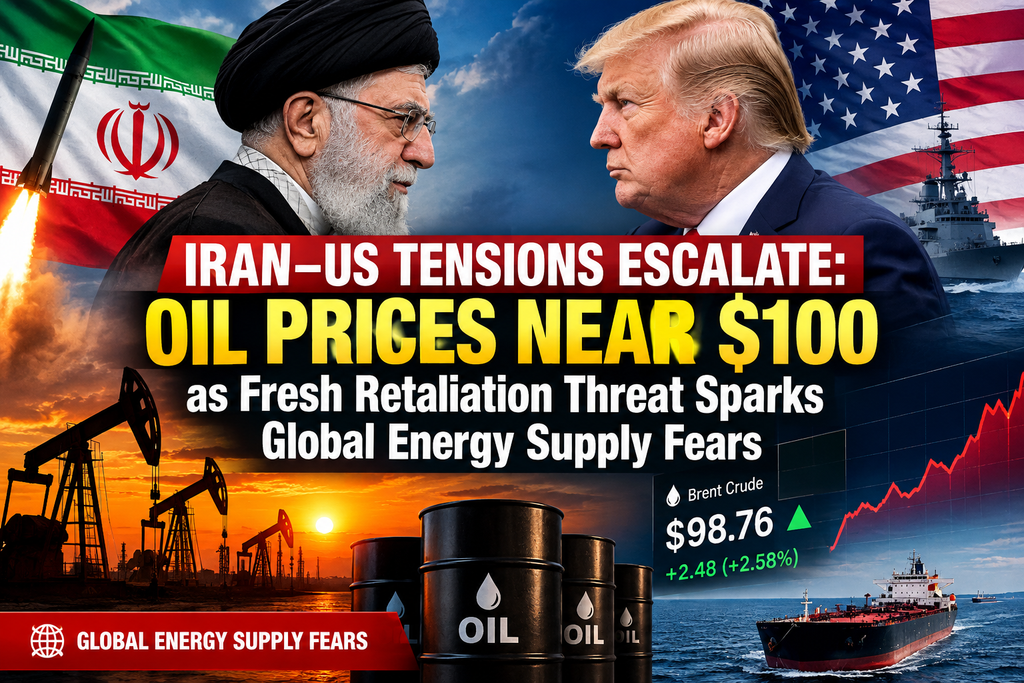
DUBAI / LONDON / WASHINGTON — Oil prices surged toward the psychologically critical $100-a-barrel threshold on Monday after the United States and Iran exchanged fresh strikes on commercial and military vessels over the weekend, prompting Tehran to issue new threats against energy infrastructure across the Persian Gulf. Brent crude futures climbed as high as $98.06 before settling near $97.30, their highest levels in six weeks, while West Texas Intermediate traded around $92–$93. The gains capped a weekly rally of roughly 8–10 per cent and left markets bracing for further upside if shipping through the Strait of Hormuz deteriorates further.
Iranian Parliament Speaker Mohammad Baqer Qalibaf delivered the sharpest warning yet, declaring “Strike our assets and you get struck” and emphasising that the region’s sprawling oil and gas production chain is “accessible and exposed.” American companies operating in the area, he added, share that vulnerability. The remarks came after U.S. Central Command confirmed strikes on three Iranian oil tankers, including one near Kharg Island, Iran’s primary crude export terminal. One vessel, the Suezmax Kylo, was reported sunk in the Gulf of Oman. Iran’s Islamic Revolutionary Guard Corps claimed it had targeted three tankers using unauthorised routes through the Strait of Hormuz as well as U.S.-linked vessels elsewhere.
Senior Iranian security official Mohsen Rezaei announced that Tehran would shortly declare a new restricted maritime zone beginning at the edge of the existing U.S. naval blockade line and extending into parts of the Gulf. Any vessel entering the zone, he said, would face Iranian sanctions. Rezaei linked the measure to continued American “sabotage, threats and attacks,” stating that Iran would only guarantee openness of the strait once those actions ceased. The statements reinforced a cycle of retaliation that has defined more than six months of conflict that began with U.S. and Israeli strikes on Iranian targets on February 28.
Shipping data underscored the immediate economic stakes. Analytics firm Kpler reported that an average of only about 10 commodity vessels transited the Strait of Hormuz daily over the previous 10 days—the lowest level since May. Before the war, the waterway typically carried nearly one-fifth of global oil supplies, or roughly 15–20 million barrels per day of crude, condensate and products. The sharp reduction has already forced producers to rely more heavily on limited pipeline alternatives and has drained commercial and strategic inventories in major consuming countries.
Market Reaction and Analyst Warnings
Traders reacted swiftly. Net-long speculative positions in U.S. crude rose to their highest since June, reflecting heightened risk premiums. European natural gas prices also jumped as much as 4 per cent in thin trading amid broader energy security concerns. Goldman Sachs analysts cautioned that sustained intensification of attacks on shipping could push oil as high as $120 a barrel. Other market participants noted that while a substantial portion of geopolitical risk has already been priced in, a true worst-case scenario involving prolonged closure or further infrastructure damage remains under-reflected.
The latest price spike occurs against a backdrop of already elevated costs for consumers and industry. In the United States, average gasoline prices hovered near multi-year highs for the Labour Day period, while refiners and airlines continued to face compressed margins and higher fuel bills. Emerging economies dependent on imported crude faced renewed pressure on currencies and fiscal balances. Every sustained $5 increase in the oil price is estimated to add roughly $190 billion in annual costs to the global economy, based on current demand of more than 100 million barrels per day.
Origins and Trajectory of the Conflict
The current confrontation traces its immediate origins to the February 28, 2026, U.S. and Israeli military operations against Iranian nuclear and military facilities. Iran responded by tightening control over the Strait of Hormuz, attacking vessels it deemed non-compliant with its preferred shipping corridors, and targeting U.S. interests in neighbouring Gulf states. An interim memorandum of understanding reached in mid-June briefly lowered tensions. It allowed some recovery in shipping volumes, but the arrangement collapsed in early July amid mutual accusations of violations. President Donald Trump declared the temporary truce “over,” and both sides resumed kinetic exchanges.
Throughout the conflict, Iran has demonstrated an ability to disrupt maritime traffic even while under sustained pressure. U.S. forces have conducted repeated strikes aimed at degrading Iran’s offensive capabilities and oil export infrastructure. Tehran has answered with ballistic missile attacks on U.S. warships, assaults on commercial tankers, and threats against energy facilities belonging to Gulf Arab states that host American forces or companies. The cumulative effect has been the largest energy supply disruption in modern history according to assessments by the International Energy Agency, with peak daily losses exceeding previous shocks from the 1970s oil crises or the 2022 Russian invasion of Ukraine.
Despite the scale of lost barrels, global markets have so far avoided outright shortages of gasoline, diesel or jet fuel. Strategic petroleum reserve releases, particularly from the United States and China, combined with redirected pipeline flows through Saudi Arabia’s East-West line to Yanbu and the UAE’s Habshan-Fujairah system, helped cushion the blow. Iranian crude exports themselves have collapsed under the combined weight of the U.S. blockade and sanctions, falling from pre-war levels near 1.7 million barrels per day to a few hundred thousand barrels in recent months, mostly moving through opaque channels or overland routes.
The Strait of Hormuz as Strategic Chokepoint
Geography continues to amplify the stakes. The Strait of Hormuz is only about 21 nautical miles wide at its narrowest point, with shipping lanes far narrower. More than 80 per cent of the oil leaving the Persian Gulf historically passed through it, destined primarily for Asian markets including China, India, Japan and South Korea. Even partial restrictions raise insurance premiums, lengthen voyage times and force inefficient routing. When volumes drop to single-digit daily vessel counts, as seen in recent data, the physical availability of light, medium and heavy Middle Eastern crude grades tightens rapidly.
Iran has long viewed control or credible threat over the strait as a core element of deterrence. By declaring new restricted zones and demanding compliance with designated corridors, Tehran seeks both to raise the cost of American military action and to signal to regional states that neutrality is not cost-free. The United States, for its part, has insisted on freedom of navigation and has used naval power to enforce a de facto blockade of Iranian ports while protecting or escorting other traffic. The resulting standoff has produced a low-level but persistent campaign against shipping that keeps risk premiums elevated even during periods of relative calm.
Economic and Political Pressures on Both Sides
For Iran, the economic toll has been severe. Inflation has soared, oil revenues have plummeted, and domestic fuel pricing has been adjusted upward for heavy users in an effort to manage scarce supplies. U.S. sanctions, tightened further after the collapse of the interim understanding, have limited buyers largely to Chinese independent refiners willing to accept steep discounts. Iranian officials have spoken of accelerating efforts to mitigate the impact, including greater use of overland exports and domestic refining, yet the structural damage to export capacity remains clear.
The United States faces its own constraints. Higher oil and gasoline prices complicate domestic political calculations, particularly with midterm elections approaching. American shale producers have benefited from elevated prices and have increased output where possible, but the lag between price signals and new production means the short-term market remains sensitive to any further reduction in Middle Eastern barrels. Gulf Arab allies, while sharing security concerns about Iran, have also absorbed economic costs through reduced exports, higher insurance, and occasional direct attacks on their facilities or vessels. Reports of an attack on Saudi Arabia’s Jazan refinery on Monday, though details remained limited, illustrated the continuing risk of spillover.
Analyst Scenarios and Market Positioning
Market participants are increasingly pricing the conflict as a prolonged rather than temporary disruption. Earlier hopes that a diplomatic breakthrough would rapidly restore pre-war flows have faded. Base-case scenarios from major institutions now contemplate oil prices remaining in an elevated $90–$110 range through the second half of 2026, with upside risks to $120 or higher if vessel attacks intensify or if major processing or export terminals suffer lasting damage. Downside scenarios still exist—renewed ceasefire talks leading to gradual normalisation—but carry lower probability in the current environment.
Inventories provide limited buffer. Commercial stocks in OECD countries and strategic reserves have already been drawn down substantially to offset the supply loss. Rebuilding those cushions will itself require higher prices or additional production from non-conflict sources. Refined product markets have shown even greater tightness than crude, with crack spreads remaining elevated long after crude prices partially retraced from their spring peaks near $125.
Regional Dynamics and Broader Implications
The conflict has also intersected with other flashpoints. Iranian-aligned Houthi forces in Yemen have periodically threatened or attacked shipping in the Red Sea and Bab el-Mandeb, complicating alternative export routes that Saudi Arabia and others have sought to expand. Israeli operations in southern Lebanon and continued friction along other fronts add layers of complexity to any potential de-escalation. Diplomatic channels remain open in theory, yet public statements from both Washington and Tehran emphasise resolve rather than compromise.
Global energy consumers outside the immediate region are adjusting. Asian refiners have sought alternative grades from the Atlantic Basin, West Africa and the Americas. European buyers, already navigating the aftermath of reduced Russian supplies, face renewed competition for available barrels. Developing economies with limited fiscal space confront the dual challenge of higher import bills and potential currency pressure.
Historical Parallels and Structural Differences
Comparisons with previous oil shocks are inevitable yet imperfect. The 1973–74 Arab oil embargo and the 1979 Iranian Revolution produced sustained high prices and economic recession in consuming countries. The 1990–91 Gulf War generated a sharp but relatively short-lived spike. The present episode is distinguished by its duration, the direct involvement of the world’s largest economy as a combatant, and the simultaneous pressure on both crude and product markets. Unlike earlier crises, today’s global oil system includes significant U.S. shale capacity, strategic stocks that can be released, and more diversified supply sources—yet the concentration of remaining low-cost barrels in the Persian Gulf still confers leverage on whoever can threaten or protect those flows.
Technology and market structure have also evolved. Real-time shipping data, sophisticated risk-management instruments and the ability of major producers to redirect volumes through pipelines mitigate some effects. At the same time, the financialization of oil markets means that geopolitical headlines translate into price moves with greater speed and amplitude than in previous decades.
Outlook: Fragile Equilibrium or Further Escalation
As of early September 2026, the situation remains finely balanced. Neither side appears eager for full-scale conventional war, yet neither has shown willingness to concede the core points of contention: Iranian control or influence over Hormuz shipping on one side, and American insistence on free navigation and pressure on Tehran’s military and nuclear programs on the other. The latest exchange of strikes and the accompanying rhetoric have reminded markets that the risk of further escalation is real and immediate.
Oil prices near $100 already embed a substantial geopolitical premium. Whether that premium expands toward the $120 levels flagged by some banks or eventually contracts will depend on concrete developments in the coming days and weeks: the precise contours of Iran’s announced restricted zone, the U.S. military response, the volume of actual shipping that continues to move, and any signs of diplomatic movement. For now, energy markets, governments and consumers worldwide are watching the narrow waters of the Strait of Hormuz with heightened concern, aware that decisions taken in Tehran and Washington can rapidly transmit through the price of the commodity that still underpins the global economy.
The coming period will test the resilience of both the physical supply system and the political will of the principal actors. With inventories lean, alternative routes constrained, and rhetoric hardening, the margin for error has narrowed. Oil prices approaching $100 serve as both a market signal and a warning: the world’s most critical energy artery remains contested, and the consequences of that contest are being felt far beyond the Gulf.