

Nisshin, Japan – September 22, 2026
In a performance that will be etched into the annals of Indian cricket history, the Harmanpreet Kaur-led Indian women’s team retained their Asian Games gold medal with a comprehensive 147-run thrashing of Sri Lanka in the final of the women’s T20 cricket competition at the Korogi Athletic Park (also referred to as Kōrogi Sports Park) in Nisshin, Aichi Prefecture. The victory, sealed on Tuesday, not only defended the title won in Hangzhou in 2023 but also delivered India’s first gold medal of the 2026 Aichi-Nagoya Asian Games.
India posted a monumental 216 for 3 in their 20 overs—the highest total in the history of women’s cricket at the Asian Games—before their spin-dominated attack dismantled Sri Lanka for a meagre 69 in just 15.4 overs. The margin of victory stands as India’s largest in women’s T20 Internationals, surpassing a previous 144-run win over Malaysia in 2018. Smriti Mandhana’s scintillating 79 off 45 balls, featuring five fours and seven sixes, set the platform, while Richa Ghosh’s explosive unbeaten 49 off 22 and Shafali Verma’s 48 off 29 provided the firepower. Deepti Sharma led the bowling with 3 for 6, supported by two wickets each from Shafali Verma, Shree Charani and Shreyanka Patil.
The result completed a dominant campaign for India, who remained unbeaten throughout the tournament. Sri Lanka, making their second successive final appearance against the same opponents, settled for silver once again. Pakistan claimed the bronze medal earlier in the day by defeating Bangladesh by 31 runs in the third-place playoff.
This triumph carries profound significance. It marks India’s second consecutive women’s cricket gold at the Asian Games, putting them level with Pakistan, which won the event in 2010 and 2014. India had not participated in those earlier editions when cricket featured at the Games. The gold also opened India’s medal account in the gold category at Aichi-Nagoya, after the contingent had already secured four silvers and two bronzes across other disciplines, bringing the overall tally to seven medals at that point.
Build-Up and Tournament Context
The 2026 Asian Games women’s cricket tournament featured eight teams competing in the T20 format at venues in Japan’s Aichi region. India entered as defending champions and clear favourites, having established themselves as the dominant force in Asian women’s cricket. Their path to the final was clinical. In the semi-final, Shafali Verma produced a sensational unbeaten 100 off 49 balls—her maiden T20I century—as India posted 195 for 4 and then bowled Bangladesh out for 81 to win by 114 runs. Sri Lanka, powered by captain Chamari Athapaththu’s consistent form, defeated Pakistan by eight wickets to set up the rematch of the Hangzhou final.
Cricket’s inclusion in the Asian Games has a relatively short but competitive history. The sport first appeared in 2010 in Guangzhou, where Pakistan claimed the women’s gold. They defended it in Incheon in 2014. After a hiatus, it returned in Hangzhou (held in 2023 due to the COVID-19 delay of the 2022 Games), where India made their debut and won gold by beating Sri Lanka by 19 runs in a low-scoring final. The 2026 edition in Japan continued the T20 format, with matches played under multi-sport Games conditions that often differ from bilateral series in terms of pitch preparation, crowd atmosphere and the broader national medal pressure.
Harmanpreet Kaur’s side arrived in Japan with a settled core. Mandhana, the elegant left-hander and vice-captain, had already become the first woman to reach 11,000 international runs during the tournament. Shafali Verma continued her evolution as a destructive opener capable of both power and composure. Deepti Sharma remained the reliable all-rounder and spinner, while Richa Ghosh provided the finishing power that has become a hallmark of India’s middle order. The bowling unit mixed experienced spinners with emerging talents such as Shreyanka Patil and Shree Charani, giving the side tactical flexibility on Japanese pitches that offered some assistance to spin.
Match Highlights: India’s Batting Masterclass
Harmanpreet Kaur won the toss and elected to bat on a surface that promised runs if batters applied themselves positively. The decision proved inspired. Openers Shafali Verma and Smriti Mandhana launched a blistering assault from the outset. Their 99-run partnership in the first 10 overs set a ferocious tempo, with both scoring at strike rates well above 150. Shafali, coming off her semi-final century, struck three fours and three sixes in her 29-ball 48. She looked set for another half-century when a mistimed reverse sweep found the fielder, ending the stand at 99 for 1 in the 10th over.
Mandhana continued serenely and then explosively. Her 79 off 45 balls was a masterclass in timing, placement and calculated aggression. She cleared the boundary seven times and found the ropes five times, punishing anything short or full. At one stage she appeared unstoppable, sending the ball to all parts of the Korogi ground. Her innings not only propelled India but also underlined her status as one of the finest batters in the world game. She eventually fell for 79, caught off the bowling of Dasanayaka, with the score at 163 for 3 in the 17th over.
Captain Harmanpreet Kaur contributed a useful 19 off 17 balls before departing. The stage was then set for Richa Ghosh. Promoted in the order and known for her clean striking, Ghosh produced a whirlwind 49 not out off just 22 deliveries, laced with six fours and three or four sixes depending on reports. Partnered late by Bharti Fulmali, who remained unbeaten on a handful of runs, Ghosh and the lower order plundered 25 runs off the final over, which included eight wides from a beleaguered Sri Lankan bowler. India finished on 216 for 3—the highest total in Asian Games women’s cricket history, surpassing Hong Kong’s 202 against Mongolia from the previous edition. The innings featured a combined 18 fours and 13 sixes, a striking illustration of India’s intent.
Sri Lanka’s bowlers struggled to contain the onslaught. Chamudi Praboda was the only one to take a wicket of note with figures of 1 for 34, while others leaked runs at economies well into double figures. The total left Sri Lanka requiring more than 10 runs per over from the start—an almost impossible task against a disciplined Indian attack.
The Bowling Stranglehold
Chasing 217, Sri Lanka needed a special performance from their experienced captain Chamari Athapaththu. She provided the only meaningful resistance, scoring 29 off 21 balls. Beyond her, the innings collapsed under relentless pressure from India’s spinners. Deepti Sharma was outstanding, returning 3 for 6 from her four overs and applying the choke early. Shafali Verma, often used as a part-time off-spinner, claimed 2 for 3. Shreyanka Patil took 2 for 9 and Shree Charani 2 for 13. The entire ten wickets fell to spin, a testament to India’s bowling depth and the conditions that favoured slower bowlers.
Sri Lanka slumped to 55 for 7 by the 12th over and were eventually dismissed for 69 in 15.4 overs. Only two other batters reached double figures. The chase never gained momentum; boundaries were scarce and wickets tumbled regularly. The 147-run margin reflected not just the gulf in batting firepower but also India’s superior fielding and tactical bowling plans. It was a complete team performance that left little room for criticism.
Player Performances and Standout Moments
Smriti Mandhana’s innings was the centrepiece. Beyond the runs, it carried historical weight as she crossed the 11,000-run milestone in international cricket during the tournament, becoming the first woman to do so. Her leadership of the batting order and consistency across formats continue to set benchmarks. Shafali Verma’s all-round contribution—48 with the bat and two wickets—highlighted her growing maturity. Richa Ghosh’s finishing ability once again proved decisive in pushing the total beyond 200. Deepti Sharma’s bowling figures underpinned the defence, while the supporting cast of spinners shared the spoils effectively.
For Sri Lanka, Athapaththu fought a lone battle. The rest of the batting line-up failed to adapt to the pressure and the spin attack. Their campaign had shown promise in reaching the final, but the gulf against a full-strength Indian side proved too wide on the day.
Medal Update and Broader Implications for India
The gold medal immediately transformed India’s standing at the Aichi-Nagoya Games. Prior to the final, the contingent had medals in shooting and other events but no gold. The cricket triumph provided the first, lifting national spirits and setting a positive tone for the remainder of the multi-sport event. Officials and athletes across disciplines celebrated the breakthrough. India’s overall medal count stood at one gold, four silver and two bronze at the time of the victory.
In the broader context of Indian women’s cricket, the result reinforces the progress made over the past decade. Consistent investment, domestic structures, the Women’s Premier League and international exposure have produced a side capable of dominating regional competitions while remaining competitive on the global stage. Back-to-back Asian Games golds place India alongside Pakistan historically and signal sustained excellence.
Pakistan’s bronze, secured through a 31-run win over Bangladesh (Pakistan 145/8, Bangladesh 114/7), added another layer to the tournament narrative. Fatima Sana’s lower-order contribution of 45 proved decisive for Pakistan, who avenged a previous bronze-medal playoff loss to Bangladesh. The podium—India gold, Sri Lanka silver, Pakistan bronze—reflected the competitive hierarchy in Asian women’s cricket while also showing that several sides remain capable of upsetting on any given day.
Historical Perspective and Future Outlook
Women’s cricket at the Asian Games has evolved from a relatively low-profile event into a significant medal opportunity. India’s absence from the 2010 and 2014 editions meant they arrived as newcomers in Hangzhou and left as champions. The successful defence in 2026 confirms that the 2023 win was no one-off. The quality of cricket on display, particularly India’s record total and clinical bowling, raises the standard for future editions.
Looking ahead, the Indian team will turn its attention to bilateral series, the ongoing ICC events cycle and eventual preparation for the next World Cup. Individual milestones such as Mandhana’s run tally and Shafali’s century will boost confidence. For Sri Lanka, the silver provides a platform for further development, especially if Athapaththu’s experience can be paired with emerging talent.
The atmosphere at Korogi Athletic Park reflected the multi-sport nature of the Games. While not a traditional cricket stadium packed with partisan fans, the presence of the Indian contingent, officials and limited spectators created a sense of national occasion. The playing of the Indian national anthem for the first time at these Games after the medal ceremony carried symbolic weight.
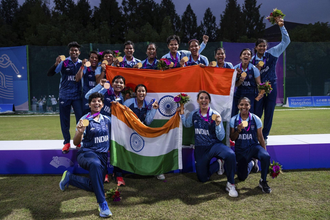
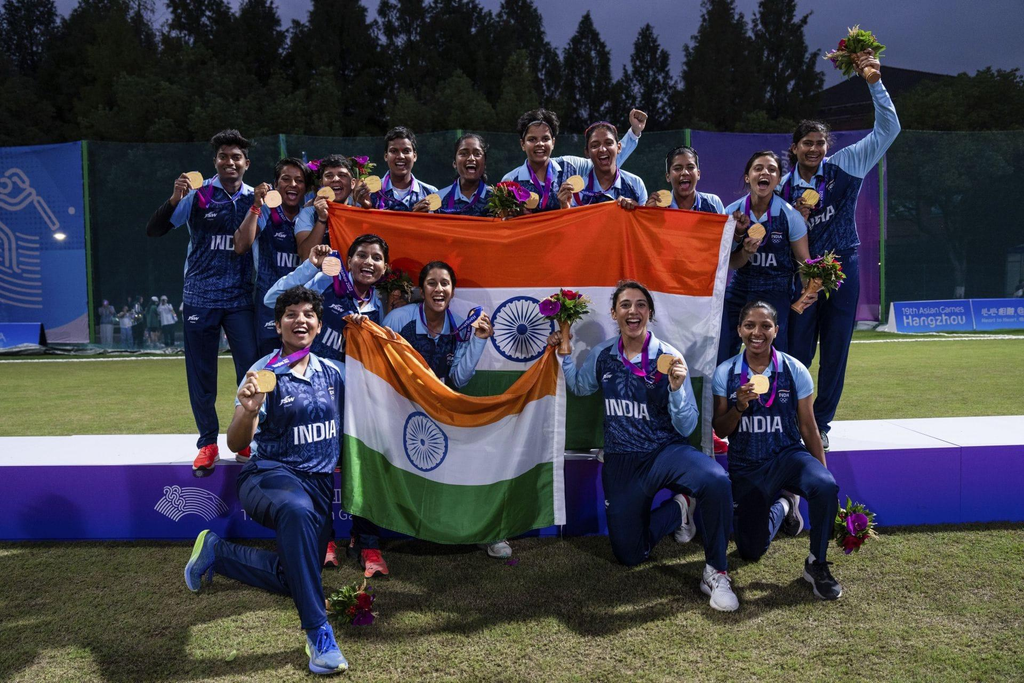
Reactions from the camp were predictably jubilant. Players spoke of the satisfaction of delivering India’s first gold and the pride in defending the title against familiar rivals. Coaching staff highlighted the collective nature of the performance—batting depth, bowling variety and fielding intensity. BCCI Women’s social media channels celebrated the back-to-back achievement with images of the podium and scorecard, capturing the joy of a squad that has grown together through highs and occasional setbacks.
Detailed Scorecard and Key Statistics
India Women 216/3 (20 overs)
Smriti Mandhana 79 (45 balls, 5×4, 7×6)
Shafali Verma 48 (29 balls, 3×4, 3×6)
Richa Ghosh 49* (22 balls)
Harmanpreet Kaur 19
Extras and other contributions made up the remainder.
Fall of wickets: 99/1 (Verma), 141/2 (Kaur), 163/3 (Mandhana).
Sri Lanka Women 69 all out (15.4 overs)
Chamari Athapaththu 29 (21)
Others in single figures or low teens.
Bowling: Deepti Sharma 3/6, Shafali Verma 2/3, Shreyanka Patil 2/9, Shree Charani 2/13.
Result: India won by 147 runs.
The statistics underline the one-sided nature of the contest. India’s run rate exceeded 10 per over; Sri Lanka managed little more than four. Boundary count, strike rates and economy rates all favoured the winners decisively.
Analysis: Why India Dominated
Several factors explain the scale of the victory. First, the batting depth and intent allowed India to post a total that was always likely to be beyond Sri Lanka’s reach. Second, the spin attack matched the conditions perfectly and executed plans with precision—variations in pace, flight and trajectory kept batters guessing. Third, the experience of having contested the previous final against the same opponent provided a psychological edge. Fourth, the form of key individuals—Mandhana in full flow, Ghosh finishing strongly, Sharma controlling the middle overs—created a perfect storm for the opposition.
Sri Lanka’s challenges were multifaceted. Their bowling lacked the penetration needed to restrict India early, and once the total climbed past 180, the chase became mathematical rather than realistic. Batting against quality spin under pressure exposed technical and mental gaps. Yet reaching the final itself remains a positive, given the strength of the Indian side.
The Road Ahead for Asian Women’s Cricket
The 2026 tournament has reinforced the value of cricket within the Asian Games programme. It provides a high-visibility platform every four years, exposes players to multi-sport environments, and contributes to national medal tallies. For developing nations in the region, it offers competitive experience against stronger sides. For India, it serves as both a validation of existing systems and a motivator for continued investment in women’s cricket infrastructure, talent pathways and professional opportunities.
As the Aichi-Nagoya Games continue, attention will shift to other sports, including the men’s cricket competition scheduled to begin later. The Shreyas Iyer-led men’s side will aim to emulate their women’s counterparts. Meanwhile, the women’s team returns home with gold medals, national pride and the satisfaction of a job thoroughly well done.
In the end, the story of September 22, 2026, in Nisshin is one of clinical excellence. From the opening partnership that announced intent, through Mandhana’s boundary-laden knock, Ghosh’s late flourish and the spin web that entangled Sri Lanka, every phase belonged to India. The 147-run margin, the record total, the first gold of the Games and the successful title defence combine to make this a landmark day for Indian women’s cricket. The team has set a new benchmark; the challenge now is to maintain and elevate that standard on the world stage.
The gold medals around their necks and the Indian flag raised highest on the podium stand as lasting symbols of a performance that was historic in every sense—dominant, record-breaking and nationally significant. India remains the team to beat in Asian women’s cricket, and on this evidence, that status is well earned.