
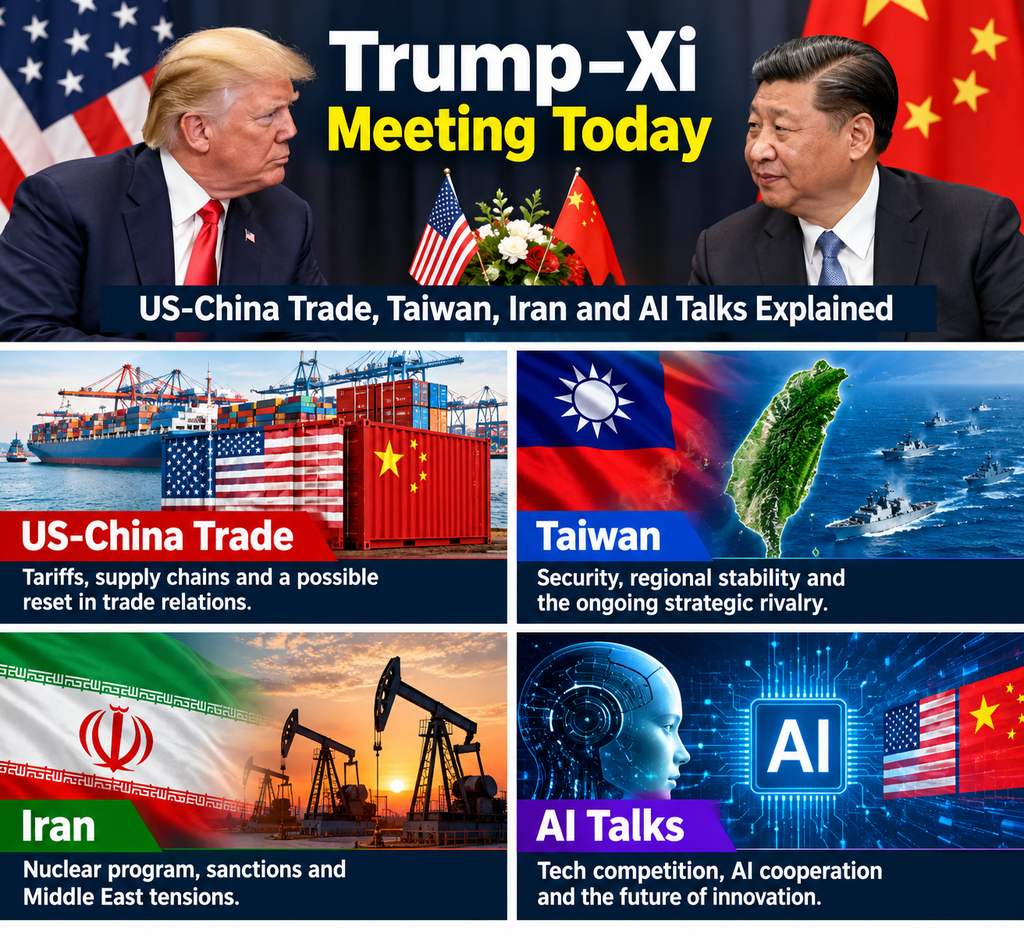
Washington, September 24, 2026 — On a crisp autumn Thursday in the American capital, the leaders of the world’s two largest economies met for high-stakes talks that blended pageantry with deep geopolitical friction. US President Donald Trump is hosting Chinese President Xi Jinping at the White House for the centrepiece of a three-day state visit, the first such trip by a Chinese leader to Washington in more than a decade and the second face-to-face encounter between the pair this year.
The summit arrives against a backdrop of managed rivalry rather than open rupture. Both sides have signalled a preference for stability even as they compete fiercely over technology, resources, security flashpoints and global influence. Tangible breakthroughs are widely expected to be limited. A fragile trade truce has already been extended, discussions on artificial intelligence risks are underway, and the most sensitive issues—Taiwan, the lingering Iran conflict, and advanced technology controls—remain deeply contested.
What follows is a detailed examination of the meeting’s context, the four headline issues dominating the agenda, the ceremonial framework surrounding the talks, the positions and leverage of each side, and the broader implications for the international order.
The Road to Washington: From Beijing Banquet to White House Red Carpet
The current summit is the reciprocal leg of diplomacy that began in May 2026, when Trump travelled to Beijing for a state visit. There, amid elaborate ceremonies at the Great Hall of the People, the two leaders held substantive talks, exchanged toasts, and publicly emphasised personal rapport. Trump invited Xi and his wife, Peng Liyuan, to Washington for a return visit on September 24—a date that has now materialised with unusual precision.
Xi’s arrival on Wednesday evening set a deliberately grand tone. Trump broke with recent protocol by greeting the Chinese leader personally at Joint Base Andrews, the first time a US president had welcomed a foreign counterpart at the air base in more than a decade (and one of the rarest such airport receptions in modern American diplomatic history). A long red carpet, honour guard, and military flyover accompanied the arrival. Melania Trump and Peng Liyuan joined their husbands for the tarmac handshake, underscoring the state-visit formality.
Thursday’s programme continues the spectacle. A formal arrival ceremony on the White House South Lawn and Rose Garden, complete with military inspection and flyovers involving advanced aircraft including a B-2 Spirit bomber and F-22 Raptors, is scheduled. Bilateral talks in the Oval Office or Cabinet Room will follow. In the evening, a state dinner in the East Room—Trump’s preferred venue after noting that a larger new ballroom under construction was not ready—will bring together senior officials and an unusually heavy contingent of American technology and AI executives. Confirmed or expected attendees include leaders from OpenAI, Nvidia, Apple, Google/Alphabet, Tesla and others. A visit to the National Archives is planned for Friday.
The optics matter. Both leaders face domestic political calendars that reward displays of strength and competence. Trump is navigating midterm election pressures and public fatigue over foreign conflicts. Xi seeks to project China’s restored centrality in global affairs and the durability of his personal diplomacy with the American president. Analysts note that the two men appear to believe time favours their respective systems: the United States through continued innovation and economic dynamism, China through industrial scale, critical mineral dominance and long-term strategic patience.
Trade: An Extended Truce and the Search for Durable Gains
Trade remains the most concrete area of progress and the issue most closely watched by markets. On Wednesday, shortly after Xi’s arrival, US Treasury Secretary Scott Bessent announced that the two sides had agreed to extend their existing trade truce until January 10, 2027. The arrangement, originally forged after a 2025 summit and previously set to expire on November 10, had paused a damaging cycle of tariffs that at one point exceeded 100 per cent on many goods in both directions.
The truce has been linked to Chinese commitments on the steady supply of rare earth minerals and critical materials essential for electronics, defence and green technology, in exchange for US restraint on new tariff escalations. Bessent described the two-month extension as providing additional time to pursue a broader economic understanding. Chinese officials have indicated interest in a longer horizon, potentially running through the remainder of Trump’s term, though no such commitment has been locked in.
Beyond the truce, both sides have floated narrower deals. US Trade Representative Jamieson Greer has pointed to possible announcements on agriculture and non-tariff barriers. Progress on a mutual reduction covering roughly $30 billion in goods—most easily achieved through Chinese cuts on American agricultural products—is being closely monitored. China has also made incremental advances on a previously discussed order of Boeing aircraft, though the scale remains modest relative to earlier ambitious figures floated after the May summit.
Structural tensions persist. The United States continues to maintain export controls on advanced semiconductors and manufacturing equipment. China retains leverage through its near-monopoly on certain rare earth processing capacity and has previously used export restrictions as a tool of economic statecraft. Domestic political realities constrain both leaders: American farmers and manufacturers seek market access and predictability; Chinese policymakers prioritise technological self-reliance and industrial upgrading.
Any sector-specific tariff relief or agricultural purchase commitments would be welcomed by markets as evidence that the relationship can deliver incremental economic stability even amid strategic competition. A full-scale comprehensive trade agreement, however, remains distant. The January extension is best understood as a pause that buys negotiating space rather than a resolution of the underlying imbalance and security-driven restrictions.
Taiwan: The Most Sensitive Fault Line
No issue carries higher potential for crisis than Taiwan. Beijing regards the democratically governed island as an inalienable part of China and has never renounced the use of force to achieve “reunification.” Washington maintains a policy of strategic ambiguity, provides defensive arms under the Taiwan Relations Act, and does not support formal independence while opposing any unilateral change to the status quo by force.
Xi is expected to press Trump hard on US arms sales. A proposed package valued at approximately $14 billion—encompassing missiles, anti-drone systems and air-defence capabilities—has been held in abeyance for months. After the May Beijing summit, Trump openly described the package as a “very good negotiating chip.” Beijing has sought both a continued delay and, ideally, a stronger public US statement opposing Taiwan independence rather than the traditional formulation of not supporting it. Chinese officials may also invoke the 1982 US-China joint communiqué language on gradually reducing arms sales.
Taiwanese authorities have expressed confidence that core US support will continue, noting that arms sales proceed through established channels and that security cooperation remains robust. An earlier $11 billion package was approved in late 2025. Taipei has also accelerated its own defence spending and indigenous production efforts, including recent live-fire drills showcasing domestically developed platforms. Regional US allies in Asia watch closely, concerned that any perceived softening of American commitment could embolden Beijing or unsettle the broader security architecture.
For Trump, the calculus is transactional yet constrained. Arms sales generate American industrial jobs and revenue while reinforcing deterrence. Completely freezing them would alarm Congress, where bipartisan support for Taiwan remains strong, and raise questions about American reliability. Completely ignoring Chinese objections risks escalating grey-zone pressure around the Taiwan Strait, where Chinese military activity has become near-daily. The most likely near-term outcome is continued delay on the largest package combined with quiet reaffirmation of existing policy, leaving the issue unresolved but contained for the duration of the visit.
Iran: Leverage, Neutrality and Unfinished Business
The nearly seven-month conflict involving Iran continues to cast a shadow. The United States and Israel launched military operations earlier in 2026 aimed at constraining Iran’s nuclear programme and related capabilities. Iran responded in part by effectively closing or severely disrupting the Strait of Hormuz, a critical artery for global energy trade, producing high economic and political costs. Public support in the United States for the conflict has eroded, contributing to pressure on the Trump administration.
China is Iran’s largest oil customer and maintains longstanding economic and diplomatic ties with Tehran. Washington has repeatedly urged Beijing to use its leverage to encourage Iran toward a settlement on American terms, including the reopening of the strait and constraints on nuclear activities. During the May summit, Trump reported that Xi expressed willingness to be helpful and assured him that China would not supply military equipment to Iran. Trump has publicly thanked both Xi and Russian President Vladimir Putin for remaining “neutral,” arguing that their restraint made the conflict more manageable.
Yet Chinese policy has prioritised continuity of energy supplies and avoidance of deeper entanglement. Beijing has resisted secondary sanctions pressure and insisted on its right to conduct legitimate trade. Reports of Chinese entities providing certain forms of support or imagery have surfaced, though the Trump administration has downplayed or dismissed some of these accounts in the interest of preserving the broader relationship.
At the Washington talks, Trump is expected to renew requests for Chinese diplomatic or economic pressure on Tehran. Xi is likely to reiterate calls for de-escalation and peaceful resolution while declining any steps that would significantly damage China’s energy security or strategic autonomy. The most realistic deliverable is continued high-level communication and a mutual interest in preventing the conflict from further destabilising global energy markets, rather than a dramatic shift in Chinese policy.
Artificial Intelligence: Competition, Safety and the Search for Guardrails
Artificial intelligence has emerged as one of the most dynamic and potentially cooperative items on the agenda. Both countries view leadership in advanced AI as central to future economic competitiveness, military capability and national power. Trump has repeatedly framed the contest in zero-sum terms—“Whoever wins AI, WINS!”—while Chinese officials emphasise the need to avoid confrontational narratives and pursue inclusive governance.
Concrete discussions have already begun. In the run-up to the summit, Treasury Secretary Bessent and Chinese Vice Premier He Lifeng held talks in New York that included the first dedicated high-level US-China exchanges on AI. The United States proposed a notification mechanism for serious AI-related incidents that rise to the level of national security concern—an idea sometimes compared to Cold War-era hotlines. Chinese officials have confirmed that constructive talks took place and that multiple points of consensus were reached. Further sessions are anticipated, including potential meetings later in the year.
Trump himself has highlighted “super intelligence” (his preferred term for advanced AI) as a major discussion topic while indicating he does not expect immediate substantive policy changes. The state dinner guest list, heavy with AI and semiconductor executives, signals the prominence of the issue and the administration’s desire to showcase American technological leadership.
Obstacles to deeper cooperation are substantial. The United States maintains stringent export controls on the most advanced chips and manufacturing tools, arguing these are essential to prevent military applications that could threaten American security. China seeks relaxation of those controls and greater acceptance of its own AI models in global markets. Accusations of intellectual property practices, data access disparities, and differing approaches to safety and alignment further complicate dialogue. Shared concerns about catastrophic misuse, autonomous systems and the societal disruption of advanced AI provide a narrow but real basis for limited confidence-building measures.
An agreement to institutionalise an AI dialogue and incident-notification channel would represent a modest but meaningful step—acknowledging mutual vulnerability without requiring either side to slow its technological race.
Broader Context and Strategic Calculations
Beyond the four headline issues, secondary topics may surface. These include cooperation against fentanyl precursor chemicals, the possible release of detained individuals, expansion of military-to-military communication channels to reduce the risk of accidental confrontation, and Chinese investment or market-access questions in non-sensitive sectors. Rare earths supply security will remain an undercurrent of the economic discussions.
Both leaders enter the talks believing structural trends favour them. American officials emphasise continued innovation leadership, demographic and capital advantages, and the ability to diversify critical supply chains over time. Chinese strategists highlight manufacturing scale, control of key mineral processing, and the perception that American political polarisation and fiscal challenges create openings. The result is a relationship characterised by competitive coexistence rather than either confrontation or genuine partnership.
Allies and partners are watching carefully. European and Asian governments seek clarity on the durability of the trade truce and the firmness of American commitments on Taiwan and technology. Energy markets remain sensitive to any signals regarding the Iran conflict and Hormuz. Global technology firms and investors will parse statements for clues about export controls and regulatory coordination.
What Success Looks Like
By the standards of high-stakes summitry between strategic rivals, success will be measured more by the absence of escalation and the presence of process than by transformative agreements. An extended trade truce, the launch or formalisation of an AI dialogue, public reaffirmation of the importance of stable relations, and the continuation of personal-level communication between Trump and Xi would constitute a positive outcome. Concrete progress on agriculture purchases, limited tariff adjustments, or humanitarian cases would provide additional tangible wins.
The deeper structural competition—over technology standards, military capabilities in the Indo-Pacific, influence in the Global South, and the rules governing emerging domains such as AI—will continue. The Washington meeting is designed to manage that competition, not to end it.
As the leaders conclude their formal talks and proceed to the state dinner, the world’s attention remains fixed on whether the personal chemistry Trump has cultivated with Xi can continue to produce pragmatic stabilisation, or whether the accumulating weight of unresolved issues will eventually overwhelm the diplomatic scaffolding. For now, both capitals appear committed to keeping the relationship on a managed, if competitive, trajectory through the remainder of the year and into 2027.
The coming hours and days will reveal the precise language of any joint statements, the details of any side agreements, and the tone each leader strikes when addressing domestic and international audiences. In an era of intensifying great-power rivalry, even limited diplomatic success carries outsized significance. The Trump–Xi meeting of September 24, 2026, will be remembered less for dramatic breakthroughs than for the careful calibration of competition and the shared, if self-interested, preference for avoiding uncontrolled escalation.