
New York / Dubai / Washington — September 24, 2026
Nearly seven months after the outbreak of open hostilities, the United States and Iran remain locked in a grinding conflict centred on the Strait of Hormuz, the narrow waterway that once carried roughly one-fifth of the world’s seaborne oil and a significant share of liquefied natural gas. As of Thursday, September 24, 2026, diplomatic contacts on the sidelines of the United Nations General Assembly in New York have produced limited movement but no breakthrough, while intermittent attacks on commercial shipping, a continuing U.S. naval blockade of Iranian ports, and elevated oil prices continue to ripple through global energy markets and regional security arrangements.
Iranian President Masoud Pezeshkian delivered a defiant address to the General Assembly on Wednesday, declaring that Iran would “never bow our head or bend at the knee” and rejecting what he called the “language of force.” Holding up photographs of the late Supreme Leader Ayatollah Ali Khamenei—killed in the opening U.S.-Israeli strikes of February 28—and of schoolchildren who died in early attacks, Pezeshkian insisted Iran was a victim of terrorism rather than its sponsor and affirmed readiness for negotiations provided they occurred without threats. The U.S. delegation walked out during parts of the speech.
Simultaneously, Mohsen Rezaei, secretary of Iran’s Supreme National Security Council, stated that Tehran would neither reopen the Strait of Hormuz nor resume formal negotiations until the United States met a set of seven conditions conveyed in writing through mediators in Pakistan and Qatar. Those conditions, according to Iranian statements, include an end to hostilities across all fronts (including those involving non-state allies), the release of frozen Iranian assets, the lifting of the U.S. naval blockade, and other guarantees. Rezaei indicated a short window of roughly four to five days for Washington to respond, warning that otherwise the strait would remain restricted.
U.S. officials have described the discussions as indirect and exploratory. Secretary of State Marco Rubio has said any deal would require prolonged effort and that President Donald Trump retains “many options.” Trump, who addressed the General Assembly a day earlier and reiterated the possibility of “annihilating” the Iranian regime if no agreement is reached, has maintained that the strait is functionally under U.S. control and open to escorted traffic.
Origins and Trajectory of the Conflict
The war, known on the U.S. side as Operation Epic Fury, began on February 28, 2026, with coordinated U.S. and Israeli strikes on Iranian military, nuclear, and leadership targets. Supreme Leader Ali Khamenei and several senior IRGC and armed-forces commanders were killed in the initial wave. Iran responded with ballistic missiles and drones against Israel and targets across the Gulf, and the Islamic Revolutionary Guard Corps declared the Strait of Hormuz closed to vessels linked to the United States, Israel, and their allies.
Pre-war, more than 20 million barrels of oil per day and substantial volumes of Qatari LNG typically transited the strait. The effective closure, combined with Iranian mining and subsequent U.S. interdiction efforts, produced sharp spikes in oil prices that at times exceeded $118–$120 per barrel for Brent crude. Global inventories were drawn down, tanker rates soared, and alternative routes—Saudi Arabia’s East-West pipeline, Iraqi exports via Turkey, and longer voyages around the Cape of Good Hope—proved only partial substitutes.
An early April ceasefire proved short-lived. A more formal Memorandum of Understanding signed on June 17 between Trump and Pezeshkian aimed to restore commercial passage through the strait for 60 days, lift the U.S. naval blockade of Iranian ports, and open the door to broader negotiations on nuclear issues, sanctions, and regional security. The MOU quickly frayed. On June 25, Iranian forces struck the Singapore-flagged container ship Ever Lovely near the Omani coast. The United States responded with airstrikes on Iranian coastal radar, missile, and drone sites. Further ship attacks and retaliatory exchanges followed in late June and July, effectively ending the temporary truce.
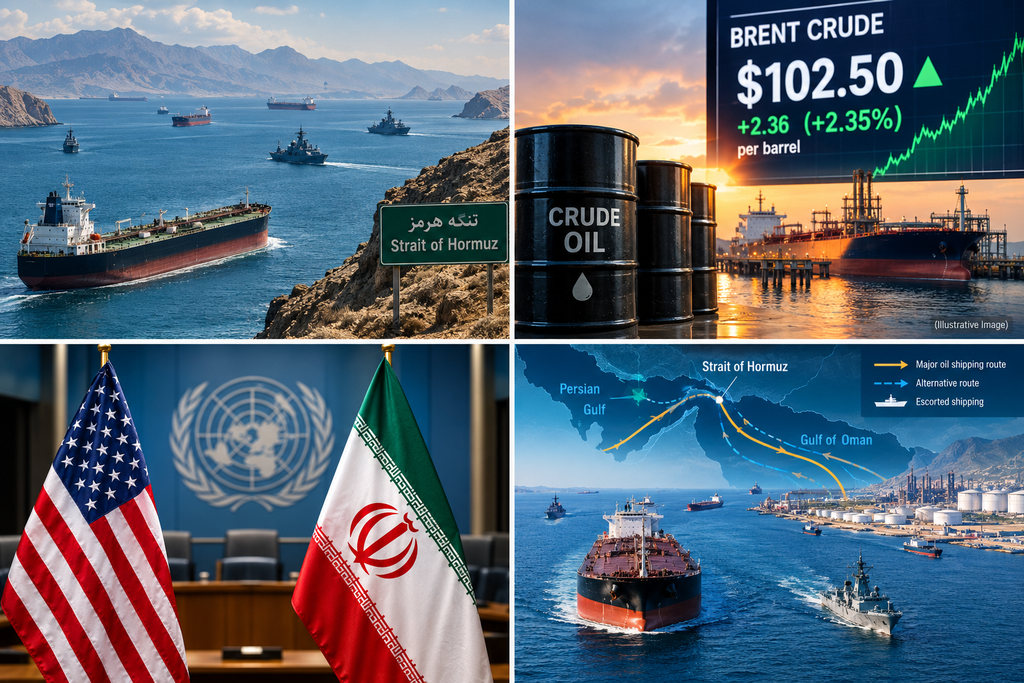
From July onward, the pattern settled into a low-to-medium intensity “tanker war” and contested control of transit corridors. The United States established and defended a southern corridor hugging Omani waters, escorting commercial vessels and periodically striking Iranian minelaying assets, small boats, and coastal infrastructure. Iran insisted that vessels use northern routes under its coordination and periodically attacked ships it deemed non-compliant. By September, the U.S. Central Command reported having redirected more than 110–115 commercial vessels attempting to reach or leave Iranian ports under its blockade, while facilitating the passage of hundreds of other ships through the strait.
Current Military and Maritime Situation
Shipping traffic remains a fraction of pre-war levels. Pre-conflict averages exceeded 130 vessels per day; recent daily counts have often hovered in the low teens or single digits for commodity carriers, though U.S.-facilitated escorted transits have occasionally been higher. On September 23, a cargo vessel was struck by a projectile in the strait, caught fire, and recorded two casualties. Earlier in the week, other vessels suffered hits or debris damage, with at least one Indian crew member reported killed in a separate incident.
Both sides have demonstrated willingness to strike economic targets. In early September U.S. forces destroyed several Iranian oil tankers after reported Iranian missile attempts against American warships, including an aircraft carrier and destroyers. Iran has launched missiles and drones at U.S. bases and facilities in Bahrain, Kuwait, Jordan, and elsewhere, most of which have been intercepted. Casualties on both sides remain limited relative to the scale of the war, but the cumulative economic and logistical costs are substantial.
Iran has also expanded pressure beyond the strait. Rezaei warned regional states against cooperating with U.S. restrictions on Iranian aviation, stating that airports facilitating such restrictions could themselves face disruption. U.S. secondary sanctions targeting Iranian airlines took effect around September 23, prompting several carriers to suspend routes.
Oil Prices and Global Energy Markets
Energy markets have tracked the conflict closely. After peaking above $118 early in the war and briefly returning near pre-war levels during the June MOU window, prices climbed again as the ceasefire collapsed. By mid-September Brent crude was trading above $100, with some sessions near $106–$107. On September 23, Brent settled around $103 after gaining nearly 4 per cent amid Pezeshkian’s rhetoric and continued uncertainty; WTI hovered in the low-to-mid $90s. Early Thursday trading saw modest easing as markets digested the diplomatic signals.
Analysts note that the market has absorbed a large effective supply disruption—estimates of lost or delayed Gulf flows run into several million barrels per day—through a combination of demand destruction, inventory draws, alternative routing, and higher production elsewhere. Yet commercial and strategic stocks are lower than at the war’s outset, diesel cracks and prices have been particularly elevated in some regions, and tanker rates for Middle East-to-Asia voyages remain multiples of normal levels. Any sustained reopening of Hormuz would likely pressure prices downward; renewed major disruption or expansion of the conflict could send them significantly higher.
Saudi Arabia’s partial restart of the East-West pipeline in late September has provided limited relief by moving crude west without relying solely on the strait. Iraqi exports via the north have also increased. Still, full normalization of Gulf production and exports would require reliable, low-risk transit for weeks or months to restore confidence among shippers, insurers, and refiners.
Regional and Broader Middle East Dynamics
Gulf Arab states have sought to insulate themselves while pressing for de-escalation. Leaders from Bahrain, Kuwait, Oman, Qatar, Saudi Arabia, and the UAE met Trump on the margins of the UN gathering. These countries remain heavily dependent on secure energy exports and host U.S. military facilities, yet they have also pursued dialogue with Iran through Omani and Qatari channels. Oman has played a recurring mediation role on maritime arrangements.
Iran-aligned groups have complicated the picture. Houthi forces in Yemen have conducted operations that further strain Red Sea and Bab el-Mandeb traffic, adding another layer of risk to global shipping. Attacks on Saudi energy infrastructure earlier in the conflict underscored the potential for wider spillover. Iraq continues to navigate internal pressures from Iran-backed militias while trying to maintain oil exports.
China, a major buyer of Iranian and Gulf crude, has called for de-escalation and maintained commercial ties where possible. Russia has watched the energy market effects with interest amid its own conflict with Ukraine. European and Asian importers have scrambled for alternative supplies, contributing to higher freight and product prices in some markets.
Diplomatic Outlook and Risks
The UN General Assembly provided a rare venue for high-level proximity. Iranian officials described mediated contacts involving Foreign Minister Abbas Araghchi and U.S. envoys, including discussion of a possible 60-day region-wide ceasefire roadmap, phased Hormuz reopening, and lifting of the blockade. Washington has not publicly accepted the Iranian conditions list, and Iranian hardliners have emphasised that trust must be rebuilt through concrete U.S. actions rather than words.
Both capitals appear to prefer managing a controlled stalemate over uncontrolled escalation. Full-scale invasion or occupation has never been the stated U.S. objective; Iran has shown it can impose economic costs through asymmetric means without inviting catastrophic conventional defeat. Yet the risk of miscalculation remains high. A successful major attack on a U.S. warship, a mass-casualty strike on a commercial tanker, or an expansion of the conflict into the Indian Ocean (as one Iranian adviser recently floated) could rapidly change the calculus.
For global energy markets, the central question is whether the current constrained flows become a new normal or whether diplomacy can restore sufficient confidence for a meaningful recovery in Hormuz traffic. Inventories, seasonal demand (including winter heating and diesel needs), and the political calendar—U.S. midterm elections are weeks away—add further pressure for resolution or at least stabilisation.
As of September 24, the Strait of Hormuz remains a contested, high-risk corridor rather than a freely functioning international waterway. Oil prices reflect that reality. Diplomatic channels are open but fragile. The war that began with precision strikes in February continues to shape not only the security architecture of the Middle East but the daily cost of energy for consumers and industries worldwide. Further developments in the coming days—responses to Iran’s stated deadline, any additional mediated meetings, or new military incidents—will determine whether the present uneasy equilibrium holds or gives way to another round of escalation.