

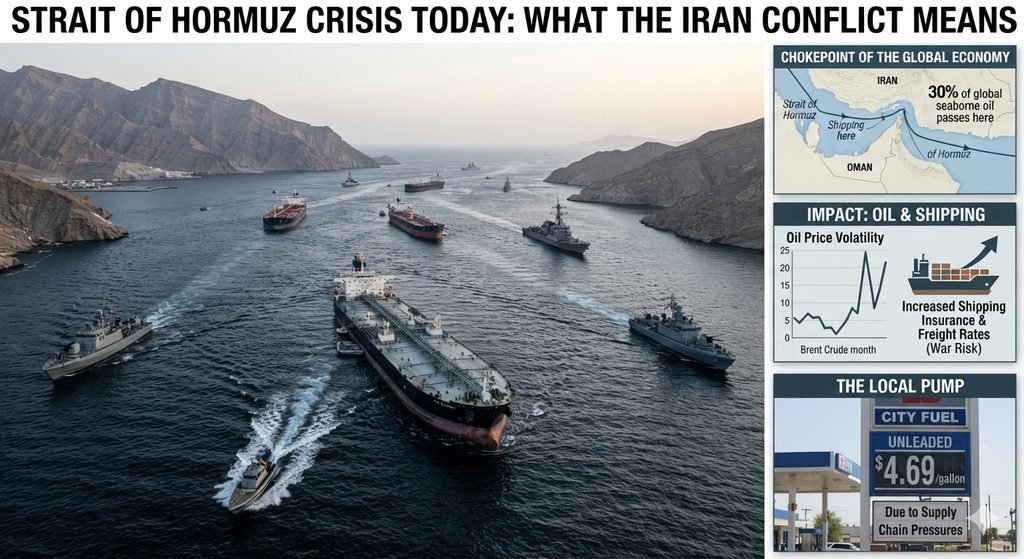
As of late September 2026, the Strait of Hormuz remains one of the most contested and disrupted waterways on Earth, more than 200 days into a conflict that began with U.S. and Israeli strikes on Iran. The narrow chokepoint between Iran and Oman, through which roughly one-fifth of the world’s oil and a substantial share of seaborne liquefied natural gas once flowed, operates at a fraction of its pre-war capacity. Commercial transits that once numbered around 130 to 140 vessels a day have collapsed in many periods to single digits or low dozens, with war-risk insurance premiums soaring to multiples of peacetime rates and hundreds of vessels left stranded or forced into risky, often dark, passages.
The human and economic stakes are high. Iranian authorities continue to assert control over transit, demanding coordination and, at times, fees, while rejecting full freedom of navigation until a U.S. naval blockade of Iranian ports is lifted. U.S. President Donald Trump has publicly rejected recent Iranian proposals for a rapid reopening tied to sanctions relief. Explosions and attacks on shipping have been reported in and around the waterway even as diplomats circle possible talks. The result is a prolonged supply shock that analysts describe as the largest volumetric disruption in modern oil-market history, with cascading effects on crude prices, tanker rates, refined-product markets, and the cost of filling a petrol tank from Houston to Mumbai.
This report examines the current state of the crisis, its origins and trajectory, the direct consequences for global oil flows, the transformation of shipping economics, the pressure on petrol and diesel prices, and the broader economic and geopolitical implications that will shape energy markets into 2027 and beyond.
Origins and Escalation of the Conflict
The crisis erupted in late February 2026 when U.S. and Israeli strikes targeted Iranian leadership and military infrastructure, killing Supreme Leader Ali Khamenei and a cadre of senior officials. Iran responded with attacks on U.S. allies in the region and by restricting access to the Strait of Hormuz. What followed was a cycle of retaliation, temporary ceasefires, and renewed hostilities that has kept the waterway under severe risk for most of the intervening months.
A U.S.-Iran memorandum of understanding in mid-June 2026 briefly raised hopes of normalisation. Oil prices tumbled as markets anticipated a return of Gulf exports. Vessel counts recovered modestly, though never to pre-war levels. That fragile calm collapsed in July when Iranian strikes on commercial vessels and U.S. responses, including the reimposition of a naval blockade on Iranian ports, returned the strait to effective near-closure. Subsequent months saw intermittent attacks on tankers, Iranian government vessels, and coastal assets, alongside Houthi actions that complicated alternative Red Sea routes.
By September 2026, the conflict had entered a grinding phase. Traffic data from maritime analytics firms showed commercial transits at times reduced to a handful of vessels per day, many operating with transponders switched off. War-risk insurance had risen to roughly 40 times normal premiums, pricing most commercial operators out of the route. Stranded vessels numbered in the low hundreds. Alternative pipelines, including Saudi Arabia’s East-West line to the Red Sea and UAE facilities at Fujairah, provided partial relief but themselves came under attack or capacity strain. Iranian oil exports continued at reduced levels, largely through shadow-fleet movements to China, while Gulf producers faced forced shut-ins as storage filled and export outlets remained constrained.
Diplomatic signals in late September offered fleeting optimism. Iranian officials floated a seven-day timeline for reopening the strait in exchange for steps toward lifting the U.S. blockade. U.S. and Iranian negotiators explored phased arrangements on the sidelines of international meetings. Those efforts faltered when Trump rejected the Iranian proposal, characterising Tehran’s position as driven by economic desperation rather than genuine willingness to restore free navigation. Iranian leaders, for their part, insisted they would not soften core demands. The waterway remained effectively closed to normal commercial traffic on what monitors described as day 211 of disruption.
The Scale of the Oil Supply Shock
Before the conflict, approximately 20 million barrels per day of crude and products moved through the Strait of Hormuz, representing about 20 per cent of global oil supply and a far higher share of seaborne trade. At the peak of disruption, the hit to Persian Gulf oil flows reached an estimated 15 to 17.6 million barrels per day—by far the largest supply shock in the history of the modern oil market, dwarfing the 1973 embargo, the 1990 Gulf War, the Iranian Revolution, and the initial impact of the Russia-Ukraine war.
Gulf producers including Saudi Arabia, the UAE, Kuwait, Iraq, Iran and Qatar collectively shut in more than 12 million barrels per day at one stage. Even as some production returned, industry outages remained substantial for months. Pipelines and alternative terminals mitigated only part of the loss. Saudi crude shipments through Hormuz rose at times in September, and the East-West pipeline was restarted after earlier disruption, yet overall throughput stayed well below normal. Dark transits and ship-to-ship transfers outside the strait became common workarounds, but they could not restore the volumes or reliability of the pre-war flow.
The market absorbed the shock through a combination of strategic and commercial inventory draws, demand destruction (particularly in Asia), and higher production elsewhere. Global inventories of crude and products fell by hundreds of millions of barrels. China’s import cuts proved especially significant in preventing an even sharper price spike. Yet these buffers have limits. Strategic petroleum reserves in major consuming countries declined markedly; the U.S. SPR reached levels not seen since the early 1980s. Refinery utilisation climbed, and product markets tightened more severely than crude markets in several periods.
As of late September 2026, Brent crude was trading in a volatile range around $98 to $106 per barrel, having peaked near $125 earlier in the crisis and briefly retreated toward the low $70s during the June ceasefire window. West Texas Intermediate tracked several dollars lower, reflecting the more seaborne nature of the Hormuz disruption. Analysts estimated that the market was pricing in not only the existing disruption of roughly 8 to 10 million barrels per day but also the risk of further losses. Fair-value estimates for September hovered near $90, implying a significant geopolitical risk premium.
Longer-term scenarios from major banks varied widely. Rapid normalisation of Hormuz flows could see prices average in the $70s. Prolonged disruption or permanent scarring of regional production capacity pointed toward sustained prices in the $90–$110 range or higher through 2027. Extreme escalation scenarios contemplated levels above $120 or even $150.
Shipping Transformed: Insurance, Freight and Risk
The crisis has rewritten the economics of tanker shipping. Pre-war VLCC freight rates from the Middle East Gulf to Asia typically added a few dollars per barrel. By September, those rates had climbed to $20–$24 per barrel on some routes, representing as much as 25 per cent of the free-on-board crude price. Loadings outside the strait in the Gulf of Oman carried lower but still elevated war-risk costs.
Insurance markets effectively closed the strait to many operators. Premiums at 40 times normal levels made commercial transit uneconomic for most charterers. Major container lines reported suspensions of service through the waterway; several vessels remained stranded inside the Gulf. The Joint Maritime Information Centre and other bodies continued to rate the risk as severe, citing mines, drone and missile threats, and the presence of Iranian naval forces enforcing preferred routes.
Alternative pathways have absorbed some traffic. Saudi and UAE pipeline capacity increased sharply in the early months of the conflict, only to face subsequent attacks that temporarily reduced throughput. Red Sea routes via Bab el-Mandeb became more important and more dangerous as Houthi activity intensified. The result is a more fragmented, higher-cost logistics system in which the delivered price of Middle Eastern crude to Asian refiners incorporates a substantial and persistent risk premium.
Crew safety and vessel integrity remain concerns. Multiple tankers have been struck; seafarers have been killed or injured. Evacuation efforts coordinated by the International Maritime Organisation were repeatedly interrupted by renewed attacks. Dark shipping—vessels operating without AIS transponders—has proliferated, complicating both commercial tracking and security monitoring.
Petrol, Diesel and the Consumer Impact
Crude price movements tell only part of the story for motorists and industry. Refined-product markets have experienced even tighter conditions. U.S. gasoline prices climbed well above $4 per gallon on a seasonally adjusted basis and remained elevated into the autumn. Diesel prices set successive records, exceeding $6 per gallon—levels that strain trucking, agriculture, and industrial users. Heating-oil and jet-fuel markets reflected similar pressure.
Crack spreads, the difference between crude and refined-product prices, widened dramatically. The Brent 3-2-1 crack spread reached multiples of its pre-conflict level even as crude itself was only modestly higher in percentage terms. This divergence arose because Middle Eastern product exports were hit harder than crude in some periods, inventories of gasoline and diesel were drawn down aggressively, and global refining capacity struggled to compensate.
In Europe and Asia, the pass-through to retail prices varied with tax structures and currency movements, but the direction was uniformly upward. Higher fuel costs fed into food prices via fertiliser and transport, into inflation readings, and into political pressure on governments facing elections or budget constraints. In the United States, the combination of elevated petrol and record diesel prices posed particular challenges ahead of midterm elections.
Demand destruction has provided some relief. Global oil demand ran several million barrels per day below year-earlier levels for extended periods, helping the market absorb the supply loss without even higher prices. Whether that restraint continues as economic activity responds to higher energy costs remains an open question.
Broader Economic and Geopolitical Implications
The Hormuz crisis has tested the resilience of the global energy system and revealed both its adaptability and its remaining vulnerabilities. Spare capacity outside the Gulf, strategic stockpiles, and demand flexibility prevented an immediate catastrophic spike. Yet the buffers have been depleted. Inventories are low, alternative routes are strained, and the political will for further large-scale stock releases may be limited.
Inflationary pressures from energy have complicated monetary policy in major economies. Higher shipping costs ripple through global trade, affecting not only oil but also containers, LNG and bulk commodities. Energy-importing nations in Asia face particular exposure; exporters in the Gulf confront revenue uncertainty even as prices rise.
Geopolitically, the conflict has reinforced the strategic importance of chokepoints and the limits of military solutions to maritime security. Iran’s demonstrated ability to disrupt traffic has given it leverage even under blockade and sanctions. U.S. and allied naval presence has protected some shipping but has not restored pre-war volumes. Regional states have pursued their own hedging strategies through pipelines and alternative terminals, accelerating a longer-term diversification of export routes that was already under way.
Looking ahead, three broad paths remain open. A negotiated reopening of the strait, whether through a comprehensive ceasefire or a narrower maritime arrangement, would allow prices to retreat and shipping to normalise, though residual risk premiums and damaged infrastructure would linger. A prolonged stalemate would keep oil in a high and volatile range, intensify demand destruction, and accelerate investment in non-Gulf supply and renewable alternatives. Full-scale regional escalation could produce the extreme price outcomes that markets have so far avoided.
As of 28 September 2026, the immediate outlook is one of continued uncertainty. Diplomatic channels remain open but constrained by mutual distrust and domestic political calculations on both sides. Physical risk in the strait persists. Oil markets are pricing a meaningful probability of further disruption even as they have demonstrated an ability to adapt.
For consumers, the practical consequence is clear: petrol and diesel remain more expensive than they would have been in a world without the Hormuz crisis, and the risk of further spikes has not disappeared. For shipping companies, the economics of operating in the Gulf have been fundamentally altered. For oil producers and refiners, the crisis has been both a challenge and, for some, a source of elevated margins. For policymakers, the episode underscores the enduring centrality of the Strait of Hormuz to global energy security and the high cost of its disruption.
The crisis that began in February 2026 is not yet over. Its effects on oil prices, shipping routes and the price at the pump will continue to shape economies and politics for months, and possibly years, to come.