

Tehran / Washington / Global Markets – September 28, 2026
Nearly seven months after the outbreak of open hostilities between the United States and Iran, the conflict has settled into a grinding war of attrition centred on the world’s most critical energy chokepoint. What began with a dramatic U.S.-Israeli strike campaign in late February 2026 that killed Iran’s Supreme Leader Ayatollah Ali Khamenei and much of the Islamic Revolutionary Guard Corps (IRGC) high command has evolved into a prolonged contest over the Strait of Hormuz, Iranian oil exports, and the stability of global energy markets. As of late September 2026, diplomatic efforts on the sidelines of the United Nations General Assembly have stalled, oil prices remain elevated well above pre-war levels, and the strait continues to operate under severe risk constraints that have reshaped global energy flows.
Background: From Shock-and-Awe to Stalemate
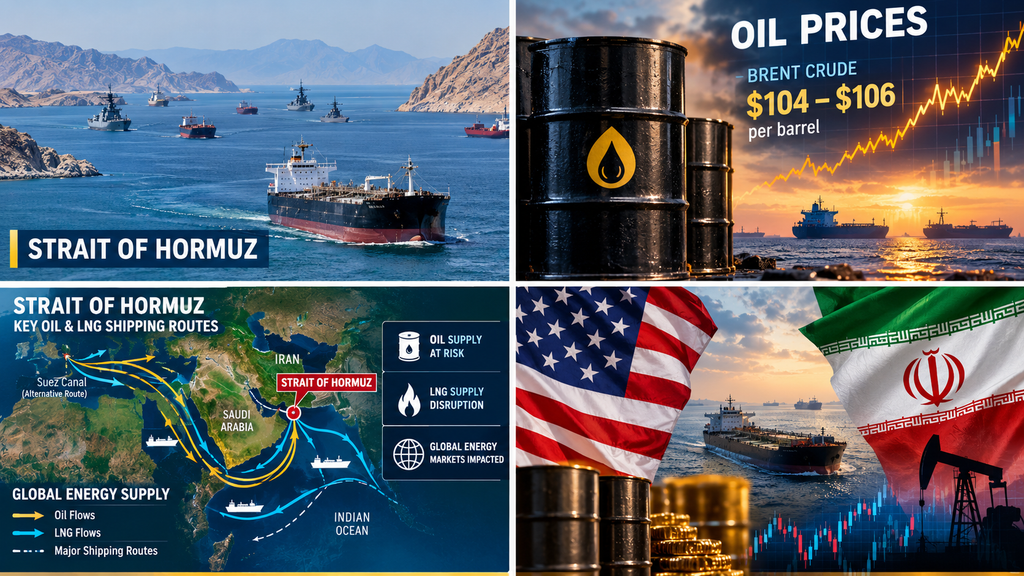
The war erupted on or around February 28, 2026, when coordinated U.S. and Israeli strikes targeted Iranian nuclear facilities, command centres, and leadership. Iranian forces responded by launching drones and missiles at U.S. bases and regional allies, while effectively restricting commercial traffic through the Strait of Hormuz. Before the war, the narrow waterway handled roughly 20 per cent of the world’s seaborne oil trade—about 20 million barrels per day—along with significant volumes of liquefied natural gas (LNG) from Qatar. Within weeks, traffic collapsed. War-risk insurance became prohibitively expensive or unavailable for most commercial operators, and the U.S. imposed a naval blockade on Iranian ports to choke off Tehran’s primary source of revenue.
A fragile ceasefire and Memorandum of Understanding (MOU) signed in mid-June 2026 between U.S. President Donald Trump and Iranian President Masoud Pezeshkian aimed to reopen the strait and lift the blockade while negotiations continued. Traffic briefly recovered to about half or more of pre-war levels. That understanding collapsed in early July amid mutual accusations of violations, renewed Iranian attacks on commercial vessels, and U.S. airstrikes on Iranian coastal military targets. President Trump declared the MOU “over.” Subsequent months saw cycles of limited strikes, pauses, and renewed exchanges, with U.S. forces conducting consecutive nights of operations in July to degrade Iranian maritime and missile capabilities along the Hormuz littoral.
By September 2026, the conflict had become one of attrition. U.S. military operations had cost an estimated $33–38 billion by early autumn. American casualties stood at 18 killed and more than 700–800 wounded. Iranian deaths were reported in the thousands (estimates ranging from roughly 3,500 to higher figures including civilians and combatants). Both sides retained the capacity to strike but faced constraints: Iran faced economic collapse and degraded capabilities, while the United States faced limits on munitions stockpiles, domestic political pressure, and the need to manage regional partners.
Latest Developments in the Strait of Hormuz
As of September 27–28, 2026, the Strait of Hormuz remains a high-risk zone rather than a fully open commercial artery. Iranian authorities continue to assert control, requiring vessels to coordinate with Iranian entities, use designated routes, and in some cases pay fees. The IRGC has warned that ships failing to comply risk attack. U.S. Central Command maintains that the strait is open for transit under its protection and has facilitated hundreds of passages while enforcing the blockade on Iranian ports—redirecting or boarding vessels attempting to evade it.
Recent data illustrate the constrained reality. Preliminary shipping analyses showed crude flows through the strait reaching around 33.7 million barrels in the week beginning September 20, carried largely by very large crude carriers (VLCCs) loaded primarily with Saudi and Iraqi oil. This represented a partial recovery but remained well below pre-war norms. Daily commercial transits have fluctuated sharply—sometimes in the low dozens or fewer for open commercial traffic, with many vessels operating with AIS transponders dark or using alternative routing and ship-to-ship transfers outside the strait. War-risk premiums and insurance costs have driven freight rates for Middle East Gulf–China VLCC voyages to record levels, with freight representing a significantly higher share of delivered crude prices.
Iran submitted a proposal in late September for a phased reopening: within seven days, the U.S. would ease military pressure, lift the naval blockade on Iranian ports, and take steps such as releasing frozen assets, after which Tehran would reopen the strait and broader talks could resume. President Trump rejected the proposal. Iranian officials, including Foreign Minister Abbas Araghchi, responded that Tehran would not soften its conditions and that the strait would not fully reopen while the blockade and sanctions remained. Explosions were reported in the waterway hours after the rejection, according to Iranian media, though details remained contested. Parallel Houthi attacks on Saudi infrastructure have added another layer of risk, prompting regional discussions among Gulf states, Turkey, and Pakistan about security support.
The practical effect is a managed but precarious flow. Some Persian Gulf producers have continued exporting by various means, including darkened tankers and alternative pipelines (Saudi East-West pipeline efforts have been disrupted and partially restored at times). Qatari LNG has faced particular challenges due to reliance on the strait. The overall picture is one of elevated risk, higher costs, and incomplete normalisation rather than total closure or free passage.
Oil Prices and Market Dynamics
Oil markets have remained highly sensitive to every diplomatic signal and military incident. Brent crude, the international benchmark, has traded in a volatile range through September, settling recently around $104–106 per barrel after fluctuating between the high $90s and above $109 earlier in the month. West Texas Intermediate (WTI) has traded lower, often in the low-to-mid $90s. Prices eased on reports of U.S.-Iran talks exploring a phased path out of the war but rose on Iranian rhetoric about never surrendering, threats to widen the conflict, or Houthi strikes on Saudi facilities.
These levels represent a substantial premium over pre-war prices. Freight costs have become a major component of delivered prices, particularly for Asian buyers dependent on Middle East Gulf loadings. The market has also contended with tight inventories. Global stock draws earlier in the conflict, combined with constrained refining activity in some regions (China and Russia among them), have left limited buffers. The U.S. Strategic Petroleum Reserve has been drawn down significantly, reaching levels last seen decades earlier and prompting debate over further releases or diesel export restrictions (reports of a potential ban circulated then were denied or walked back by the administration).
Downstream effects have been pronounced. U.S. diesel prices have spiked above previous records in some periods, gasoline has risen sharply year-over-year, and refiners have operated at high utilisation rates. Asian importers have faced higher all-in costs, while European markets have dealt with cancelled cargoes and alternative sourcing. The cumulative impact of the Iran conflict layered on top of residual disruptions from the Russia-Ukraine war has kept global oil balances tight even when diplomatic hopes briefly soften prices.
The Broader Global Energy Crisis
The prolonged restriction of Hormuz flows has produced the most significant energy supply shock in decades. Early in the war, oil prices surged dramatically, and governments in multiple countries resorted to rationing, shorter workweeks, or industrial slowdowns. Inventories were drawn heavily to cushion the blow. Although partial recovery of Gulf exports and alternative routing have mitigated the worst-case scenarios, the crisis has not been resolved.
Key impacts include:
- Supply security and diversification: Major consumers have accelerated efforts to secure non-Gulf supplies, expand strategic reserves (where possible), and invest in alternative energy sources. However, the scale of Middle East volumes makes rapid substitution difficult.
- Economic consequences: Higher energy prices have fed inflation in many economies, complicated monetary policy, and contributed to slower growth projections for energy-importing nations. Gulf producers themselves have suffered from export disruptions and infrastructure damage, with significant GDP contractions projected for some smaller states heavily dependent on the strait (Qatar, Kuwait, Bahrain among those cited in analyses).
- LNG and downstream markets: Qatar’s LNG exports, critical for Europe and Asia, have been particularly vulnerable. Damage to infrastructure and transit risks have led to lost revenue estimates in the tens of billions annually for affected producers and higher costs for importers.
- Geopolitical realignments: China, a major buyer of Iranian and Gulf oil, has navigated carefully, continuing some purchases while avoiding direct entanglement. Russia has faced its own refining constraints. Regional actors such as Saudi Arabia have worked to restore pipelines and maintain exports despite Houthi threats. Mediators including Qatar and Oman have repeatedly sought to broker de-escalation because of their own economic exposure.
- Military and fiscal costs: Beyond direct combat expenditures, the need to protect shipping, sustain forward deployments, and manage munitions stocks has imposed ongoing burdens. Domestic political debates in the United States over war powers, authorisation, and exit strategies have intensified as the conflict has dragged on.
Analysts describe the current phase as energy “trench warfare.” Neither side has demonstrated a clear path to decisive victory or full capitulation. Iran’s economy has been severely damaged by the near-collapse of oil exports (down dramatically from pre-war levels during blockade periods), yet Tehran views control or influence over Hormuz as core strategic leverage. The United States has degraded Iranian military capabilities and enforced the blockade but faces the political and economic costs of prolonged high energy prices and an open-ended commitment.
Diplomatic Outlook and Risks Ahead
Indirect talks in New York during the UN General Assembly represented the first significant contact in months, but gaps remain wide. Iran insists on lifting the blockade and easing pressure as preconditions for full reopening of the strait; the U.S. has rejected proposals it views as insufficiently reciprocal or as rewarding attacks on shipping. President Pezeshkian has signalled openness to negotiations while rejecting “bullying” and vowing not to surrender. U.S. officials have emphasised continued enforcement of freedom of navigation and the blockade.
Risks of renewed escalation persist. Iranian threats to expand operations (including potentially into the Indian Ocean) and U.S. “tanker-for-tanker” responses or strikes on Iranian oil infrastructure illustrate the potential for rapid intensification. Parallel conflicts involving Houthis, residual Hezbollah activity, and other regional flashpoints could broaden the crisis. At the same time, mutual exhaustion, economic pressure on Iran, and political costs in the United States create incentives for a durable arrangement—if the core issues of Hormuz control, sanctions, and nuclear questions can be bridged.
For global energy markets, the immediate outlook remains one of elevated volatility and risk premiums. Sustained flows near current partial-recovery levels would still leave inventories tight and prices higher than pre-war norms. A credible, verified reopening of the strait under stable security arrangements could ease pressure significantly; a major new escalation or prolonged effective closure would deepen the crisis, with cascading effects on inflation, growth, and energy security worldwide.
The U.S.-Iran war of 2026 has already rewritten assumptions about energy chokepoints, the resilience of global supply chains, and the limits of military coercion in the face of geographic and economic realities. As of September 28, 2026, the Strait of Hormuz remains the central arena—neither fully open nor completely closed—holding the balance of the conflict and the health of the world economy in a precarious equilibrium. Further developments in the coming days and weeks, particularly any movement on the Iranian proposal or U.S. responses, will determine whether the current stalemate holds or gives way to another dangerous cycle.